
Insight
October 2, 2026
Lorem ipsum dolor sit amet, consectetur adipiscing elit. Suspendisse varius enim in eros elementum tristique. Duis cursus, mi quis viverra ornare, eros dolor interdum nulla, ut commodo diam libero vitae erat. Aenean faucibus nibh et justo cursus id rutrum lorem imperdiet. Nunc ut sem vitae risus tristique posuere.
Hong Kong university students are being invited to take part in the first Hong Kong University Students Fintech Innovation Competition, organised by Industrial and Commercial Bank of China (Asia). The competition gives students a chance to develop ideas around financial technology, with cash prizes, internship opportunities and a route to the national finals of the ICBC Cup on offer.
The competition is part of the 17th ICBC Cup and marks the first time ICBC has established a competition zone in Hong Kong. It is supported by the Financial Services and the Treasury Bureau and the Hong Kong Monetary Authority, with 12 Hong Kong universities also backing the initiative.
The participating universities are the University of Hong Kong, the Chinese University of Hong Kong, Hong Kong University of Science and Technology, Hong Kong Polytechnic University, City University of Hong Kong, Hong Kong Baptist University, Hong Kong Metropolitan University, Lingnan University, Hong Kong Shue Yan University, the Education University of Hong Kong, Hang Seng University of Hong Kong and St. Francis University.
For ICBC Asia, the competition is also intended to support the development of fintech in Hong Kong and expand the city's fintech talent pool. Dr. Liu Yagan, Chairman and Executive Director of Industrial and Commercial Bank of China (Asia), said the competition is designed to encourage students to develop practical applications for financial technology and explore new banking business models.
"This competition encourages university students across Hong Kong to propose practical solutions for fintech applications and banking business model innovation from the perspective of financial products and services, providing a platform for Hong Kong youth to connect with cutting-edge industries and unleash their innovative potential."
The initiative will also connect Hong Kong students with the wider ICBC Group. Liu said this would help deepen exchanges between young talent in Hong Kong and the Mainland.
The competition is open to full-time university students in Hong Kong and carries the theme "Digital Banking, Creating the Future." Students can develop ideas across 10 areas, ranging from fintech and digital finance to green finance, inclusive finance, pension finance and wealth management. The categories also include financial security services, specialised financial services, youth services and open innovation services.
The competition also offers cash prizes: the First Prize winner will receive HK$50,000; two Second Prize winners will receive HK$30,000 each; three Third Prize winners will receive HK$20,000 each; and four Honorable Mention recipients will receive HK$10,000 each.
Beyond the prize money, qualifying winners will have the opportunity to undertake internships at ICBC (Asia). The team that wins the Hong Kong First Prize will also have the opportunity to travel to Beijing in December for the ICBC Cup national finals, where it will compete against teams from across the country.
With registration now open, the competition gives Hong Kong university students an opportunity to take ideas in financial technology from the classroom into areas such as banking products, services and business models.
Insight
October 2, 2026
Lorem ipsum dolor sit amet, consectetur adipiscing elit. Suspendisse varius enim in eros elementum tristique. Duis cursus, mi quis viverra ornare, eros dolor interdum nulla, ut commodo diam libero vitae erat. Aenean faucibus nibh et justo cursus id rutrum lorem imperdiet. Nunc ut sem vitae risus tristique posuere.
The HKUST-Sino Million Dollar Entrepreneurship Competition 2026 will hold its finals on October 12, following a record 390 teams from 24 countries and regions taking part in this year's competition.
Jointly organised by the Hong Kong University of Science and Technology (HKUST) and Sino Group, the competition aims to give young entrepreneurs a platform to develop and present their ideas. Sino Group Deputy Chief Executive Officer Wong Wing-lung said the Group has partnered with HKUST for many years to support young talent and the development of innovation and technology in Hong Kong.
He said the competition gives young entrepreneurs a platform to showcase their creativity, exchange ideas and put their concepts into practice.
The international participation is reflected in the universities and regions represented this year. Participants include students from the University of Oxford in the UK, the University of Pennsylvania in the US and the National University of Singapore. Teams have also joined from Australia and South Africa.
After multiple rounds of assessment, 15 teams have advanced to the finals. Their projects cover health technology, generative AI, smart buildings, and green energy management. At the finals, the teams will present their solutions to a judging panel comprising venture capital investors, industry leaders and academic experts. They will compete for more than HK$1 million in prizes and awards.
The 2026 competition has also expanded the areas it recognises. Three new awards have been introduced this year: the Transformative AI Award, the NextGen Biotech Award and the Societal Influential Award. The competition will also continue to offer the Sustainability Impact Award. Together, the awards focus on areas ranging from emerging technologies to social and sustainability challenges.
The organisers are also adding new activities to help teams develop their ideas further. This year's programme includes pitching skills training, AI workshops, investor matching sessions and mentorship opportunities. The AI workshops will cover areas including generative AI and AI agents, while representatives from venture capital firms such as Gobi Partners and InnoAngel Fund have been invited to share insights on fundraising, product positioning and market expansion.
These activities are intended to help young entrepreneurs strengthen their business plans and presentation skills. They also give teams opportunities to explore technology commercialisation and potential market applications.
The competition will also launch the InnoBay 1M PLUS Program during the Grand Final. The programme will focus initially on Smart City Development and aims to connect HKUST start-ups and competition alumni with industry partners. It will also support potential proof-of-concept opportunities and help promising innovations move towards commercial adoption.
The Grand Final will also include an audience voting segment. Members of the public will be able to vote for the team they believe has the greatest potential and impact, with those who correctly vote for an eventual winning team entering a lucky draw.
For Wong, the competition is part of a broader effort to develop Hong Kong's innovation and technology talent. He noted that Hong Kong's first Five-Year Plan and latest Policy Address both highlight innovation, technology and talent development.
Prof. Tim Cheng Kwang-Ting, HKUST's Vice-President for Research and Development, said the competition has also served as a platform for aspiring entrepreneurs to connect with investors, understand market needs, test their ideas and gain practical entrepreneurial experience. He added that the competition has strengthened its training, mentorship and networking activities this year.
The Group believes that closer cooperation between industry, academia and research institutions can help turn innovative ideas into practical applications. Through the competition and its wider support programmes, young entrepreneurs are given opportunities to develop their ideas, connect with potential partners and explore how they can be taken from early concepts towards real-world applications.
Startups
September 2, 2026
Lorem ipsum dolor sit amet, consectetur adipiscing elit. Suspendisse varius enim in eros elementum tristique. Duis cursus, mi quis viverra ornare, eros dolor interdum nulla, ut commodo diam libero vitae erat. Aenean faucibus nibh et justo cursus id rutrum lorem imperdiet. Nunc ut sem vitae risus tristique posuere.
According to Australian government figures, 1,326 people died on Australian roads in the 12 months to July 2026, up 0.9% from the previous 12-month period. The latest available national data also shows that road crashes led to around 36,000 hospitalised injuries. Yet many near misses are never reported.
Consider a driver turning across a pedestrian crossing without noticing someone still on the road. They miss each other by a few seconds. No one is injured, and the incident is soon forgotten. For transport authorities, however, that near miss could be an early warning of a dangerous intersection.
Australian intelligent transport startup XVision AI wants to help road authorities capture these warning signs and respond earlier. “We’re trying to create the intelligence layer for roads and infrastructure,” founder Simon Maselli says. His goal is to build smart road infrastructure that can see what is happening, understand the risks and take action when necessary.
Founded in 2023, XVision AI develops AI-powered traffic management systems for governments, transport agencies and infrastructure operators. Its technology monitors how vehicles, cyclists and pedestrians move through intersections, roads and work zones. It can count and classify road users, measure traffic speeds and queues and identify potentially dangerous interactions in real time.
Maselli came to road technology through engineering, industrial systems and testing. He previously worked on complex projects for companies including BHP Group, a major Australian multinational mining and metals corporation. He also spent time at Keppel FELS in Singapore, where he was involved in certification, approvals and scientific testing for ships.
The idea for XVision came after Maselli started his own testing company about ten years ago. One customer relied on an infrastructure system assembled from components made by several vendors. When the original provider failed to service it properly, the customer asked Maselli’s company to reproduce it.
His team succeeded, but the replacement inherited the same fundamental problem: it was large, complicated and made up of too many separate components. Maselli saw a similar pattern in road infrastructure, where one product might handle detection, another communication and additional equipment that allows for the connections between them.
“I thought there had to be a smarter way to put all those parts into one small device,” Maselli recalls. The solution also had to be easy to install without extensive roadworks, expensive components or several suppliers. That thinking eventually led to EagleEye, XVision AI’s flagship road intelligence system.
EagleEye uses two camera lenses to create a three-dimensional view of the road. Unlike an ordinary camera that only records footage, the device uses edge AI to process what it sees locally. It detects road users, follows their trajectories and analyses how they interact.
Maselli describes its functions in three stages: perception, thinking and communication. The system first identifies vehicles, pedestrians and cyclists. It then examines their speed, direction and behaviour. Finally, it can communicate with roadside infrastructure such as traffic controllers and digital signs, as well as vehicles equipped with vehicle-to-everything technology, commonly known as V2X.
For example, if a vehicle approaches a conflict area — the part of an intersection where different paths cross — at a dangerous speed, EagleEye could keep other approaches on red until it passes. If pedestrians have not finished crossing, the system could hold conflicting traffic for longer. Connected vehicles could also receive warnings about hazards or people their drivers cannot yet see.
These applications reflect Maselli’s vision for more proactive road safety. Authorities often rely on crash reports to identify dangerous locations, meaning someone may need to be injured before a problem receives attention. Short traffic surveys offer useful information, but they can miss changing road conditions and near misses that occur outside the survey period.
XVision AI aims to give traffic engineers a continuous view of movement, congestion and risk. Near-miss data could help them identify recurring conflicts, adjust signal timing or investigate an intersection before a serious collision occurs. Maselli puts the motivation simply: “One death on the road is too many.”
The company is also addressing the fragmented nature of traffic infrastructure. A single intersection may use road loops, radar, cameras, thermal sensors and analytics software from different suppliers. Bringing these systems takes time and can make upgrades expensive. Maselli estimates that a typical road upgrade in Australia can cost around AUD1.4 million and take 18 months.
EagleEye combines several of these functions inside one unit mounted on an existing pole and connects to the traffic controller. Maselli says installation only take a couple of hours, reducing the need for disruptive civil works. Although EagleEye may cost more than an individual conventional sensor, XVision argues that it can lower the overall cost by replacing several separate systems.
The software behind the hardware may be the company’s strongest commercial advantage. Customers begin with basic traffic analytics and data collection, then activate more applications on the same device. XVision has developed around ten modules, including adaptive signal control and traffic enforcement functions.
Its strongest commercial advantage is, however, the software behind the hardware. Customers begin with basic analytics and data-collection functions, then activate additional applications on the same device. XVision has developed around ten modules, including functions for adaptive signal control and traffic enforcement.
“The important thing to remember is that the hardware is only part of the business,” Maselli says. “Our core business is selling software modules.”
He calls the model “software-defined infrastructure”. Conventional road equipment is usually installed for a fixed purpose and may remain unchanged for years. XVision’s devices can receive new functions through software updates, allowing road authorities to expand their systems without repeatedly replacing roadside hardware.
The wider XVision AI platform includes two other devices. “Scout” is a smaller, solar-compatible sensor designed for quick deployment along roads and corridors. It cannot directly control traffic equipment like EagleEye, but it can collect traffic data and support wireless V2X communication. “Outpost”, on the other hand, places similar technology on a portable trailer, making it suitable for roadworks, temporary traffic studies and work zones. XVision Command brings information from these sites into one platform for monitoring, analysis and reporting.
By June 2026, Maselli said XVision had secured around 190 paid deployments across five Australian states and territories, along with six international pilots. The company has also tested its technology in Vietnam and Thailand.
Nevertheless, expanding into more markets will require more than accurate AI. Traffic enforcement and control systems must meet technical standards that differ between countries and sometimes between states. Some XVision modules, including speed enforcement, red-light enforcement and seatbelt detection, still require regulatory approval before customers can activate them.
Certification is costly and time-consuming, but it could strengthen XVision’s position once the necessary approvals are in place. Maselli describes the enforcement applications as the company’s “highest-value modules”. He estimates that certification could add AUD25 million in lifetime value across its existing deployments without installing new devices, though this remains the company’s own projection.
“Once we’re certified, we’re no longer competing in that highly competitive segment,” Maselli says. “We move into blue-ocean territory.” In practical terms, approval would allow XVision to compete in a more specialised market with fewer certified rivals.
As with any surveillance technology, privacy presents another challenge. Roadside cameras can make members of the public uncomfortable, even when they are being used for traffic analysis rather than surveillance. To address this, XVision works with customers to display signs explaining why the equipment is present. Its system also blurs video and displays it at low resolution by default, while access to identifiable, high-resolution footage requires additional authorisation.
Maselli views Australia as a proving ground for a much larger market. He sees opportunities in India, Vietnam and Thailand, where governments are investing in traffic technology. The U.S. is another target because of its larger infrastructure budgets and growing demand for connected road systems.
XVision AI still has to navigate government procurement, regulatory approval and competition from established traffic-equipment suppliers. Supporting physical devices across several countries will also be harder than expanding a cloud-based software platform.
Its advantage lies in how the technology was developed. XVision grew from years of solving practical infrastructure problems, including the fragmented system that first convinced Maselli there had to be a simpler approach. If the company succeeds, near misses that once disappeared without a trace could become the evidence road authorities need to prevent the next crash.
Startups
August 13, 2026
Lorem ipsum dolor sit amet, consectetur adipiscing elit. Suspendisse varius enim in eros elementum tristique. Duis cursus, mi quis viverra ornare, eros dolor interdum nulla, ut commodo diam libero vitae erat. Aenean faucibus nibh et justo cursus id rutrum lorem imperdiet. Nunc ut sem vitae risus tristique posuere.
Anyone who has opened a carton of milk before its expiry date only to find that it smells off or tastes bitter has experienced the problem firsthand. For dairy processors, the same issue can play out across thousands of litres. Milk may pass routine quality checks, make it through production and still spoil before reaching the end of its expected shelf life.
CYBERTONGUE®, a biosensing platform, is designed to give dairy processors an earlier warning.
Developed by Canberra-based biotech startup PPB Technology, the compact food testing system allows processors to analyse milk on-site and receive results within minutes. Its first commercial application detects protease, an enzyme linked to spoilage, shorter shelf life and production losses across dairy products.
Dairy companies already test milk for fat, protein, bacteria, antibiotics and other indicators. Samples from individual farms may be sent to central laboratories, while tanker loads are tested again when they reach processing plants. These checks provide useful information, but they do not always show whether milk will remain stable in a UHT carton, meet a supermarket’s shelf-life requirements or produce the expected amount of cheese.
Even after heat treatment, protease can continue affecting milk. For processors making UHT milk, fresh milk or mature cheese, that creates a costly blind spot.
“Right now, dairy processors are working blind on this,” PPB Technology founder Stephen Trowell told Ventureport. “It’s becoming more of a problem as customers expect longer shelf lives and higher quality.”
CYBERTONGUE® uses engineered biosensing proteins that emit blue and green light. The balance between the two colours changes when the protein reacts with a target substance. The reader measures that shift and calculates how much of the target is present.

Trowell describes himself as a protein engineer at heart. He spent around three decades at CSIRO, Australia's national science and technology agency, and close to four decades in research before becoming a startup founder. The technology behind CYBERTONGUE® grew out of years of biological research, including earlier experiments involving wine aromas and explosives detection.
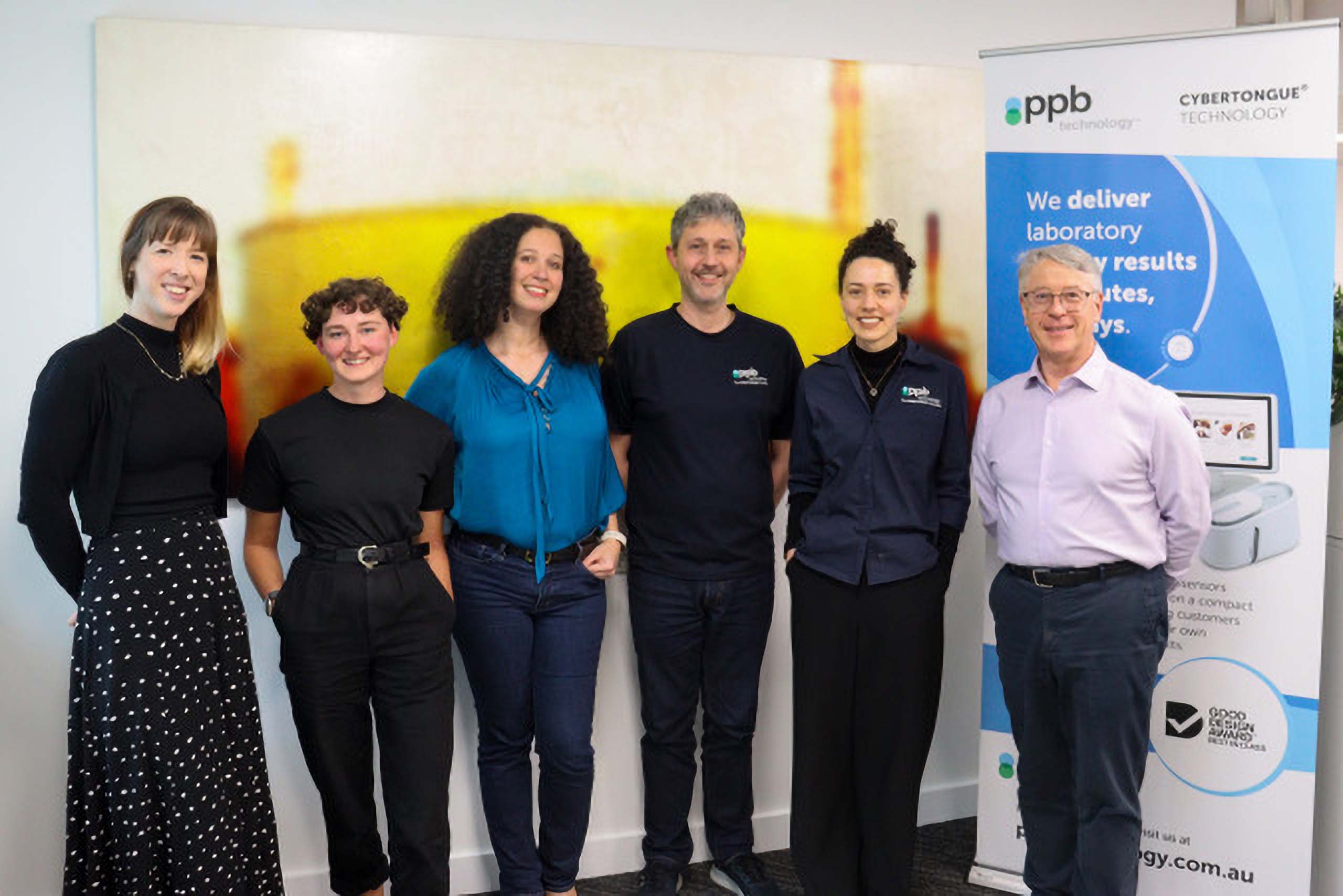
PPB initially developed its technology to measure plasmin, an enzyme derived from cows. After feedback from the dairy industry, the company shifted its focus to bacterial proteases, which were identified as a more pressing spoilage problem. The platform can make some existing tests faster, but PPB chose to focus first on a measurement previously unavailable to processors.
“Where we’ve chosen to lead is with a measurement nobody else can do at all,” he said. “The blue ocean, if you like.”
That focused entry point shapes PPB’s wider strategy. CYBERTONGUE® could eventually test for lactose, allergens, microbial toxins and other targets. Yet launching everything at once would stretch a six-person company too far. Protease gives it a clear route into dairy, where the financial value is easier to demonstrate.
A processor that detects high protease activity may redirect a batch of milk away from long-life products and use it for yoghurt, curd or another product where the enzyme causes less damage. PPB also says its tests can help trace problems in the milk supply and detect biofilms on processing equipment, allowing factories to take corrective cleaning measures.
Fresh milk presents another sizeable opportunity, with the global market estimated at around US$81 billion in 2026 and projected to grow at 6.83% annually through 2035. At that scale, even small gains in shelf-life consistency could prevent substantial losses. Supermarkets often require milk to have a minimum amount of shelf life remaining on delivery. Products that fall short may be rejected, discounted or discarded at the processor’s expense. While Australian processors typically aim for a shelf life of 19 to 21 days, they do not always achieve it. CYBERTONGUE® could help them reach that target more consistently.
Cheese producers face a related issue. Protease can create bitter flavours in hard cheeses and reduce production yield. Cheesemakers add another enzyme, chymosin, during production, often without knowing how much protease activity is already present in the milk. Better information could help them adjust the process and get more value from the same raw material.
PPB sells the reader as laboratory equipment, but its long-term business model centres on repeat testing. Customers buy the machine, then purchase a PPB reagent cartridge each time they run an assay. Future tests are intended to work on the same reader, making the system more useful as the catalogue expands.
CYBERTONGUE®’s compact design reflects PPB’s focus on practical onsite testing. The device is small enough to fit into two cupped hands and comes with a tablet running PPB’s software.

At the time of the interview, 13 to 15 systems had been installed with paying customers. PPB had made sales in 11 countries across five continents, with Europe as its largest market.
Trowell describes PPB as “born global”. While Australia and New Zealand have sophisticated dairy industries, Trowell thinks CYBERTONGUE® may offer even more value in regions where milk quality is less consistent, transport routes are longer or refrigeration is harder to maintain.
Trowell also believes PPB has a strong competitive moat, with the combination of manufacturing both the hardware and consumable reagents. Patents form one layer, but he does not consider legal protection sufficient on its own. A competitor would need expertise in protein engineering, reagent production, optical hardware, software and dairy processing.
Calibration adds another barrier. For each new box of reagents, PPB securely uploads the required calibration data to the customer’s machine. A third party could not simply manufacture a cartridge with the same dimensions and expect it to work correctly.
“We own the whole stack,” Trowell said, referring to everything from the sensing molecule to the hardware, software and cloud platform.
That said, he accepts that no technology is impossible to copy. His view is that PPB’s mix of scientific knowledge, integrated system and experience in dairy gives it enough of a head start to build a meaningful position before competitors catch up.
The technology could eventually reach beyond food. Trowell sees possible uses in environmental testing, veterinary care and medical diagnostics, including the analysis of blood, serum or saliva. PPB has already discussed potential applications with organisations outside the food industry.
For now, however, moving directly into clinical diagnostics would create more risk than opportunity. Medical products can require years of trials, extensive regulatory work and large development budgets. PPB would also need to build new sales channels and choose between many possible clinical uses without knowing which one would attract the strongest demand.
For these reasons, food testing offers PPB a clearer path. The regulatory barriers are generally lower, customers have immediate operational problems, and PPB has already built relationships in dairy. Once the platform has proved itself commercially, the company could enter other sectors through partnerships or licensing.
Trowell has held that view for years. The immediate goal is to build a successful food testing company rather than chase the prestige often attached to medical biotechnology.
The opportunity may also expand as food production becomes more complex. Dairy factories increasingly process oat, soy and other alternatives on equipment that also handles cow’s milk. This creates cross-contamination and allergen risks, offering another potential use for CYBERTONGUE®.
PPB still has plenty to prove. It must secure repeat reagent orders, convert early trials into wider deployments and expand its test catalogue without compromising accuracy. Scaling an integrated biotech hardware business across international markets will not be simple.
Still, its approach offers a useful lesson for other deep-tech startups. Instead of beginning with every possible application, PPB picked a specific problem that costs customers money today. It built a product around that pain point, then used the same technology as the foundation for a broader platform.
As Trowell put it, customers “need it fast, and they need it right.” CYBERTONGUE® is betting that food testing can deliver both.
Startups
August 5, 2026
Lorem ipsum dolor sit amet, consectetur adipiscing elit. Suspendisse varius enim in eros elementum tristique. Duis cursus, mi quis viverra ornare, eros dolor interdum nulla, ut commodo diam libero vitae erat. Aenean faucibus nibh et justo cursus id rutrum lorem imperdiet. Nunc ut sem vitae risus tristique posuere.
Anyone who has snorkeled over a coral reef has probably admired its vibrant colours and the marine life swimming between its branches. What is less visible is how easily these ecosystems can be damaged. Rising ocean temperatures and pollution continue to put reefs under pressure, while coastal development creates another threat. Construction can stir up sediment that settles on corals, blocking the sunlight they need and making it harder for damaged reefs to recover.
Protecting marine ecosystems is becoming a shared responsibility. Alongside scientists, governments and conservation groups, businesses whose operations affect the ocean are increasingly expected to understand, manage and reduce their environmental impact. They must also show regulators, banks and investors that they are meeting their environmental commitments.
Archireef helps businesses meet those demands. Founded by Vriko Yu, the Hong Kong-rooted B2B startup specializes in marine ecosystem restoration and ocean nature risk management. Drawing on years of research at the University of Hong Kong, Yu built the company to help organisations understand, measure and reduce their impact on marine ecosystems.
Yu describes Archireef as an “end-to-end ocean nature risk management company”.
“What we offer them is a credible way to meet those obligations and stand behind the results,” she says.
One of the company’s main tools for restoring damaged marine ecosystems is its flagship 3D-printed terracotta reef tile. The tiles provide a stable foundation where young corals can attach, grow and survive over time.
Archireef chose terracotta instead of concrete and other conventional materials because it is pH-neutral and does not release harmful chemicals into the water. Its surface also gives corals a suitable place to attach naturally.
Before placing a single tile in the ocean, the team studies the proposed restoration site to determine whether recovery is possible. It assesses the water quality, biodiversity and general health of the ecosystem. As Yu explains, restoration should begin only where nature has a realistic chance to recover.
“Restoration isn’t about replacing nature or engineering a reef into existence. It is about removing the barriers and giving a degraded system the conditions it needs to begin recovering on its own”, she says.
Once the team selects a site, divers carefully place the tiles on the seabed. Their curves, ridges and crevices imitate the structure of a natural coral reef, creating sheltered spaces for marine species. The design also helps limit sediment build-up, which can block sunlight and smother young corals.
.webp)
Archireef adjusts the shape of its reef tiles for each project.
“There’s no universal reef, so there’s no universal tile”, Yu says.
Instead of producing one standard model, the company adapts each design to the coral species, water conditions and surrounding marine environment. A coral restoration project in Hong Kong may therefore require a different tile from one in Saudi Arabia, even when the same manufacturing process is used.
“The biggest adaptation from site to site is usually the match between design, species and environment, not the manufacturing itself ”, Yu explains.

Although the reef tile is Archireef’s most recognizable innovation, Yu sees it as one part of a much broader service.
“The reef tile gets the attention because it’s tangible,” she says. “But the real product is the proof — defensible, audit-ready evidence of nature recovery that an organization can put in a disclosure and stand behind under scrutiny”.
Producing that evidence requires years of biodiversity monitoring. Long after the reef tiles have been installed, Archireef continues to track coral survival and the health of the surrounding marine ecosystem. Its monitoring methods include ecological surveys, AI-assisted species recognition, photogrammetry and environmental DNA testing.

Photogrammetry uses photographs to produce detailed 3D models of the reef. These models allow the team to measure changes in coral growth and reef structure over time.
Environmental DNA, commonly known as eDNA, offers another way to monitor marine biodiversity. Traditional ecological surveys often depend on divers recording the species they can see. eDNA testing instead examines traces of genetic material left in the water by marine organisms, including skin cells, mucus and waste.
By analyzing these traces, Archireef can detect species that may be hidden, difficult to identify or absent during a dive. This gives the company a more complete picture of the ecosystem and how it is changing.
For Archireef, the success of a coral reef restoration project is determined by what happens several years after installation.
“The indicators that matter aren’t the ones that look good on deployment day”, Yu says. “They’re the ones that show, two, three and five years on, whether a genuine ecosystem is establishing and sustaining itself”.
At the company’s first restoration site in Hoi Ha Wan, Hong Kong, around 90% of the transplanted corals remained alive four years after deployment. The long-term survival rate suggests that the ecosystem is recovering rather than simply appearing healthy during the early stages of the project.
Results like these have helped Archireef move beyond academic research and secure collaborations across the public and private sectors. In Hong Kong, the company has worked with government departments and public organisations responsible for coastal infrastructure and marine conservation.
Operations & Scale
May 26, 2026
Lorem ipsum dolor sit amet, consectetur adipiscing elit. Suspendisse varius enim in eros elementum tristique. Duis cursus, mi quis viverra ornare, eros dolor interdum nulla, ut commodo diam libero vitae erat. Aenean faucibus nibh et justo cursus id rutrum lorem imperdiet. Nunc ut sem vitae risus tristique posuere.
TECO Electric & Machinery is expanding further into Southeast Asia’s AI data center infrastructure market through a new acquisition in Malaysia.
The Taiwan-based company has signed an agreement to acquire approximately 78 percent of Malaysian engineering firm Dynaciate Engineering in a deal valued at around MYR 200 million (US$50.8 million). According to TECO, the acquisition is aimed at strengthening its modular data center manufacturing capabilities and supporting its expansion across Southeast Asia’s data center infrastructure sector.
Under the agreement, Dynaciate will become TECO’s global manufacturing hub for modular data center and power equipment products. The company will also serve as an engineering hub supporting TECO’s regional expansion efforts, particularly in AI data center infrastructure projects.
TECO Chairman Morris Li said the integration between both companies has improved execution efficiency and increased the company’s in-house modular prefabrication capabilities. According to the company, the collaboration has reduced data center delivery timelines to as little as six months.
Dynaciate is headquartered in Johor Bahru, Malaysia. Its facilities span approximately 36,000 square meters and include eight production buildings focused on stainless steel and carbon steel fabrication. The company said the site is also eligible for export tax incentives that support future global supply chain deployment.
According to TECO, Dynaciate has experience in engineering, steel fabrication and large-scale industrial projects for multinational corporations. The company added that Dynaciate has expanded into the data center engineering market since 2025 through projects involving international cloud service provider clients.
TECO estimates that after the acquisition, around 65 percent of future data center-related revenue will come from modular data centers and prefabricated products, while the remaining 35 percent will come from AI data center engineering projects. The company also forecasts that data center-related revenue within its Power & Energy Business Group will rise from below 10 percent to 30 percent this year.
Dynaciate CEO Ng Kim Thiea said the company is entering a new phase of growth through the partnership with TECO. He added that Dynaciate has extensive experience supporting engineering and industrial projects across the region.
The acquisition marks a further expansion of TECO’s presence in the AI data center infrastructure sector as companies continue increasing investments in modular infrastructure and regional engineering capacity.
Artificial Intelligence
May 26, 2026
Lorem ipsum dolor sit amet, consectetur adipiscing elit. Suspendisse varius enim in eros elementum tristique. Duis cursus, mi quis viverra ornare, eros dolor interdum nulla, ut commodo diam libero vitae erat. Aenean faucibus nibh et justo cursus id rutrum lorem imperdiet. Nunc ut sem vitae risus tristique posuere.
As AI companies continue scaling larger models and data centers, the pressure is no longer falling only on chip design. Manufacturing capacity, advanced packaging and infrastructure deployment are becoming equally important parts of the AI race. AMD’s latest investment announcement reflects how quickly that shift is accelerating.
The US chipmaker announced plans to invest more than US$10 billion across Taiwan’s semiconductor and manufacturing ecosystem to support next-generation AI infrastructure. The investment focuses on expanding partnerships and increasing advanced packaging capacity needed for future AI systems.
The announcement highlights a growing reality across the AI industry. Building powerful AI chips is no longer enough on its own. Companies now also need the manufacturing networks, packaging technologies and supply chain coordination required to deploy AI infrastructure at global scale.
AMD’s investments center heavily around advanced chip packaging, an area becoming increasingly critical as AI systems demand higher performance and greater power efficiency. Traditional chip architectures are struggling to keep pace with the size and complexity of modern AI workloads. Advanced packaging helps connect processors, memory and computing systems more efficiently while managing power and cooling limitations inside large-scale AI environments.
The company said it is working with Taiwan-based partners including ASE, SPIL and PTI to develop next-generation packaging technologies for its upcoming 6th Gen AMD EPYC processors, codenamed “Venice.” AMD also said it had qualified what it described as the industry’s first 2.5D panel-based EFB interconnect technology alongside PTI.
At the center of the broader strategy is AMD Helios, the company’s rack-scale AI infrastructure platform scheduled for deployment beginning in the second half of 2026. The platform combines AMD Instinct MI450X GPUs, 6th Gen EPYC CPUs, networking systems and AMD’s ROCm software stack into integrated AI infrastructure systems designed for hyperscale deployment.
Rather than selling individual processors alone, companies are increasingly building complete AI infrastructure platforms that combine hardware, software, cooling systems and power management into unified deployments. That transition is reshaping how AI infrastructure is designed, manufactured and delivered.
Taiwan is also becoming more deeply embedded in that process. AMD’s investment spans not only semiconductor packaging companies but also manufacturing and system integration partners including Sanmina, Wiwynn, Wistron and Inventec. The partnerships reflect Taiwan’s growing role as one of the operational centers of the global AI infrastructure economy.
Dr. Lisa Su, Chair and CEO of AMD, said: “As AI adoption accelerates, our global customers are rapidly scaling AI infrastructure to meet growing compute demand. By combining AMD leadership in high-performance computing with the Taiwan ecosystem and our strategic global partners, we are enabling integrated, rack-scale AI infrastructure that helps customers accelerate deployment of next-generation AI systems”.
Power efficiency is becoming another major challenge shaping AI infrastructure decisions. As AI workloads consume more electricity and generate more heat, infrastructure providers are increasingly being forced to rethink cooling systems, interconnect technologies and deployment economics.
AMD’s announcement signals how the AI competition is evolving beyond model development and raw computing power. The next stage may depend just as heavily on who can manufacture, package and deploy AI infrastructure fast enough to support global demand.
Scaling & Growth
May 25, 2026
Lorem ipsum dolor sit amet, consectetur adipiscing elit. Suspendisse varius enim in eros elementum tristique. Duis cursus, mi quis viverra ornare, eros dolor interdum nulla, ut commodo diam libero vitae erat. Aenean faucibus nibh et justo cursus id rutrum lorem imperdiet. Nunc ut sem vitae risus tristique posuere.
As drone adoption grows across industrial sectors, more startups are moving beyond hardware sales and into service-based business models. Instead of simply selling drones, companies are increasingly trying to build recurring revenue through inspection, mapping and infrastructure-monitoring services. That shift is shaping ZenaTech’s latest expansion strategy.
ZenaTech is a Vancouver-based startup that develops AI drone and Drone as a Service (DaaS) technologies. The company has signed an offer to acquire an Alberta-based land surveying and geomatics business operating across Western Canada. If completed, the deal would mark ZenaTech’s first land surveying acquisition in Canada and its first major push into the oil and gas sector.
The move gives the startup something more valuable than just another acquisition target. It provides direct access to an industry where drones are already becoming part of everyday operations.
The Alberta surveying company works with oil and gas producers across Alberta, Eastern British Columbia and Saskatchewan. Its services include land surveying, geomatics, mapping and environmental support for infrastructure and energy development projects.
According to ZenaTech, drones are already used in roughly 80 percent of the target company’s existing projects. That matters because it reduces the operational gap between traditional surveying work and AI-powered automation.
Rather than introducing drones into a completely manual workflow, ZenaTech is entering a business where drone-based data collection is already established. The startup says it plans to build on that foundation by integrating more AI-powered capabilities across surveying, mapping, inspections and infrastructure monitoring.
Shaun Passley, Ph.D., CEO of ZenaTech, said: "This proposed acquisition represents an important strategic expansion of our Drone as a Service business into Canada’s oil and gas sector, one of the most significant energy markets in North America. This company brings an established commercial customer base, strong regional expertise, and extensive experience supporting surveying and geomatics projects including for some large producers. We believe there is a significant opportunity to further enhance these services through AI-powered drone technology for surveying, mapping, inspections, and infrastructure monitoring applications, enabling us to establish a core expertise that we can bring to this fast-growing global industry."
The timing is also significant. ZenaTech pointed to estimates showing the global oil and gas drone inspection services market is currently valued at around US$ 2.3 billion and projected to grow at a compound annual growth rate of roughly 28.5 percent.
Much of that growth is being driven by energy companies looking for faster ways to inspect infrastructure, monitor remote sites and reduce manual field operations.
ZenaTech’s broader strategy centers around building a global DaaS network through acquisitions. Instead of creating local operations from scratch, the startup is acquiring existing service businesses with established customers and then layering drone automation and AI systems into those operations.
The company says its DaaS platform offers businesses and government clients subscription-based or on-demand drone services across areas such as inspections, surveying, maintenance, inventory management and precision agriculture.
The larger opportunity for startups in this space may not be drone manufacturing alone. Increasingly, the focus is shifting toward startups that can build scalable drone service networks and integrate them into industries that already rely on large-scale field operations. Oil and gas appear to be one of the next major targets for that expansion.
Artificial Intelligence
May 19, 2026
Lorem ipsum dolor sit amet, consectetur adipiscing elit. Suspendisse varius enim in eros elementum tristique. Duis cursus, mi quis viverra ornare, eros dolor interdum nulla, ut commodo diam libero vitae erat. Aenean faucibus nibh et justo cursus id rutrum lorem imperdiet. Nunc ut sem vitae risus tristique posuere.
As AI companies build larger models and deploy more AI agents, the industry is running into a new constraint: electricity. The challenge is no longer just about computing power. It is increasingly about how to supply, manage and sustain the energy needed to run AI infrastructure at scale.
That was the central argument behind Huawei’s latest AI data center strategy unveiled at its Global AIDC Industry Summit in Dongguan.
The company introduced what it calls a grid-interactive AIDC strategy, focused on redesigning AI data centers around power supply, cooling systems and energy management. AIDC refers to AI data centers built specifically for large-scale AI computing workloads.
The announcement reflects a broader shift happening across the industry. As AI systems grow larger, data centers are consuming more electricity and generating more heat than traditional computing infrastructure was designed to handle. Companies are now being forced to rethink not just chips and servers, but the physical systems supporting them.
Huawei argues that future AI infrastructure will need closer coordination between computing systems and energy grids. The company says traditional data center designs are struggling to keep up with fluctuating AI workloads, rising power density and the growing use of renewable energy sources.
Hou Jinlong, Director of the Board of Huawei and President of Huawei Digital Power, said: "The booming AI industry, widely adopted large models, and numerous AI agents are creating huge energy demands, set to boost the global AIDC capacity. Electricity is essential for computing; energy is the foundation for AI long-term development. Computing and electricity will deeply synergize and empower each other, progressively building an integrated framework that brings together new power systems and AI infrastructure."
A large part of Huawei’s strategy focuses on power architecture. AI workloads can create sudden spikes in electricity demand, especially in high-density computing environments. To manage that, Huawei says it plans to develop new power systems that combine grid-friendly UPS infrastructure with energy storage technologies.
Cooling is becoming another major pressure point. AI servers generate significantly more heat than traditional enterprise systems and Huawei says liquid cooling is now becoming essential for large-scale AI deployments. The company introduced a liquid cooling system designed to improve long-term thermal management inside high-density AI environments.
Huawei is also pushing modular construction methods to reduce deployment times for AI data centers. Instead of building infrastructure entirely onsite, parts of the system can be prefabricated and tested in factories before installation.
Bob He, Vice President of Huawei Digital Power, said: "The global AI industry is booming, and the token demand surges. As such, the AIDC industry is entering the Token era."
As part of that shift, Huawei introduced a proposed measurement system called the TokEnergy Index. The company says the metric is designed to measure the relationship between energy consumption and AI computing output, rather than relying only on traditional data center efficiency metrics such as PUE.
The broader message behind the strategy is that AI infrastructure is becoming an energy engineering problem as much as a computing problem. As global demand for AI continues to rise, companies across the sector are beginning to realise that the future of AI may depend not only on better models, but also on whether power grids and data centers can keep up with them.
Artificial Intelligence
May 19, 2026
Lorem ipsum dolor sit amet, consectetur adipiscing elit. Suspendisse varius enim in eros elementum tristique. Duis cursus, mi quis viverra ornare, eros dolor interdum nulla, ut commodo diam libero vitae erat. Aenean faucibus nibh et justo cursus id rutrum lorem imperdiet. Nunc ut sem vitae risus tristique posuere.
Investor interest in humanoid robotics is continuing to grow as startups race to build systems capable of working alongside humans in real-world environments. That momentum was reflected after WIRobotics announced a KRW 95 billion (USD 68 million) Series B funding round to accelerate development of its humanoid robotics platform, ALLEX.
The Seoul-based startup said the funding comes roughly two years after its KRW 13 billion Series A round in 2024. JB Investment led the financing alongside investors including InterVest, Hana Ventures, Smilegate Investment, SBVA, NH Investment & Securities, Company K Partners, GU Investment and FuturePlay.
WIRobotics has spent the past several years building wearable robotics systems designed to assist human movement. The startup is now using that foundation to expand deeper into humanoid robotics and Physical AI, a category focused on AI systems that can interact with the physical world through movement, perception and manipulation.
Its humanoid platform, ALLEX, is being developed to support human-level object manipulation and interaction capabilities. The startup was recently selected for NVIDIA’s Physical AI Fellowship, a global robotics and AI development initiative aimed at supporting next-generation robotics research.
Rather than building humanoid systems entirely from scratch, WIRobotics is drawing on movement data collected through its wearable walking-assist robot, WIM. Over the past three years, the startup says it has built large real-world datasets around gait patterns, mobility and human movement control.
That wearable robotics business has also started showing commercial traction. WIM has sold more than 3,000 cumulative units and expanded into overseas markets including Europe, China, Türkiye and Japan. Revenue grew from KRW 560 million in 2023 to KRW 1.3 billion in 2024, then to KRW 2.79 billion in 2025. According to the startup, first-quarter 2026 revenue has already surpassed its full-year 2024 total.
The startup believes that real-world movement data collected through wearable robotics could become a competitive advantage as humanoid systems move closer to commercial deployment. WIRobotics is also expanding its global footprint alongside its robotics development efforts. The startup said it is establishing a North American entity in California while growing partnerships with overseas distributors and healthcare networks.
Its humanoid ambitions are moving into a more operational phase as well. Beginning later this year, WIRobotics plans to supply a research-focused version of its Mobile ALLEX platform to global research institutions and international partners for testing and collaborative development. The startup is also in discussions with a global automotive manufacturer around manufacturing-focused platform validation projects.
Yeonbaek Lee said: "This investment represents global recognition that the real-world movement data and control technologies accumulated through wearable robotics can evolve into next-generation humanoid robotics. We aim to accelerate the arrival of humanoid robots capable of interacting naturally with people".
Yongjae Kim added: "All investors from our previous Series A round participated again in this Series B financing, demonstrating strong confidence in WIRobotics' technological capabilities and growth potential amid intensifying global humanoid competition. Our mission is to realize humanoids capable of fundamentally human-like interaction and force control, driving a paradigm shift in high-performance manipulation technologies".
As competition intensifies across humanoid robotics, startups are increasingly trying to differentiate themselves through real-world deployment data rather than simulation alone. WIRobotics is positioning its wearable robotics business as the foundation for that transition, betting that years of human movement data could help shape the next generation of humanoid systems.
Hong Kong
May 14, 2026
Lorem ipsum dolor sit amet, consectetur adipiscing elit. Suspendisse varius enim in eros elementum tristique. Duis cursus, mi quis viverra ornare, eros dolor interdum nulla, ut commodo diam libero vitae erat. Aenean faucibus nibh et justo cursus id rutrum lorem imperdiet. Nunc ut sem vitae risus tristique posuere.
Investors are beginning to place bigger bets on AI startups focused on drug delivery infrastructure rather than drug discovery alone. That shift was on display this week after METiS TechBio, a Hong Kong tech-bio startup focused on AI-powered drug delivery systems, debuted on the Hong Kong Stock Exchange.
The listing made METiS TechBio the world’s first publicly traded AI-powered drug delivery startup and the first AI-powered large-molecule biopharmaceutical startup listed in Hong Kong. The startup raised more than HKD 2.1 billion through its IPO, making it the largest healthcare listing in Hong Kong so far in 2026.
Investor demand was unusually strong. The Hong Kong public offering was oversubscribed by more than 6,900 times while the international tranche recorded 82 times oversubscription. More than 280 institutional investors participated in the international placing.
The strong demand reflects a wider shift in AI biotech. Over the past few years, much of the sector’s attention has focused on using AI to discover new drugs or molecules. METiS is taking a different approach. The startup focuses on how medicines are delivered inside the body after they are developed.
That challenge is becoming harder to ignore in biotech. Designing a therapy is only one part of the process. Delivering it precisely to specific organs, tissues or cells remains a major hurdle, especially for newer therapies involving RNA, proteins and large-molecule drugs.
METiS is trying to solve that problem through its proprietary NanoForge platform. The system uses AI to design and test nanodelivery systems that help medicines reach targeted areas inside the body more efficiently. The platform combines AI models, simulation systems and high-throughput screening tools to speed up formulation development and improve delivery precision.
The startup says it has already achieved targeted delivery across eight organs and tissue systems including the liver, lungs, heart, muscles and central nervous system.
One of its lead programs, MTS-004, became China’s first AI-enabled formulation drug to complete a Phase III clinical trial. The drug is being developed for pseudobulbar affect, a neurological condition that affects emotional expression. According to the startup, AI tools helped reduce preclinical formulation development time from up to two years to less than three months.
Investor interest in the IPO also came from some of the world’s largest asset managers and healthcare funds. BlackRock led the cornerstone investments with a USD 50 million subscription. Other participating investors included UBS Asset Management Singapore, Mirae Asset, ORIX Corporation, Deerfield, RTW, Hillhouse Capital and IDG Capital.
METiS is also building what it describes as a “platform collaboration + product partnership” business model. The startup currently works with more than 30 pharmaceutical and biotechnology partners globally, including large pharmaceutical companies and medical research institutions.
The company reported RMB 105 million in revenue in 2025, largely tied to upfront payments connected to its MTS-004 partnership agreements. It also said some platform collaboration contracts could reach milestone values of up to USD 109 million.
Chris Lai said: "The future of biomedicine will no longer be simply about 'taking medicine when one falls ill.' METiS TechBio's ambition is to harness AI to build nano-rockets that can navigate with precision through the inner space of the human body's 30 trillion cells, write the code of nucleic acids and proteins into cells, and reprogram diseased and aging cells into healthy cells. This was our founding aspiration, and it is the mission to which we will dedicate our lives. The IPO marks a new starting point for us to accelerate forward, and we will strive to live up to the support and trust we have received from all sectors."
The IPO also highlights how Hong Kong is increasingly positioning itself as a hub for next-generation biotech and AI healthcare startups. While investor excitement around AI drug discovery has cooled in parts of the market, startups focused on delivery systems and biotech infrastructure are beginning to attract stronger institutional backing.
For METiS, the challenge now will be turning that investor confidence into commercially viable therapies and long-term partnerships. But the listing suggests that AI-driven drug delivery is starting to emerge as a category investors are willing to treat as core biotech infrastructure rather than a niche research experiment.
Artificial Intelligence
May 13, 2026
Lorem ipsum dolor sit amet, consectetur adipiscing elit. Suspendisse varius enim in eros elementum tristique. Duis cursus, mi quis viverra ornare, eros dolor interdum nulla, ut commodo diam libero vitae erat. Aenean faucibus nibh et justo cursus id rutrum lorem imperdiet. Nunc ut sem vitae risus tristique posuere.
As copyright disputes continue to grow around AI-generated music, Sonilo, the world’s first professionally licensed video-to-music AI platform, has partnered with Shutterstock to train its models on licensed music catalogs.
The agreement gives Sonilo access to Shutterstock’s music library for AI model training. According to the companies, it is Shutterstock’s first partnership with a video-to-music AI platform and the timing is significant. AI music companies are facing growing pressure over how their systems are trained. Artists and record labels have increasingly challenged the use of copyrighted music in AI datasets, especially when licensing agreements or compensation structures are unclear.
That tension has created a divide across the industry. Some companies have continued building models around scraped or disputed data. Others are trying to position licensing as part of the product itself.
Sonilo falls into the second group. The company says its models are trained only on licensed material where artists and rights holders have agreed to participate and receive compensation. The Shutterstock partnership strengthens that position while giving Sonilo access to a larger pool of commercially cleared music.
The collaboration also points to a broader change happening inside generative AI. As AI tools move into commercial production, companies are being pushed to show not just what their models can generate, but also where their training data comes from.
Sonilo’s platform is built around video rather than text prompts. The system analyses footage directly, studies pacing and emotional tone, then generates an original soundtrack to match the content. The company says this removes the need for manual music searches, syncing or editing workflows. The generated tracks are cleared for commercial use across social media, branded content and broadcast production.
Shawn Song, CEO of Sonilo, said: "Music has always been the last unsolved layer of video creation, and video has always carried its own soundtrack. We built Sonilo to hear it and compose from it, without a single text prompt. But how we build matters as much as what we build. While others have chosen to take artists' work without permission and charge creators for the privilege, we've chosen a different path—one where artists are compensated from day one. Partnering with Shutterstock reflects that standard. Every model we train meets a bar the music industry can stand behind, because the most innovative AI platforms don't have to come at the expense of the artists who make all of these possible."
For Shutterstock, the deal expands the company’s growing role in generative AI infrastructure. The company has increasingly focused on licensing content for AI systems across images, video and music.
Jessica April, Vice President of Data Licensing & AI Services at Shutterstock, said: "AI innovation depends on access to high-quality, rights-cleared content and trusted licensing partnerships. Sonilo's approach reflects the growing demand for responsibly sourced training data and commercially safe AI workflows. We're pleased to support companies building generative AI products with licensed content and scalable data solutions that help accelerate innovation while respecting creators and rights holders."
The partnership also comes as Sonilo expands into creator and developer ecosystems. Earlier this month, the company launched as a native node inside ComfyUI, an open-source AI workflow platform used by millions of creators. Sonilo also offers API access for integration into creator tools, video platforms, game engines and other AI systems.
As AI-generated music becomes more common across advertising, creator platforms and digital media, the industry’s focus is shifting beyond generation alone. Questions around licensing, ownership and compensation are increasingly shaping how AI music companies position themselves and build trust with creators.
Artificial Intelligence
May 11, 2026
Lorem ipsum dolor sit amet, consectetur adipiscing elit. Suspendisse varius enim in eros elementum tristique. Duis cursus, mi quis viverra ornare, eros dolor interdum nulla, ut commodo diam libero vitae erat. Aenean faucibus nibh et justo cursus id rutrum lorem imperdiet. Nunc ut sem vitae risus tristique posuere.
Votee AI, an enterprise AI company headquartered in Hong Kong, has partnered with its Toronto-based research lab Beever AI to launch Beever Atlas. The new platform is designed to turn workplace chats into searchable knowledge that AI systems can retrieve and understand.
The release focuses on a growing issue inside organisations. Much of today’s workplace knowledge now exists inside chat platforms such as Slack, Microsoft Teams, Discord and Telegram. Important discussions, project decisions and technical information often disappear into long message histories that are difficult to search later.
Beever AI developed the platform to organise those conversations into a structured system for AI assistants. The software connects with Telegram, Discord, Mattermost, Microsoft Teams and Slack, then converts conversations into linked records of people, projects, files and decisions.
The collaboration combines Votee AI’s enterprise infrastructure work with Beever AI’s research around AI memory systems. The companies are releasing two versions of the product. The open-source edition is aimed at individual developers, researchers and creators. The enterprise edition is designed for banks, government agencies and larger organisations with stricter security requirements.
The release also reflects a broader shift happening across the AI industry. Companies are increasingly looking at how AI systems store and retrieve long-term knowledge, rather than relying solely on large context windows or search-based retrieval.
Earlier this year, OpenAI founding member and former director of AI at Tesla Andrej Karpathy discussed the growing need for what he described as “LLM Knowledge Bases.” He argued that AI systems need structured and evolving memory rather than depending only on context windows and vector search.
Beever Atlas approaches that problem through workplace communication. Instead of focusing mainly on uploaded files, the system is designed around conversations that happen daily across team chat platforms. It can also process images, PDFs, voice notes and video files within the same searchable system.
The companies say the software is designed to work directly with AI assistants and coding tools such as Cursor, AWS Kiro and Qwen Code. Integrations for OpenClaw and Hermes Agent are expected later in 2026.
Pak-Sun Ting, Co-Founder and CEO of Votee AI said: "Hong Kong has always been known for property and finance. Beever Atlas is proof that world-class AI infrastructure can emerge from an HK-headquartered company and be shared openly with the world. Every growing organization faces the same silent liability: conversational knowledge loss. Beever Atlas turns this perishable resource into a compounding organizational asset."
A large part of the enterprise version focuses on privacy and access control. The system mirrors permissions from Slack and Microsoft Teams so users can only retrieve information they are already authorised to access. Permission updates are reflected automatically when access changes inside company systems.
The enterprise edition also includes audit logs, encryption controls and data retention settings for organisations handling sensitive internal data. Companies can run the software entirely inside their own infrastructure using Docker and connect it to their preferred AI models through LiteLLM.
The companies argue that organising information is more useful than simply storing chat archives. Jacky Chan Co-Founder and CTO of Votee AI said: "The key technical decision was to treat agent memory as a knowledge engineering problem, not a retrieval problem. Structure beats similarity — a typed graph of who works on what is more useful to an AI than vector search over a Slack archive."
The software also includes protections against prompt injection attacks and systems designed to reduce hallucinated responses. According to the companies, the AI is designed to return “I don't know” with citations when confidence is low instead of generating unsupported answers.
As workplace communication becomes increasingly fragmented across chat platforms, companies are beginning to treat internal conversations as information that AI systems can organise, retrieve and build on. Beever Atlas reflects a broader push to turn everyday workplace communication into long-term organisational memory.
Hong Kong
May 6, 2026
Lorem ipsum dolor sit amet, consectetur adipiscing elit. Suspendisse varius enim in eros elementum tristique. Duis cursus, mi quis viverra ornare, eros dolor interdum nulla, ut commodo diam libero vitae erat. Aenean faucibus nibh et justo cursus id rutrum lorem imperdiet. Nunc ut sem vitae risus tristique posuere.
Across Hong Kong’s public universities, entrepreneurship is now part of the campus ecosystem. Many universities offer startup funding, mentorship, training, workspace, investor access and pathways into larger incubation programmes such as Hong Kong Science and Technology Park (HKSTP) and Cyberport.
For student founders, researchers and alumni, this can be a useful place to begin. You may be able to test an idea, build a prototype, form a company or apply for early funding through your own university before looking for external investors.
The challenge is knowing where to start. Each university has its own startup programmes, eligibility rules and funding structure. Some are designed for student ideas. Others are built for research commercialization, deep tech ventures or startups already preparing to raise investment. Below is a practical guide to startup support and university startup funding at five major publicly funded universities in Hong Kong.

HKU offers a wide range of entrepreneurship support through HKU Techno-Entrepreneurship Core, also known as HKU TEC. Its programmes cover early ideas, deep tech projects, Greater Bay Area (GBA) expansion, research commercialization and investor matching.
HKU is especially relevant for founders working with university research, intellectual property or technology-led business ideas. It also has entry-level support for students and graduates who are still testing an idea.
Best fit: HKU works well for student founders, researchers and alumni who want a structured route from idea stage to technology commercialization.

CityUHK’s main startup platform is HK Tech 300. It is one of the clearest university startup pathways in Hong Kong because it is built in stages: training, seed funding, angel investment and access to external funding.
The programme is open to CityUHK students, alumni, research staff and members of the public using CityUHK intellectual property or technology.
Best fit: CityUHK is a strong choice for founders who want a step-by-step startup journey with clear funding stages.

HKUST has a broad startup ecosystem with support for students, alumni, researchers and faculty. Its entrepreneurship pathway covers idea exploration, prototyping, MVP testing, research commercialization and investment.
The university’s startup support is especially strong for technology companies, deep tech projects and teams commercialising HKUST research.
Best fit: HKUST is especially useful for tech startups, deep tech teams and founders who need a route from prototype to commercialization.

PolyU’s startup support is practical and product-focused. Its programmes cover early ideas, seed-stage teams, Greater Bay Area expansion, translational research and investment.
This makes PolyU a good fit for founders working on engineering, hardware, applied technology, social impact or commercialization of university research.
Best fit: PolyU is well suited for product-led startups, applied technology projects, GBA expansion and founders who want industry-facing support.

CUHK offers support for student founders, researchers and alumni through the Pi Centre and the Knowledge Transfer Office. Its ecosystem covers pre-incubation, TSSSU funding, early translational research, social impact projects and Greater Bay Area entrepreneurship.
CUHK is especially useful for students who want to start with an idea and later move into funding, mentorship or external incubation.
Best fit: CUHK is a good starting point for student founders who need pre-incubation support, and for researchers moving early-stage ideas toward commercial use.
There is no single best programme for every founder. The right choice depends on your stage, your university connection and the type of startup you are building.
Hong Kong’s university startup ecosystem is bigger than many founders realize. If you are a student, alumnus, researcher or university-linked founder, your campus may already offer a route into funding, mentorship, workspace and incubation.
The key is to choose a programme that matches your current stage. Some founders should start with idea validation. Others may be ready for seed funding, TSSSU support or investment.
Before applying, check the latest deadline and eligibility rules on the official university page. These programmes change often, and some funding rounds open only once or twice a year.
Artificial Intelligence
May 5, 2026
Lorem ipsum dolor sit amet, consectetur adipiscing elit. Suspendisse varius enim in eros elementum tristique. Duis cursus, mi quis viverra ornare, eros dolor interdum nulla, ut commodo diam libero vitae erat. Aenean faucibus nibh et justo cursus id rutrum lorem imperdiet. Nunc ut sem vitae risus tristique posuere.
A new survey from Povaddo, a policy research firm, suggests that concern about artificial intelligence is no longer limited to industry or academia. It is now firmly present within the policy community.
The survey draws on responses from 301 public policy professionals across the United States and Europe, including lawmakers, staffers and analysts involved in shaping and evaluating public policy. A majority of respondents—61%—say governments are falling short in addressing the negative impacts of AI.
There is also broad agreement that regulation needs to increase. In the United States, 92% of respondents support stronger AI regulation, compared to 70% in Europe. At a time when consensus is often difficult, the findings point to a shared view across policy circles that current frameworks are not keeping pace with technological development.
Differences emerge when looking at how AI is affecting national contexts. In the U.S., 57% of policy experts believe AI is already harming the labor market. In Europe, 34% say the same. U.S. respondents are also more likely to see AI as a greater threat to jobs than immigration, with 63% holding that view compared to 47% in Europe.
On misinformation, responses are closely aligned. A large majority of policy experts in both regions expect an AI-driven misinformation crisis within the next one to two years—87% in the U.S. and 82% in Europe. Many also believe that AI-generated or AI-amplified misinformation could affect elections and public health information.
Some respondents frame the risks in more fundamental terms. In the United States, 41% of policy experts say AI poses an existential threat to humanity. In Europe, 29% share that view. U.S. respondents are also more likely to believe that advances in AI could harm global security and stability.
The findings come as policymakers begin to respond more actively. In the U.S., Senators Josh Hawley, Richard Blumenthal and Mark Warner have introduced bipartisan legislation focused on AI accountability, including measures aimed at protecting workers and children.
In Europe, the introduction of the EU AI Act marks a more advanced regulatory approach. The framework sets out rules based on levels of risk and is widely seen as the first comprehensive attempt to govern AI at scale.
William Stewart, President and Founder of Povaddo, said: "What makes these findings so significant is who is saying it. These are the practitioners who work inside the policy process every day, spanning every corner of the policy world from defense to healthcare to finance, not activists or everyday citizens. These findings foreshadow real action. The current path of governments accelerating AI deployment while falling short on governance is not sustainable, and the people who know that best are the ones in this survey. You cannot have nine-in-ten policy insiders demanding more regulation and four-in-ten calling AI an existential threat without that eventually moving the needle in Washington and Brussels in terms of legislative or regulatory action".
Taken together, the survey reflects a shift in how AI is being discussed within policymaking circles. Concern is no longer limited to future risks. It is increasingly tied to current gaps in governance and the pace of deployment.
Artificial Intelligence
May 1, 2026
Lorem ipsum dolor sit amet, consectetur adipiscing elit. Suspendisse varius enim in eros elementum tristique. Duis cursus, mi quis viverra ornare, eros dolor interdum nulla, ut commodo diam libero vitae erat. Aenean faucibus nibh et justo cursus id rutrum lorem imperdiet. Nunc ut sem vitae risus tristique posuere.
MagicLab Robotics is a Chinese startup that describes itself as an embodied AI company. At an event in Silicon Valley this week, it outlined its global ambitions and introduced new products designed for real-world use. The company said its international business now spans more than 50 countries and regions, with overseas markets accounting for 60% of total sales in 2025. That gives some indication of how quickly Chinese robotics firms are expanding beyond their home market.
At the centre of the announcement was MagicLab’s latest product line-up. It included Magic-Mix, described as a foundational world model for robots, the H01 dexterous robotic hand and its humanoid robot, MagicBot X1. In practical terms, the company is trying to build robots that can better understand their surroundings and perform physical tasks with greater precision. That is the core idea behind embodied AI, where intelligence is combined with movement and interaction in the real world rather than limited to software alone.
MagicLab says it develops both hardware and software internally. Its product range includes humanoid robots and four-legged machines, with systems designed for factories, commercial services and home use. The company also outlined where it sees demand emerging. It listed sectors such as healthcare, manufacturing, logistics, security, public safety, education and household assistance.
That wide spread of target markets reflects a broader challenge in robotics. Building capable machines is only one part of the equation. The harder task is finding enough practical uses where customers are willing to pay for them.
MagicLab also used the summit to set out a long-term commercial goal. It projected a path toward US$14 billion in annual revenue by 2036 through wider adoption of embodied AI systems. It also announced what it calls the “Co-Create 1000 Initiative”, a plan to work with external developers and partner companies.
As part of that effort, the startup said it plans to invest US$1 billion over the next five years to build a developer ecosystem that would allow third parties to create new applications for its robots. The strategy mirrors what happened in smartphones and cloud software, where ecosystems often mattered as much as the original hardware. If robotics follows a similar path, companies that attract developers could gain an advantage over those selling machines alone.
For now, MagicLab’s announcement is less about immediate breakthroughs and more about positioning. The company is presenting itself not simply as a robot maker, but as a platform business seeking a role in the next phase of intelligent machines.
Operations & Scale
May 1, 2026
Lorem ipsum dolor sit amet, consectetur adipiscing elit. Suspendisse varius enim in eros elementum tristique. Duis cursus, mi quis viverra ornare, eros dolor interdum nulla, ut commodo diam libero vitae erat. Aenean faucibus nibh et justo cursus id rutrum lorem imperdiet. Nunc ut sem vitae risus tristique posuere.
Circles, a Singapore startup that builds software for digital telecom operators, has launched an AI concierge as part of its partnership with OpenAI. The release marks a new step in the company’s effort to modernise how telecom providers serve and retain customers. The move reflects a wider shift in the telecom sector. Many operators still rely on older support systems that can be slow, fragmented and costly to run. AI is now being tested as a way to improve service while creating new revenue opportunities.
Circles said the concierge is built on OpenAI’s API platform and sits within what it calls an AI-native telecom stack. In practical terms, the system is designed to handle customer support, account changes and personalised offers through automated interactions.
One part of the platform is called CareX. According to the company, it can deal with billing issues, service requests and network-related problems. Circles said CareX currently resolves 85% of customer queries globally without human intervention and reaches a 95% resolution rate on end-to-end tasks. That matters because customer support remains one of the larger operating costs for telecom providers. Faster automated handling could lower pressure on service teams while reducing wait times for users.
The second part of the platform is Xplore IQ, which focuses on revenue growth. The tool is designed to predict what a customer may need, recommend a suitable plan or offer and complete upgrades or downgrades automatically. Circles said the early rollout has led to a 22% rise in average revenue per user for Circles.Life Singapore. It also said personalised offers helped reduce customer churn by 9%.
"AI should empower users - not force-fit into outdated journeys. OpenAI's role has been critical in enabling Circles to scale this vision globally. With the AI concierge, we are moving beyond providing simple answers to delivering real-world outcomes, along with balancing cost and latency to maximize value for operators and customers alike", said Awais Malik, Global Chief Growth Officer at Circles.
"Circles is demonstrating how advanced AI can modernize essential industries like telecommunications at scale. By combining frontier models with multi-agent systems, they are enabling telecom operators globally to deliver faster, smarter and more personalized customer experiences. This milestone is a strong example of how AI can deliver tangible value for businesses and customers they serve", Oliver Jay, Managing Director, International for OpenAI, added.
Together, the tools are intended to connect customer service, operations and sales into one system. Rather than treating support and monetisation as separate functions, the company is combining them into a single digital layer.
Circles said the partnership will continue over the next two years as both companies work toward a more autonomous telecom model. Whether that vision is achieved remains to be seen, but the direction is clear: telecom operators are increasingly treating AI as core infrastructure rather than an optional add-on.
Ecosystem Spotlights
April 29, 2026
Lorem ipsum dolor sit amet, consectetur adipiscing elit. Suspendisse varius enim in eros elementum tristique. Duis cursus, mi quis viverra ornare, eros dolor interdum nulla, ut commodo diam libero vitae erat. Aenean faucibus nibh et justo cursus id rutrum lorem imperdiet. Nunc ut sem vitae risus tristique posuere.
Overview Energy, a startup focused on space-based power systems, has announced a new agreement with Meta to develop a new source of electricity for data centers. The partnership centres on space solar energy, with an orbital demonstration planned for 2028 and commercial power delivery targeted for 2030.
The deal gives Meta early access to as much as 1 gigawatt of future capacity from Overview’s system. That matters because large technology companies are searching for reliable power sources as demand rises from AI computing and data center expansion.
Overview’s idea is straightforward, though the engineering is ambitious. The company plans to place satellites in orbit that collect sunlight continuously in space. That energy would then be sent to existing solar sites on Earth, where it would be converted into electricity.
Unlike ground-based solar farms, which only generate power when the sun is shining locally, a space-based system is designed to extend power generation beyond daylight hours. In theory, this could help solar facilities produce electricity around the clock without using extra land.
"Space solar technology represents a transformative step forward by leveraging existing terrestrial infrastructure to deliver new, uninterrupted energy from orbit. We're excited to partner with Overview Energy to pioneer innovative energy solutions to advance our AI ambitions and infrastructure", said Nat Sahlstrom, VP of Energy and Sustainability, Meta. "This collaboration demonstrates our commitment to innovation – leveraging cutting-edge technology to strengthen America's energy leadership".
For Meta, the agreement is less about a near-term energy fix and more about securing future options. Major data center operators are increasingly competing for electricity as AI systems require more computing power and more cooling capacity. Traditional energy projects can take years to build, making alternative supply models more attractive.
Overview says its system is designed to work with solar projects that already exist. Instead of building entirely new power plants, the company aims to increase output from current sites by adding energy received from orbit.
"Space is becoming part of America's energy infrastructure", said Marc Berte, CEO of Overview Energy. "Our approach to space solar energy enables hyperscalers and technology providers to secure clean power with reliable siting, and speed to power.” "Together with Meta, we're looking beyond traditional constraints on where and when power can be delivered to meet the growing demand for electricity".
The larger significance of the partnership is what it signals about the energy market. As AI infrastructure expands, companies are beginning to look beyond conventional grids, gas plants and land-based renewables. Technologies once considered experimental are now being explored as part of long-term infrastructure planning.
There is still a long road ahead. Space solar power has been discussed for decades, but commercial deployment remains unproven. Launch costs, regulation and system reliability will all matter.
Even so, the Meta-Overview agreement shows how rising demand for constant power is reshaping where the technology sector looks for its next energy source.
Robotics
April 24, 2026
Lorem ipsum dolor sit amet, consectetur adipiscing elit. Suspendisse varius enim in eros elementum tristique. Duis cursus, mi quis viverra ornare, eros dolor interdum nulla, ut commodo diam libero vitae erat. Aenean faucibus nibh et justo cursus id rutrum lorem imperdiet. Nunc ut sem vitae risus tristique posuere.
Pudu Robotics, a Shenzhen-based startup building robots for commercial environments, has raised nearly US$150 million in a new funding round, pushing its valuation past US$1.5 billion. The raise brings the company’s total funding to more than US$300 million.
The company focuses on service robotics across sectors such as delivery, cleaning and industrial logistics. Its systems are used in places like retail stores, warehouses and public venues where routine tasks can be automated. Over time, Pudu has expanded from single-purpose machines to a broader portfolio that combines hardware with AI-driven navigation and coordination.
The funding is expected to support several areas of growth. These include further development of its AI systems, expansion of its product range and continued international rollout. The company also plans to invest in manufacturing and supply chain capacity, suggesting a focus on scaling production alongside demand.
Pudu’s recent growth provides some context for the raise. The company reported a doubling of revenue by 2025, with its cleaning robots now accounting for the majority of its business. Its industrial delivery robots have also seen early traction, with thousands of units deployed within a year of launch.
Its products are already in use with large global retailers including Carrefour, Walmart and EDEKA. Industry estimates place Pudu among the largest players in commercial service robotics, with a leading share of the global market.
Technically, the company develops much of its core stack in-house, including navigation systems, multi-robot coordination software and motion control. This allows its robots to operate in complex real-world environments where multiple machines need to move and work together.
“This financial milestone is a powerful confirmation of Pudu’s industry leadership, the strength of its products and technology, its global brand, and its commercial infrastructure. With the support of our strategic investors and industry partners, Pudu will continue to push the boundaries of embedded AI and business service robotics. We remain committed to innovating with an inventor’s spirit and leveraging a global vision to accelerate robot adoption, thereby elevating the industry to new heights in the global value chain”. said Felix Zhang, founder and CEO of Pudu Robotics.
The funding round points to a broader shift in the sector. As service robotics moves from pilot deployments to wider adoption, companies are increasingly being judged on their ability to scale production and operate across markets, not just on the novelty of their technology.
Artificial Intelligence
April 24, 2026
Lorem ipsum dolor sit amet, consectetur adipiscing elit. Suspendisse varius enim in eros elementum tristique. Duis cursus, mi quis viverra ornare, eros dolor interdum nulla, ut commodo diam libero vitae erat. Aenean faucibus nibh et justo cursus id rutrum lorem imperdiet. Nunc ut sem vitae risus tristique posuere.
Flexcompute, a startup that builds software to simulate real-world physics, is working with Northrop Grumman to change how space missions are prepared. Together, they have developed an AI-based system that can predict how spacecraft respond during critical manoeuvres such as docking—when one spacecraft moves in and connects with another in orbit. These steps have traditionally taken months of preparation.
At the centre of this work is a long-standing problem in space operations. When a spacecraft fires its thrusters, the exhaust plume interacts with nearby surfaces. These interactions can affect movement, temperature and stability. Because these effects are difficult to test in real conditions, engineers have relied on large volumes of computer simulations to estimate outcomes before a mission. That process is slow and resource-intensive.
The new system replaces much of that workflow with a trained AI model. Instead of running millions of simulations, the model learns patterns from physics-based data and can make predictions in seconds. It also provides a measure of uncertainty, which helps engineers understand how reliable those predictions are when making decisions.
"At Northrop Grumman, we're pioneering physics AI to accelerate design and solve complex simulation and modelling problems like plume impingement—critical for station keeping, rendezvous and space robotics. Simply put: we're pushing the boundaries of advanced space operations", said Fahad Khan, Director of AI Foundations at Northrop Grumman. "Partnering with Flexcompute and NVIDIA, we're accelerating innovation and mission timelines to deliver superior space capabilities for customers at the speed they need".
The system is built using technology from NVIDIA, which provides the computing framework behind the model. Flexcompute has adapted it to handle the specific challenges of spaceflight, including how gases expand and interact in a vacuum. The result is a tool that can simulate complex scenarios much faster while maintaining the level of accuracy needed for mission planning.
By shortening preparation time, the model changes how engineers approach spacecraft design and operations. Faster predictions mean teams can test more scenarios and adjust plans more quickly. It also helps improve fuel use and extend the lifespan of spacecraft.
"Northrop Grumman's confidence reflects what sets Flexcompute apart", said Vera Yang, President and Co-Founder of Flexcompute. "We are able to take the most accurate and scalable physics foundations and evolve them into highly trained, customized Physics AI solutions that engineers can rely on. This work shows how we are transforming the role of simulation, not just speeding it up, but expanding what engineers can confidently solve and how quickly they can act".
The collaboration points to a broader shift in how engineering problems are being handled. Instead of relying only on detailed simulations that take time to run, companies are beginning to use AI systems that can approximate those results quickly while still reflecting the underlying physics.
"The industry's most ambitious space missions now demand a level of speed and precision that traditional engineering cycles can no longer sustain", said Tim Costa, vice president and general manager of computational engineering at NVIDIA. "By integrating NVIDIA PhysicsNeMo, Northrop Grumman and Flexcompute are transforming complex simulations like plume impingement from days of compute into seconds of insight, drastically accelerating the path from mission concept to orbit".
What emerges from this work is a shift in how missions are prepared. When prediction cycles move from months to seconds, testing and decision-making can happen faster. For space operations, where timing and precision are closely linked, that change could reshape how systems are built and run.
Artificial Intelligence
April 20, 2026
Lorem ipsum dolor sit amet, consectetur adipiscing elit. Suspendisse varius enim in eros elementum tristique. Duis cursus, mi quis viverra ornare, eros dolor interdum nulla, ut commodo diam libero vitae erat. Aenean faucibus nibh et justo cursus id rutrum lorem imperdiet. Nunc ut sem vitae risus tristique posuere.
Vizrt, a media technology company, has introduced a new AI-powered tool to simplify the creation of virtual scenes in live production. Its latest release, the AI Keyer, is built around a simple idea: remove the need for green screens and make virtual production possible in almost any environment.
Traditionally, creating virtual backgrounds or augmented reality (AR) scenes requires controlled studio setups, green screens, precise lighting and skilled operators. That makes high-end visual production expensive and difficult to scale, especially for smaller teams or live, on-the-ground reporting.
The AI Keyer is designed to address that gap. It uses AI trained on real-world footage to identify people in a frame and separate them from the background in real time. This allows production teams to replace backgrounds, insert AR graphics or place presenters into virtual environments—whether they are indoors, outdoors or on location.
"Creating XR environments typically demands large infrastructure investments and requires specialized skills for daily operations. The Vizrt AI Keyer removes all these constraints, so high-quality virtual scenes and AR graphics become a reality for live productions of every size", says Edouard Griveaud, Senior Product Manager at Vizrt.
In practical terms, this means a presenter can appear in a different location without moving, a remote speaker can be placed inside a virtual event space or branded graphics can be added to live interviews without a complex setup. The system works without chroma keying, reducing both preparation time and production overhead.
This shift also reflects how the company is approaching AI more broadly. Instead of treating it as a background feature, Vizrt is positioning AI as a core part of the content creation and delivery process.
"AI is transforming the world, and the creative industries are no exception. At Vizrt, we have been on this journey for years, embedding intelligence into our solutions, empowering storytellers and delivering real, measurable impact for our customers", says Rohit Nagarajan, CEO of Vizrt. "That is not a vision for tomorrow. That is happening today. The Vizrt AI Keyer is the latest proof point of our relentless commitment to innovation. Putting breakthrough technology in the hands of every creative, at every level, everywhere in the world".
Beyond the product itself, the direction is clear. By removing the need for green screens and complex setups, tools like the AI Keyer make it easier to produce high-quality visual content in more flexible settings. The result is a production model that is less tied to physical studios and more adaptable to real-world environments, where content can be created and adjusted in real time.
Artificial Intelligence
April 15, 2026
Lorem ipsum dolor sit amet, consectetur adipiscing elit. Suspendisse varius enim in eros elementum tristique. Duis cursus, mi quis viverra ornare, eros dolor interdum nulla, ut commodo diam libero vitae erat. Aenean faucibus nibh et justo cursus id rutrum lorem imperdiet. Nunc ut sem vitae risus tristique posuere.
DeepCyte, a startup in the drug development space, is focusing on a long-standing problem: why drugs that appear safe in early testing still fail in clinical trials or are withdrawn later due to toxicity. DeepCyte has launched with US$1.5 million in seed funding to build tools that detect and explain the harmful effects of drugs at much earlier stages.
The startup’s approach focuses on how individual cells respond to a drug. Instead of analysing cells in bulk, it studies them one by one. This helps capture differences in how cells react, which are often missed in traditional testing methods.
Drug toxicity remains one of the main reasons for failure in drug development. Methods such as animal testing and bulk cell analysis do not always reflect how human cells behave. This gap has pushed the industry to look for more reliable and human-relevant ways to test drug safety.
DeepCyte combines cell-level data with artificial intelligence. Its platform, MetaCore, studies what is happening inside individual cells by capturing detailed molecular information. This data is used to build large datasets that can train AI models.
Additionally, the company has developed an AI system called DeeImmuno. It is designed to predict whether a drug could be toxic and identify the biological reasons behind it. In internal testing on 100 drugs, the system identified different types of toxicity and their underlying mechanisms with a reported accuracy of 94 percent.
The focus on explaining why a drug is toxic, not just whether it is, reflects a broader shift in the industry. Regulators such as the U.S. Food and Drug Administration and the European Medicines Agency have been encouraging methods that rely more on human cell data and clearer biological evidence. The seed funding will be used to develop and scale these tools. The company aims to help drug developers make earlier decisions, which could reduce costly failures in later stages. Whether tools like this become widely used will depend on how they perform in real-world settings. For now, DeepCyte’s approach highlights a growing effort to make drug testing more precise by focusing on how drugs affect cells at the most detailed level.
Corporate Innovation
April 15, 2026
Lorem ipsum dolor sit amet, consectetur adipiscing elit. Suspendisse varius enim in eros elementum tristique. Duis cursus, mi quis viverra ornare, eros dolor interdum nulla, ut commodo diam libero vitae erat. Aenean faucibus nibh et justo cursus id rutrum lorem imperdiet. Nunc ut sem vitae risus tristique posuere.
Smartphones today feel more familiar than new. Each year brings better performance and better cameras, but fewer real surprises. So when a company unveils something called a “Robot Phone”, it’s bound to get attention.
HONOR did exactly that at the Mobile World Congress (MWC) in Barcelona this year. While most smartphone brands are focused on software upgrades, HONOR is trying something different with hardware. Its Robot Phone is built to move and adjust on its own. The camera sits on a motorized system that can tilt, track motion and shift angles automatically. It almost looks like a small robotic head, following whatever is happening in front of it. It can pick up sound, recognize motion and stay visually aware of its surroundings. This result feels less like using a regular phone and more like interacting with something responsive.
So what makes HONOR’s Robot Phone different from the smartphones we already use? Here’s a closer look at its camera system, AI features and design, and whether it is truly something new or simply smart marketing.
At its core, the Robot Phone still works like a regular smartphone. What makes it different is the camera system. It has a 200MP camera that sits on a motorized arm with a three-axis gimbal, which extends when in use and folds back into the phone when not needed. The compact motor gives the camera physical movement, while motion control allows it to sense, track and follow a person or object in real time. That means it can keep a subject in frame without constant manual adjustment.
The camera also adds a more playful side to the experience. It can respond with simple gestures, such as nodding or shaking its head, and it can even move in sync with music.
This setup could be particularly useful for content creators. As CNET tech journalist and YouTuber Andrew Lanxon pointed out, it removes the need to carry a separate gimbal. Since the robotic camera module can easily fold into the body of the phone, it is easier to carry around and more convenient for filming or taking photos on the go.
The Robot Phone also has the practical advantage of a smartphone display. It gives users a bigger screen than a standalone camera for framing, monitoring and reviewing footage. Since it runs on Android, the process of recording, editing and sharing content is also more direct.
The most impressive part of the HONOR Robot Phone design is how it fits a moving camera system into the body of a smartphone without needing external attachments.
To make this possible, HONOR uses a custom micro motor that is 70% smaller than mainstream competitors. The company also says it is the industry’s smallest four-degrees-of-freedom (4DoF) gimbal system. To support the stable movement of the camera module, the internal structure uses high-strength materials such as steel and titanium alloy. These materials help the mechanism stay durable as it shifts and repositions over time.
Battery life is another obvious question. HONOR has not revealed the battery capacity of the Robot Phone itself, but it did showcase its Silicon-Carbon Blade Battery technology at MWC 2026. The company says this battery is designed to increase energy density while keeping devices slim, and that it could support capacities of 7,000 mAh and beyond in future foldable devices.
That is not specific to the Robot Phone, but it does hint at the kind of battery improvements that may be needed for smartphones with moving parts and more advanced camera systems.
The AI features in Honor’s Robot Phone are focused on how the device sees and responds to its surroundings in real time. At the most basic level, the phone can track what is happening in a scene and adjust itself without constant user input.
On the functional side, the system keeps subjects framed and in focus automatically. Its AI Object Tracking ensures subjects stay centred, while AI SpinShot enables controlled 90° and 180° rotations for smoother transitions, even when the phone is used one-handed. It can also detect motion and recognize sound, which lets it respond to activity as it happens instead of reacting frame by frame.
The AI becomes more noticeable in the way the device behaves. When activated, the camera module unfolds and the screen displays a pair of animated eyes that track the user’s face and gaze. Honor calls this “embodied AI”, meaning the assistant expresses itself through movement rather than only voice or text. The camera module can adjust its angle during video calls, which makes it feel a little more physically present.
According to Thomas Bai, AI product expert at Honor, the goal is to move beyond passive assistance. By combining sensing, movement and real-time processing, the device is designed to interact with its environment in a more continuous way. In practice, that could mean interpreting its surroundings and responding as situations change, such as when someone is moving through an unfamiliar space.
The Robot Phone has sparked curiosity, but there is still a lot we do not know. For one thing, it is still a prototype, with a release expected later this year. Early signs also suggest it may be expensive, partly because of rising memory chip costs. Some of its more playful features also feel uncertain. In demos, the phone can move along to music, but with only a handful of pre-set tracks, it is hard to tell whether that feature will be genuinely useful or remain more of a showcase moment.
Then there are the practical questions. A motorized camera system could make the phone heavier and more top-heavy, which may affect comfort during daily use. Running a motor alongside continuous AI tracking will also likely put pressure on battery life. These are not dealbreakers, but they are trade-offs that will matter outside of a demo.
Privacy is another concern that is hard to overlook. Some of the AI features rely on cloud processing, which means certain data is sent to external servers instead of being processed fully on the device. That is common in many AI systems today, but it feels more significant here because the phone is built to actively track movement and reposition its camera in real time. For some people, that level of autonomy may feel intrusive rather than helpful. It also raises bigger questions about what sensors are built into the device and how much data they collect during everyday use.
So, is the HONOR Robot Phone a real step forward, or just a clever idea packaged well?
The answer depends on who it is for.
For content creators, the appeal is obvious. Early indications suggest it could make video capture easier by reducing the need for extra gear. Honor’s collaboration with cinema camera company ARRI also suggests a serious push toward more cinematic smartphone footage.
For everyone else, the value is less clear. Outside of content creation, it is still hard to see how these features would translate into everyday use in a meaningful way.
For now, the Robot Phone sits somewhere between promise and experiment. Whether it turns into a genuinely useful new kind of smartphone or fades away as a novelty will only become clear once it moves beyond controlled demos and into real life.
Artificial Intelligence
April 13, 2026
Lorem ipsum dolor sit amet, consectetur adipiscing elit. Suspendisse varius enim in eros elementum tristique. Duis cursus, mi quis viverra ornare, eros dolor interdum nulla, ut commodo diam libero vitae erat. Aenean faucibus nibh et justo cursus id rutrum lorem imperdiet. Nunc ut sem vitae risus tristique posuere.
A newly built district in northern China is being used to test how cities function when infrastructure, data and automation are integrated from the ground up. In Xiong'an New Area, traffic systems, public monitoring and urban services are designed to respond in real time rather than operate on fixed rules.
At the centre of this is a traffic management system powered by more than 20,000 roadside sensors. These track traffic flow, vehicle types and congestion levels, feeding data into an AI system that adjusts signals in milliseconds. Official figures show this has reduced the average number of stops per vehicle by half. The system also detects equipment faults, sends alerts and generates maintenance requests without manual input.
Automation extends beyond roads. Drones are deployed across the city for routine monitoring. In the Rongdong district, roadside units release drones that follow fixed patrol routes of around 1.27 kilometres, completing each run in about five minutes. They are used to monitor traffic, detect illegal parking and inspect public spaces. Similar systems operate in parks to track water levels and issue flood alerts, while in some work zones, drones transport packages of up to five kilograms between buildings.
These applications reflect a broader approach: integrating multiple systems into a single, connected urban framework. Unlike older cities where infrastructure evolves in layers, Xiong’an has been built with coordinated digital systems from the outset. This allows transport, maintenance and public services to operate through shared data systems rather than in isolation.
Alongside this, the area is being developed as a technology and innovation hub. Since its establishment in 2017, it has attracted more than 400 branches of state-owned enterprises and over 200 companies working in sectors such as artificial intelligence, aerospace information and digital technology.
This ecosystem supports projects like the “Xiong’an-1” satellite, which completed research, design, production and testing within eight months of regulatory approval in 2025. The satellite is currently undergoing testing, with a planned launch expected in the second quarter of 2026. It forms part of a broader push to build an aerospace information industry in the region.
The area is also structured to bring companies, research and production closer together. At the Zhongguancun Science Park in Xiong’an, which spans 207,000 square metres, 269 technology companies operate across sectors including AI, robotics and biotechnology. The park hosts more than 2,700 researchers and industry professionals, with companies organised into sector-specific clusters.
Policy support continues to shape this development. In early 2026, the State Council approved the upgrade of Xiong’an’s high-tech industrial development zone to national level status, with a focus on attracting high-end research and strengthening links between scientific development and industrial output.
Xiong’an is positioned as a testing ground for how smart city systems can be deployed at scale. The model depends on coordinated planning, integrated infrastructure and sustained policy support. Whether these systems can be adapted to existing cities, where infrastructure and governance are more fragmented, remains an open question.
Trade & Geopolitics
April 13, 2026
Lorem ipsum dolor sit amet, consectetur adipiscing elit. Suspendisse varius enim in eros elementum tristique. Duis cursus, mi quis viverra ornare, eros dolor interdum nulla, ut commodo diam libero vitae erat. Aenean faucibus nibh et justo cursus id rutrum lorem imperdiet. Nunc ut sem vitae risus tristique posuere.
A newly built district in northern China is being used to test how cities function when infrastructure, data and automation are integrated from the ground up. In Xiong'an New Area, traffic systems, public monitoring and urban services are designed to respond in real time rather than operate on fixed rules.
At the centre of this is a traffic management system powered by more than 20,000 roadside sensors. These track traffic flow, vehicle types and congestion levels, feeding data into an AI system that adjusts signals in milliseconds. Official figures show this has reduced the average number of stops per vehicle by half. The system also detects equipment faults, sends alerts and generates maintenance requests without manual input.
Automation extends beyond roads. Drones are deployed across the city for routine monitoring. In the Rongdong district, roadside units release drones that follow fixed patrol routes of around 1.27 kilometres, completing each run in about five minutes. They are used to monitor traffic, detect illegal parking and inspect public spaces. Similar systems operate in parks to track water levels and issue flood alerts, while in some work zones, drones transport packages of up to five kilograms between buildings.
These applications reflect a broader approach: integrating multiple systems into a single, connected urban framework. Unlike older cities where infrastructure evolves in layers, Xiong’an has been built with coordinated digital systems from the outset. This allows transport, maintenance and public services to operate through shared data systems rather than in isolation.
Alongside this, the area is being developed as a technology and innovation hub. Since its establishment in 2017, it has attracted more than 400 branches of state-owned enterprises and over 200 companies working in sectors such as artificial intelligence, aerospace information and digital technology.
This ecosystem supports projects like the “Xiong’an-1” satellite, which completed research, design, production and testing within eight months of regulatory approval in 2025. The satellite is currently undergoing testing, with a planned launch expected in the second quarter of 2026. It forms part of a broader push to build an aerospace information industry in the region.
The area is also structured to bring companies, research and production closer together. At the Zhongguancun Science Park in Xiong’an, which spans 207,000 square metres, 269 technology companies operate across sectors including AI, robotics and biotechnology. The park hosts more than 2,700 researchers and industry professionals, with companies organised into sector-specific clusters.
Policy support continues to shape this development. In early 2026, the State Council approved the upgrade of Xiong’an’s high-tech industrial development zone to national level status, with a focus on attracting high-end research and strengthening links between scientific development and industrial output.
Xiong’an is positioned as a testing ground for how smart city systems can be deployed at scale. The model depends on coordinated planning, integrated infrastructure and sustained policy support. Whether these systems can be adapted to existing cities, where infrastructure and governance are more fragmented, remains an open question.
Hong Kong
April 8, 2026
Lorem ipsum dolor sit amet, consectetur adipiscing elit. Suspendisse varius enim in eros elementum tristique. Duis cursus, mi quis viverra ornare, eros dolor interdum nulla, ut commodo diam libero vitae erat. Aenean faucibus nibh et justo cursus id rutrum lorem imperdiet. Nunc ut sem vitae risus tristique posuere.
On January 22, 2026, World of Dance Hong Kong became the first global event to pilot Mitico’s community-based livestreaming model. The idea is simple: rethink how live competitions are shared in a digital-first world.
Instead of relying on a single official broadcast, the event was produced as one centralised live feed. It was then distributed across multiple creators and influencers, each hosting the stream for their own audience.
This gave creators room to add their own commentary, adapt the language and bring in cultural context that suited their communities, while the production remained consistent behind the scenes.
“Dance is a universal language”, said David Gonzalez, President of World of Dance. “Our collaboration with Mitico to produce an international, creator-led livestream in Hong Kong allowed a regional competition to reach a global audience. With personalised commentary from hosts in different languages, we can begin to see how regional events may connect through global communities”. This approach points to a shift away from traditional broadcaster-led distribution and toward creator-led amplification.
.jpg)
Mitico’s approach begins with a familiar industry challenge: the high cost of production and licensing, which often makes it difficult to livestream cultural and sports events at scale.
“Many cultural and sports competitions are never livestreamed because traditional broadcasting is too costly and complex”, said Chengcheng Li, Founder of Mitico. “By distributing a centralised production feed through creators and community hosts, regional events can reach global audiences while maintaining a unified production workflow”.
World of Dance (WOD) offered a natural test environment. It started as a global dance competition platform before entering a television partnership with NBC, which later produced four seasons of the World of Dance reality series. While the television programme concluded in 2021, the competition business has continued to expand through an international network of partners. Today, World of Dance competitions are represented in more than 72 countries, producing nearly 100 events each year, with a digital audience of more than 34 million followers across platforms
Despite that scale, many competitions are not livestreamed due to the high production costs and technical demands associated with traditional broadcasting. The Hong Kong event was selected to assess whether a community-led distribution model could offer a more scalable alternative for live coverage.
While no changes to World of Dance’s broader distribution strategy have been announced, the Hong Kong pilot offers an early indication of how global competitions may rethink livestreaming in an increasingly creator-driven media environment.
Health & Biotech
April 8, 2026
Lorem ipsum dolor sit amet, consectetur adipiscing elit. Suspendisse varius enim in eros elementum tristique. Duis cursus, mi quis viverra ornare, eros dolor interdum nulla, ut commodo diam libero vitae erat. Aenean faucibus nibh et justo cursus id rutrum lorem imperdiet. Nunc ut sem vitae risus tristique posuere.
The China International Medical Equipment Fair 2026 will open in Shanghai from April 9 to 12 at the National Exhibition and Convention Center. It is one of the largest gatherings in the medical device industry. This year’s edition will cover more than 320,000 square metres. Nearly 5,000 companies and brands are expected to participate, representing over 20 countries and regions. Organisers also expect more than 200,000 professional visitors and buyers from around 150 markets.
A key focus this year is the growing use of artificial intelligence in healthcare. One of the headline technologies is an AI agent designed to carry out multiple diagnoses from a single scan. The exhibition will also feature diagnostic software that is already in clinical use. In addition, an integrated platform for AI training and inference will be showcased to improve computing capacity within healthcare institutions.
Robotics will also play a central role at the event. New systems across surgical procedures, rehabilitation and elderly care are expected to be presented. Together, these developments point to a steady move toward more precise and assisted forms of care. Many of these technologies are designed to support clinicians and patients, especially in tasks that require consistent accuracy or long-term physical assistance.
For the first time, the event will introduce a dedicated Future Tech Arena. It will focus on brain-computer interfaces, embodied intelligence and university-led innovation. The space will include AI-assisted MRI systems for Alzheimer’s diagnosis. It will also feature brain-computer interface technologies used for cognitive assessment and training, along with wearable robotic exoskeletons.
Alongside product showcases, the event will continue to act as a platform for international trade and collaboration. An International Zone will host exhibitors from countries such as the United States, Germany, Japan, South Korea, the United Kingdom, France, Singapore, Malaysia and Thailand. This provides a view of how different markets are approaching medical technology. It also reflects the global nature of innovation and deployment in this sector.
The programme will include a set of networking and exchange formats under its “We” initiative. These include discussion stages with representatives from consulates and industry organisations, as well as matchmaking sessions based on verified buyer demand. Guided tours will also be organised to help international visitors connect with relevant exhibitors. In parallel, organisers are working with hospital partners to provide medical support services for attendees during the event.
Across the four days, hundreds of forums are scheduled. These will bring together policymakers, researchers and industry leaders to discuss regulatory frameworks, market access and the future of healthcare innovation. Some of these sessions will be led by the Global Harmonization Working Party in collaboration with the Ministry of Health of Malaysia, with a focus on regulatory alignment and cross-border cooperation in medical devices.
As healthcare systems continue to adopt digital tools and advanced equipment, events like CMEF provide a clear view of how these technologies are being developed and applied. The scale of participation this year reflects continued activity across both innovation and international collaboration in the medical device sector.
Deep Tech
April 8, 2026
Lorem ipsum dolor sit amet, consectetur adipiscing elit. Suspendisse varius enim in eros elementum tristique. Duis cursus, mi quis viverra ornare, eros dolor interdum nulla, ut commodo diam libero vitae erat. Aenean faucibus nibh et justo cursus id rutrum lorem imperdiet. Nunc ut sem vitae risus tristique posuere.
As the FIFA World Cup 2026 approaches, attention is beginning to shift beyond the matches themselves to how an event of this scale is organised and run. Managing teams, coordinating venues and handling large crowds requires a system that works with precision. This time, robotics is set to become part of that system.
Hyundai Motor Company, a long-time FIFA partner, is expanding its role for the 2026 tournament. Alongside its traditional responsibility of providing vehicles for teams, officials and media, the company will introduce robotics in collaboration with Boston Dynamics. Robots including Atlas and Spot are expected to be deployed at selected venues.
According to the announcement, these systems will be used to support tournament operations while contributing to safety and efficiency. They will also play a role in shaping how fans experience the event, indicating a broader use of technology within the tournament environment. While specific use cases have not been detailed, the inclusion of robotics reflects a growing effort to integrate advanced systems into large-scale public events.
The direction was introduced through the company’s global campaign, “Next Starts Now,” unveiled at the 2026 New York International Auto Show. The campaign is positioned around its wider focus on innovation across mobility and robotics, aligning with its long-standing partnership with FIFA, which now spans more than two decades. As part of the 2026 tournament, the company will also deploy its largest mobility fleet to date, working alongside these newer systems across venues.
Beyond operations, the initiative extends into community engagement. Youth football camps are set to take place across four host cities in the United States—Atlanta, Miami, New Jersey and Los Angeles—targeting children between the ages of six and twelve. A global drawing programme will also invite young fans to submit artwork supporting their national teams, with selected designs to be featured on official team buses during the tournament.
Taken together, the introduction of robotics alongside existing infrastructure points to a gradual shift in how major events are supported. Rather than operating only behind the scenes, technology is becoming more visible within the event itself. How these systems perform in a live, large-scale setting will become clearer once the tournament begins.
Artificial Intelligence
April 1, 2026
Lorem ipsum dolor sit amet, consectetur adipiscing elit. Suspendisse varius enim in eros elementum tristique. Duis cursus, mi quis viverra ornare, eros dolor interdum nulla, ut commodo diam libero vitae erat. Aenean faucibus nibh et justo cursus id rutrum lorem imperdiet. Nunc ut sem vitae risus tristique posuere.
As artificial intelligence makes it easier to write code, a different problem is starting to surface. Building software is no longer limited by technical skill alone. Increasingly, the challenge lies in deciding what to build, how to structure it, and how to turn an idea into something that actually works.
That shift sits at the centre of BrainGrid, a startup that has raised $1 million in pre-seed funding led by Menlo Ventures, with participation from Next Tier Ventures and Brainstorm Ventures. The company is building what it describes as an AI-powered planning layer for people who want to create software but may not have a technical background.
The timing reflects a broader change in how products are being built. Tools like Claude Code and Cursor have made it possible to generate working code through simple prompts. For many first-time founders, this has lowered the barrier to entry. But writing code is only one part of the process. Turning that code into a reliable product requires structure, sequencing and clarity—areas where many projects begin to fall apart.
In traditional teams, this responsibility sits with product managers who define what needs to be built and in what order. Without that layer, even well-written code can lead to products that feel disjointed or incomplete. Features may not work together, integrations can break and the final product often does not match the original idea.
BrainGrid is designed to address that gap. Instead of focusing on generating code, it helps users map out the structure of a product before development begins. The aim is to give builders a clearer starting point so that the tools they use—whether human or AI—can produce more consistent results.
The company says more than 500 builders have already used it to create software products across areas like fitness, healthcare and productivity. These range from first-time founders experimenting with new ideas to experienced developers working independently. In many cases, the products are already live and generating revenue, suggesting that the demand is not just for experimentation but for building something that can scale.
For investors, the appeal lies in the evolving role of software development. As AI takes on more of the technical work, the value shifts toward defining the problem and structuring the solution. In that sense, planning becomes less of a background task and more of a core capability.
The US$1 million raise is relatively modest, but it points to a larger trend. As more people gain access to AI tools, the number of potential builders expands. What remains limited is the ability to organise ideas into products that work in the real world. If that shift continues, the next wave of software may not be defined by who can code, but by who can plan.
Artificial Intelligence
March 30, 2026
Lorem ipsum dolor sit amet, consectetur adipiscing elit. Suspendisse varius enim in eros elementum tristique. Duis cursus, mi quis viverra ornare, eros dolor interdum nulla, ut commodo diam libero vitae erat. Aenean faucibus nibh et justo cursus id rutrum lorem imperdiet. Nunc ut sem vitae risus tristique posuere.
As global tech ecosystems become more interconnected, the ability to move innovation across borders is becoming just as important as building it. A new partnership between MTR Lab, the investment arm of MTR Corporation and ZGC Science City Ltd, a government-backed technology ecosystem based in Beijing’s Haidian district, reflects this shift.
At its core, the collaboration is designed to connect high-potential Chinese startups with global capital, real-world deployment opportunities and international markets. It focuses on sectors like AI, robotics, smart mobility and sustainable urban development—areas where China already has strong technical depth but where scaling beyond domestic markets can be more complex.
This is where the partnership begins to matter. ZGC Science City sits at the center of one of China’s most concentrated innovation clusters, with thousands of AI companies and a growing base of specialised and high-growth firms. MTR Lab, on the other hand, brings access to international markets, industry networks and practical deployment environments tied to infrastructure, transport and urban systems. Together, they are attempting to bridge a familiar gap: turning local innovation into globally relevant products.
In practice, the model is straightforward. ZGC Science City will introduce MTR Lab to startups working in priority sectors, creating a pipeline for potential investment and collaboration. From there, MTR Lab can support these companies through funding, pilot projects and access to overseas markets. The idea is not just to invest, but to help startups test and apply their technologies in real-world settings, particularly in complex urban environments.
The timing is notable. China’s AI and deep tech ecosystem has expanded rapidly, with thousands of companies contributing to advancements in automation, smart infrastructure and sustainability. At the same time, global demand for these technologies is rising, especially as cities look for more efficient and scalable solutions. Yet, moving from innovation to adoption often requires cross-border coordination—something individual startups may struggle to navigate alone.
This partnership also builds on a broader pattern. Corporate venture arms like MTR Lab are increasingly positioning themselves not just as investors, but as connectors between markets. By combining capital with access to infrastructure and deployment scenarios, they offer startups a way to move faster from development to real-world use. For ZGC Science City, the collaboration adds an international layer to its ecosystem, helping local companies extend beyond domestic growth.
What emerges is a model that goes beyond a typical investment announcement. It reflects a growing recognition that innovation today is rarely confined to one geography. Technologies may be developed in one ecosystem, refined in another and scaled globally through partnerships like this.
As cross-border collaboration becomes more central to how startups grow, partnerships like the one between MTR Lab and ZGC Science City point to a more connected innovation landscape—one where access, not just invention, defines success.
Ecosystem Spotlights
March 30, 2026
Lorem ipsum dolor sit amet, consectetur adipiscing elit. Suspendisse varius enim in eros elementum tristique. Duis cursus, mi quis viverra ornare, eros dolor interdum nulla, ut commodo diam libero vitae erat. Aenean faucibus nibh et justo cursus id rutrum lorem imperdiet. Nunc ut sem vitae risus tristique posuere.
As global tech ecosystems become more interconnected, the ability to move innovation across borders is becoming just as important as building it. A new partnership between MTR Lab, the investment arm of MTR Corporation and ZGC Science City Ltd, a government-backed technology ecosystem based in Beijing’s Haidian district, reflects this shift.
At its core, the collaboration is designed to connect high-potential Chinese startups with global capital, real-world deployment opportunities and international markets. It focuses on sectors like AI, robotics, smart mobility and sustainable urban development—areas where China already has strong technical depth but where scaling beyond domestic markets can be more complex.
This is where the partnership begins to matter. ZGC Science City sits at the center of one of China’s most concentrated innovation clusters, with thousands of AI companies and a growing base of specialised and high-growth firms. MTR Lab, on the other hand, brings access to international markets, industry networks and practical deployment environments tied to infrastructure, transport and urban systems. Together, they are attempting to bridge a familiar gap: turning local innovation into globally relevant products.
In practice, the model is straightforward. ZGC Science City will introduce MTR Lab to startups working in priority sectors, creating a pipeline for potential investment and collaboration. From there, MTR Lab can support these companies through funding, pilot projects and access to overseas markets. The idea is not just to invest, but to help startups test and apply their technologies in real-world settings, particularly in complex urban environments.
The timing is notable. China’s AI and deep tech ecosystem has expanded rapidly, with thousands of companies contributing to advancements in automation, smart infrastructure and sustainability. At the same time, global demand for these technologies is rising, especially as cities look for more efficient and scalable solutions. Yet, moving from innovation to adoption often requires cross-border coordination—something individual startups may struggle to navigate alone.
This partnership also builds on a broader pattern. Corporate venture arms like MTR Lab are increasingly positioning themselves not just as investors, but as connectors between markets. By combining capital with access to infrastructure and deployment scenarios, they offer startups a way to move faster from development to real-world use. For ZGC Science City, the collaboration adds an international layer to its ecosystem, helping local companies extend beyond domestic growth.
What emerges is a model that goes beyond a typical investment announcement. It reflects a growing recognition that innovation today is rarely confined to one geography. Technologies may be developed in one ecosystem, refined in another and scaled globally through partnerships like this.
As cross-border collaboration becomes more central to how startups grow, partnerships like the one between MTR Lab and ZGC Science City point to a more connected innovation landscape—one where access, not just invention, defines success.
Ecosystem Spotlights
March 24, 2026
Lorem ipsum dolor sit amet, consectetur adipiscing elit. Suspendisse varius enim in eros elementum tristique. Duis cursus, mi quis viverra ornare, eros dolor interdum nulla, ut commodo diam libero vitae erat. Aenean faucibus nibh et justo cursus id rutrum lorem imperdiet. Nunc ut sem vitae risus tristique posuere.
At NVIDIA GTC 2026 in Palo Alto, a group of 16 Taiwanese startups used the global AI stage to do more than showcase products—they tested how far their technologies could travel beyond domestic markets. The delegation, led by Startup Island TAIWAN Silicon Valley Hub with support from Taiwan’s National Development Council, reflected a broader shift in the country’s role within the AI ecosystem.
The startups represented a mix of emerging areas including digital twins, robotics, AI agents and healthcare, aligning closely with enterprise AI adoption trends. Some gained formal visibility within NVIDIA’s ecosystem, with companies such as MetAI and Spingence featured in the Inception Program, while six others presented their work in the conference’s poster gallery. These formats allowed them to engage directly with developers, enterprise users and potential partners rather than simply exhibiting technology.
A defining feature of Taiwan’s presence this year was how closely startups operated alongside established hardware companies such as ASUS, AAEON and Compal. This setup reflected a vertically integrated model where infrastructure and applications are developed together, offering a clearer path from product development to deployment. It also underscored Taiwan’s gradual shift from being primarily a hardware supplier to participating more actively across the full AI stack.
Activity around the conference extended well beyond the exhibition floor. A Taiwan Demo Day held during the week drew more than 1,000 registrations and nearly 600 in-person attendees, bringing startups into contact with close to 200 international investors. The event focused on structured introductions and deal flow, positioning startups in front of venture firms and corporate innovation teams looking for AI applications.
Alongside these formal sessions, Taiwan Startup Night provided a more informal but equally strategic setting. With over 100 curated participants, including founders, investors and corporate representatives, the gathering created space for early-stage conversations that could evolve into partnerships or market entry opportunities. These interactions, while less visible than on-stage presentations, are often where initial collaboration takes shape.
Taken together, the events around GTC point to a more coordinated approach to international expansion. Through platforms like Startup Island TAIWAN, the emphasis is not just on visibility but on building continuity—connecting startups with investors, partners and customers across multiple touchpoints in a single week. As AI development increasingly spans chips, systems and applications, Taiwan’s presence at GTC suggests a more integrated role, where the focus is as much on enabling global deployment as it is on developing the technology itself.
Operations & Scale
March 24, 2026
Lorem ipsum dolor sit amet, consectetur adipiscing elit. Suspendisse varius enim in eros elementum tristique. Duis cursus, mi quis viverra ornare, eros dolor interdum nulla, ut commodo diam libero vitae erat. Aenean faucibus nibh et justo cursus id rutrum lorem imperdiet. Nunc ut sem vitae risus tristique posuere.
Airports are some of the most complex systems in the world. Every day, they manage thousands of flights, passengers, crew schedules, gates and ground operations—all moving at the same time. But much of this still runs on older software that doesn’t connect well, making simple decisions harder than they need to be.
This is the gap companies like AirportLabs are trying to address. Instead of relying on multiple disconnected systems, their approach brings airport operations into one cloud-based platform. The goal is straightforward: take scattered data and turn it into something teams can actually use in real time.
In practice, this means combining core systems like flight databases, resource management and display systems into a single interface. When everything is connected, airport staff can respond faster—whether it’s adjusting gate assignments, managing delays, or coordinating ground crews. Rather than reacting late, decisions can be made as situations unfold.
Another shift is how this technology is built. Traditional airport systems often require heavy on-site infrastructure and long deployment timelines. In contrast, cloud-based platforms remove much of that complexity. Updates are faster, systems are easier to scale and teams spend less time maintaining servers and more time improving operations.
What stands out is the speed of adoption. Instead of multi-year rollouts, newer systems can be implemented in weeks, allowing airports to see improvements much sooner.
At a broader level, this reflects a familiar pattern seen across industries. As operations become more data-heavy, the advantage shifts to those who can simplify complexity. In aviation, that doesn’t just mean better technology—it means making the entire system easier to run.
Operations & Scale
March 18, 2026
Lorem ipsum dolor sit amet, consectetur adipiscing elit. Suspendisse varius enim in eros elementum tristique. Duis cursus, mi quis viverra ornare, eros dolor interdum nulla, ut commodo diam libero vitae erat. Aenean faucibus nibh et justo cursus id rutrum lorem imperdiet. Nunc ut sem vitae risus tristique posuere.
Coffee has grown beyond being just a drink—it’s part of culture, connection and even a daily productivity hack. Think about it: friends catch up over cappuccinos, professionals start the day with a quick espresso and students practically live on iced lattes during exams. It’s woven into routines, with two-thirds of American adults consuming coffee on a daily basis and averaging around three cups per day. That is much higher than other beverages like tea, juice and bottled water. It is therefore no surprise that the global coffee shop industry is projected to reach about US$123.43 billion by 2030. For entrepreneurs, that makes coffee shops more than cozy corners with good aesthetics. They’re a real business opportunity. But before you open a coffee shop, here are five things you should know.
Like any small business, the success of your coffee shop often hinges on where it is. Coffee may have broad appeal, but daytime foot traffic and visibility can still make the difference between a busy café and one that struggles to stay afloat. Opening near universities, office parks, co-working hubs or residential neighbourhoods with young professionals can instantly give you a strong stream of potential customers.
That said, choosing a coffee shop location is not just about picking a busy area. You also need to know your target market. For example, opening a third-wave specialty coffee shop in a low-income neighbourhood may not work if your prices are beyond what local residents want to pay. The same café might perform much better in a more affluent or fast-changing district.
Competition matters a lot in the equation too. Walk around the area and see what other coffee shops are doing. The goal is not always to avoid competition but to find a gap in the market. If nearby cafés focus on quick grab-and-go drinks, there may be room for a slower, more community-driven coffee shop built around hand-poured brews and a relaxed atmosphere. Simply put, your shop’s exact street address could make or break your business.
It’s important to understand this early on: running a coffee shop is not just about serving coffee. Customers today have endless options, from making coffee at home to buying from major chains like Starbucks. What brings them through your doors is often the overall experience.
According to a report by Salesforce, 91% of customers say they’re more likely to make another purchase after a great service experience. That means your café needs to give people a reason to stay, come back and recommend it to others. Maybe it is the interior design, the playlist that feels just right, the reliable Wi-Fi, the convenient charging points or simply the way the space feels. Remember, good coffee gets people in once, but a strong customer experience gives them a reason to return.
Opening a modest-sized sit-down café in the U.S. can cost anywhere between US$100,000 and US$350,000. The final number depends on your location, your coffee shop concept, your equipment and how much you spend on the fit-out and interior design. Beyond those startup costs, your monthly expenses—like rent, utilities, staff salaries and coffee bean purchases—will play a huge role in whether your business survives the first year.
Profit margins in coffee retail are thinner than new owners expect. On average, small to medium-sized coffee shops make a 3-10% profit margin, which means efficiency is key. Selling higher-margin items like snacks, light bites and pastries can help lift revenue. A US$2 slice of banana bread, for example, may cost cents to make but can still raise the average spend per customer.
You also need to factor in seasonality when planning your coffee shop revenue. For instance, in warmer months, there is usually higher demand for iced and cold beverages. Many cafés respond by introducing cold brew, iced teas, smoothies or limited seasonal drinks to their menus. That helps keep sales steady and protects the average ticket size throughout the year. At the end of the day, running a café is just as much about managing the numbers as it is about serving great coffee.
A barista isn’t just someone pulling espresso shots; they’re often the face of your coffee shop. A warm smile, remembering a regular’s order or sharing a fun fact about the beans can create the kind of connection that keeps customers coming back.
As specialty coffee culture boomed in the early 2010s, baristas became more than brewers—they are now guides and storytellers. By talking about coffee origin, processing methods, bean varieties and roast profiles, they help customers understand what they are buying and why it matters. That mix of knowledge and personality can have a real impact on customer loyalty.
That’s why hiring and retaining great baristas is one of the smartest investments a café owner can make. Beyond competitive pay, creating a workplace where people feel valued also matters. Training, room for creativity and a sense of pride in the craft can go a long way in helping staff stay engaged.
Opening a coffee shop is exciting, but opening the doors and hoping people walk in is not enough. Good coffee shop marketing today is less about spending big and more about telling a story people want to follow. Well before you launch, start building hype and share behind-the-scenes snippets on Instagram, whether that is taste-tests, design decisions or even the messy parts of setting up the space. That kind of content feels real and helps build anticipation.
Once your café is open, think beyond basic promotion. Loyalty programs, collaborations with local businesses or even hosting events like poetry nights, art exhibits or coffee cupping sessions can all help bring people in. Social media is useful here too; it is not only a place to post latte art but also where you show what your brand stands for. Do you focus on sustainability? Do you source coffee ethically? Do you support local artists? Those details humanize your brand and make your café more than just a pitstop for caffeine.
Overall, opening a coffee shop blends passion, community and entrepreneurship. It also requires clear thinking and strong business decisions. From choosing the right location and creating a memorable customer experience to managing costs and building a great team, success takes more than just brewing good coffee. If you treat your coffee shop as both a craft and a business, you give it a much better chance of becoming a local favourite.
Health & Biotech
March 17, 2026
Lorem ipsum dolor sit amet, consectetur adipiscing elit. Suspendisse varius enim in eros elementum tristique. Duis cursus, mi quis viverra ornare, eros dolor interdum nulla, ut commodo diam libero vitae erat. Aenean faucibus nibh et justo cursus id rutrum lorem imperdiet. Nunc ut sem vitae risus tristique posuere.
Endometriosis affects roughly one in ten women worldwide, yet diagnosing the condition often takes years. In many cases, patients experience symptoms for nearly a decade before receiving a confirmed diagnosis. One reason is that detecting endometriosis through ultrasound requires specialized training and clinicians do not always encounter enough real cases to build that expertise.
To address this gap, medical simulation company Surgical Science has introduced a new ultrasound training module designed specifically for identifying endometriosis. The system allows clinicians to practice scanning techniques in a virtual environment, helping them recognize signs of the disease without relying solely on real-patient cases.
A key feature of the simulator is training on the “sliding sign,” an ultrasound indicator used to detect deep endometriosis. Because the condition can appear differently from patient to patient, mastering this assessment in real clinical settings can be difficult. The simulator allows clinicians to repeat the process across multiple scenarios, improving their ability to identify the condition during routine examinations.
The module also incorporates the International Deep Endometriosis Analysis (IDEA) protocol, which provides a structured method for performing a complete pelvic ultrasound assessment. Additional training cases, region-based scenarios and certification options are included to support standardized learning.
Early training results suggest strong improvements in clinician confidence, including higher skill levels in transvaginal ultrasound and better recognition of deep endometriosis. By expanding access to structured ultrasound training, simulation tools like this could help reduce diagnostic delays and improve care for millions of women living with the condition.
Deep Tech
March 13, 2026
Lorem ipsum dolor sit amet, consectetur adipiscing elit. Suspendisse varius enim in eros elementum tristique. Duis cursus, mi quis viverra ornare, eros dolor interdum nulla, ut commodo diam libero vitae erat. Aenean faucibus nibh et justo cursus id rutrum lorem imperdiet. Nunc ut sem vitae risus tristique posuere.
People often assume robots make people uneasy everywhere. But a new global study suggests something more nuanced. Robot anxiety tends to be highest in places where people rarely see robots in real life. Where robots are more visible, attitudes are often far more positive. That insight comes from a global study by Hexagon AB, which surveyed 18,000 participants across nine major markets. The research explored how adults and children think about robots and how those views change depending on everyday exposure.
In the United Kingdom, anxiety about robots is the highest among the countries studied. Around 52% of adults say they feel worried that something might go wrong when they think about interacting with or working alongside robots. South Korea sits at the other end of the spectrum, with only 29% reporting similar concerns. One factor appears to explain much of the gap: familiarity.
British adults are among the least likely to have encountered robots in real life. Only about 30% say they have seen or used one. In contrast, countries where robots are more visible tend to report greater comfort. China offers the clearest example. Around 75% of adults there say they have seen or interacted with robots. At the same time, 81% say they feel excited about the technology’s future potential.
The study suggests that attitudes toward robots are not fixed. Instead, they shift depending on where people encounter them and what tasks they perform. When robots are seen solving clear, practical problems, confidence tends to rise.
Across the surveyed countries, adults report the highest comfort levels with robots working in factories and warehouses. Around 63% say they are comfortable with robots in those environments. These are settings where tasks are clearly defined and safety standards are well understood. Acceptance drops in more personal spaces. Only 46% say they feel comfortable with robots in the home, while comfort falls further to 39% when robots are imagined in classrooms.
In other words, context matters. People appear more willing to accept robots when they take on physically demanding or dangerous work. Half of the respondents say improved safety is one of the main advantages of robotics in those environments. A similar share point to productivity gains as another benefit. Another finding challenges a common assumption about public fears. Job loss is often described as the biggest concern surrounding robotics. But the study suggests security risk worries people more.
Around 51% of adults say their biggest concern about robots at work is the possibility that the machines could be hacked or misused. That fear outweighs worries about physical malfunction or injury, which stand at 41%. Concerns about being replaced at work appear at the same level.
For many respondents, the issue is not simply whether robots can perform tasks. It is whether the systems controlling them are secure. According to researchers involved in the study, these concerns reflect how people evaluate emerging technologies. Instead of having a single opinion about robotics, people tend to judge each situation individually.
A robot helping assemble products in a factory may feel acceptable. The same technology operating in more sensitive environments can raise different questions. Dr. Jim Everett, an associate professor in moral psychology, says trust in artificial intelligence and robotics is often misunderstood. People are not simply asking whether they trust the technology, he notes. They are thinking about specific tools performing specific roles.
A robot assisting in a classroom or helping in healthcare carries different expectations than an AI system used in defense or surveillance. Even though these technologies are often grouped together in public debates, people evaluate them differently depending on their purpose.
Finally, the study also highlights another important factor shaping public attitudes: experience. When people actually encounter robots, fear often declines. Michael Szollosy, a robotics researcher involved in the project, says reactions tend to change quickly when individuals meet a robot for the first time.
The idea of an autonomous machine can feel intimidating in theory. But when people see a small service robot or an industrial machine performing a straightforward task, the reaction is often much calmer. Exposure can shift perceptions from abstract fears to practical understanding.
That shift matters because robotics is moving steadily into everyday environments. From manufacturing and logistics to healthcare and public services, machines capable of autonomous or semi-autonomous work are becoming more common.
As that happens, the study suggests public confidence may depend less on technical breakthroughs and more on visibility and transparency. Burkhard Boeckem, chief technology officer at Hexagon AB, argues that trust grows when people understand what robots are designed to do and where their limits lie.
Anxiety tends to increase when systems feel invisible or poorly understood. Clear boundaries and clear explanations can have the opposite effect. When people see robots working safely alongside humans, performing well-defined tasks and operating within clear rules, the technology becomes easier to accept.
In that sense, the future of robotics may depend as much on public familiarity as on engineering. The machines themselves are advancing quickly. But the relationship between humans and robots is still being negotiated. For now, the study offers a simple insight: the more people encounter robots in everyday life, the less mysterious they become. And once the mystery fades, the conversation often changes from fear to curiosity.
Artificial Intelligence
March 13, 2026
Lorem ipsum dolor sit amet, consectetur adipiscing elit. Suspendisse varius enim in eros elementum tristique. Duis cursus, mi quis viverra ornare, eros dolor interdum nulla, ut commodo diam libero vitae erat. Aenean faucibus nibh et justo cursus id rutrum lorem imperdiet. Nunc ut sem vitae risus tristique posuere.
As Hollywood prepares for this weekend’s Oscars, a different kind of performer is stepping into the spotlight — one that doesn’t physically exist.
Tilly Norwood, described as the world’s first AI actor, has released her debut musical comedy video, Take the Lead. The project arrives at a moment when artificial intelligence has become one of the most contentious topics in the film industry.
The message of the song is simple. AI should not be seen as a threat to actors. Instead, it can become another creative tool. The release also offers a first look at what Norwood’s creators call the “Tillyverse”. It is envisioned as a cloud-based entertainment world where AI characters can live, interact and perform.
Behind the character is actor and producer Eline van der Velden. She is the CEO of production company Particle6 and AI talent studio Xicoia. Van der Velden created Tilly as a way to experiment with how artificial intelligence could be used in storytelling.
The timing is not accidental. The entertainment industry has spent the past few years debating the role AI should play in filmmaking and acting. Questions about digital replicas, automated performances and creative ownership continue to divide artists and studios.
Norwood’s musical video enters that debate with a different tone. Instead of warning about AI replacing actors, the project suggests that the technology could expand what performers are able to do.
The video itself also serves as a technical experiment. The song Take the Lead was generated using the AI music platform Suno. The video was then produced using a combination of widely available AI tools and Particle6’s own creative process.
One of the newer techniques used in the project is performance capture. Van der Velden physically acted out Tilly’s movements and expressions so the digital character could mirror a human performance. But the production was far from automated. According to Particle6, a team of 18 people worked on the video. The group included a director, editor, production designer, costume designer, comedy writer and creative technologist. In other words, the project still relied heavily on human creativity.
“Tilly has always been a vehicle to test the creative capabilities and boundaries of AI,” van der Velden said. “It’s not about taking anyone’s job”. She added that even with powerful tools, good AI content still takes time, taste and creative direction.
The project also reflects how quickly production technology is evolving. Tools that once required large studios are now accessible to smaller creative teams experimenting with AI-driven storytelling.
For Particle6, the character of Tilly Norwood acts as a testing ground. Each project explores how AI performers might be developed, directed and integrated into entertainment. Whether audiences embrace digital actors remains an open question. Many in the industry are still wary of how AI could reshape creative work.
But projects like Take the Lead show another possibility. Instead of replacing performers, artificial intelligence could become part of the creative process itself. In that sense, Tilly Norwood may represent something more than a virtual performer. She is also an experiment in how humans and machines might collaborate in the future of entertainment.
Artificial Intelligence
March 12, 2026
Lorem ipsum dolor sit amet, consectetur adipiscing elit. Suspendisse varius enim in eros elementum tristique. Duis cursus, mi quis viverra ornare, eros dolor interdum nulla, ut commodo diam libero vitae erat. Aenean faucibus nibh et justo cursus id rutrum lorem imperdiet. Nunc ut sem vitae risus tristique posuere.
Sandbar, a New York–based interface startup, has raised US$23 million in Series A funding to develop a wearable device that lets people interact with artificial intelligence via voice rather than screens.
Adjacent and Kindred Ventures led the round; both venture firms focused on early-stage technology startups. The investment brings Sandbar’s total funding to us$36 million. Earlier backing included a US$10 million seed round led by True Ventures, a venture capital firm, as well as a US$3 million pre-seed round supported by Upfront Ventures, a venture firm and Betaworks, a startup studio and investment firm.
Sandbar was founded by Mina Fahmi and Kirak Hong, who previously worked together at CTRL-labs, a neural interface startup acquired by Meta in 2019. Their earlier work explored how computers could respond more directly to human intent — an idea that continues to shape Sandbar’s approach to AI interfaces.
The new funding will help the company expand its team across machine learning, interaction design and software engineering as it prepares to launch its first product. That product, called Stream, combines a wearable ring with a conversational AI interface. The system allows users to speak to an AI assistant without unlocking a phone or opening an app.
The concept is simple. Instead of typing into a screen, users press a button on the ring and talk. The system can capture notes, organize ideas, retrieve information from the web or trigger actions through connected applications.
The ring includes a microphone, a touchpad and subtle haptic feedback. These elements allow the device to respond through gentle vibrations rather than visual alerts. According to the company, the ring only listens when the user presses the button — a design meant to address common concerns around always-on microphones.
That design reflects a larger shift Sandbar believes is underway. As AI assistants become more capable, many startups are experimenting with new ways to interact with them. The focus is moving away from screens and keyboards toward interfaces that feel more natural and immediate.
Stream uses multiple AI models working together to process requests, search the web and structure information in real time. The company says users remain in control of their data and can choose whether to share information with other apps.
Sandbar is also developing a feature called Inner Voice, which responds using a voice customized to the user. The feature will debut during a closed beta planned for this spring, giving the company time to refine how the software behaves in everyday use.
The startup currently employs a team of 15 people. Many have worked on well-known consumer devices including the iPhone, Fitbit, Kindle and Vision Pro. Recent hires include Sam Bowen, formerly of Amazon and Fitbit, who joined as vice president of hardware and Brooke Travis, previously at Equinox, Dior and Gap, who now leads marketing.
Sandbar plans to begin shipping Stream in summer 2026 after completing early testing. As artificial intelligence tools become more integrated into daily life, the company is betting that the next shift in computing will not come from another app — but from new ways for people to interact with AI itself.
Deep Tech
March 12, 2026
Lorem ipsum dolor sit amet, consectetur adipiscing elit. Suspendisse varius enim in eros elementum tristique. Duis cursus, mi quis viverra ornare, eros dolor interdum nulla, ut commodo diam libero vitae erat. Aenean faucibus nibh et justo cursus id rutrum lorem imperdiet. Nunc ut sem vitae risus tristique posuere.
Police in Macau recently detained a humanoid robot after it frightened an elderly woman on a public street. The unusual encounter quickly spread online, prompting jokes about what some called the world’s first “robot arrest”.
On the evening of March 5, the robot was taken away by officers after the encounter triggered alarm among bystanders. Videos circulating on social media show an elderly woman confronting the robot on a sidewalk, visibly distressed and shouting that her “heart is pounding” while demanding to know why such “nonsense” was happening on the street. In the clip, the robot raises both hands toward the woman after she lashes out in fear — a gesture many viewers interpreted as a sign of apology.
Shortly afterwards, two officers from the Macau Public Security Police Force were seen escorting the robot and a man believed to be its operator away from the area. An officer is seen placing his right hand on the robot’s shoulder — the same posture police often use when presenting arrested suspects in official photographs.
That scene quickly spread online, fuelling jokes about what some called the world’s first “robot arrest”.
Photos shared online show a humanoid robot with long limbs and exposed mechanical joints, built from a black metallic frame without an outer shell. In dim lighting, several commenters said it resembled a “moving skeleton” — a striking sight for pedestrians encountering it unexpectedly on the street.
Witnesses said the woman appeared severely shaken and an ambulance was eventually called to take her to the hospital.
The incident also sparked discussion online about robots operating in public spaces. Some commenters argued that experimental technologies should be tested in controlled environments, while others said machines moving through public areas should have clearer designs or safety measures to avoid alarming pedestrians.
It remains unclear who deployed the robot or what purpose it was serving in the area at the time of the incident. Authorities have not released further details about the device or whether any action was taken following the encounter.
Deep Tech
March 6, 2026
Lorem ipsum dolor sit amet, consectetur adipiscing elit. Suspendisse varius enim in eros elementum tristique. Duis cursus, mi quis viverra ornare, eros dolor interdum nulla, ut commodo diam libero vitae erat. Aenean faucibus nibh et justo cursus id rutrum lorem imperdiet. Nunc ut sem vitae risus tristique posuere.
As plans for a long-term human presence on the Moon pick up pace, the focus is shifting from landing there to working there. It is one thing to reach the surface. It is another to build roads, prepare sites and extract materials in a way that can support real activity.
That is where Interlune and Astrolab come in. Interlune is a space resources company. Astrolab builds planetary rovers. The two are now working together to mount Interlune’s lunar digging system onto Astrolab’s Flexible Logistics and Exploration (FLEX) rover. They have completed a concept study and are planning hardware testing in Houston.
The aim is straightforward: combine a rover that can move reliably across the Moon with equipment that can dig, collect and handle lunar soil. Interlune is focused on harvesting natural resources from the Moon, starting with helium-3. To do that at scale, the system cannot sit in one place. It has to move across the surface, handle dust and operate in harsh conditions. "Reliable, autonomous mobility is crucial to the Interlune harvesting system and broader lunar infrastructure development", said Rob Meyerson, co-founder and CEO of Interlune. "Astrolab's FLEX is the right vehicle for the job".
By fitting its digging and collection hardware onto FLEX, Interlune is working toward a mobile system that can gather large amounts of lunar soil and support future construction needs. Beyond helium-3, the same setup could help prepare base sites, level ground, build protective barriers and lay the groundwork for other structures. In simple terms, it is about turning a rover into a working machine for the Moon.
The partnership also connects to Interlune’s work with Vermeer Corporation to develop equipment for continuous, high-volume digging adapted to lunar conditions. Taken together, the goal is to build systems that can support both commercial and government missions — whether that means resource extraction or preparing land for future bases.
For Astrolab, the collaboration strengthens the role of FLEX as more than just a transport vehicle.
"Working with Interlune further differentiates FLEX as the rover of choice for commercial and government Moon missions", said Jaret Matthews, Astrolab founder and CEO. "Interlune's expertise in developing and testing highly specialized regolith simulant will further enhance FLEX's ability to mitigate dust and operate in extreme environments".
Testing will be centered in Houston, which is becoming an important hub for commercial space development. Astrolab was the first company to lease space at the Texas A&M University Space Institute, currently under construction at NASA’s Johnson Space Center. Interlune operates the Houston-based Interlune Research Lab, where it creates and tests simulated versions of lunar soil.
That detail matters. Moon dust is fine, abrasive and difficult to manage. Before any hardware flies, it needs to prove it can survive and function in those conditions. By testing their systems in realistic soil simulants, the companies can refine how the rover moves and how the digging system performs.
The Houston lab is partially funded by the Texas Space Commission, reflecting the growing role of regional space initiatives in supporting private companies building beyond Earth. Overall, the collaboration is not about grand promises. It is about integrating hardware, running real tests and taking practical steps toward operating on the Moon.
Market Trends
March 6, 2026
Lorem ipsum dolor sit amet, consectetur adipiscing elit. Suspendisse varius enim in eros elementum tristique. Duis cursus, mi quis viverra ornare, eros dolor interdum nulla, ut commodo diam libero vitae erat. Aenean faucibus nibh et justo cursus id rutrum lorem imperdiet. Nunc ut sem vitae risus tristique posuere.
Women’s Day offers brands an opportunity to show what they stand for through meaningful action. But the strongest International Women’s Day campaigns do more than say “thank you”. They speak to women’s everyday lives.
Instead of big, vague empowerment slogans, some brands focus on small moments that shape confidence and wellbeing. Think about how we compliment young girls, how safe public spaces feel, what comfort really looks like and how friendship plays help women grow. When a campaign is built on a real insight and backed by something practical, it lands harder and lasts longer.
If you’re a startup planning a Women’s Day initiative, there’s value in studying what actually works. The examples below show how clarity, credibility and usefulness can turn International Women’s Day into something that feels meaningful and on-brand.

To celebrate the International Day of the Girl on October 11, 2025, Dove launched #ChangeTheCompliment—a campaign that asked parents and caregivers to rethink how they praise girls. Instead of defaulting to looks-based comments, Dove encouraged adults to acknowledge qualities like resilience, intelligence and determination alongside beauty.
The idea was grounded in data from Dove’s 2024 Real State of Beauty report, which found that more than 60% of girls feel pressure to be beautiful. Dove brought the message to life through a digital film showing parents broadening their praise in everyday moments.
In Canada, the campaign expanded through a partnership with psychologist Dr. Vanessa Lapointe, who helped anchor #ChangeTheCompliment in expert insight. She linked the campaign’s core message to Dove’s long-running Self-Esteem Project, launched in 2004 to provide free, evidence-based tools developed with psychologists and body image experts. Some of these tools included “Confident Me”, a classroom workshop on body confidence and “Amazing Me”, age-appropriate lessons designed to support self-esteem at school.
What worked here is that it didn’t stay inside a brand video. Parents, teachers and creators joined in by sharing their own examples online, posting revised compliments, building quick classroom activities or filming short clips where they swapped appearance-based praise for character-based words. From social posts to simple at-home conversations, the idea travelled beyond the original film and made participation easy.
Startup takeaway: Don’t build a Women’s Day campaign around a fuzzy theme. Focus on specific, everyday behaviors your audience relates to and design your campaign to shift them. Specificity makes your message practical and memorable.

In March 2024, Tetley Green Tea Immune launched the “I Am More Than My Nickname” campaign in India to challenge a common social habit: labeling someone’s fitness based on how their body looks. In many communities, body-type nicknames are used casually. Some of them might sound harmless, but they can chip away at confidence and self-worth over time. Tetley’s point was simple: fitness isn’t a body size. It’s strength, health and well-being.
The campaign centered on a digital film featuring a young girl nicknamed “Golu”, a Hindi term often used to describe someone as chubby. Throughout the film, she’s judged before she even tries, with people deciding what she can and cannot do based on her appearance. As the story unfolds, she pushes back. The film closes with women of different body types holding placards displaying various nicknames, ending with a clear line: “My Body Can, Your Body Can, Every Body Can”. It’s a strong example of a brand taking a familiar social habit and giving people a new way to see it.
Startup takeaway: Look for one small, common behaviour your audience sees every day. Then give people a simple way to engage with it, whether that’s sharing a story, rethinking a phrase or calling out a habit. When participation is baked into the idea, the campaign spreads naturally.

For International Anti-Street Harassment Week 2025, L'Oréal Paris launched its “Never Your Fault” campaign as part of its Stand Up Against Street Harassment program. The campaign drew on L’Oréal Paris research with Ipsos showing the scale of the problem: 75% of women reported experiencing harassment, and 60% said they adjust their clothing or appearance in public.
The message was clear: harassment is never the victim’s fault, and public spaces should feel safer for women. That matters because a lot of women still end up internalizing blame and changing how they dress just to lower the risk.
The campaign also came with a clear next step. It builds on L’Oréal’s partnership with Right To Be, an international NGO focused on stopping harassment, which began in 2020. Through Right To Be’s 5D framework—Distract, Delegate, Document, Delay and Direct—the program teaches bystanders simple, practical ways to intervene safely in the moment.
Startup takeaway: If you’re addressing a sensitive issue in a Women’s Day campaign, don’t go about it alone. Work with experts who bring trust, depth and real tools. It makes your message stronger fast.
.jpg)
In 2025, Van Heusen Innerwear marked Women’s Day with a single visual that many women immediately recognized. The poster showed a crumpled shirt with a bra placed over it, capturing that end-of-day moment of relief.
The slogan on the poster—“Happy Women’s Day has nothing to do with us”—makes the point that real comfort is personal, not performative. The message wasn’t really about taking off a bra, but about the pressure women carry all day, including the expectation to look a certain way, feel a certain way and still keep going. By leaning into a real, everyday experience, Van Heusen positioned itself as a brand that listens rather than lectures.
Startup takeaway: Skip the predictable in Women’s Day slogans. Find an honest, lived moment and build around it. When your campaign reflects real life, it feels relevant instead of seasonal.

In 2025, Mattel celebrated International Women’s Day by honoring real-life female friendship duos with one-of-a-kind Barbie Role Model dolls made in their likeness. The campaign focused on the idea that strong friendships help women grow, succeed and support each other. Instead of spotlighting individual achievement, it highlighted collective strength—women empowering women.
By featuring duos such as Alicia Keys and Ann Mincieli, Jordan Chiles and Jade Carey and other global pairs across sports, entertainment and advocacy, the campaign framed friendship as a source of confidence and ambition from girlhood onward. To make it practical, Mattel partnered with psychologist and best-selling author Dr. Marisa G. Franco, who shared simple advice for girls: take initiative in making friends, assume people will like you, express appreciation openly, try new activities together and prioritize quality over quantity in relationships.
Startup takeaway: If your Women’s Day campaign is built on a social insight, make it actionable. Storytelling helps, but tools, education and frameworks are what make it useful.
Across these International Women’s Day campaigns, the playbook is consistent: choose one real, everyday behaviour and shift it. Whether it’s the way we compliment girls, the labels we use, how bystanders intervene, what comfort feels like or how we nurture friendships, each brand anchored its message in something tangible and built action around it.
For startups, the lesson is straightforward: be precise in what you’re addressing, be credible in how you show up and make your message usable. Attention is easy to grab, but relevance is harder to earn and far more valuable.
Artificial Intelligence
March 4, 2026
Lorem ipsum dolor sit amet, consectetur adipiscing elit. Suspendisse varius enim in eros elementum tristique. Duis cursus, mi quis viverra ornare, eros dolor interdum nulla, ut commodo diam libero vitae erat. Aenean faucibus nibh et justo cursus id rutrum lorem imperdiet. Nunc ut sem vitae risus tristique posuere.
As hiring pressures mount across global markets, ManpowerGroup is turning to technology to strengthen how it connects people to work. The workforce solutions major has announced a global partnership with Hubert, a startup focused on AI-driven structured interviews. The aim is simple: make hiring faster and fairer, without removing the human touch.
ManpowerGroup has spent decades operating at the center of the global labor market. The company works with employers across industries to fill roles, manage workforce planning and build talent pipelines. With millions of placements each year, it has a clear view of how strained hiring has become. A large share of employers today report difficulty finding skilled talent. At the same time, candidates expect more transparency, quicker feedback and flexibility in how they engage with employers.
Hubert enters this picture as a specialist in structured digital interviewing. The startup has built tools that allow candidates to complete interviews online, at any time, while being assessed against consistent criteria. Instead of relying on informal screening calls or resume filters, its system focuses on standardized questions tied directly to job requirements. The idea is to bring more consistency to early-stage hiring.
The partnership brings these capabilities into ManpowerGroup’s global operations. AI-powered interviews will now support the first stage of screening, helping recruiters identify qualified candidates earlier in the process. This does not replace recruiters. Final decisions and contextual judgment remain with experienced hiring professionals. What changes is the speed and structure of the initial assessment.
For employers, this could mean earlier visibility into job-ready talent and less time spent on manual screening. For candidates, it offers more flexibility. A significant portion of interviews on Hubert’s platform are completed outside regular office hours, allowing applicants to engage when it suits them. That flexibility can make a difference in competitive labor markets where timing matters.
The collaboration is also positioned as a step toward reducing bias. By evaluating each candidate against the same transparent standards, the process becomes more consistent. While no system can remove bias entirely, structured assessments can reduce the variability that often comes with unstructured interviews.
At its core, the partnership addresses a gap many large organizations are facing. They need scale and speed, but they cannot afford to lose the human judgment that good hiring depends on. Manual processes are too slow. Fully automated systems can feel impersonal and risky. ManpowerGroup’s approach suggests a middle path, where technology handles repetition and structure and recruiters focus on potential and fit.
The move also reflects a broader shift in the workforce industry. AI is no longer being tested on the sidelines. It is being built into the foundation of hiring operations. For established players like ManpowerGroup, the challenge is not whether to adopt AI, but how to do so responsibly and at scale.
By working with Hubert, the company is signaling that the future of recruitment will likely blend structured digital tools with human expertise. In a market defined by talent shortages and rising expectations, that balance may prove critical.
Artificial Intelligence
March 3, 2026
Lorem ipsum dolor sit amet, consectetur adipiscing elit. Suspendisse varius enim in eros elementum tristique. Duis cursus, mi quis viverra ornare, eros dolor interdum nulla, ut commodo diam libero vitae erat. Aenean faucibus nibh et justo cursus id rutrum lorem imperdiet. Nunc ut sem vitae risus tristique posuere.
Rokid, a Chinese company specializing in AI-powered smart eyewear and human–computer interaction, has rolled out a major software update for the international version of its Rokid Glasses. This update makes it the first smart glasses manufacturer to natively support Google’s Gemini, alongside three other leading large language models: OpenAI’s ChatGPT, Alibaba’s Qwen and DeepSeek.
The integration is powered by Rokid’s device-to-cloud architecture, which enables users to switch between AI models on the fly. In practice, this means a traveler can receive a real-time translation in Japanese using one AI model, then quickly switch to ChatGPT to answer a technical query—without noticeable delay. The system also supports multi-modal inputs like voice and gestures, making interactions more intuitive for everyday use.
This is more than a routine software update. By combining AI models from both U.S. and Chinese developers, Rokid is making its smart glasses relevant to global users, with features that adapt to local languages and preferences while maintaining high performance.
These technological advancements have directly fueled Rokid’s international growth. Between November 2024 and October 2025, Shangpu Group data shows Rokid Glasses ranked No.1 in global sales for AI glasses with display functionality. Crowdfunding milestones further reflect this momentum: the product became the fastest smart glasses to raise over 100 million Japanese Yen on Japan’s MAKUAKE platform and broke Kickstarter records for smart eyewear.
Taken together, Rokid’s update highlights a shift in the smart glasses space: success increasingly comes from openness, flexibility and localized AI experiences rather than closed, single-platform ecosystems. By giving users choice, integrating global AI capabilities and bridging cultural and linguistic gaps, Rokid is positioning itself as a serious contender in the international AR and AI wearable market.
Funding & Deals
February 27, 2026
Lorem ipsum dolor sit amet, consectetur adipiscing elit. Suspendisse varius enim in eros elementum tristique. Duis cursus, mi quis viverra ornare, eros dolor interdum nulla, ut commodo diam libero vitae erat. Aenean faucibus nibh et justo cursus id rutrum lorem imperdiet. Nunc ut sem vitae risus tristique posuere.
Myrias Optics, a Massachusetts-based optical technology startup, has raised US$2.1 million in a Seed 1 financing round to accelerate the commercialization of its advanced light-control technology. The round was led by MassVentures, with participation from existing investors Hoss Investment Inc., Maroon Venture Partners and Tenon Venture Partners, as well as new investors Mill Town Capital, TiE Boston Angels and Doug Crane. This new round follows a US$3.3 million seed financing completed in December 2023, led by Asia Optical, and a US$1.5 million Direct-to-Phase II award from the National Science Foundation. In total, Myrias has secured US$6.9 million to date, positioning it to move from development to scaled production.
The company builds ultra-thin, nano-patterned surfaces that precisely control how light moves through a device. These structures replace or enhance traditional lenses and optical parts inside products such as augmented reality headsets, AI data center hardware, consumer electronics, industrial systems and medical imaging devices. The goal is straightforward: to deliver high optical performance while making the parts easier and more cost-effective to manufacture in large quantities.
Across industries such as augmented reality and AI infrastructure, manufacturers face a common challenge. They need highly precise light-guiding components that can withstand heat and long-term use. At the same time, those components must be produced consistently and at scale. Traditional semiconductor-style fabrication can be costly, while polymer-based optical manufacturing can face limits in durability and thermal stability.
Myrias addresses this gap by using inorganic materials and a nanoimprint manufacturing process to create stable, repeatable optical layers on wafers. This approach is designed to combine performance with manufacturability. In augmented reality systems, for example, the company’s technology enables higher viewing angles while remaining suitable for volume production. In AI data centers, the same material and process advantages support improved light transfer and stronger performance under demanding thermal conditions. These benefits also extend to advanced imaging systems in consumer, industrial and medical markets.
The new Seed 1 funding is intended to expand manufacturing capacity and scale pilot production lines. The company will also continue executing active customer programs. Myrias is already working with strategic partners and Tier 1 supply chain participants to integrate its waveguide and light-shaping solutions into commercial AR platforms, AI photonics systems and advanced imaging products. The capital, therefore, supports a clear next step: moving from validated prototypes to a steady commercial supply.
Scaling & Growth
February 26, 2026
Lorem ipsum dolor sit amet, consectetur adipiscing elit. Suspendisse varius enim in eros elementum tristique. Duis cursus, mi quis viverra ornare, eros dolor interdum nulla, ut commodo diam libero vitae erat. Aenean faucibus nibh et justo cursus id rutrum lorem imperdiet. Nunc ut sem vitae risus tristique posuere.
Two western Pennsylvania companies — Kate’s Real Food and Healthy Origins — are expanding beyond the U.S. through a partnership with Coupang.
Coupang, a U.S.-technology and Fortune 150 company, operates one of the largest e-commerce platforms in South Korea. It allows American sellers to reach customers overseas without setting up their own distribution networks. Businesses ship products to a domestic Coupang logistics facility. From there, the company manages storage, fulfillment and delivery directly to customers abroad.
For Kate’s Real Food and Healthy Origins, this system opens the door to new markets without requiring on-the-ground operations. Kate’s Real Food makes organic energy and protein bars. Healthy Origins is a family-owned supplements business based near Pittsburgh. Both are now selling to customers in South Korea and in Healthy Origins’ case, Taiwan as well.
That structure addresses a practical gap for growing brands: how to access international demand without building international operations. Instead of navigating foreign warehousing and retail partnerships independently, sellers plug into an existing marketplace and logistics system.
“At Coupang, we’re proud to help thousands of American small and medium-sized businesses, agricultural producers and larger brands sell their goods to customers around the world”, said Coupang vice president Bill Anaya. “We’ve built an innovative, AI-driven export engine that enables great American entrepreneurs — like those who created Kate’s Real Food and Healthy Origins — to expand their horizons, find new revenue abroad and keep growing their local teams".
For Kate’s Real Food, the move marks its entry into South Korea for the first time. For Healthy Origins, the results have been measurable. The company reports that sales of its products on the platform have increased more than 50% year over year since partnering with Coupang. It has also expanded into Taiwan.
“Partnering with Coupang has been a significant step forward for our business”, said Bret Eby, CEO of Healthy Origins. “Coupang makes it easier to deliver a great shopping experience and we’ve appreciated the collaboration and support throughout the process. Its scale, efficiency and consumer reach in Korea are unmatched and launching on Coupang allowed us to elevate our presence and connect with customers in a much more impactful and direct way”.
The broader relevance lies in the model itself. Digital marketplaces are building integrated cross-border infrastructure. That shift changes what international expansion requires. Smaller regional brands no longer need to replicate warehousing, logistics and retail partnerships in every new market. Instead, they can plug into an existing system and reach customers abroad.
In this case, two Pennsylvania companies are doing exactly that. Their expansion illustrates how platform-led trade is reshaping the path from local operations to global reach.
Ecosystem Spotlights
February 24, 2026
Lorem ipsum dolor sit amet, consectetur adipiscing elit. Suspendisse varius enim in eros elementum tristique. Duis cursus, mi quis viverra ornare, eros dolor interdum nulla, ut commodo diam libero vitae erat. Aenean faucibus nibh et justo cursus id rutrum lorem imperdiet. Nunc ut sem vitae risus tristique posuere.
The Knot Worldwide, a global wedding technology platform and vendor marketplace, has launched a new grant initiative aimed at small businesses in the wedding industry.
The company, which operates brands such as The Knot and WeddingWire, connects couples with wedding professionals and provides tools to help vendors grow. It says the new WeddingPro Grant Program is designed to address a persistent challenge in the sector: access to capital.
Under the program, up to US$500,000 will be distributed to U.S.-based wedding professionals who run small businesses. The support will come in the form of financial grants, advertising credits on WeddingPro and mentorship. Selected businesses will also receive access to education resources and community support through the company’s network.
The move comes at a time when many wedding businesses remain small and resource-constrained. According to the company’s State of the Vendor Report, more than half of wedding businesses employ fewer than ten people. Three in four professionals surveyed said adaptability is critical to long-term success, while flexible funding remains a barrier. The grant program is positioned as a response to that funding gap.
“Our mission at The Knot Worldwide is to help the nearly 900,000 small businesses on our global platforms get discovered through our centralized vendor marketplace as well as give them the tools and resources to grow their business,” said Raina Moskowitz, Chief Executive Officer, The Knot Worldwide. “We consistently hear from our wedding professionals that access to capital is a barrier to getting started in the industry. With our new WeddingPro Grant Program, we will provide access to both capital and critical support services such as mentorship and education that will enable small business owners to further grow and scale.”
The application window opens on February 23 and closes on March 27. Winners are expected to be notified by May 2026, subject to eligibility verification and compliance with the official rules.
The program is open to U.S. wedding professionals who operate small businesses, have been in business for at least six months, can demonstrate an active revenue stream and earn at least 50% of their revenue from weddings. Applicants must submit a short form and a video outlining their business and how they would use the grant funds over the next 12 to 24 months. They can choose whether they prefer a monetary grant or free advertising support on WeddingPro.
To execute the program, The Knot Worldwide has partnered with the Global Entrepreneurship Network, which works with entrepreneurs worldwide. The company says the initiative builds on earlier efforts to support vendors on its platform, which includes about 200,000 wedding professionals in the United States. Its impact will depend on how effectively the support reaches the businesses that need it most. The real measure will be whether it helps them achieve steady, sustainable growth.
Artificial Intelligence
February 20, 2026
Lorem ipsum dolor sit amet, consectetur adipiscing elit. Suspendisse varius enim in eros elementum tristique. Duis cursus, mi quis viverra ornare, eros dolor interdum nulla, ut commodo diam libero vitae erat. Aenean faucibus nibh et justo cursus id rutrum lorem imperdiet. Nunc ut sem vitae risus tristique posuere.
As AI tools improve, creating 3D content is becoming faster and easier. However, building that content into interactive experiences still requires time, structure and technical work. That difference between generation and execution is where HTC VIVERSE and World Labs are focusing their new collaboration.
HTC VIVERSE is a 3D content platform developed by HTC. It provides creators with tools to build, refine and publish interactive virtual environments. Meanwhile, World Labs is an AI startup founded by researcher Fei-Fei Li and a team of machine learning specialists. The company recently introduced Marble, a tool that generates full 3D environments from simple text, image or video prompts.
While Marble can quickly create a digital world, that world on its own is not yet a finished experience. It still needs structure, navigation and interaction. This is where VIVERSE fits in. By combining Marble’s world generation with VIVERSE’s building tools, creators can move from an AI-generated scene to a usable, interactive product.
In practice, the workflow works in two steps. First, Marble produces the base 3D environment. Then, creators bring that environment into VIVERSE, where they add game mechanics, scenes and interactive elements. In this model, AI handles the early visual creation, while the human creator defines how users explore and interact with the world.
To demonstrate this process, the companies developed three example projects. Whiskerhill turns a Marble-generated world into a simple quest-based experience. Whiskerport connects multiple AI-generated scenes into a multi-level environment that users navigate through portals. Clockwork Conspiracy, built by VIVERSE, uses Marble’s generation system to create a more structured, multi-scene game. These projects are not just demos. They serve as proof that AI-generated worlds can evolve beyond static visuals and become interactive environments.
This matters because generative AI is often judged by how quickly it produces content. However, speed alone does not create usable products. Digital experiences still require sequencing, design decisions and user interaction. As a result, the real challenge is not generation, but integration — connecting AI output to tools that make it functional.
Seen in this context, the collaboration is less about a single product and more about workflow. VIVERSE provides a system that allows AI-generated environments to be edited and structured. World Labs provides the engine that creates those environments in the first place. Together, they are testing whether AI can fit directly into a full production pipeline rather than remain a standalone tool.
Ultimately, the collaboration reflects a broader change in creative technology. AI is no longer only producing isolated assets. It is beginning to plug into the larger process of building complete experiences. The key question is no longer how quickly a world can be generated, but how easily that world can be turned into something people can actually use and explore.
Artificial Intelligence
February 20, 2026
Lorem ipsum dolor sit amet, consectetur adipiscing elit. Suspendisse varius enim in eros elementum tristique. Duis cursus, mi quis viverra ornare, eros dolor interdum nulla, ut commodo diam libero vitae erat. Aenean faucibus nibh et justo cursus id rutrum lorem imperdiet. Nunc ut sem vitae risus tristique posuere.
Cyber risk is increasingly treated as a financial issue. Boards want to know how much a cyber incident could cost the company, how it could affect earnings, and whether current security spending is justified.
Yet many organizations still measure cyber risk through periodic reviews. These assessments are often conducted once or twice a year, supported by consultants and spreadsheet models. By the time the report reaches senior leadership, the company’s systems may have changed and new threats may have emerged. The way risk is measured does not always match how quickly it evolves.
This gap is where Quantara AI is positioning its new platform. Quantara AI, a Boise-based cybersecurity startup, has introduced what it describes as the industry’s first persistent AI-powered cyber risk solution. The system is designed to run continuously rather than rely on occasional assessments.
The company’s core argument is straightforward: not every security weakness carries the same financial consequence. Instead of ranking issues only by technical severity, the platform analyzes active threats, identifies which company systems are exposed, and estimates how much money a successful attack could cost. It uses statistical models, including Value at Risk (VaR), to calculate potential losses. It also estimates how specific security improvements could reduce that projected loss.
The timing aligns with a broader market shift. International Data Corporation (IDC) projects that by 2028, 40% of enterprises will adopt AI-based cyber risk quantification platforms. These tools convert security data into financial estimates that can guide budgeting and investment decisions. The forecast reflects growing pressure on security leaders to present risk in terms that boards and regulators understand.
Traditional compliance and risk management systems often focus on meeting regulatory standards. Vulnerability management programs typically score weaknesses based on technical characteristics. Consultant-led risk studies provide detailed analysis, but they are usually performed at set intervals. In fast-changing threat environments, that model can leave decision-makers working with outdated information.
Quantara’s platform attempts to replace that periodic process with continuous measurement. It brings together threat data, internal system information and financial modeling in one system. The goal is to show, at any given time, which specific weaknesses could lead to the largest financial losses.
Cyber risk quantification as a concept is not new. What is changing is the expectation that these calculations be updated regularly and tied directly to financial decision-making. As cyber incidents carry clearer monetary consequences, companies are looking for ways to measure exposure with greater precision.
The broader question is whether enterprises will shift fully toward continuous, AI-driven risk analysis or continue relying on periodic external assessments. What is clear is that cybersecurity discussions are moving closer to financial reporting — and tools that estimate potential loss in dollar terms are becoming central to that shift.
Artificial Intelligence
February 18, 2026
Lorem ipsum dolor sit amet, consectetur adipiscing elit. Suspendisse varius enim in eros elementum tristique. Duis cursus, mi quis viverra ornare, eros dolor interdum nulla, ut commodo diam libero vitae erat. Aenean faucibus nibh et justo cursus id rutrum lorem imperdiet. Nunc ut sem vitae risus tristique posuere.
Enterprise interest in AI has moved quickly from experimentation to execution. Many organizations have tested generative tools, but turning those tools into systems that can run inside daily operations remains a separate challenge. Cognizant, an IT services firm, is expanding its partnership with Google Cloud to help enterprises move from AI pilots to fully deployed, production-ready systems.
Cognizant and Google Cloud are deepening their collaboration around Google’s Gemini Enterprise and Google Workspace. Cognizant is deploying these tools across its own workforce first, using them to support internal productivity and collaboration. The idea is simple: test and refine the systems internally, then package similar capabilities for clients.
The focus of the partnership is what Cognizant calls “agentic AI.” In practical terms, this refers to AI systems that can plan, act and complete tasks with limited human input. Instead of generating isolated outputs, these systems are designed to fit into business workflows and carry out structured tasks.
To make that workable at scale, Cognizant is building delivery infrastructure around the technology. The company is setting up a dedicated Gemini Enterprise Center of Excellence and formalizing an Agent Development Lifecycle. This framework covers the full process, from early design and blueprinting to validation and production rollout. The aim is to give enterprises a clearer path from the AI concept to a deployed system.
Cognizant also plans to introduce a bundled productivity offering that combines Gemini Enterprise with Google Workspace. The targeted use cases are operational rather than experimental. These include collaborative content creation, supplier communications and other workflow-heavy processes that can be standardized and automated.
Beyond productivity tools, Cognizant is integrating Gemini into its broader service platforms. Through Cognizant Ignition, enabled by Gemini, the company supports early-stage discovery and prototyping while helping clients strengthen their data foundations. Its Agent Foundry platform provides pre-configured and no-code capabilities for specific use cases such as AI-powered contact centers and intelligent order management. These tools are designed to reduce the amount of custom development required for each deployment.
Scaling is another element of the strategy. Cognizant, a multi-year Google Cloud Data Partner of the Year award winner, says it will rely on a global network of Gemini-trained specialists to deliver these systems. The company is also expanding work tied to Google Distributed Cloud and showcasing capabilities through its Google Experience Zones and Gen AI Studios.
For Google Cloud, the partnership reinforces its enterprise AI ecosystem. Cloud providers can offer models and infrastructure, but enterprise adoption often depends on service partners that can integrate tools into existing systems and manage ongoing operations. By aligning closely with Cognizant, Google strengthens its ability to move Gemini from platform capability to production deployment.
The announcement does not introduce a new AI model. Instead, it reflects a shift in emphasis. The core question is no longer whether AI tools exist, but how they are implemented, governed and scaled across large organizations. Cognizant’s expanded role suggests that execution frameworks, internal deployment and structured delivery models are becoming central to how enterprises approach AI.
In that sense, the partnership is less about new technology and more about operational maturity. It highlights how AI is moving from isolated pilots to managed systems embedded in business processes — a transition that will likely define the next phase of enterprise adoption.
Artificial Intelligence
February 18, 2026
Lorem ipsum dolor sit amet, consectetur adipiscing elit. Suspendisse varius enim in eros elementum tristique. Duis cursus, mi quis viverra ornare, eros dolor interdum nulla, ut commodo diam libero vitae erat. Aenean faucibus nibh et justo cursus id rutrum lorem imperdiet. Nunc ut sem vitae risus tristique posuere.
Humanoid robotics has advanced quickly in recent years. Machines can now walk, balance, and interact with their surroundings in ways that once seemed out of reach. Yet most deployments remain limited. Many robots perform well in controlled settings but struggle in real-world environments. Integration is often complex, hardware interfaces are closed, software tools are fragmented, and scaling across industries remains difficult.
Against this backdrop, X-Humanoid has introduced its latest general-purpose platform, Embodied Tien Kung 3.0. The company positions it not simply as another humanoid robot, but as a system designed to address the practical barriers that have slowed adoption, with a focus on openness and usability.
At the hardware level, Embodied Tien Kung 3.0 is built for mobility, strength, and stability. It is equipped with high-torque integrated joints that provide strong limb force for high-load applications. The company says it is the first full-size humanoid robot to achieve whole-body, high-dynamic motion control integrated with tactile interaction. In practice, this means the robot is designed to maintain balance and execute dynamic movements even in uneven or cluttered environments. It can clear one-meter obstacles, perform consecutive high-dynamic maneuvers, and carry out actions such as kneeling, bending, and turning with coordinated whole-body control.
Precision is also a focus. Through multi-degree-of-freedom limb coordination and calibrated joint linkage, the system is designed to achieve millimeter-level operational accuracy. This level of control is intended to support industrial-grade tasks that require consistent performance and minimal error across changing conditions.
But hardware is only part of the equation. The company pairs the robot with its proprietary Wise KaiWu general-purpose embodied AI platform. This system supports perception, reasoning, and real-time control through what the company describes as a coordinated “brain–cerebellum” architecture. It establishes a continuous perception–decision–execution loop, allowing the robot to operate with greater autonomy and reduced reliance on remote control.
For higher-level cognition, Wise KaiWu incorporates components such as a world model and vision-language models (VLM) to interpret visual scenes, understand language instructions, and break complex objectives into structured steps. For real-time execution, a vision-language-action (VLA) model and full autonomous navigation system manage obstacle avoidance and precise motion under variable conditions. The platform also supports multi-agent collaboration, enabling cross-platform compatibility, asynchronous task coordination, and centralized scheduling across multiple robots.
A central part of the platform is openness. The company states that the system is designed to address compatibility and adaptation challenges across both development and deployment layers. On the hardware side, Embodied Tien Kung 3.0 includes multiple expansion interfaces that support different end-effectors and tools, allowing faster adaptation to industrial manufacturing, specialized operations, and commercial service scenarios. On the software side, the Wise KaiWu ecosystem provides documentation, toolchains, and a low-code development environment. It supports widely adopted communication standards, including ROS2, MQTT, and TCP/IP, enabling partners to customize applications without rebuilding core systems.
The company also highlights its open-source approach. X-Humanoid has open-sourced key components from the Embodied Tien Kung and Wise KaiWu platforms, including the robot body architecture, motion control framework, world model, embodied VLM and cross-ontology VLA models, training toolchains, the RoboMIND dataset, and the ArtVIP simulation asset library. By opening access to these elements, the company aims to reduce development costs, lower technical barriers, and encourage broader participation from researchers, universities, and enterprises.
Embodied Tien Kung 3.0 enters a market where technical progress is visible but large-scale adoption remains uneven. The gap is not only about movement or strength. It is about integration, interoperability, and the ability to operate reliably and autonomously in everyday industrial and commercial settings. If platforms can reduce fragmentation and simplify deployment, humanoid robots may move beyond demonstrations and into sustained commercial use.
In that sense, the significance of Embodied Tien Kung 3.0 lies less in isolated technical claims and more in how its high-dynamic hardware, embodied AI system, open interfaces, and collaborative architecture are structured to work together. Whether that integrated approach can close the deployment gap will shape how quickly humanoid robotics becomes part of real-world operations.
Deep Tech
February 12, 2026
Lorem ipsum dolor sit amet, consectetur adipiscing elit. Suspendisse varius enim in eros elementum tristique. Duis cursus, mi quis viverra ornare, eros dolor interdum nulla, ut commodo diam libero vitae erat. Aenean faucibus nibh et justo cursus id rutrum lorem imperdiet. Nunc ut sem vitae risus tristique posuere.
Location trackers have become everyday accessories for keys, bags and luggage. But as personal items grow slimmer and more design-focused — from minimalist wallets to passport sleeves and specialised gear — tracking them has become less straightforward. Most trackers are built as small, rigid discs that assume the presence of space, loops or compartments. That assumption has created a growing mismatch between modern product design and the technology meant to secure it.
Hong Kong–based startup Bitmo Lab is attempting to address that gap with a device called MeetSticker. Instead of the solid plastic casing typical of most trackers, MeetSticker is engineered to be flexible and ultra-thin, measuring just 0.8 millimetres thick. The bendable design allows it to sit within narrow compartments or along curved surfaces without altering the shape of the object. Rather than attaching to an item externally, it is intended to integrate discreetly inside it.
That structural shift is the core of the product’s proposition. By removing the rigid shell that defines conventional tracking hardware, MeetSticker can be placed in items that previously had no practical way to accommodate a tracker. Bitmo Lab states that the device connects through a proprietary network and a companion application compatible with both iOS and Android, positioning it as a cross-platform solution rather than one tied to a single ecosystem.
The implications extend beyond form factor. Objects without obvious attachment points — such as compact travel accessories or specialised tools — could potentially be monitored without visible add-ons. In doing so, the device broadens the scope of tracking technology into categories where aesthetics, aerodynamics or compact design matter as much as functionality.
Before moving toward retail distribution, however, the company is focusing on validation. Bitmo Lab has launched a five-week global alpha testing programme beginning February 9. Sixty participants will receive a prototype unit and early access to the app. According to the company, the programme is designed to assess durability, usability and real-world performance before a wider commercial release. Participants who provide feedback will receive a retail unit upon launch.
Such testing is particularly relevant for flexible electronics. Unlike rigid devices, bendable hardware must withstand repeated flexing, daily handling and environmental exposure. Early user data can help refine manufacturing processes and software optimisation before scaling production.
As with other connected tracking devices, privacy considerations remain part of the equation. Bitmo Lab has stated that data collected during the alpha programme will be used strictly for testing purposes and deleted once the programme concludes.
Whether flexible trackers will redefine the category will depend on how they perform outside controlled testing environments. Still, the introduction of a near-invisible, bendable tracking device reflects a broader shift in consumer technology. As everyday products become thinner and more design-conscious, the tools built to protect them may need to adapt just as seamlessly.
M&A & IPOs
February 12, 2026
Lorem ipsum dolor sit amet, consectetur adipiscing elit. Suspendisse varius enim in eros elementum tristique. Duis cursus, mi quis viverra ornare, eros dolor interdum nulla, ut commodo diam libero vitae erat. Aenean faucibus nibh et justo cursus id rutrum lorem imperdiet. Nunc ut sem vitae risus tristique posuere.
Artificial intelligence is often discussed in terms of large models trained in distant data centres. Less visible, but increasingly consequential, is the layer of computing that enables machines to interpret and respond to the physical world in real-time. As AI systems move from abstract software into vehicles, cameras and factory equipment, the chips that power on-device decision-making are becoming strategic assets in their own right.
It is within this shift that Axera, a Shanghai-based semiconductor company, began trading on the Hong Kong Stock Exchange on February 10 under the ticker symbol 00600.HK. The company priced its shares at HK$28.2, debuting with a market capitalization of approximately HK$16.6 billion. Its listing marks the first time a Chinese company focused primarily on AI perception and edge inference chips has gone public in the city — a milestone that underscores growing investor interest in the hardware layer of artificial intelligence.
The listing comes at a time when demand for flexible, on-device intelligence is expanding. As manufacturers, automakers and infrastructure operators integrate AI into physical systems, the need for specialized processors capable of handling visual and sensor data efficiently has grown. At the same time, China’s domestic semiconductor industry has faced increasing pressure to build local capabilities across the chip value chain. Companies such as Axera sit at the intersection of these dynamics, serving both commercial markets and broader industrial policy priorities.
For Hong Kong, the debut adds to a cohort of technology companies seeking public capital to scale hardware-intensive businesses. Unlike software firms, semiconductor designers operate in a capital-intensive environment shaped by supply chains, fabrication partnerships and rapid product cycles. Their presence on the exchange reflects a maturing investor appetite for AI infrastructure, not just consumer-facing applications.
Axera’s early backer, Qiming Venture Partners, led the company’s pre-A financing round in 2020 and continued to participate in subsequent rounds. Prior to the IPO, it held more than 6 percent of the company, making it the second-largest institutional investor. The public offering provides liquidity for early investors and new funding for a company operating in a highly competitive and technologically demanding sector.
Axera’s market debut does not resolve the competitive challenges of the semiconductor industry, where innovation cycles are short and global competition is intense. But it does signal that investors are placing tangible value on the hardware, enabling AI’s expansion beyond the cloud. In that sense, the listing represents more than a corporate milestone; it reflects a broader transition in how artificial intelligence is built, deployed and financed — moving steadily from software abstraction toward the silicon that makes real-world autonomy possible.
Ecosystem Spotlights
February 10, 2026
Lorem ipsum dolor sit amet, consectetur adipiscing elit. Suspendisse varius enim in eros elementum tristique. Duis cursus, mi quis viverra ornare, eros dolor interdum nulla, ut commodo diam libero vitae erat. Aenean faucibus nibh et justo cursus id rutrum lorem imperdiet. Nunc ut sem vitae risus tristique posuere.
The nascent industry of electric vertical takeoff and landing (eVTOL) aircraft has long been defined by a specific set of limitations: small payloads, short distances and a primary focus on urban air taxis. AutoFlight, a Chinese aviation startup, recently moved to shift that narrative by unveiling "Matrix," a five-tonne aircraft that represents a significant leap in scale for electric aviation.
In a demonstration at the company’s flight test center, the Matrix completed a full transition flight—the technically demanding process of switching from vertical lift-off to forward wing-born flight and back to a vertical landing. While small-scale drones and four-seat prototypes have become increasingly common, this marks the first time an electric aircraft of this mass has successfully executed the maneuver.
The sheer scale of the Matrix places it in a different category than the "flying cars" currently being tested for hops over city traffic. With a maximum takeoff weight of 5,700 kilograms (roughly 12,500 pounds), the aircraft has the footprint of a traditional regional turboprop, boasting a 20-meter wingspan. Its size allows for configurations that the industry has previously struggled to accommodate, including a ten-seat business class cabin or a cargo hold capable of carrying 1,500 kilograms of freight.
This increased capacity is more than just a feat of engineering; it is a direct attempt to solve the financial hurdles that have plagued the sector, specifically addressing the skepticism industry analysts have often expressed regarding the economic viability of smaller eVTOLs. These critics frequently cite the high cost of operation relative to the low passenger count as a barrier to entry.
AutoFlight’s founder and CEO, Tian Yu, suggested the Matrix is a direct response to those concerns. “Matrix is not just a rising star in the aviation industry, but also an ambitious disruptor,” Yu stated. “It will eliminate the industry perception that eVTOL = short-haul, low payload and reshape the rules of eVTOL routes. Through economies of scale, it significantly reduces transportation costs per seat-kilometer and per ton-kilometer, thus revolutionizing costs and driving profitability.”
To achieve this, the aircraft utilizes a "lift and cruise" configuration. In simple terms, this means the plane uses one set of dedicated rotors to lift it off the ground like a helicopter, but once it reaches a certain speed, it uses a separate propeller to fly forward like a traditional airplane, allowing the wings to provide the lift. This design is paired with a distinctive "triplane" layout—three layers of wings—and a six-arm structure to keep the massive frame stable.
These features allow the Matrix to serve a variety of roles. For the "low-altitude economy" being promoted by Chinese regulators, the startup is offering a pure electric model with a 250-kilometer range for regional hops, alongside a hybrid-electric version capable of traveling 1,500 kilometers. The latter version, equipped with a forward-opening door to fit standard air freight containers, targets a logistics sector still heavily reliant on carbon-intensive trucking.
However, the road to commercial flight remains a steep one. Despite the successful flight demonstration, AutoFlight faces the same formidable headwinds as its competitors, such as a complex global regulatory landscape and the rigorous demands of airworthiness certification. While the Matrix validates the company's high-power propulsion, moving from a test-center demonstration to a commercial fleet will require years of safety data.
Nevertheless, the debut of the Matrix signals a maturation of the startup’s ambitions. Having previously developed smaller models for autonomous logistics and urban mobility, AutoFlight is now betting that the future of electric flight isn't just in avoiding gridlock, but in hauling the weight of regional commerce. Whether the infrastructure and regulators are ready to accommodate a five-tonne electric disruptor remains the industry's unanswered question.
Funding & Deals
February 7, 2026
Lorem ipsum dolor sit amet, consectetur adipiscing elit. Suspendisse varius enim in eros elementum tristique. Duis cursus, mi quis viverra ornare, eros dolor interdum nulla, ut commodo diam libero vitae erat. Aenean faucibus nibh et justo cursus id rutrum lorem imperdiet. Nunc ut sem vitae risus tristique posuere.
Bedrock Robotics has raised US$270 million in Series B funding as it works to integrate greater automation into the construction industry. The round, co-led by CapitalG and the Valor Atreides AI Fund, values the San Francisco-based company at US$1.75 billion, bringing its total funding to more than US$350 million.
The size of the investment reflects growing interest in technologies that can change how large infrastructure and industrial projects are built. Bedrock is not trying to reinvent construction from scratch. Instead, it is focused on upgrading the machines contractors already use—so they can work more efficiently, safely and consistently.
Founded in 2024 by former Waymo engineers, Bedrock develops systems that allow heavy equipment to operate with increasing levels of autonomy. Its software and hardware can be retrofitted onto machines such as excavators, bulldozers and loaders. Rather than relying on one-off robotic tools, the company is building a connected platform that lets fleets of machines understand their surroundings and coordinate with one another on job sites.
This is what Bedrock calls “system-level autonomy”. Its technology combines cameras, lidar and AI models to help machines perceive terrain, detect obstacles, track work progress and carry out tasks like digging and grading with precision. Human supervisors remain in control, monitoring operations and stepping in when needed. Over time, Bedrock aims to reduce the amount of direct intervention those machines require.
The funding comes as contractors face rising pressure to deliver projects faster and with fewer available workers. In the press release, Bedrock notes that the industry needs nearly 800,000 additional workers over the next two years and that project backlogs have grown to more than eight months. These constraints are pushing firms to explore new ways to keep sites productive without compromising safety or quality.
Bedrock states that autonomy can help address those challenges. Not by removing people from the equation—but by allowing crews to supervise more equipment at once and reduce idle time. If machines can operate longer, with better awareness of their environment, sites can run more smoothly and with fewer disruptions.
The company has already started deploying its system in large-scale excavation work, including manufacturing and infrastructure projects. Contractors are using Bedrock’s platform to test how autonomous equipment can support real-world operations at scale, particularly in earthmoving tasks that demand precision and consistency.
From a business standpoint, the Series B funding will allow Bedrock to expand both its technology and its customer deployments. The company has also strengthened its leadership team with senior hires from Meta and Waymo, deepening its focus on AI evaluation, safety and operational growth. Bedrock says it is targeting its first fully operator-less excavator deployments with customers in 2026—a milestone for autonomy in complex construction equipment.
In that context, this round is not just about capital. It is about giving Bedrock the runway to prove that autonomous systems can move from controlled pilots into everyday use on job sites. The company bets that the future of construction will be shaped less by individual machines—and more by coordinated, intelligent systems that work alongside human crews.
Artificial Intelligence
February 5, 2026
Lorem ipsum dolor sit amet, consectetur adipiscing elit. Suspendisse varius enim in eros elementum tristique. Duis cursus, mi quis viverra ornare, eros dolor interdum nulla, ut commodo diam libero vitae erat. Aenean faucibus nibh et justo cursus id rutrum lorem imperdiet. Nunc ut sem vitae risus tristique posuere.
Spielwarenmesse in Nuremberg is the global meeting point for the toy industry, where brands and designers preview what will shape how children play and learn next. At this year’s fair, one message stood out clearly: toys are no longer built just to entertain, but to listen, respond and grow with children. Tuya Smart, a global AI cloud platform company, used the event to show how AI-powered toys are turning familiar formats into interactive companions that can talk, react emotionally and adapt over time.
The company’s central argument was simple but far-reaching. The next generation of artificial intelligence toys will not be defined by motors, sensors or screens alone, but by how well they understand human behavior. Instead of being single-function objects, smart toys for children are becoming systems that combine language models, emotion recognition and memory to support ongoing interaction.
One of the most talked-about examples was Tuya Smart’s Nebula Plush AI Toy. At first glance, it looks like a soft, expressive plush figure. Inside, it uses emotional recognition to change its LED facial expressions in real time. If a child sounds sad or excited, the toy’s eyes respond visually. It supports natural conversation, reacts to hugs and touch and combines storytelling, news-style updates and interactive games. Over time, it builds memory, allowing it to behave less like a gadget and more like an interactive AI toy that recalls past interactions.
Another example was Walulu, also developed using Tuya’s AI toy platform. Walulu is an AI pet built around personalization. It can detect up to 19 emotional states and speak more than 60 languages. It connects to major large language models such as ChatGPT, Gemini, DeepSeek, Qwen and Doubao. Through simple app-based controls, users choose traits like cheerful, quiet, curious or thoughtful. Those choices shape how Walulu talks and reacts. Instead of repeating scripts, it adjusts its tone and behavior over time. The result is not a novelty item, but an emotionally responsive AI toy that feels consistent in daily use.
Tuya also showed how educational AI toys can extend into learning and exploration. Its AI Learning Camera blends computer vision with interactive content. When it recognizes an object, it links it to cultural and learning material. If a child points it at a foreign word, it offers real-time pronunciation and translation. It can also turn drawings into digital artwork, encouraging active creativity rather than passive screen time. In this sense, AI toys for kids are becoming tools for learning as much as play.
These products point to a larger strategy. Tuya is not just making toys — it is building the AI toy development platform behind them. Through its AI Toy Solution, developers can design a toy’s personality, memory logic and behavior without training models from scratch. The system integrates with leading AI models and supports multi-turn conversation and emotional feedback, turning standard hardware into responsive AI companions.
The platform supports multiple development paths. Brands can use ready-to-market OEM solutions, add AI to existing products or build custom toys around their own characters. Plush toys, robots, educational tools and wearables can all become AI-powered toys without changing their physical design.
Because these products are made for children and families, safety is built in. Tuya’s system includes parental controls, conversation history review and content management. It supports standards such as GDPR and CCPA with encryption and data localization.
From a business standpoint, Tuya’s pitch is speed and scale. The company says its AI toy infrastructure can cut development time by more than half and reduce R&D costs by up to 50 percent. Its AIoT network spans over 200 countries and supports more than 60 languages, making global deployment of AI toys easier.
What emerged at Spielwarenmesse 2026 was not just a lineup of smart gadgets, but a clear shift in the category. AI toys are evolving into emotionally aware systems that talk, listen, remember and adapt. Their value lies not in sounding clever, but in fitting naturally into everyday life.
The fair did not present AI toys as a distant future. It showed them as products already entering the mainstream. The real question now is not whether toys will use AI, but how carefully that intelligence is designed for children.
Talent & Organisation
February 5, 2026
Lorem ipsum dolor sit amet, consectetur adipiscing elit. Suspendisse varius enim in eros elementum tristique. Duis cursus, mi quis viverra ornare, eros dolor interdum nulla, ut commodo diam libero vitae erat. Aenean faucibus nibh et justo cursus id rutrum lorem imperdiet. Nunc ut sem vitae risus tristique posuere.
Large trade shows are built for scale. But for small and medium-sized manufacturers, that scale often creates distance between what’s on display and what they can actually use. Too many options, too little time, and very few tools designed for companies that are still growing. That mismatch is what PMMI is trying to correct with its new SMB FastTrack Program at PACK EXPO East 2026.
That is the problem PMMI is trying to address with its new SMB FastTrack Program, launching at PACK EXPO East 2026 in Philadelphia.
PMMI — the Association for Packaging and Processing Technologies — is the industry body behind the PACK EXPO trade shows and a central organization in the global packaging and processing sector. Through FastTrack, it has created a program (not an app or a product) designed to help small and mid-sized companies navigate the show more efficiently and connect with solutions that fit their scale.
The idea behind SMB FastTrack is simple: reduce friction. Instead of asking smaller firms to sort through hundreds of exhibitors and sessions on their own, the program curates what is most relevant to them. Exhibitors that offer flexible pricing, right-sized machinery, or SMB-focused services are clearly identified with visual icons in both the online directory and on the show floor. That way, a small manufacturer can quickly distinguish between enterprise-only vendors and partners that are realistically accessible.
The same logic carries into education. Rather than treating all attendees the same, PACK EXPO East 2026 will include a learning track specifically built around SMB realities. These sessions focus on issues that smaller teams actually face—how to hire and train workers, use AI without over-investing, improve food safety, cut operating costs, and adopt technology in stages. The goal is not inspiration, but applicability: content that reflects real constraints, not ideal scenarios.
Planning, too, is built into the structure of the program. Through a dedicated FastTrack landing page, participants can access curated supplier lists, recommended sessions, and planning tools that help organize their time before they ever step onto the show floor. Tools like category search and sustainability finders are meant to narrow choices quickly, turning a massive event into something manageable.
Seen together, these elements point to a broader intention. PMMI is not simply adding features—it is reshaping how smaller manufacturers experience a major industry event. Instead of competing for attention in a space built for scale, SMBs are given clearer paths to the people, tools, and knowledge that match where they actually are in their growth cycle.
What makes SMB FastTrack notable is not the technology behind it, but the intention behind it. PMMI is recognizing that progress for small and mid-sized manufacturers depends less on spectacle and more on fit—solutions that are accessible, affordable, and adaptable. The program is designed to help companies move with purpose, not pressure.
In an industry where visibility often follows size, SMB FastTrack represents a structural shift. It treats small and medium-sized manufacturers not as a subset of the audience, but as a distinct group with distinct needs. By doing so, PMMI is quietly redefining what a trade show can be: not just a marketplace of innovation, but a usable platform for companies still building their next stage of growth.
Deep Tech
February 3, 2026
Lorem ipsum dolor sit amet, consectetur adipiscing elit. Suspendisse varius enim in eros elementum tristique. Duis cursus, mi quis viverra ornare, eros dolor interdum nulla, ut commodo diam libero vitae erat. Aenean faucibus nibh et justo cursus id rutrum lorem imperdiet. Nunc ut sem vitae risus tristique posuere.
Compressed air is used across factories, data centers and industrial plants to move materials, cool systems and power tools. Once it has done that job, the air is usually released — and its remaining energy goes unused.
That everyday waste is what caught the attention of a research team at Chung-Ang University in South Korea. They are investigating how this overlooked airflow can be harnessed to generate electricity instead of disappearing into the background.
Most of the world’s power today comes from systems like turbines, which turn moving fluids into energy or solar cells, which convert sunlight into electricity. The Chung-Ang team has built a device that uses compressed air to generate electricity without relying on traditional blades or sunlight.
At the center of the work is a simple question: what happens when high-pressure air spins through a specially shaped device at very high speed? The answer lies in the air itself. The researchers found that tiny particles naturally present in the air carry an electric charge. When that air moves rapidly across certain surfaces, it can transfer charge without physical contact. This creates electricity through a process known as the “particulate static effect.”
To use that effect, the team designed a generator based on a Tesla turbine. Unlike conventional turbines with blades, a Tesla turbine uses smooth rotating disks and relies on the viscosity of air to create motion. Compressed air enters the device, spins the disks at high speed and triggers charge buildup on specially layered surfaces inside.
What makes this approach different is that the system does not depend on friction between parts rubbing together. Instead, the charge comes from particles in the air interacting with the surfaces as they move past. This reduces wear and allows the generator to operate at very high speeds. And those speeds translate into real output.
In lab tests, the device produced strong electrical power. The researchers also showed that this energy could be used in practical ways. It ran small electronic devices, helped pull moisture from the air and removed dust particles from its surroundings.
The problem this research is addressing is straightforward.
Compressed air is already everywhere in industry, but its leftover energy is usually ignored. This system is designed to capture part of that unused motion and convert it into electricity without adding complex equipment or major safety risks.
Earlier methods of harvesting static electricity from particles showed promise, but they came with dangers. Uncontrolled discharge could cause sparks or even ignition. By using a sealed, turbine-based structure, the Chung-Ang University team offers a safer and more stable way to apply the same physical effect.
As a result, the technology is still in the research stage, but its direction is easy to see. It points toward a future where energy is not only generated in power plants or stored in batteries, but also recovered from everyday industrial processes.
Deep Tech
January 30, 2026
Lorem ipsum dolor sit amet, consectetur adipiscing elit. Suspendisse varius enim in eros elementum tristique. Duis cursus, mi quis viverra ornare, eros dolor interdum nulla, ut commodo diam libero vitae erat. Aenean faucibus nibh et justo cursus id rutrum lorem imperdiet. Nunc ut sem vitae risus tristique posuere.
Modern data centers operate on a simple yet fundamental principle: computers require the ability to share data extremely quickly. As AI and cloud systems grow, servers are no longer confined to a single rack. They are spread across many racks, sometimes across entire rooms. When that happens, moving data quickly and cleanly becomes harder.
Montage Technology, a Shanghai-based semiconductor company, builds the chips and connection systems that help servers exchange data without delays. This week, the company announced a new Active Electrical Cable (AEC) solution based on PCIe 6.x and CXL 3.x — two important standards used to connect CPUs, GPUs, network cards and storage inside modern data centers.
In simple terms, Montage’s new AEC product helps different parts of a data center “talk” to each other faster and more reliably, even when those parts are physically far apart.
As data centers grow to support AI and cloud workloads, their architecture is changing. Instead of everything sitting inside one rack, systems now stretch across multiple racks and even multiple rows. This creates a new problem: the longer the distance between machines, the harder it is to keep data signals clean and fast.
This is where Active Electrical Cables come in. Unlike regular copper cables, AECs include small electronic components inside the cable itself. These components strengthen and clean up the data signal as it travels, so information can move farther without getting distorted or delayed.
Montage’s solution uses its own retimer chip based on PCIe 6.x and CXL 3.x. A “retimer” refreshes the data signal so it arrives accurately at the other end. This allows servers, GPUs, storage devices and network cards to stay tightly connected even across longer distances inside large data centers.
The company also uses high-density cable designs and built-in monitoring tools so operators can track performance and fix issues faster. That makes large data centers easier to deploy and maintain.
According to Montage, the solution has already passed interoperability tests with CPUs, xPUs, PCIe switches and network cards. It has also been jointly developed with cable manufacturers in China and validated at the system level.
What makes this development important is not just speed. It is about scale. AI models, cloud services and real-time applications demand massive amounts of data to move continuously between machines. If that movement slows down, everything else slows with it.
By improving how machines connect across racks, Montage’s AEC solution supports the kind of infrastructure that next-generation AI and cloud systems depend on.
Looking ahead, the company plans to expand its high-speed interconnect products further, including work on PCIe 7.0 and Ethernet retimer technologies.
Quietly, in the background of every AI system and cloud service, there is a network of cables and chips doing the hard work of moving data. Montage’s latest launch focuses on making that hidden layer faster, cleaner and ready for the scale that modern computing now demands.
Fintech & Payments
January 28, 2026
Lorem ipsum dolor sit amet, consectetur adipiscing elit. Suspendisse varius enim in eros elementum tristique. Duis cursus, mi quis viverra ornare, eros dolor interdum nulla, ut commodo diam libero vitae erat. Aenean faucibus nibh et justo cursus id rutrum lorem imperdiet. Nunc ut sem vitae risus tristique posuere.
Mercuryo is a fintech startup that builds the infrastructure to enable money to move seamlessly between crypto and traditional banking systems. In simple terms, it works on the problem of turning digital assets into usable cash.
As more people hold crypto through wallets and exchanges, one practical issue keeps arising: how do you actually withdraw that money and use it in the real world? For many users, converting tokens into local currency is still slow, confusing or expensive. That gap between “owning” crypto and being able to spend it is where Mercuryo operates.
The company’s latest step forward is a partnership with Visa to improve what is known as “off-ramping” — the process of converting crypto into fiat currency like dollars or euros. Until now, this has often been slow, expensive and confusing for users. Mercuryo is using Visa Direct, Visa’s real-time payments system, to make that process faster and more direct.
With this integration, users can convert their digital tokens into local currency and send the money straight to a Visa debit or credit card. The transaction happens through systems that already power global card payments, which means the money can arrive in near real time instead of days later.
Technically, this connects two very different worlds. On one side is blockchain-based crypto, which moves value on decentralised networks. On the other side is the traditional payment system, which runs on banks, cards and regulated rails. Mercuryo’s platform sits between the two and handles the conversion and movement of funds.
Instead of users leaving their wallet or exchange to cash out, Mercuryo allows the conversion to happen inside the apps and platforms they already use. The user does not need to understand the plumbing behind it. They just see that crypto becomes spendable money on their card.
This matters because access is what makes any financial system usable. If people cannot easily move their money, they treat it as locked or risky. Faster off-ramps make digital assets more practical, not just speculative.
Mercuryo’s work is not about creating new tokens or trading tools. It is about building the pipes that let money move smoothly between Web3 and the traditional financial world. The Visa partnership strengthens those pipes by using a global, trusted payments network that already works at scale.
Visa also framed the partnership as a bridge between systems. Anastasia Serikova, Head of Visa Direct, Europe, said: "By leveraging Visa Direct's capabilities, Mercuryo is not only making converting to fiat faster, simpler and more accessible than ever—it's building bridges between the crypto space and the traditional financial system. This integration empowers users to seamlessly convert digital assets into fiat in near real time, creating a more connected and convenient payment experience".
Over time, this kind of infrastructure is what determines whether crypto remains niche or becomes part of everyday finance. Not through headlines, but through systems that quietly reduce friction.
Mercuryo’s direction is clear: make digital assets easier to use, easier to exit and easier to connect to the money systems people already rely on.
Artificial Intelligence
January 23, 2026
Lorem ipsum dolor sit amet, consectetur adipiscing elit. Suspendisse varius enim in eros elementum tristique. Duis cursus, mi quis viverra ornare, eros dolor interdum nulla, ut commodo diam libero vitae erat. Aenean faucibus nibh et justo cursus id rutrum lorem imperdiet. Nunc ut sem vitae risus tristique posuere.
AI has transformed how we shop—predicting trends, powering virtual try-ons and streamlining fashion logistics. Yet some of the biggest pain points remain: endless scrolling, too many tabs and never knowing if you’ve overpaid. That’s the gap Phia aims to close.
Co-founded by Phoebe Gates, daughter of Bill Gates, and climate activist Sophia Kianni, Phia was born in a Stanford dorm room and launched in April 2025. The app, available on mobile and as a browser extension, compares prices across over 40,000 retailers and thrift platforms to show what an item really costs. Its hallmark feature, “Should I Buy This?”, instantly flags whether something is overpriced, fair or a genuine deal.
The mission is simple: make shopping smarter, fairer and more sustainable. In just five months, Phia has attracted more than 500,000 users, indexed billions of products and built over 5,000 brand partnerships. It also secured a US$8 million seed round led by Kleiner Perkins, joined by Hailey Bieber, Kris Jenner, Sara Blakely and Sheryl Sandberg—investors who bridge tech, retail and culture. “Phia is redefining how people make purchase decisions,” said Annie Case, partner at Kleiner Perkins.
Phia’s AI engine scans real-time data from more than 250 million products across its network, including Vestiaire Collective, StockX, eBay and Poshmark. Beyond comparing prices, the app helps users discover cheaper or more sustainable options by displaying pre-owned items next to new ones—helping users see the full spectrum of choices before they buy. It also evaluates how different brands perform over time, analysing how well their products hold resale value. This insight helps shoppers judge whether a purchase is likely to last in value or if opting for a second-hand version makes more sense. The result is a platform that naturally encourages circular shopping—keeping items in use longer through resale, repair or recycling—and resonates strongly with Gen Z and millennial values of sustainability and mindful spending.
By encouraging transparency and smarter choices, Phia signals a broader shift in consumer technology: one where AI doesn’t just automate decisions but empowers users to understand them. Instead of merely digitizing the act of shopping, Phia embodies data-driven accountability—using intelligent search to help consumers make informed and ethical choices in markets long clouded by complexity. Retail analysts believe this level of visibility could push brands to maintain accurate and competitive pricing. Skeptics, however, argue that Phia must evolve beyond comparison to create emotional connection and loyalty. Still, one fact stands out: algorithms are no longer just recommending what we buy—they’re rewriting how we decide.
With new funding powering GPU expansion and advanced personalization tools, Phia’s next step is to build a true AI shopping agent—one that helps people buy better, live smarter and rethink what it means to shop with purpose.
Artificial Intelligence
January 23, 2026
Lorem ipsum dolor sit amet, consectetur adipiscing elit. Suspendisse varius enim in eros elementum tristique. Duis cursus, mi quis viverra ornare, eros dolor interdum nulla, ut commodo diam libero vitae erat. Aenean faucibus nibh et justo cursus id rutrum lorem imperdiet. Nunc ut sem vitae risus tristique posuere.
In an era where pixels and intelligence converge, few companies bridge art and science as seamlessly as Digital Domain. Founded three decades ago by visionary filmmaker James Cameron, the company built its name through cinematic wizardry—bringing to life the impossible worlds of Titanic, The Curious Case of Benjamin Button and the Marvel universe. But today, its focus has evolved far beyond Hollywood: Digital Domain is reimagining the future of AI-driven virtual humans—and it’s doing so from right here in Hong Kong.
.jpg)
“AI and visual technology are merging faster than anyone imagined,” says William Wong, Chairman and CEO of Digital Domain. “For us, the question is not whether AI will reshape entertainment—it already has. The question is how we can extend that power into everyday life.”
Though globally recognized for its work on blockbuster films and AAA games, Digital Domain’s story is also deeply connected to Asia. A Hong Kong–listed company, it operates a network of production and research centers across North America, China and India. In 2024, it announced a major milestone—setting up a new R&D hub at Hong Kong Science Park focused on advancing artificial intelligence and virtual human technologies. “Our roots are in visual storytelling, but AI is unlocking a new frontier,” Wong says. “Hong Kong has been very proactive in promoting innovation and research, and with the right partnerships, we see real potential to make this a global R&D base.”
Building on that commitment, the company plans to invest about HK$200 million over five years, assembling a team of more than 40 professional talents specializing in computer vision, machine learning and digital production. For now, the team is still growing and has room to expand. “Talent is everything,” says Wong. “We want to grow local expertise while bringing in global experience to accelerate the learning curve.”


Digital Domain’s latest chapter revolves around one of AI’s most fascinating frontiers: the creation of virtual humans.
These are hyperrealistic, AI-powered virtual humans capable of speaking, moving and responding in real time. Using the advanced motion-capture and rendering techniques that transformed Hollywood visual effects, the company now builds digital personalities that appear on screens and in physical environments—serving in media, education, retail and even public services.
One of its most visible projects is “Aida”, the AI-powered presenter who delivers nightly weather reports on the Radio Television Hong Kong (RTHK). Another initiative, now in testing, will soon feature AI-powered concierges greeting travelers at airports, able to communicate in multiple languages and provide real-time personalized services. Similar collaborations are under way in healthcare, customer service and education.
“What’s exciting,” says Wong, “is that our technologies amplify human capability, helping to deliver better experiences, greater efficiency and higher capacity. AI-powered virtual humans can interact naturally, emotionally and in any language. They can help scale creativity and service, not replace it.”
To make that possible, Digital Domain has designed its system for compatibility and flexibility. It can connect to major AI models—from OpenAI and Google to Baidu—and operate across cloud platforms like AWS, Alibaba Cloud and Microsoft Azure. “It’s about openness,” says Wong. “Our clients can choose the AI brain that best fits their business.”
Establishing a permanent R&D base in Hong Kong marks a turning point for the company—and, in a broader sense, for the city’s technology ecosystem. With the support of the Office for Attracting Strategic Enterprises (OASES) in Hong Kong, Digital Domain hopes to make the city a creative hub where AI meets visual arts. “Hong Kong is the perfect meeting point,” Wong says. “It combines international exposure with a growing innovation ecosystem. We want to make it a hub for creative AI.”
As part of this effort, the company is also collaborating with universities such as the University of Hong Kong, City University of Hong Kong and Hong Kong Baptist University to co-develop new AI solutions and nurture the next generation of engineers. “The goal,” Wong notes, “is not just R&D for the sake of research—but R&D that translates into real-world impact.”

The collaboration with OASES underscores how both the company and the city share a vision for innovation-led growth. As Peter Yan King-shun, Director-General of OASES, notes, the initiative reflects Hong Kong’s growing strength as a global innovation and technology hub. “OASES was set up to attract high-potential enterprises from around the world across key sectors such as AI, data science, and cultural and creative technology,” he says. “Digital Domain’s new R&D center is a strong example of how Hong Kong can combine world-class talent, technology and creativity to drive innovation and global competitiveness.”
Digital Domain’s story mirrors the evolution of Hong Kong’s own innovation landscape—where creativity, technology and global ambition converge. From the big screen to the next generation of intelligent avatars, the company continues to prove that imagination is not bound by borders, but powered by the courage to reinvent what’s possible.
Startup Profiles
January 23, 2026
Lorem ipsum dolor sit amet, consectetur adipiscing elit. Suspendisse varius enim in eros elementum tristique. Duis cursus, mi quis viverra ornare, eros dolor interdum nulla, ut commodo diam libero vitae erat. Aenean faucibus nibh et justo cursus id rutrum lorem imperdiet. Nunc ut sem vitae risus tristique posuere.
Most running apps focus on measurement. Distance, pace, heart rate, badges. They record activity well, but struggle to help users maintain consistency over time. As a result, many people track diligently at first, then gradually disengage.
That drop-off has pushed developers to rethink what fitness technology is actually for. Instead of just documenting activity, some platforms are now trying to influence behaviour itself. Paceful, an AI-powered running platform developed by SportsTech startup xCREW, is part of that shift — not by adding more metrics, but by focusing on how people stay consistent. The platform is built on a simple behavioural insight: most people don’t stop exercising because they don’t care about health. They stop because routines are fragile. Miss a few days and the habit collapses. Technology that focuses only on performance metrics doesn’t solve that. Systems that reinforce consistency, belonging and feedback loops might.
Instead of treating running as a solo, data-driven task, Paceful is built around two ideas: behavioural incentives and social alignment. The system turns real-world running activity into tangible rewards and it uses AI to connect runners to people, clubs and challenges that fit how and where they actually run.
At the technical level, Paceful connects with existing fitness ecosystems. Users can import workout data from platforms like Apple Health and Strava rather than starting from scratch. Once inside the system, AI models analyse pace, frequency, location and participation patterns. That data is used to recommend running partners, clubs and group challenges that match each runner’s habits and context.
What makes this approach different is not the tracking itself, but what the platform does with the data it collects. Running distance and consistency become inputs for a reward system that offers physical-world incentives, such as gear, race entries or gift cards. The idea is to link effort to something concrete, rather than abstract. The company also built the system around community logic rather than individual competition. Even solo runners are placed into challenge formats designed to simulate the motivation of a group. In practice, that means users feel part of a shared structure even when running alone.
During a six-month beta phase in the US, xCREW tested Paceful with more than 4,000 running clubs and around 50,000 runners. According to the company, users increased their running frequency significantly and weekly retention remained unusually high for a fitness platform. One beta tester summed it up this way: “Strava just logs records, but Paceful rewards you for every run, which is a completely different motivation”.
The company has raised seed funding and plans to expand the platform beyond running, walking, trekking, cycling and swimming. Instead of asking how accurately technology can measure the body, platforms like Paceful are asking a different question: how technology might influence everyday behaviour. Not by adding more data, but by shaping the conditions around effort, feedback and social connection.
As AI becomes more common in consumer products, its real impact may depend less on how advanced the models are and more on what they are applied to. In this case, the focus isn’t speed or performance — it’s consistency. And whether systems like this can meaningfully support it over time.
Artificial Intelligence
January 22, 2026
Lorem ipsum dolor sit amet, consectetur adipiscing elit. Suspendisse varius enim in eros elementum tristique. Duis cursus, mi quis viverra ornare, eros dolor interdum nulla, ut commodo diam libero vitae erat. Aenean faucibus nibh et justo cursus id rutrum lorem imperdiet. Nunc ut sem vitae risus tristique posuere.
In the past, “educational toys” usually meant flashcards, prerecorded stories or apps that asked children to tap a screen. ChooChoo takes a different approach. It is designed not to instruct children at them, but to talk with them.
ChooChoo is an AI-powered interactive reading companion built for children aged three to six. Instead of playing stories passively, it engages kids in conversation while reading. It asks questions, reacts to answers, introduces new words in context and adjusts the story flow based on how the child responds. The goal is not entertainment alone, but language development through dialogue.
That idea is rooted in research, not novelty. ChooChoo is inspired by dialogic reading methods from Yale’s early childhood language development work, which show that children learn language faster when stories become two-way conversations rather than one-way narration. Used consistently, this approach has been shown to improve vocabulary, comprehension and confidence within weeks.
The project was created by Dr. Diana Zhu, who holds a PhD from Yale and focused her work on how children acquire language. Her aim with ChooChoo was to turn academic insight into something practical and warm enough to live in a child’s room. The result is a device that listens, responds and adapts instead of simply playing content on command.
What makes this possible is not just AI, but where that AI runs.
Unlike many smart toys that rely heavily on the cloud, ChooChoo is built on RiseLink’s edge AI platform. That means much of the intelligence happens directly on the device itself rather than being sent back and forth to remote servers. This design choice has three major implications.
First, it reduces delay. Conversations feel natural because the toy can respond almost instantly. Second, it lowers power consumption, allowing the device to stay “always on” without draining the battery quickly. Third, it improves privacy. Sensitive interactions are processed locally instead of being continuously streamed online.
RiseLink’s hardware, including its ultra-low-power AI system-on-chip designs, is already used at large scale in consumer electronics. The company ships hundreds of millions of connected chips every year and works with global brands like LG, Samsung, Midea and Hisense. In ChooChoo’s case, that same industrial-grade reliability is being applied to a child’s learning environment.
The result is a toy that behaves less like a gadget and more like a conversational partner. It engages children in back-and-forth discussion during stories, introduces new vocabulary in natural context, pays attention to comprehension and emotional language and adjusts its pace and tone based on each child’s interests and progress. Parents can also view progress through an optional app that shows what words their child has learned and how the system is adjusting over time.
What matters here is not that ChooChoo is “smart,” but that it reflects a shift in how technology enters early education. Instead of replacing teachers or parents, tools like this are designed to support human interaction by modeling it. The emphasis is on listening, responding and encouraging curiosity rather than testing or drilling.
That same philosophy is starting to shape the future of companion robots more broadly. As edge AI improves and hardware becomes smaller and more energy efficient, we are likely to see more devices that live alongside people instead of in front of them. Not just toys, but helpers, tutors and assistants that operate quietly in the background, responding when needed and staying out of the way when not.
In that sense, ChooChoo is less about novelty and more about direction. It shows what happens when AI is designed not for spectacle, but for presence. Not for control, but for conversation.
If companion robots become part of daily life in the coming years, their success may depend less on how powerful they are and more on how well they understand when to speak, when to listen and how to grow with the people who use them.
Ecosystem Spotlights
January 21, 2026
Lorem ipsum dolor sit amet, consectetur adipiscing elit. Suspendisse varius enim in eros elementum tristique. Duis cursus, mi quis viverra ornare, eros dolor interdum nulla, ut commodo diam libero vitae erat. Aenean faucibus nibh et justo cursus id rutrum lorem imperdiet. Nunc ut sem vitae risus tristique posuere.
HyveGeo, a climate-focused startup, has been named one of the global winners of the FoodTech Challenge, an international competition designed to surface practical technologies that strengthen food systems in arid and climate-stressed regions.
The FoodTech Challenge (FTC) is based in the UAE and brings together governments, foundations and agri-food institutions to identify early-stage solutions that address food production, land degradation and resource efficiency. Each year, hundreds of startups apply from around the world. In 2026, more than 1,200 teams from 113 countries submitted entries. Only four were selected.
HyveGeo stood out for its approach to one of agriculture’s hardest problems: how to make desert soil usable again. Founded in 2023 by a group of scientists and researchers, the Abu Dhabi-based company focuses on regenerating degraded land using a process built around biochar, a carbon-rich material made from agricultural waste, enhanced with microalgae. The aim is to accelerate soil recovery in environments where water is limited and land has been heavily stressed.
What caught the judges’ attention was not just the technology itself, but the way it links several challenges at once. The system turns waste into a usable soil input, reduces the time it takes for land to become productive and locks carbon into the ground instead of releasing it into the atmosphere. In short, it addresses land degradation, food production and climate pressure through a single framework.
As a winner of the FoodTech Challenge, HyveGeo will share a US$2 million prize with the other selected startups. Beyond funding, the company will also receive support from the UAE’s innovation ecosystem, including research backing, pilot projects, market access and incubation services to help move from testing into wider deployment.
The team’s plans focus on scaling within the UAE first. HyveGeo aims to work across Abu Dhabi’s network of farms and gradually expand into other arid and climate-stressed regions. Its longer-term target is to restore thousands of hectares of degraded land and contribute to carbon removal through soil-based methods.
Placed in a broader context, HyveGeo’s win reflects a shift in how food and climate technologies are being evaluated. Instead of chasing dramatic breakthroughs, competitions like the FTC are increasingly backing systems that connect waste, land, water and carbon into something usable on the ground. Not futuristic agriculture, but practical repair work for environments that can no longer rely on old farming assumptions. If that direction continues, the next wave of food innovation may be less about spectacle and more about quiet, scalable fixes for places where growing food has become hardest.
Scaling & Growth
January 15, 2026
Lorem ipsum dolor sit amet, consectetur adipiscing elit. Suspendisse varius enim in eros elementum tristique. Duis cursus, mi quis viverra ornare, eros dolor interdum nulla, ut commodo diam libero vitae erat. Aenean faucibus nibh et justo cursus id rutrum lorem imperdiet. Nunc ut sem vitae risus tristique posuere.
The Body Shop, known worldwide for its ethical values and cruelty-free beauty products, has had very different results in two of its major markets. In the United States, challenges such as shifting retail trends and tougher competition led to the closure of most physical stores in early 2024. Meanwhile, in India, The Body Shop has risen to become one of its top five global markets. After reaching customers in more than 1,500 Indian cities through its omnichannel network, the company now plans to double its 200-store footprint over the next three to five years.
So what did The Body Shop do in India that proved harder to pull off in the U.S.? Below, we break down why The Body Shop struggled in the U.S., what’s driving The Body Shop India’s growth and what startup founders can learn from the contrast.
In March 2024, The Body Shop’s U.S. unit filed for Chapter 7 bankruptcy and stopped operating its roughly 50 stores. That move effectively ended its brick-and-mortar presence in the country.
A big part of the story is that the U.S. beauty market moved faster than The Body Shop did. Prestige beauty kept growing, and shoppers increasingly gravitated to retailers and brands that feel current and have a strong online presence. Paul Dodd, Chief Innovation Officer at e-commerce fulfilment partner Huboo, have pointed to The Body Shop’s slow approach to digital growth as a major factor behind its decline. With U.S. prestige beauty sales reaching about US$33.9 billion in 2024 and growing at 7% year over year, the demand is clearly there. The brands that stand out and get rewarded were the ones that matched how people now discover products and buy them.
The company also leaned too heavily on stores at a time when stores were getting harder to run. When foot traffic drops and rents rise, the pressure shows up quickly. Shoppers also had more places to go, including Sephora, Ulta, Amazon and direct-to-consumer sites. A similar pattern played out in Canada, where restructuring included store closures and halted e-commerce. It was another sign that North America had become an operational headache, not just a marketing challenge.
Then there’s the branding issue: its “ethical pioneer” position simply stopped being a moat in the U.S. market. Today, cruelty-free and vegan claims are now table stakes across many newer brands, and “clean beauty” messaging is everywhere. “Initially, the purpose-driven brand was revolutionary, so much so that competitors like Drunk Elephant have adopted a similar ethos,” says Dan Hocking, Chief Operating Officer at advertising agency TroubleMaker. “It was a concept that rightly earned success in the 80s and 90s, but The Body Shop didn’t adapt to changing consumer habits and preferences”. Meanwhile, competitors like Lush have kept people talking through stronger creator/influencer marketing, faster product cycles and more immersive in-store experiences.
Internal disruption likely made the turnaround even harder. Reporting on the U.S. bankruptcy points to instability, including the U.S. unit saying it did not have advance notice of decisions tied to the U.K. parent’s restructuring. When leadership decisions land without warning, it becomes harder to plan inventory, fund marketing and commit to a clear digital roadmap.
1. Expansion into tier 2 and 3 cities
For years, India’s beauty industry focused mainly on metropolitan cities. Today, however, increasing internet penetration, rising disposable incomes, exposure to global beauty trends and an appetite for ethical, sustainable brands have fuelled demand in smaller towns. That tailwind matters because India’s beauty and personal care market is expected to reach a gross merchandise value (GMV) of US$30 billion by 2027 and is projected to grow at roughly an 10% CAGR. There’s plenty of room for both premium and “affordable luxury” players that can meet consumer where they are.
The Body Shop has leaned into this shift. Harmeet Singh, Chief Brand Officer of The Body Shop Asia South, has said the brand is expanding into Tier 2 and Tier 3 cities with a focus on central and Northeast India. Reports also point to a clear advantage here: more than 200 stores across dozens of cities, plus online reach into over 1,500 cities. That foundation makes non-metro expansion feel like the next move, not a risky leap.
2. Omni-channel retail strategy for beauty shoppers
Unlike its U.S. front, The Body Shop India has put effort into digital and distribution. Besides its own online store, customers can find the brand on big beauty and retail platforms like Nykaa, Amazon, Flipkart, Tatacliq and Myntra. It has also built more direct routes to purchase through WhatsApp, social commerce, expert chats and live video consultations. For even faster access, it’s on quick-commerce apps like Blinkit and Swiggy.
This strategy is already showing up in the numbers. Nearly 30% of The Body Shop India’s business came from digital channels as of June 2025. Rahul Shanker, Chief Executive of The Body Shop India, has said the brand wants to lift online revenue to 45–50% of total sales by 2030.
This approach lines up with what’s happening in the market. NielsenIQ data found beauty e-commerce and quick-commerce sales in India rose 39% in value between June and November 2024, with offline growth over the same period being just 3%. The logic is simple: if the market is moving online, you want to be easy to buy online.
3. Inclusivity, accessibility and social impact
The Body Shop’s people-first approach shows up not just in its marketing, but in how it runs the business day to day. Inside the company, it has pushed gender sensitivity across teams. Out of 600 employees, it has 10 staff members who are part of the LGBTQA+ spectrum.
In stores, the brand has worked on improving accessibility. In 2024, The Body Shop India launched a Braille initiative for visually impaired customers. The programme introduced Braille category callouts in select locations so shoppers can navigate more independently.
On the sustainability side, the brand ties its message to its supply chain. An example is its long-term partnership with Plastics for Change, a Bengaluru-based social enterprise, to source “Community Fair Trade” recycled plastic for packaging. The collaboration has resulted in more predictable income, safer work and better access to social services and housing and education projects for the waste picker communities, which often include marginalized groups and women.
The same intent can also be seen in its physical retail. The Body Shop India has been converting stores into its “Activist Workshop” format, where everything is made from recycled materials, including store fixtures and interiors. By mid-2024, it had around 20 Activist Workshop stores in India.
4. Pricing that fits the Indian beauty market
In April 2025, The Body Shop India launched its “More Love for Less” campaign to make products more accessible. Through the campaign, the company lowered the prices of more than 60 best-sellers by 28–30%. The goal was to remove a clear barrier for many shoppers while maintaining the same quality.
The company has also positioned this as a pricing reset, not a short-term discount push. It’s meant to widen the funnel, especially among younger consumers aged 18–25, where price has been a major hurdle. That matters even more as the brand expands deeper into Tier 2 and Tier 3 cities, where value is often front and centre.
5. Local marketing that feels made for India
The Body Shop India has leaned into localized marketing in a way that feels specific, not generic. In late 2024, it launched “The India Edit”, a collection inspired by native ingredients like lotus, hibiscus, pomegranate and black grape. The tagline, “Only in India, for You,” makes the intent clear: India is not a copy-paste market. This approach matters because India is one of the most competitive beauty battlegrounds right now, with ongoing entry from global beauty brands. When everyone is fighting for attention, local storytelling helps The Body Shop stand out and feel closer to the customer.
The Body Shop’s story in the U.S. and India shows how differently a global beauty brand can perform depending on local strategy. In the U.S., it ran into a tough mix of fast-changing consumer habits, heavy competition and a liquidation process that left little room to rebuild. In India, the brand is riding big tailwinds in beauty retail growth, plus the shift to e-commerce and quick commerce. It has also put real effort into localization, pricing and omnichannel distribution.
If you’re trying to scale a consumer brand, there’s a clear takeaway here. Understand how your market shops, build strong digital distribution and make the brand feel local. The Body Shop India’s playbook is a useful example of how to do it.
Startup Profiles
January 14, 2026
Lorem ipsum dolor sit amet, consectetur adipiscing elit. Suspendisse varius enim in eros elementum tristique. Duis cursus, mi quis viverra ornare, eros dolor interdum nulla, ut commodo diam libero vitae erat. Aenean faucibus nibh et justo cursus id rutrum lorem imperdiet. Nunc ut sem vitae risus tristique posuere.
Applied Brain Research (ABR), a Canada-based startup, has closed its seed funding round to advance its work in “on-device voice AI”. The round was led by Two Small Fish Ventures, with its general partner Eva Lau joining ABR’s board, reflecting investor confidence in the company’s technical direction and market focus.
The round was oversubscribed, meaning more investors wanted to participate than the company had planned for. That response reflects growing interest in technologies that reduce reliance on cloud-based AI systems.
ABR is focused on a clear problem in voice-enabled products today. Most voice features depend on cloud servers to process speech, which can cause delays, increase costs, raise privacy concerns and limit performance on devices with small batteries or limited computing power.
ABR’s approach is built around keeping voice AI fully on-device. Instead of relying on cloud connectivity, its technology allows devices to process speech locally, enabling faster responses and more predictable performance while reducing data exposure.
Central to this approach is the company’s TSP1 chip, a processor designed specifically for handling time-based data such as speech. Built for real-time voice processing at the edge, TSP1 allows tasks like speech recognition and text-to-speech to run on smaller, power-constrained devices.
This specialization is particularly relevant as voice interfaces become more common across emerging products. Many edge devices such as wearables or mobile robotics cannot support traditional voice AI systems without compromising battery life or responsiveness. The TSP1 addresses this limitation by enabling these capabilities at significantly lower power levels than conventional alternatives. According to the company, full speech-to-text and text-to-speech can run at under 30 milliwatts of power, which is roughly 10 to 100 times lower than many existing alternatives. This level of efficiency makes advanced voice interaction feasible on devices where power consumption has long been a limiting factor.
That efficiency makes the technology applicable across a wide range of use cases. In augmented reality glasses, it supports responsive, hands-free voice control. In robotics, it enables real-time voice interaction without cloud latency or ongoing service costs. For wearables, it expands voice functionality without severely impacting battery life. In medical devices, it allows on-device inference while keeping sensitive data local. And in automotive systems, it enables consistent voice experiences regardless of network availability.
For investors, this combination of timing and technology is what stands out. Voice interfaces are becoming more common, while reliance on cloud infrastructure is increasingly seen as a limitation rather than a strength. ABR sits at the intersection of those two shifts.
With fresh funding in place, ABR is now working with partners across AR, robotics, healthcare, automotive and wearables to bring that future closer. For startup watchers, it’s a reminder that some of the most meaningful AI advances aren’t about bigger models but about making intelligence fit where it actually needs to live.
Deep Tech
January 13, 2026
Lorem ipsum dolor sit amet, consectetur adipiscing elit. Suspendisse varius enim in eros elementum tristique. Duis cursus, mi quis viverra ornare, eros dolor interdum nulla, ut commodo diam libero vitae erat. Aenean faucibus nibh et justo cursus id rutrum lorem imperdiet. Nunc ut sem vitae risus tristique posuere.
CES 2026 highlighted how robotics is taking many different forms. VIGX, a wearable robotics company, used the event to introduce the π6, a portable exoskeleton robot designed to be carried and worn only when needed. Unveiled in Las Vegas, the device reflects a broader shift at CES toward robotics that move with people rather than staying fixed in industrial or clinical settings.
Exoskeletons have existed for years, most commonly in controlled environments such as factories, rehabilitation facilities and specialised research settings. In these contexts, they have tended to be large, fixed systems intended for long sessions of supervised use rather than something a person could deploy on their own.
Against that backdrop, the π6 explores a more personal and flexible approach to assistance. Instead of treating an exoskeleton as permanent equipment, it is designed to be something users carry with them and wear only when a task or situation calls for extra support.
The π6 weighs 1.9 kilograms and folds down to a size that fits into a bag. When worn, it sits around the waist and legs, providing mechanical assistance during activities such as walking, climbing or extended movement. Rather than altering how people move, the system adds controlled rotational force at key joints to reduce physical strain over time.
According to the company, the device delivers up to 800 watts of peak power and 16 Nm of rotational force. In practical terms, this means the system is designed to help users sustain effort for longer periods, especially during physically demanding activities_ by easing the body's load rather than pushing it beyond normal limits.
The π6 is designed to support users weighing between 45 kilograms and 120 kilograms and is intended for intermittent use. This reinforces its role as a wearable companion — something taken out when needed and set aside when not — rather than a device meant to be worn continuously.
Another aspect of the system is how it responds to different environments. Using onboard sensors and processing, the exoskeleton can detect changes such as slopes or uneven ground and adjust the level of assistance accordingly. This reduces the need for manual adjustments and helps maintain a consistent walking experience across varied terrain, with software fine-tuning how assistance is applied rather than directing movement itself.
The hardware design follows a similar logic. The power belt contains a detachable battery, allowing users to remove or swap it without handling the entire system. This keeps the wearable components lighter and makes the exoskeleton easier to transport. The battery can also be used as a general power source for small electronic devices, adding a layer of practicality beyond the exoskeleton’s core function.
VIGX frames its work around accessibility rather than industrial automation. “To empower ordinary people,” said founder Bob Yu, explaining why the company chose to focus on exoskeleton robotics. “VIGX is dedicated to expanding the physical limits of humans, enabling deeper outdoor adventures, making running and cycling easier and more enjoyable and allowing people to sustain their outdoor pursuits regardless of age.”
Placed within the wider context of CES, the π6 sits alongside a growing number of portable robots and wearable systems that prioritise convenience, mobility and personal use. By reducing the physical and practical barriers to wearing an exoskeleton, VIGX is testing whether assistive robotics can move beyond niche environments and into everyday life. If that experiment succeeds, wearable robots may become less about dramatic augmentation and more about quiet support — present when needed and easy to put away when not.
Major Forums & Conferences
January 7, 2026
Lorem ipsum dolor sit amet, consectetur adipiscing elit. Suspendisse varius enim in eros elementum tristique. Duis cursus, mi quis viverra ornare, eros dolor interdum nulla, ut commodo diam libero vitae erat. Aenean faucibus nibh et justo cursus id rutrum lorem imperdiet. Nunc ut sem vitae risus tristique posuere.
CES 2026 did not frame robotics as a distant future or a technological spectacle. Instead, it highlighted machines designed for the slow, practical work of fitting into human systems. Across the show floor, robots were no longer performing for attention but being shaped by real-world constraints—space, safety, fatigue and repetition.
They appeared in factories, homes, emergency settings and industrial sites, each responding to a specific kind of human limitation. Together, these four robots reveal how robotics is being redefined: not as a replacement for people, but as infrastructure that quietly takes on work humans are least meant to carry alone.
Hyundai Motor unveiled its electric humanoid robot, Atlas, during a media day on January 5, 2026, at the Mandalay Bay Convention Center in Las Vegas as part of CES 2026. Developed with Boston Dynamics, Hyundai’s U.S.-based robotics subsidiary, Atlas was presented in two forms: a research prototype and a commercial model designed for real factory environments.
Shown under the theme “AI Robotics, Beyond the Lab to Life: Partnering Human Progress,” Atlas is designed to work alongside humans rather than replace them. The premise is straightforward—robots take on physically demanding and repetitive tasks such as sorting and assembly, while people focus on work requiring judgment, creativity and decision-making.
Built for industrial use, the commercial version of Atlas is designed to adapt quickly, with Hyundai stating it can learn new tasks within a day. Its adult-sized humanoid form features 56 degrees of freedom, enabling flexible, human-like movement. Tactile sensors in its hands and a 360-degree vision system support spatial awareness and precise operation.
Atlas is also engineered for demanding conditions. It can lift up to 50 kilograms, operate in temperatures ranging from –20°C to 40°C and is waterproof, making it suitable for challenging factory settings.
Looking ahead, Hyundai expects Atlas to begin with parts sorting and sequencing by 2028, move into assembly by 2030 and later take on precision tasks that require sustained physical effort and focus.
Widemount’s Smart Firefighting Robot is designed to operate in environments that are difficult and dangerous for humans to enter. Developed by Widemount Dynamics, a spinout from the Hong Kong Polytechnic University, the robot is built to support emergency teams during fires, particularly in enclosed and smoke-filled spaces.
The robot can move through buildings and industrial facilities even when visibility is near zero. Rather than relying on cameras or GPS, it uses radar-based mapping to understand its surroundings and determine a safe path forward. This allows it to continue operating when smoke, heat or debris would normally restrict access.
As it approaches a fire, the robot analyses the burning object. Its onboard AI helps identify the material involved and selects an appropriate extinguishing method. Sensors simultaneously assess flame intensity and send real-time updates to command centres, giving responders clearer situational awareness.
When actively fighting a fire, the robot can aim directly at the source and deploy extinguishing agents autonomously. The system continuously adjusts its actions based on incoming sensor data, reducing the need for constant human intervention during high-risk situations.
At CES 2026, LG Electronics offered a glimpse into how household work could gradually shift from people to machines. The company introduced LG CLOiD, an AI-powered home robot designed to manage everyday chores by working directly with connected appliances within LG’s ThinQ ecosystem.
Designed for indoor living spaces, CLOiD features a compact upper body with two articulated arms, a head unit and a wheeled base that enables steady movement across floors. Its torso can tilt to adjust height, allowing it to reach items placed low or on kitchen counters. The arms and hands are built for careful handling, enabling the robot to grip common household objects rather than heavy tools. The head also functions as a mobile control unit, housing cameras, sensors, a display and voice interaction capabilities for communication and monitoring.
In practice, CLOiD acts as a task coordinator. It can retrieve items from appliances, operate ovens and washing machines and manage laundry cycles from start to finish, including folding and stacking clothes. By connecting multiple devices through the ThinQ system, the robot turns separate appliances into a single, coordinated workflow.
These capabilities are supported by LG’s Physical AI system. CLOiD uses vision to recognise objects and interpret its surroundings, language processing to understand instructions and action control to execute tasks step by step. Together, these systems allow the robot to follow routines, respond to user input and adjust task execution over time.
Doosan Robotics introduced Scan & Go at CES 2026, an AI-driven robotic system designed to automate large-scale surface repair and inspection. The solution targets environments with complex, irregular surfaces that are difficult to pre-program, such as aircraft structures, wind turbine blades and large industrial installations.
Scan & Go operates by scanning surfaces on site and building an understanding of their shape in real time. Instead of relying on detailed digital models or manual coding, the system plans its movements based on live data. This enables it to adapt to variations in size, curvature and surface condition without extensive setup.
The underlying technology combines 3D sensing with AI-based motion planning. The system interprets surface data, generates tool paths and refines its actions as work progresses. In practical terms, this reduces manual intervention while maintaining consistency across large work areas.
By handling surface preparation and inspection tasks that are time-consuming and physically demanding, Scan & Go is positioned as a support tool for industrial teams operating at scale.
Taken together, these robots signal a clear shift in how machines are being designed and deployed. Across factories, homes, emergency sites and industrial infrastructure, robotics is moving beyond demonstrations and into practical roles that support human work.
The unifying theme is not replacement, but relief—robots taking on tasks that are repetitive, hazardous or physically demanding. CES 2026 suggests that robotics is evolving from spectacle to utility, with a growing focus on systems that adapt to real environments, respond to genuine constraints and integrate into everyday workflows.
Climate & Energy
January 7, 2026
Lorem ipsum dolor sit amet, consectetur adipiscing elit. Suspendisse varius enim in eros elementum tristique. Duis cursus, mi quis viverra ornare, eros dolor interdum nulla, ut commodo diam libero vitae erat. Aenean faucibus nibh et justo cursus id rutrum lorem imperdiet. Nunc ut sem vitae risus tristique posuere.
Most computing systems have one unavoidable side effect: they get hot. That heat is usually treated as a problem and pushed away using cooling systems. Canaan Inc., a technology company that builds high-performance computing machines, is now showing how that same heat can be reused instead of wasted.
In a pilot project in Manitoba, Canada, Canaan is working with greenhouse operator Bitforest Investment to recover heat generated by its computing systems. Rather than focusing only on computing output, the project looks at a more basic question—what happens to all the heat these machines produce and can it serve a practical purpose?
The idea is simple. Canaan’s computers run continuously and naturally generate heat. Instead of releasing that heat into the environment, the system captures it and uses it to warm water. That warm water is then fed into the greenhouse’s existing heating system. As a result, the greenhouse needs less additional energy to maintain the temperatures required for plant growth.
This is enabled through liquid cooling. Instead of using air to cool the machines, a liquid circulates through the system and absorbs heat more efficiently. Because liquid retains heat better than air, the recovered water reaches temperatures that are suitable for industrial use. In effect, the computing system supports greenhouse heating while continuing to perform its primary computing function.
What makes this approach workable is that it integrates with existing infrastructure. The recovered heat does not replace the greenhouse’s boilers but supplements them. By preheating the water that enters the boiler system, the overall energy demand is reduced. Based on current assumptions, Canaan estimates that a significant portion of the electricity used by the servers can be recovered as usable heat, though actual results will be confirmed once the system is fully operational.
This matters because heating is one of the largest energy expenses for commercial greenhouses, particularly in colder regions like Canada. Many facilities still rely heavily on fossil-fuel-based heating and policies such as carbon pricing are encouraging lower-emission alternatives. Reusing computing heat offers a way to improve efficiency without requiring a complete overhaul of existing systems.
The project is planned to run for an initial two-year period, allowing Canaan to evaluate real-world performance factors such as reliability, system stability and maintenance needs. These findings will help determine whether the model can be replicated in other agricultural or industrial settings.
More broadly, the initiative reflects a shift in how computing infrastructure can be designed. Instead of operating as energy-intensive systems isolated from everyday use, computing equipment can contribute to real-world applications. Canaan’s greenhouse pilot highlights how excess heat—often seen as a by-product—can become part of a more efficient and thoughtful energy loop.
In doing so, the project suggests that improving sustainability in technology is not only about reducing energy consumption, but also about finding smarter ways to reuse the energy already being generated.
Artificial Intelligence
January 6, 2026
Lorem ipsum dolor sit amet, consectetur adipiscing elit. Suspendisse varius enim in eros elementum tristique. Duis cursus, mi quis viverra ornare, eros dolor interdum nulla, ut commodo diam libero vitae erat. Aenean faucibus nibh et justo cursus id rutrum lorem imperdiet. Nunc ut sem vitae risus tristique posuere.
South Korea–based water technology company ECOPEACE is working on a practical challenge many cities face today: keeping urban water bodies clean as pollution and algae growth become more frequent. Rather than relying on periodic cleanup drives, the company focuses on systems that can monitor and manage water conditions on an ongoing basis.
At the core of ECOPEACE’s work are autonomous water-cleanup robots known as ECOBOT. These machines operate directly on lakes, reservoirs and rivers, removing algae and surface waste while also collecting information about water quality. The idea is to combine cleaning with constant observation so changes in water conditions do not go unnoticed.
Alongside the robots, ECOPEACE uses a filtration and treatment system designed to process polluted water continuously. This system filters out contaminants using fine metal filters and treats the water using electrical processes. It also cleans itself automatically, which allows it to run for long periods without frequent manual maintenance.
The role of AI in this setup is largely about decision-making rather than direct control. Sensors placed across the water body collect data such as pollution levels and water quality indicators. The software then analyses this data to spot early signs of issues like algae growth. Based on these patterns, the system adjusts how the robots and filtration units operate, such as changing treatment intensity or water flow. In simple terms, the technology helps the system respond sooner instead of waiting for visible problems to appear.
ECOPEACE has already deployed these systems across several reservoirs, rivers and urban waterways in South Korea. Those projects have helped refine how the robots, sensors and software work together in real environments rather than controlled test sites.
Building on that experience, the company has begun expanding beyond Korea. It is currently running pilot and proof-of-concept projects in Singapore and the United Arab Emirates. These deployments are testing how the technology performs in dense urban settings where waterways are closely linked to public health, infrastructure and daily city life.
Both regions have invested heavily in smart city initiatives and water management, making them suitable test beds for automated monitoring and cleanup systems. The pilots focus on algae control, surface cleaning and real-time tracking of water quality rather than large-scale rollout.
As cities continue to grow and climate-related pressures on water systems increase, managing waterways is becoming less about occasional intervention and more about continuous oversight. ECOPEACE’s approach reflects that shift by using automation and data to address problems early and reduce the need for reactive cleanup later.
Deep Tech
January 6, 2026
Lorem ipsum dolor sit amet, consectetur adipiscing elit. Suspendisse varius enim in eros elementum tristique. Duis cursus, mi quis viverra ornare, eros dolor interdum nulla, ut commodo diam libero vitae erat. Aenean faucibus nibh et justo cursus id rutrum lorem imperdiet. Nunc ut sem vitae risus tristique posuere.
A new partnership between Hesai Technology, a LiDAR solutions company and Keeta Drone, an urban delivery platform under Meituan, offers a glimpse into how drone delivery is moving from experimentation to real-world scale.
Under the collaboration, Hesai will supply solid-state LiDAR sensors for Keeta’s next-generation delivery drones. The goal is to make everyday drone deliveries more reliable as they move from trials to routine operations. Keeta Drone operates in a challenging space—low-altitude urban airspace. Its drones deliver food, medicine and emergency supplies across cities such as Beijing, Shanghai, Hong Kong and Dubai. With more than 740,000 deliveries completed across 65 routes, the company has discontinued testing the concept. It is scaling it. For that scale to work, drones must be able to navigate crowded environments filled with buildings, trees, power lines and unpredictable conditions. This is where Hesai’s technology comes in.
Hesai’s solid-state LiDAR is integrated into Keeta's latest long-range delivery drones. LiDAR stands for Light Detection and Ranging. In simple terms, it is a sensing technology that helps machines understand their surroundings by sending out laser pulses and measuring how they bounce back. Unlike GPS, LiDAR does not rely solely on satellites to determine position. Instead, it gives drones a direct sense of their surroundings, helping them spot small but critical obstacles like wires or tree branches.
In a recent demonstration, Keeta Drone completed a nighttime flight using LiDAR-based navigation alone without relying on cameras or satellite positioning. This shows how the technology can support stable operations even when visibility is poor or GPS signals are limited.
The LiDAR system used in these drones is Hesai’s second-generation solid-state model known as FTX. Compared with earlier versions, the sensor offers higher resolution while being smaller and lighter—important considerations for airborne systems where weight and space are limited. The updated design also reduces integration complexity, making it easier to incorporate into commercial drone platforms. Large-scale production of the sensor is expected to begin in 2026.
From Hesai’s perspective, delivery drones are one of several forms robots are expected to take in the coming decades. Industry forecasts suggest robots will increasingly appear in many roles from industrial systems to service applications, with drones becoming a familiar part of urban infrastructure rather than a novelty.
For Keeta Drone, this improves safety and reliability. And for the broader industry, it signals that drone logistics is entering a more mature phase—one defined less by experimentation and more by dependable execution. Taken together, the partnership highlights a practical evolution in drone delivery.
As cities grow more complex, the question is no longer whether drones can fly but whether they can do so reliably, safely and at scale. At its core, this partnership is not about drones or sensors as products. It is about what it takes to make a complex system work quietly in real cities. As drone delivery moves out of pilot zones and into everyday use, reliability matters more than novelty.
Startup Profiles
December 31, 2025
Lorem ipsum dolor sit amet, consectetur adipiscing elit. Suspendisse varius enim in eros elementum tristique. Duis cursus, mi quis viverra ornare, eros dolor interdum nulla, ut commodo diam libero vitae erat. Aenean faucibus nibh et justo cursus id rutrum lorem imperdiet. Nunc ut sem vitae risus tristique posuere.
At a Silicon Valley pitch event crowded with AI, SaaS and deep-tech startups, the company that stood out was not selling software or algorithms. It was selling pet treats.
Eastseabrother, a premium pet food brand from South Korea, ranked first at a Plug and Play–hosted investor pitch competition in Sunnyvale. The product itself is simple: single-ingredient pet treats made from wild-caught seafood sourced from Korea’s East Sea. The company follows a principle it calls “Only What the Sea Allows”, working directly with regional fishermen while avoiding overfishing. With no additives and minimal processing, what sets Eastseabrother apart is not novelty, but control—over sourcing, supply chains and consistency.
That clarity helped the company walk away with both Best Product and Best Potential. “Investors asked detailed questions about repeat purchase rates and customer feedback, not just our technology or supply chain”, said Eunyul Kim, CEO of Eastseabrother. “That told us the market is shifting—real consumer trust now carries as much weight as a compelling tech narrative”.
What truly caught investors’ attention was not an ambitious vision of the future, but concrete evidence of traction today. Eastseabrother has already secured shelf space in specialty pet stores across California, New York and North Carolina, including an exclusive partnership with EarthWise Pet, a national specialty retail chain. At a consumer showcase at San Francisco’s Ferry Building, the brand recorded the highest on-site sales among all participating companies.
At its core, the pitch was built on simplicity: one ingredient, clear sourcing and a defined customer need. In a market saturated with complex products and abstract claims, that focus and transparency stood out.
The judges’ decision also reflects a broader shift in venture capital thinking. Not every successful startup is built on complex software or high-tech innovation. In categories like pet care—where trust, quality and transparency shape buying behavior—execution and credibility can matter more than technical sophistication.
Today, Eastseabrother has extended its reach beyond the U.S., expanding into Singapore and Hong Kong, with additional plans to grow further in North America as demand for premium pet food rises. And the broader takeaway from this pitch is not that consumer brands are overtaking tech startups. It is that investors are increasingly focused on fundamentals: who is buying, why they are returning and whether the business can sustain itself beyond the pitch deck.
Deep Tech
December 31, 2025
Lorem ipsum dolor sit amet, consectetur adipiscing elit. Suspendisse varius enim in eros elementum tristique. Duis cursus, mi quis viverra ornare, eros dolor interdum nulla, ut commodo diam libero vitae erat. Aenean faucibus nibh et justo cursus id rutrum lorem imperdiet. Nunc ut sem vitae risus tristique posuere.
Oversonic Robotics, an Italian company known for building cognitive humanoid robots, has signed an agreement with STMicroelectronics, one of the world’s largest semiconductor manufacturers, to deploy humanoid robots inside semiconductor plants.
According to the companies, this is the first time cognitive humanoid robots will be used operationally inside semiconductor manufacturing facilities. And the first deployment has already taken place at ST’s advanced packaging and test plant in Malta.
At the center of the collaboration is RoBee, Oversonic’s humanoid robot. RoBee is designed to carry out support tasks within industrial environments, particularly where flexibility and interaction with human workers are required. In ST’s factories, the robots will assist with complex manufacturing and logistics flows linked to new semiconductor products. They are intended to work alongside existing automation systems, not replace them.
RoBee is notable for its ability to operate in environments shared with people. It is currently the only humanoid robot certified for use in both industrial and healthcare settings and is already in operation within several Italian companies. The robot is also being used in experimental hospital programs. That background helped position RoBee for deployment in tightly controlled manufacturing environments such as semiconductor plants.
Fabio Puglia, President of Oversonic Robotics, described the agreement as a milestone for deploying humanoid robots in complex industrial settings: “The partnership with STMicroelectronics is a great source of pride for us because it embodies the vision of cognitive robotics that Oversonic has brought to the industrial and healthcare markets. Being the first to introduce cognitive humanoid robots in a sophisticated production context such as semiconductors means measuring ourselves against the highest standards in terms of reliability, safety and operational continuity. This agreement represents a fundamental milestone for Oversonic and, more generally, for the industrial challenges these new machines are called to face in innovative and highly complex environments, alongside people and supporting their quality of work”.
From STMicroelectronics’ side, the use of humanoid robots is framed as part of a broader effort to manage growing manufacturing complexity. he company said RoBee will support complex tasks and help manage the intricate production flows required by newer semiconductor products. It is also expected to contribute to improved product quality and shorter manufacturing cycle times. The robots are designed to integrate with existing automation and software systems, helping improve safety and operational continuity.
In semiconductor manufacturing, precision and reliability leave little room for experimentation. Therefore, introducing humanoid robots into this environment signals a practical shift. It shows how robotics is starting to fill gaps that traditional automation has struggled to address.
Artificial Intelligence
December 30, 2025
Lorem ipsum dolor sit amet, consectetur adipiscing elit. Suspendisse varius enim in eros elementum tristique. Duis cursus, mi quis viverra ornare, eros dolor interdum nulla, ut commodo diam libero vitae erat. Aenean faucibus nibh et justo cursus id rutrum lorem imperdiet. Nunc ut sem vitae risus tristique posuere.
SK Telecom, South Korea’s largest mobile operator, has unveiled A.X K1, a hyperscale artificial intelligence model with 519 billion parameters. The model sits at the center of a government-backed effort to build advanced AI systems and domestic AI infrastructure within Korea. This comes at a time when companies in the United States and China largely dominate the development of the most powerful large language models.
Rather than framing A.X K1 as just another large language model, SK Telecom is positioning it as part of a broader push to build sovereign AI capacity from the ground up. The model is being developed as part of the Korean government’s Sovereign AI Foundation Model project, which aims to ensure that core AI systems are built, trained and operated within the country. In simple terms, the initiative focuses on reducing reliance on foreign AI platforms and cloud-based AI infrastructure, while giving Korea more control over how artificial intelligence is developed and deployed at scale.
One of the gaps this approach is trying to address is how AI knowledge flows across a national ecosystem. Today, the most powerful AI foundation models are often closed, expensive and concentrated within a small number of global technology companies. A.X K1 is designed to function as a “teacher model,” meaning it can transfer its capabilities to smaller, more specialized AI systems. This allows developers, enterprises and public institutions to build tailored AI tools without starting from scratch or depending entirely on overseas AI providers.
That distinction matters because most real-world applications of artificial intelligence do not require massive models operating independently. They require focused, reliable AI systems designed for specific use cases such as customer service, enterprise search, manufacturing automation or mobility. By anchoring those systems to a large, domestically developed foundation model, SK Telecom and its partners are aiming to create a more resilient and self-sustaining AI ecosystem.
The effort also reflects a shift in how AI is being positioned for everyday use. SK Telecom plans to connect A.X K1 to services that already reach millions of users, including its AI assistant platform A., which operates across phone calls, messaging, web services and mobile applications. The broader goal is to make advanced AI feel less like a distant research asset and more like an embedded digital infrastructure that supports daily interactions.
This approach extends beyond consumer-facing services. Members of the SKT consortium are testing how the hyperscale AI model can support industrial and enterprise applications, including manufacturing systems, game development, robotics and autonomous technologies. The underlying logic is that national competitiveness in artificial intelligence now depends not only on model performance, but on whether those models can be deployed, adapted and validated in real-world environments.
There is also a hardware dimension to the project. Operating an AI model at the 500-billion-parameter scale places heavy demands on computing infrastructure, particularly memory performance and communication between processors. A.X K1 is being used to test and validate Korea’s semiconductor and AI chip capabilities under real workloads, linking large-scale AI software development directly to domestic semiconductor innovation.
The initiative brings together technology companies, universities and research institutions, including Krafton, KAIST and Seoul National University. Each contributes specialized expertise ranging from data validation and multimodal AI research to system scalability. More than 20 institutions have already expressed interest in testing and deploying the model, reinforcing the idea that A.X K1 is being treated as shared national AI infrastructure rather than a closed commercial product.
Looking ahead, SK Telecom plans to release A.X K1 as open-source AI software, alongside APIs and portions of the training data. If fully implemented, the move could lower barriers for developers, startups and researchers across Korea’s AI ecosystem, enabling them to build on top of a large-scale foundation model without incurring the cost and complexity of developing one independently.
Future of X
December 23, 2025
Lorem ipsum dolor sit amet, consectetur adipiscing elit. Suspendisse varius enim in eros elementum tristique. Duis cursus, mi quis viverra ornare, eros dolor interdum nulla, ut commodo diam libero vitae erat. Aenean faucibus nibh et justo cursus id rutrum lorem imperdiet. Nunc ut sem vitae risus tristique posuere.
Grab your popcorn—the 2026 sci-fi movie slate is stacked. We’re getting everything from post-apocalyptic survival films to AI thrillers, plus a big-space adventure and a fresh DC superhero story. Some films launch new worlds, others expand familiar ones, but all of them aim to leave an impression, but all of them look like the kind of movies you’ll want to talk about after the credits.
Here are five upcoming sci-fi movies to mark on your calendar.

Release Date: January 9, 2026
Director: Kate Dolan
Stars: Lily Sullivan, David Rysdahl and Claudia Doumit
If you like your sci-fi with a creepy edge, Soulm8te is very much in that lane. A spin-off from the M3GAN universe, the film follows a man grieving the loss of his wife who turns to an AI android to ease the pain. At first, it seems to help. The connection feels real, even comforting. But before long, it becomes a little too real and slips into something far more dangerous. What makes Soulm8te unsettling is how close it feels to the present. AI companions are no longer science fiction, and the film plays with that reality in a way that feels intimate rather than futuristic. Directed by Kate Dolan, the story stays on quiet unease instead of spectacle, allowing tension to build as affection turns possessive and attachment becomes dangerous. The film is produced by Allison Williams and James Wan, both closely involved in the hit horror franchise M3GAN, and their experience with technology-driven horror is clearly felt here. Fans of grounded, psychological sci-fi should keep this one on their radar.

Release Date: January 9, 2026
Director: Ric Roman Waugh
Stars: Gerard Butler, Morena Baccarin, Amber Rose Revah, Sophie Thompson, Trond Fausa Aurvåg
Back in 2020, Greenland introduced audiences to John Garrity (Gerard Butler), a father racing against time to save his family as comet fragments threatened to wipe out life on Earth. The film ended with survivors heading into bunkers deep in Greenland, hanging on to the last thin thread of hope. This sequel follows the Garrity family as they leave the safety of underground shelters and face a world that no longer resembles home. The setting moves across a battered Europe, where every decision carries weight and every journey feels uncertain. Rather than repeating the ticking-clock chaos of the original, Migration leans into endurance, exhaustion and the question of whether rebuilding is even possible. It’s a post-apocalyptic movie about movement, loss and the cost of starting over.

Release Date: March 20, 2026
Director: Phil Lord & Chris Miller
Stars: Ryan Gosling, Milana Vayntrub, Sandra Hüller
Based on Andy Weir’s best-selling novel, Project Hail Mary is shaping up to be one of the most talked-about space survival films of 2026. Ryan Gosling stars as Ryland Grace, an unlikely astronaut whose journey into space begins with confusion rather than heroics. Grace, a former junior high science teacher, wakes up alone on a spacecraft, cut off from Earth and missing key memories about how he got there. As pieces slowly fall into place, so does the scale of the problem he’s been sent to solve. The film blends real science with high-stakes isolation, balancing quiet moments with the pressure of a mission that affects the entire planet. Directed by Phil Lord and Chris Miller, Project Hail Mary promises tension, curiosity and a heavy dose of human vulnerability set against the vastness of space.

Release Date: March 27, 2026
Director: Ridley Scott
Stars: Jacob Elordi, Josh Brolin
The Dog Stars strips the apocalypse down to its bare essentials. Based on Peter Heller’s novel of the same name, the film features a screenplay by Mark L. Smith and Christopher Wilkinson, known for The Revenant and Ali. The setup of The Dog Stars is simple and bleak: a virus has erased most of humanity. What’s left is silence, abandoned airfields and roaming scavengers known as the “Reapers” who prey on the few survivors left behind.
Jacob Elordi plays Hig, a pilot living in isolation with his dog and a heavily armed companion. His days follow a strict routine, broken only by short flights in his aging Cessna. That fragile balance shatters when a distant radio signal breaks through the quiet. It’s the first real sign of life he has heard in years, and it draws him toward a journey that could change everything. Directed by Ridley Scott, the film focuses less on large-scale destruction and more on loneliness, hope and the risk of reaching out in a broken world. The result is a post-apocalyptic thriller that feels intimate, reflective and quietly tense.

Release Date: June 26, 2026
Director: Craig Gillespie
Stars: Milly Alcock, Jason Momoa, Matthias Schoenaerts
Supergirl: Woman of Tomorrow offers a very different take on the DC universe. This is a cosmic sci-fi story first, superhero film second. Kara Zor-El is older, tougher and shaped by memories of a world she lost. Unlike her cousin Superman, she remembers the destruction of Krypton clearly, and that history weighs heavily on her. The film follows Kara as she crosses paths with a young alien seeking justice, pulling her into a dangerous journey across distant worlds. Rather than focusing on Earth-saving spectacle, the story explores identity, grief and what heroism looks like far from home. With Milly Alcock stepping into the role, Supergirl 2026 aims to expand DC’s sci-fi side while giving the character emotional depth rarely seen on screen.
One reason science fiction movies stick with us is that they ask big questions in a way that feels personal. What happens when tech starts filling emotional gaps? What does survival look like when the world doesn’t bounce back? And how far would you go to save everyone you’ve ever known? If you’re looking for 2026 sci-fi movies that range from gritty to hopeful to unsettling, this lineup has you covered.
Health & Biotech
December 23, 2025
Lorem ipsum dolor sit amet, consectetur adipiscing elit. Suspendisse varius enim in eros elementum tristique. Duis cursus, mi quis viverra ornare, eros dolor interdum nulla, ut commodo diam libero vitae erat. Aenean faucibus nibh et justo cursus id rutrum lorem imperdiet. Nunc ut sem vitae risus tristique posuere.
Heart disease does not always announce itself clearly, especially in women. Many of the symptoms are ordinary, including fatigue, shortness of breath and swelling. These signs are frequently dismissed or explained away. As a result, many women are diagnosed late, when treatment options are narrower and outcomes are worse. That diagnostic gap is the context behind a recent investment involving Ultromics and the American Heart Association’s Go Red for Women Venture Fund.
Ultromics is a health technology company that uses artificial intelligence to help doctors spot early signs of heart failure from routine heart scans. It has received a strategic investment from the American Heart Association’s Go Red for Women Venture Fund.
The focus of the investment is a long-standing blind spot in cardiac care. Heart failure with preserved ejection fraction, or HFpEF, affects millions of people worldwide, with women disproportionately impacted. It is one of the most common forms of heart failure, yet also one of the hardest to diagnose. Studies even show women are twice as likely as men to develop the condition and around 64% of cases go undiagnosed in routine clinical practice.
Ultromics works with a tool most patients already experience during heart care: the echocardiogram. There is no new scan and no added burden for patients. Its software analyzes standard heart ultrasound images and looks for subtle patterns that point to early heart failure. The goal is clarity. Give clinicians better signals earlier, before the disease advances.
“Heart failure with preserved ejection fraction is one of the most complex and overlooked diseases in cardiology. For too long, clinicians have been expected to diagnose it using tools that weren't built to detect it and as a result, many patients are identified too late,” said Ross Upton, PhD, CEO and Founder of Ultromics. “By augmenting physicians' decision making with EchoGo, we can help them recognize disease at an earlier stage and treat it more effectively.”
The stakes are high. Research suggests women are twice as likely as men to develop the condition and that a majority of cases are missed in routine clinical practice. That delay matters. New therapies can reduce hospitalizations and improve survival, but only if patients are diagnosed in time.
This is why early detection has become a priority for mission-driven investors. “Closing the diagnostic gap by recognizing disease before irreversible damage occurs is critical to improving health for women—and everyone,” said Tracy Warren, Senior Managing Director, Go Red for Women Venture Fund. “We are gratified to see technologies, such as this one, that are accepted by leading institutions as advances in the field of cardiovascular diagnostics. That's the kind of progress our fund was created to accelerate.”
Ultromics’ platform is already cleared by regulators for clinical use and is being deployed in hospitals across the US and UK. The company says its technology has analyzed hundreds of thousands of heart scans, helping clinicians reach clearer conclusions when traditional methods fall short.
Taken together, the investment reflects a broader shift in healthcare. Attention is shifting earlier—toward detection instead of reaction. Toward tools that fit into existing care rather than complicate it. In this case, the funding is not about introducing something new into the system. It is about seeing what has long been missed—and doing so in time.
Market Trends
December 19, 2025
Lorem ipsum dolor sit amet, consectetur adipiscing elit. Suspendisse varius enim in eros elementum tristique. Duis cursus, mi quis viverra ornare, eros dolor interdum nulla, ut commodo diam libero vitae erat. Aenean faucibus nibh et justo cursus id rutrum lorem imperdiet. Nunc ut sem vitae risus tristique posuere.
The Oscars are moving to YouTube. Beginning in 2029, the Academy of Motion Picture Arts and Sciences has signed a multi-year agreement that makes YouTube the exclusive global home of the Oscars through 2033. From the ceremony itself to red carpet coverage, behind-the-scenes access and the Governors Ball, the entire experience will live on a platform most people already open every day.
On the surface, it looks like a distribution shift. In reality, it signals a broader strategic reset. For decades, television delivered scale for cultural institutions. Today, reach and discovery live on platforms, not channels. By choosing YouTube, the Academy is quietly acknowledging that cultural relevance today is built where audiences already are. In that context, YouTube is no longer just a place to watch clips but an emerging piece of cultural infrastructure.
What also stands out is how the Oscars are being reframed. This partnership is not limited to one night a year. Alongside the ceremony, YouTube will host year-round Academy programming through the Oscars YouTube channel. That includes nominations announcements, the Governors Awards, the Student Academy Awards, the Scientific and Technical Awards, filmmaker interviews, podcasts and education programs. Instead of a single broadcast moment, the Oscars are turning into an always-on ecosystem.
Accessibility is another central pillar of the deal. The Oscars will be free to watch globally, supported by closed captioning and audio tracks in multiple languages. This is less about nice-to-have features and more about staying relevant in a global, digital-first world. Younger audiences and viewers outside traditional Western markets expect access by default. The Academy is clearly building with that expectation in mind.
There is also a deeper exchange happening between heritage and technology. YouTube gains cultural weight by hosting one of the world’s most established creative institutions. The Academy, in turn, gains technological legitimacy and a clearer path into the future.
That balance extends to how the transition is being handled. The Academy’s domestic broadcast partnership with Disney ABC will continue through the 100th Oscars in 2028 and the international arrangement with Disney’s Buena Vista International remains in place until then. This is not an abrupt break from legacy media but a carefully phased shift. Change is being managed without burning bridges.
“We are thrilled to enter into a multifaceted global partnership with YouTube to be the future home of the Oscars and our year-round Academy programming,” said Academy CEO Bill Kramer and Academy President Lynette Howell Taylor. “The Academy is an international organization and this partnership will allow us to expand access to the work of the Academy to the largest worldwide audience possible — which will be beneficial for our Academy members and the film community. This collaboration will leverage YouTube’s vast reach and infuse the Oscars and other Academy programming with innovative opportunities for engagement while honoring our legacy. We will be able to celebrate cinema, inspire new generations of filmmakers and provide access to our film history on an unprecedented global scale.”
From YouTube’s side, the partnership places the platform firmly in the center of global cultural moments. “The Oscars are one of our essential cultural institutions, honoring excellence in storytelling and artistry,” said Neal Mohan, CEO, YouTube. “Partnering with the Academy to bring this celebration of art and entertainment to viewers all over the world will inspire a new generation of creativity and film lovers while staying true to the Oscars’ storied legacy.”
Google Arts & Culture extends the partnership beyond the ceremony. Select Academy Museum exhibitions and materials from the Academy’s 52-million-item collection will be made digitally accessible worldwide, bringing film history and education onto the same platform.
Taken together, the deal is less about where the Oscars will stream and more about how cultural institutions are adapting to the changing landscape. The Academy is positioning itself to be present year-round, globally accessible and aligned with the platforms that shape everyday viewing.
Strategy & Leadership
December 17, 2025
Lorem ipsum dolor sit amet, consectetur adipiscing elit. Suspendisse varius enim in eros elementum tristique. Duis cursus, mi quis viverra ornare, eros dolor interdum nulla, ut commodo diam libero vitae erat. Aenean faucibus nibh et justo cursus id rutrum lorem imperdiet. Nunc ut sem vitae risus tristique posuere.
Autonomous driving is often discussed in terms of futuristic cars and distant timelines. This investment is about something more immediate. Japan-based TIER IV has invested in Turing Drive, a Taiwan startup that builds autonomous driving systems designed for controlled, everyday environments such as factories, ports, airports and industrial campuses. The investment establishes a capital and business alliance between the two companies, with a shared focus on developing autonomous driving technology and expanding operations across Asia.
Rather than targeting open roads and city traffic, Turing Drive’s work centres on places where vehicles follow fixed routes and move at low speeds. These include logistics hubs, manufacturing facilities and commercial sites where automation is already part of daily operations. According to the release, Turing Drive has deployments across Taiwan, Japan and other regions and works closely with vehicle manufacturers to integrate autonomous systems into special-purpose vehicles.
The investment also connects Turing Drive more closely with Autoware, an open-source autonomous driving software ecosystem supported by TIER IV. Turing Drive joined the Autoware Foundation in September 2024 and develops its systems using this shared software framework. TIER IV’s own Pilot.Auto platform, which is built around Autoware, is used across applications such as factory transport, public transit, freight movement and autonomous mobility services.
Through the alliance, TIER IV plans to work with Turing Drive to further develop autonomous driving systems for these controlled environments, while strengthening its presence in Taiwan and the broader Asia-Pacific region. The collaboration brings together software development and on-the-ground deployment experience within markets where autonomous driving is already being tested in real operational settings.
“This partnership with Turing Drive represents a significant step forward in accelerating the deployment of autonomous driving across Asia”, said TIER IV CEO Shinpei Kato. “At TIER IV, our mission has always been to make autonomous driving accessible to all. By collaborating with Turing Drive, which has demonstrated remarkable achievements in real-world deployments in Taiwan, we aim to deliver autonomous driving that enables a safer, more sustainable and more inclusive society”.
“We are thrilled to establish this strategic alliance with TIER IV, a global leader in open-source autonomous driving”, said Weilung Chen, chairman of Turing Drive. “In Taiwan, autonomous driving deployment is gaining significant momentum, particularly across logistics hubs, ports, airports and industrial campuses. By combining our field expertise with TIER IV's world-class Pilot.Auto platform, we aim to accelerate the development of practical, commercially viable mobility services powered by autonomous driving”. Overall, the investment highlights how autonomous driving in Asia is being shaped by operational needs and gradual integration, rather than headline-grabbing demonstrations.
Funding & Deals
December 17, 2025
Lorem ipsum dolor sit amet, consectetur adipiscing elit. Suspendisse varius enim in eros elementum tristique. Duis cursus, mi quis viverra ornare, eros dolor interdum nulla, ut commodo diam libero vitae erat. Aenean faucibus nibh et justo cursus id rutrum lorem imperdiet. Nunc ut sem vitae risus tristique posuere.
Rokid has reached a significant crowdfunding milestone in Taiwan. Its Rokid Glasses campaign surpassed NT$62 million in pre-order funding on zeczec, Taiwan’s creative-oriented crowdfunding platform. The campaign ranked No. 1 across all categories on the platform in 2025 and entered the Top 10 funded campaigns in zeczec’s history, setting new records for AI and XR-related projects.
The campaign launched on October 28 and became one of the platform’s most prominent technology initiatives of the year. According to the company, the outcome followed growing visibility for Rokid Glasses after product showcases in New York, Berlin, Singapore and Paris, positioning the Taiwan campaign within a broader international rollout.
The crowdfunding achievement coincided with Rokid’s official market entry in Taiwan. On December 10, the company debuted Rokid Glasses locally, introducing the product to media, partners and early users in the region. The Taiwan launch mirrored earlier international events and connected the online crowdfunding campaign with a physical market presence.
Rokid Glasses combine augmented reality displays with built-in AI functions, including real-time multilingual translation, live transcription, navigation, object recognition and voice assistance. These capabilities were central to how the product was presented during both the crowdfunding campaign and the Taiwan launch, without framing the project as a traditional consumer electronics release.
The Taiwan campaign builds on Rokid’s prior crowdfunding history. The company previously raised more than US$4 million on Kickstarter, where Rokid Glasses became the highest-funded XR wearable project on the platform. The zeczec campaign extends that track record into one of Asia’s most established consumer electronics markets.
“Taiwan has one of the world's most mature and discerning consumer electronics markets”, said Said Justo Chang, Head of Global Channels at Rokid. “Reaching the top of Taiwan's crowdfunding platform is a great commercial achievement. We are excited to finally introduce Rokid Glasses to Taiwan”.
More broadly, the campaign highlights how crowdfunding platforms continue to function as launch and distribution channels for emerging AI and XR hardware. In Rokid’s case, product rollout, market entry and public participation converged within a single campaign, marking a notable moment for AI-enabled wearables in Taiwan’s technology landscape.
Artificial Intelligence
December 16, 2025
Lorem ipsum dolor sit amet, consectetur adipiscing elit. Suspendisse varius enim in eros elementum tristique. Duis cursus, mi quis viverra ornare, eros dolor interdum nulla, ut commodo diam libero vitae erat. Aenean faucibus nibh et justo cursus id rutrum lorem imperdiet. Nunc ut sem vitae risus tristique posuere.
As artificial intelligence models grow larger and more demanding, the quiet pressure point isn’t the algorithms themselves—it’s the AI infrastructure that has to run them. Training and deploying modern AI models now requires enormous amounts of computing power, which creates a different kind of challenge: heat, energy use and space inside data centers. This is the context in which Supermicro and NVIDIA’s collaboration on AI infrastructure begins to matter.
Supermicro designs and builds large-scale computing systems for data centers. It has now expanded its support for NVIDIA’s Blackwell generation of AI chips with new liquid-cooled server platforms built around the NVIDIA HGX B300. The announcement isn’t just about faster hardware. It reflects a broader effort to rethink how AI data center infrastructure is built as facilities strain under rising power and cooling demands.
At a basic level, the systems are designed to pack more AI chips into less space while using less energy to keep them running. Instead of relying mainly on air cooling—fans, chillers and large amounts of electricity, these liquid-cooled AI servers circulate liquid directly across critical components. That approach removes heat more efficiently, allowing servers to run denser AI workloads without overheating or wasting energy.
Why does that matter outside a data center? Because AI doesn’t scale in isolation. As models become more complex, the cost of running them rises quickly, not just in hardware budgets, but in electricity use, water consumption and physical footprint. Traditional air-cooling methods are increasingly becoming a bottleneck, limiting how far AI systems can grow before energy and infrastructure costs spiral.
This is where the Supermicro–NVIDIA partnership fits in. NVIDIA supplies the computing engines—the Blackwell-based GPUs designed to handle massive AI workloads. Supermicro focuses on how those chips are deployed in the real world: how many GPUs can fit in a rack, how they are cooled, how quickly systems can be assembled and how reliably they can operate at scale in modern data centers. Together, the goal is to make high-density AI computing more practical, not just more powerful.
The new liquid-cooled designs are aimed at hyperscale data centers and so-called AI factories—facilities built specifically to train and run large AI models continuously. By increasing GPU density per rack and removing most of the heat through liquid cooling, these systems aim to ease a growing tension in the AI boom: the need for more computers without an equally dramatic rise in energy waste.
Just as important is speed. Large organizations don’t want to spend months stitching together custom AI infrastructure. Supermicro’s approach packages compute, networking and cooling into pre-validated data center building blocks that can be deployed faster. In a world where AI capabilities are advancing rapidly, time to deployment can matter as much as raw performance.
Stepping back, this development says less about one product launch and more about a shift in priorities across the AI industry. The next phase of AI growth isn’t only about smarter models—it’s about whether the physical infrastructure powering AI can scale responsibly. Efficiency, power use and sustainability are becoming as critical as speed.
Artificial Intelligence
December 12, 2025
Lorem ipsum dolor sit amet, consectetur adipiscing elit. Suspendisse varius enim in eros elementum tristique. Duis cursus, mi quis viverra ornare, eros dolor interdum nulla, ut commodo diam libero vitae erat. Aenean faucibus nibh et justo cursus id rutrum lorem imperdiet. Nunc ut sem vitae risus tristique posuere.
Humanoid robots are shifting from sci-fi speculation to engineering reality, and the pace of progress is prompting investors to reassess how the next decade of physical automation will unfold. ALM Ventures has launched a new US$100 million early-stage fund aimed squarely at this moment—one where advances in robot control, embodied AI and spatial intelligence are beginning to converge into something commercially meaningful.
ALM Ventures Fund I, is designed for the earliest stages of company formation, targeting seed and pre-seed teams building the foundations of humanoid deployment. It’s a concentrated fund that seeks to take early ownership in a sector that many now consider the next major technological frontier.
For Founder and General Partner Modar Alaoui, the timing is not accidental. “After years of research, humanoids are finally entering a phase where performance, reliability and cost are converging toward commercial viability”, he said. “What the category needs now is focused capital and deep technical diligence to turn prototypes into scalable, enduring companies”.
That framing captures a shift happening across robotics: the field is moving out of the lab and into early commercial readiness. Improvements in perception systems, model-based reasoning and motion control are accelerating the transition. Advances in simulation are also lowering the complexity and cost of integrating humanoid platforms into real environments. As these systems become more capable, the gap between research prototypes and market-ready products is narrowing.
ALM Ventures is positioning itself at this inflection point. Fund I’s thesis centers on the core technologies required to scale humanoids safely and economically. This includes next-generation robot platforms, spatial reasoning engines, embodied intelligence models, world-modeling systems and the infrastructure needed for early deployment. Rather than chasing every robotics trend, the fund is concentrating on the essential layers that will determine whether humanoids can work reliably outside controlled settings.
The firm isn’t starting from zero. During the fund’s formation, ALM Ventures made ten early investments that directly align with its investment focus. The portfolio includes companies building at different layers of the humanoid stack, such as Sanctuary AI, Weave Robotics, Emancro, High Torque Robotics, MicroFactory, Mbodi, Adamo, Haptica Robotics, UMA and O-ID. The list reflects a broad but intentional spread, from hardware to intelligence to manufacturing approaches, all oriented toward enabling scalable physical AI.
Beyond capital, ALM Ventures has been shaping the ecosystem through its global Humanoids Summit series in Silicon Valley, London and Tokyo. The series gives the firm early visibility into emerging technologies, pre-incorporation teams and the senior leaders steering the global robotics landscape. That vantage point has helped the firm identify where commercialization is truly taking root and where bottlenecks still exist.
The rise of humanoids is often compared to the early days of self-driving cars: a long arc of research suddenly meeting an acceleration point. What separates this moment is that advances in embodied AI and spatial intelligence are giving robots a more intuitive understanding of the physical world, making them easier to deploy, teach and scale. ALM Ventures’ Fund I is an attempt to capture that transition while shaping the companies that could define the next technological era.
With US$100 million dedicated to the earliest builders in the space, ALM Ventures is signaling its belief that humanoids are not just another robotics cycle—they may be the next major platform shift in AI.
Fintech & Payments
December 11, 2025
Lorem ipsum dolor sit amet, consectetur adipiscing elit. Suspendisse varius enim in eros elementum tristique. Duis cursus, mi quis viverra ornare, eros dolor interdum nulla, ut commodo diam libero vitae erat. Aenean faucibus nibh et justo cursus id rutrum lorem imperdiet. Nunc ut sem vitae risus tristique posuere.
Noah Holdings, one of Asia’s leading wealth management firms serving global Chinese high-net-worth families, hosted its annual Black Diamond Summit in Macau from December 7–11. The city has become a significant gathering place for Noah’s community, where clients, partners, and experts converge each year to explore how global trends are transforming wealth and family life. This year’s theme, “AI Together, Co-Generating the Future”, set the tone for a conversation about how modern wealth management must adapt in an age defined by artificial intelligence.
More than 3,000 attendees joined discussions that connected technology, global mobility, and long-term family planning. The Summit built on earlier sessions held in Shanghai, creating a continuous dialogue around one central question: how can families prepare for a world that is becoming more digital, more complex and more interconnected?
A major moment came when Noah introduced “Noya”, its new AI Relationship Manager. Noya is now part of the upgraded iARK Hong Kong and Singapore apps. It is built to support licensed human advisors, not replace them. The goal is simple: combine human judgment with AI intelligence to help clients understand their wealth more clearly and manage it across borders. Noya offers real-time insights, deeper personalisation, cleaner access to global financial information, smoother coordination between regions, and end-to-end execution through Noah’s global booking centres.
The Summit’s tone shifted toward long-term thinking when Co-Founder and Chairwoman Norah Wang delivered her keynote, “From Chaos to Clarity: Building a Global Operating System for Wealth Management”. She reflected on twenty years of serving more than 400,000 clients and explained that families today face new pressures. As she put it, “The real pain point for Chinese families today is not investment performance, but navigating the growing complexities of a global lifestyle”. Her message was straightforward: wealth is no longer just about returns. It is about managing uncertainty in a world where technology, geopolitics, and mobility collide.
Wang described how two major shifts have shaped modern wealth—first the Internet Era, which changed how people built wealth, and now what she calls the AI Civilisation Era, which is changing how people must protect it. She outlined the forces that influence today’s decisions: geopolitical shifts, persistent inflation, the rising importance of security and supply-chain technologies, the spread of AI, and the need for stronger family governance across generations. Each of these factors adds complexity, and families need tools that help them see the bigger picture.
To respond to this reality, Noah presented its integrated global wealth infrastructure. It is built on three pillars:
Together, these pillars function as an AI-supported system designed to simplify global complexity and help families preserve long-term stability.
One of the most discussed conversations featured Noah’s CEO, Zander Yin, and Tony Shale, Co-Founder & Chairman of Asian Private Banker China. They spoke about how AI is transforming private banking in Asia. Their view was that wealth management is moving from a product-centred model to one led by insight, trust, and human-tech collaboration. AI may accelerate analysis, but human expertise will continue to guide judgment, relationships, and long-term strategy.
The closing message of the Summit centred on redefining what prosperity means in an AI-driven age. For Noah, wealth is no longer a destination. It is an ongoing journey through a world that is increasingly fast-moving and unpredictable. As Wang noted, “With AI reshaping the very foundations of civilisation, wealth and financial freedom represent not a static endpoint, but a continuous journey. Here, we find our purpose: to help global Chinese investors navigate an increasingly complex world and achieve true prosperity, supported by resilient wealth management infrastructure and deep human expertise”.
The Summit ended on that note—a reminder that the future of wealth is not only about financial assets, but about clarity, confidence and the ability to adapt as the world transforms.
Deep Tech
December 11, 2025
Lorem ipsum dolor sit amet, consectetur adipiscing elit. Suspendisse varius enim in eros elementum tristique. Duis cursus, mi quis viverra ornare, eros dolor interdum nulla, ut commodo diam libero vitae erat. Aenean faucibus nibh et justo cursus id rutrum lorem imperdiet. Nunc ut sem vitae risus tristique posuere.
SPhotonix, a young deep-tech startup, is working on something unexpected for the data storage world: tiny, glass-like crystals that can hold enormous amounts of information for extremely long periods of time. The company works where light and data meet, using photonics—the science of shaping and guiding light—to build optical components and explore a new form of memory called “5D optical storage”.
It’s based on research that began more than twenty years ago, when Professor Peter Kazansky showed that a small crystal could preserve data—from the human genome to the entire Wikipedia—essentially forever.
Their new US$4.5 million pre-seed round, led by Creator Fund and XTX Ventures, is meant to turn that science into real products. And the timing aligns with a growing problem: the world is generating far more digital data than current storage systems can handle. Most of it isn’t needed every day, but it can’t be thrown away either. This long-term, rarely accessed cold data is piling up faster than existing storage infrastructure can manage and maintaining giant warehouses of servers just to keep it all alive is becoming expensive and environmentally unsustainable.
This is the problem SPhotonix is stepping in to solve. They want to store huge amounts of information in a stable format that doesn’t degrade, doesn’t need electricity to preserve data and doesn’t require constant swapping of hardware. Instead of racks of spinning drives, the idea is a durable optical crystal storage system that could last for generations.
The company’s underlying technology—called FemtoEtch™—uses ultrafast lasers to engrave microscopic patterns inside fused silica. These precisely etched structures can function as high-performance optical components for fields like aerospace, microscopy and semiconductor manufacturing. But the same ultra-controlled process can also encode information in five dimensions within the crystal, transforming the material into a compact, long-lasting archive capable of holding massive amounts of information in a very small footprint.
The new funding allows SPhotonix to expand its engineering team, grow its R&D facility in Switzerland and prepare the technology for real-world deployment. Investors say the opportunity is significant: global data generation has more than doubled in recent years and traditional storage systems—drives, disks, tapes—weren’t designed for the scale or longevity modern data demands.
While the company has been gaining attention in research circles (and even made an appearance in the latest Mission Impossible film), its next step is all about practical adoption. If the technology reaches commercial viability, it could offer an alternative to the energy-hungry, short-lived storage hardware that underpins much of today’s digital infrastructure.
As digital information continues to multiply, preserving it safely and sustainably is becoming one of the biggest challenges in modern computing. SPhotonix’s work points toward a future where long-lasting, low-maintenance optical data storage becomes a practical alternative to today’s fragile systems. It offers a more resilient way to preserve knowledge for the decades ahead.
Artificial Intelligence
December 5, 2025
Lorem ipsum dolor sit amet, consectetur adipiscing elit. Suspendisse varius enim in eros elementum tristique. Duis cursus, mi quis viverra ornare, eros dolor interdum nulla, ut commodo diam libero vitae erat. Aenean faucibus nibh et justo cursus id rutrum lorem imperdiet. Nunc ut sem vitae risus tristique posuere.
MicroCloud Hologram Inc. (NASDAQ: HOLO), a technology service provider recognized for its holography and imaging systems, is now expanding into a more advanced realm: a quantum-driven 3D intelligent model. The goal is to generate detailed 3D models and images with far less manual effort — a need that has only grown as industries flood the world with more visual data every year.
The concept is straightforward, even if the technology behind it isn’t. Traditional 3D modeling workflows are slow, fragmented and depend on large teams to clean datasets, train models, adjust parameters and fine-tune every output. HOLO is trying to close that gap by combining quantum computing with AI-powered 3D modeling, enabling the system to process massive datasets quickly and automatically produce high-precision 3D assets with much less human involvement.
To achieve this, the company developed a distributed architecture comprising of several specialized subsystems. One subsystem collects and cleans raw visual data from different sources. Another uses quantum deep learning to understand patterns in that data. A third converts the trained model into ready-to-use 3D assets based on user inputs. Additional modules manage visualization, secure data storage and system-wide protection — all supported by quantum-level encryption. Each subsystem runs in its own container and communicates through encrypted interfaces, allowing flexible upgrades and scaling without disrupting the entire system.
Why this matters: Industries ranging from gaming and film to manufacturing, simulation and digital twins are rapidly increasing their reliance on 3D content. The real bottleneck isn’t creativity — it’s time. Producing accurate, high-quality 3D assets still requires a huge amount of manual processing. HOLO’s approach attempts to lighten that workload by utilizing quantum tools to speed up data processing, model training, generation and scaling, while keeping user data secure.
According to the company, the system’s biggest advantages include its ability to handle massive datasets more efficiently, generate precise 3D models with fewer manual steps, and scale easily thanks to its modular, quantum-optimized design. Whether quantum computing will become a mainstream part of 3D production remains an open question. Still, the model shows how companies are beginning to rethink traditional 3D workflows as demand for high-quality digital content continues to surge.
Artificial Intelligence
December 3, 2025
Lorem ipsum dolor sit amet, consectetur adipiscing elit. Suspendisse varius enim in eros elementum tristique. Duis cursus, mi quis viverra ornare, eros dolor interdum nulla, ut commodo diam libero vitae erat. Aenean faucibus nibh et justo cursus id rutrum lorem imperdiet. Nunc ut sem vitae risus tristique posuere.
E-commerce keeps growing and with it, the number of products moving through warehouses every day. Items vary more than ever — different shapes, seasonal packaging, limited editions and constantly updated designs. At the same time, many logistics centers are dealing with labour shortages and rising pressure to automate.
But today’s image-recognition AI isn’t built for this level of change. Most systems rely on deep-learning models that need to be adjusted or retrained whenever new products appear. Every update — whether it’s a new item or a packaging change — adds extra time, energy use and operational cost. And for warehouses handling huge product catalogs, these retraining cycles can slow everything down.
KIOXIA, a company known for its memory and storage technologies, is working on a different approach. In a new collaboration with Tsubakimoto Chain and EAGLYS, the team has developed an AI-based image recognition system that is designed to adapt more easily as product lines grow and shift. The idea is to help logistics sites automatically identify items moving through their workflows without constantly reworking the core AI model.
At the center of the system is KIOXIA’s AiSAQ software paired with its Memory-Centric AI technology. Instead of retraining the model each time new products appear, the system stores new product data — images, labels and feature information — directly in high-capacity storage. This allows warehouses to add new items quickly without altering the original AI model.
Because storing more data can lead to longer search times, the system also indexes the stored product information and transfers the index into SSD storage. This makes it easier for the AI to retrieve relevant features fast, using a Retrieval-Augmented Generation–style method adapted for image recognition.
The collaboration will be showcased at the 2025 International Robot Exhibition in Tokyo. Visitors will see the system classify items in real time as they move along a conveyor, drawing on stored product features to identify them instantly. The demonstration aims to illustrate how logistics sites can handle continuously changing inventories with greater accuracy and reduced friction.
Overall, as logistics networks become increasingly busy and product lines evolve faster than ever, this memory-driven approach provides a practical way to keep automation adaptable and less fragile.
Artificial Intelligence
November 27, 2025
Lorem ipsum dolor sit amet, consectetur adipiscing elit. Suspendisse varius enim in eros elementum tristique. Duis cursus, mi quis viverra ornare, eros dolor interdum nulla, ut commodo diam libero vitae erat. Aenean faucibus nibh et justo cursus id rutrum lorem imperdiet. Nunc ut sem vitae risus tristique posuere.
A new collaboration between ChainGPT, an AI company specialising in blockchain development tools and Secret Network, a privacy-focused blockchain platform, is redefining how developers can safely build smart contracts with artificial intelligence. Together, they’ve achieved a major industry first: an AI model trained exclusively to write and audit Solidity code is now running inside a Trusted Execution Environment (TEE). For the blockchain ecosystem, this marks a turning point in how AI, privacy and on-chain development can work together.
For years, smart-contract developers have faced a trade-off. AI assistants could speed up coding and security reviews, but only if developers uploaded their most sensitive source code to external servers. That meant exposing intellectual property, confidential logic and even potential vulnerabilities. In an industry where trust is everything, this risk held many teams back from using AI at all.
ChainGPT’s Solidity-LLM aims to solve that problem. It is a specialised large language model trained on over 650,000 curated Solidity contracts, giving it a deep understanding of how real smart contracts are structured, optimised and secured. And now, by running inside SecretVM, the Confidential Virtual Machine that powers Secret Network’s encrypted compute layer, the model can assist developers without ever revealing their code to outside parties.
“Confidential computing is no longer an abstract concept,” said Luke Bowman, COO of the Secret Network Foundation. “We've shown that you can run a complex AI model, purpose-built for Solidity, inside a fully encrypted environment and that every inference can be verified on-chain. This is a real milestone for both privacy and decentralised infrastructure”.
SecretVM makes this workflow possible by using hardware-backed encryption to protect all data while computations take place. Developers don’t interact with the underlying hardware or cryptography. Instead, they simply work inside a private, sealed environment where their code stays invisible to everyone except them—even node operators. For the first time, developers can generate, test and analyse smart contracts with AI while keeping every detail confidential.
This shift opens new possibilities for the broader blockchain community. Developers gain a private coding partner that can streamline contract logic or catch vulnerabilities without risking leaks. Auditors can rely on AI-assisted analysis while keeping sensitive audit material protected. Enterprises working in finance, healthcare or governance finally have a path to adopt AI-driven blockchain automation without raising compliance concerns. Even decentralised organisations can run smart-contract agents that make decisions privately, without exposing internal logic on a public chain.
The system also supports secure model training and fine-tuning on encrypted datasets. This enables collaborative AI development without forcing anyone to share raw data—a meaningful step toward decentralised and privacy-preserving AI at scale.
By combining specialised AI with confidential computing, ChainGPT and Secret Network are shifting the trust model of on-chain development. Instead of relying on centralised cloud AI services, developers now have a verifiable, encrypted environment where they keep full control of their code, their data and their workflow. It’s a practical solution to one of blockchain’s biggest challenges: using powerful AI tools without sacrificing privacy.
As the technology evolves, the roadmap includes confidential model fine-tuning, multi-agent AI systems and cross-chain use cases. But the core advancement is already clear: developers now have a way to use AI for smart contract development that is fast, private and verifiable—without compromising the security standards that decentralised systems rely on.
Climate & Energy
November 26, 2025
Lorem ipsum dolor sit amet, consectetur adipiscing elit. Suspendisse varius enim in eros elementum tristique. Duis cursus, mi quis viverra ornare, eros dolor interdum nulla, ut commodo diam libero vitae erat. Aenean faucibus nibh et justo cursus id rutrum lorem imperdiet. Nunc ut sem vitae risus tristique posuere.
Managing vegetation around power lines has long been one of the biggest operational challenges for utilities. A single tree growing too close to electrical infrastructure can trigger outages or, in the worst cases, spark fires. With vast service territories, shifting weather patterns and limited visibility into changing landscape conditions, utilities often rely on inspections and broad wildfire-risk maps that provide only partial insight into where the most serious threats actually are.
Overstory, a company specializing in AI-powered vegetation intelligence, addresses this visibility gap with a platform that uses high-resolution satellite imagery and machine-learning models to interpret vegetation conditions in detail.Instead of assessing risk by region, terrain type or outdated maps, the system evaluates conditions tree by tree. This helps utilities identify precisely where hazards exist and which areas demand immediate intervention—critical in regions where small variations in vegetation density, fuel type or moisture levels can influence how quickly a spark might spread.
At the core of this technology is Overstory’s proprietary Fuel Detection Model, designed to identify vegetation most likely to ignite or accelerate wildfire spread. Unlike broad, publicly available fire-risk maps, the model analyzes the specific fuel conditions surrounding electrical infrastructure. By pinpointing exact locations where certain fuel types or densities create elevated risk, utilities can plan targeted wildfire-mitigation work rather than relying on sweeping, resource-heavy maintenance cycles.
This data-driven approach is reshaping how utilities structure vegetation-management programs. Having visibility into where risks are concentrated—and which trees or areas pose the highest threat—allows teams to prioritize work based on measurable evidence. For many utilities, this shift supports more efficient crew deployment, reduces unnecessary trims and builds clearer justification for preventive action. It also offers a path to strengthening grid reliability without expanding operational budgets.
Overstory’s recent US$43 million Series B funding round, led by Blume Equity with support from Energy Impact Partners and existing investors, reflects growing interest in AI tools that translate environmental data into actionable wildfire-prevention intelligence. The investment will support further development of Overstory’s risk models and help expand access to its vegetation-intelligence platform.
Yet the company’s focus remains consistent: giving utilities sharper, real-time visibility into the landscapes they manage. By converting satellite observations into clear and actionable insights, Overstory’s AI system provides a more informed foundation for decisions that impact grid safety and community resilience. In an environment where a single missed hazard can have far-reaching consequences, early and precise detection has become an essential tool for preventing wildfires before they start.
Artificial Intelligence
November 25, 2025
Lorem ipsum dolor sit amet, consectetur adipiscing elit. Suspendisse varius enim in eros elementum tristique. Duis cursus, mi quis viverra ornare, eros dolor interdum nulla, ut commodo diam libero vitae erat. Aenean faucibus nibh et justo cursus id rutrum lorem imperdiet. Nunc ut sem vitae risus tristique posuere.
Speech and language delays are common, yet access to therapy remains limited. In Taiwan, only about 2,200 licensed speech-language pathologists serve hundreds of thousands of children who need support—especially those with autism spectrum disorders or significant communication challenges. As a result, many children miss crucial periods of language development simply because help isn’t available soon enough.
MIRDC’s new AI-powered interactive speech therapy system aims to close that gap. Instead of focusing solely on articulation, it targets a wider range of language skills that many children struggle with: oral expression, comprehension, sentence building and conversational ability. This makes it a more complete tool for childhood speech and language development.
The system combines game-based learning, AI-driven guidance and automated language assessment into one platform that can be used both in clinics and at home. This integrated design helps children practice more consistently, providing therapists and parents with clearer insight into their progress.
The interactive game modules are built around clinically validated therapy methods. Imitation exercises, picture cards, storybooks and conversational prompts are turned into structured game levels, each aligned with a specific developmental goal. This step-by-step approach helps children move from simple naming tasks to more complex comprehension and response skills, all within a sequenced curriculum.
A key differentiator is the system’s real-time AI speech interpretation. As the child talks, the AI analyzes the response and generates tailored therapeutic cues—such as imitation, modeling, expansion or extension—based on the conversation. These are the same strategies used by speech-language pathologists, but now children can access them continuously, supporting more effective at-home practice and reducing long gaps between sessions.
After each session, the system automatically conducts a data-driven language assessment using 20 objective indicators across semantics, syntax and pragmatics. This provides clinicians and families with measurable, easy-to-understand reports that show how the child is progressing and which skills need more attention—something many traditional tools do not offer.
By offering a personalized, scalable and clinically grounded solution, MIRDC’s AI therapy system helps address the ongoing shortage of speech-language services. It doesn’t replace therapists; instead, it extends their reach, allows for more consistent practice and helps families support their child’s communication at home.
As an added recognition of its impact, the system recently earned two R&D 100 Awards, including the Silver Award for Corporate Social Responsibility. But at its core, the project remains focused on a simple mission: making high-quality speech therapy accessible to every child who needs a voice.
Deep Tech
November 24, 2025
Lorem ipsum dolor sit amet, consectetur adipiscing elit. Suspendisse varius enim in eros elementum tristique. Duis cursus, mi quis viverra ornare, eros dolor interdum nulla, ut commodo diam libero vitae erat. Aenean faucibus nibh et justo cursus id rutrum lorem imperdiet. Nunc ut sem vitae risus tristique posuere.
Farms today are under pressure. Fields are getting bigger, workers are harder to find and many jobs still rely on long hours of manual labor. XAG’s new P150 Max agricultural drone is designed for exactly this reality. Instead of replacing farmers, it takes over the heavy, repetitive fieldwork that slows them down, making farm operations more efficient and more precise.
The P150 Max is built around one simple idea: a single machine that can handle multiple farming tasks. Most farm drones focus only on spraying or mapping, but this one is fully modular. With a quick switch of attachments, it can spray crops, spread seeds or fertilizer, map fields or transport supplies. This flexibility helps farmers keep up with changing tasks throughout the day without needing different machines, improving both productivity and cost-efficiency.
A key challenge in agriculture is that fields are rarely smooth or predictable. Tractors can get stuck, smaller drones can’t carry much and some areas—like orchards or hilly plots—are simply hard to reach. The P150 Max fills that gap with an 80-kilogram payload and fast flight speed, letting it cover more ground per trip. Fewer takeoffs mean less downtime and more work completed before weather or daylight cuts operations short.
When it’s time to spray, the drone uses a smart spraying system that allows farmers to adjust droplet size based on the crop’s needs. This matters because precise spraying reduces waste and improves targeting. With an output of up to 46 liters per minute, the drone can serve both large open fields and dense orchards where consistent coverage is traditionally difficult.
The spreading system applies the same logic. Instead of dropping seeds or fertilizer unevenly, the vertical mechanism spreads material smoothly and resists wind drift. This ensures uniform application across irregular or hard-to-reach land—an ongoing challenge for modern farms aiming for higher yield and better resource use.
Another everyday issue for farmers is understanding and surveying the land before working on it. The P150 Max helps here with a built-in mapping tool that covers up to 20 hectares per flight and instantly converts the images into detailed maps. With AI detecting obstacles like trees or irrigation lines, the drone can plan safe and efficient autonomous routes, reducing manual planning time.
Beyond spraying and spreading, the drone can transport tools, produce and farm supplies using a sling attachment. This is particularly helpful after heavy rain, when vehicles cannot easily move across muddy or flooded fields.
Under all these functions is XAG’s upgraded flight control system, which provides centimeter-level accuracy even when network signals are weak. Integrated sensors—including 4D radar and a wide-angle camera—help the drone recognize hazards such as poles and wires. Farmers can manage all operations through the XAG One app or a handheld controller, both of which automatically generate the best route based on field shape and terrain.
Since long field days require long operating hours, the fast-charging battery system can recharge in about seven minutes using a dedicated kit. This supports continuous drone use throughout the day with minimal interruptions.
After years of testing, the XAG P150 Max is essentially an effort to make practical, scalable farm automation more accessible. By combining spraying, spreading, mapping and transport into one heavy-duty platform, it offers a way to ease labor shortages while keeping operations efficient and sustainable. Instead of focusing on one task, the drone aims to take over the time-consuming physical work so farmers can focus on decisions, planning and crop management.
Deep Tech
November 20, 2025
Lorem ipsum dolor sit amet, consectetur adipiscing elit. Suspendisse varius enim in eros elementum tristique. Duis cursus, mi quis viverra ornare, eros dolor interdum nulla, ut commodo diam libero vitae erat. Aenean faucibus nibh et justo cursus id rutrum lorem imperdiet. Nunc ut sem vitae risus tristique posuere.
PowerBank Corporation and Smartlink AI, the company behind Orbit AI, are preparing to send a very different kind of satellite into space. Their upcoming mission, scheduled for December 2025, aims to test what they call the world’s first “Orbital Cloud” — a system that moves parts of today’s digital infrastructure off the ground and into orbit. While satellites already handle GPS, TV signals and weather data, this project tries to do something bigger: turn space itself into a platform for computing, artificial intelligence (AI) and secure blockchain-based digital transactions. In essence, it marks the beginning of space-based cloud computing.
To understand why this matters, it is helpful to examine the limitations of our current systems. As AI tools grow more advanced, they require massive data centers that consume enormous amounts of electricity, especially for cooling. These facilities depend on national power grids, face regulatory constraints and are concentrated in just a few regions. Meanwhile, global connectivity still struggles with inequalities, censorship, congestion and geopolitical bottlenecks. The Orbital Cloud is meant to plug these gaps by building a computing and communication layer above Earth — a solar-powered, space-cooled network in Low Earth Orbit (LEO) that no single nation or company fully controls.
Orbit AI’s approach brings together two new systems. The first, called DeStarlink, is a decentralized satellite network designed for global internet-style connectivity and resilient communication. The second, DeStarAI, is a set of AI-focused in-orbit data centers placed directly on satellites, using space’s naturally cold environment instead of the energy-hungry cooling towers used on Earth. When these two ideas merge, the result is a floating digital layer where information can be transmitted, processed and verified without touching terrestrial infrastructure — a key shift in how AI workloads and cloud computing may be handled in the future.
PowerBank enters the picture by supplying the electricity and temperature-control technology needed to keep these satellites running. In space, sunlight is constant and uninterrupted — no clouds, no storms, no nighttime periods where panels lie idle. PowerBank plans to provide high-efficiency solar arrays and adaptive thermal systems that help the satellites manage heat in orbit. This collaboration marks a shift for PowerBank, which is expanding from traditional solar and battery projects into the realm of digital infrastructure, AI energy systems and next-generation satellite technology.
Describing the ambition behind this move, Dr. Richard Lu, CEO of PowerBank, said: “The next frontier of human innovation isn't just in space exploration, it's in building the infrastructure of tomorrow above the Earth”. He pointed to a future market that could surpass US$700 billion, driven by orbital satellites, AI computing in space, blockchain verification and solar-powered data systems. Integrating solar energy with orbital computing, he said, could help create “a globally sovereign, AI-enabled digital layer in space, which is a system that can help power finance, communications and critical infrastructure”.
Orbit AI’s Co-Founder and CEO, Gus Liu, describes their satellites as deliberately autonomous and intelligent. “Orbit AI is creating the first truly intelligent layer in orbit — satellites that compute, verify and optimize themselves autonomously”, he said, “The Orbital Cloud turns space into a platform for AI, blockchain and global connectivity. By leveraging solar-powered compute payloads and decentralized verification nodes, we are opening an entirely new, potentially US$700+ billion-dollar market opportunity — one that combines energy, data and sovereignty to reshape industries from finance to government and Web3. PowerBank's expertise in advanced solar energy systems will be significant in supporting this initiative."
This vision is not isolated. Earlier this year, Jeff Bezos echoed a similar idea at Italian Tech Week, saying: “We will be able to beat the cost of terrestrial data centres in space in the next couple of decades. These giant training clusters will be better built in space, because we have solar power there, 24/7 — no clouds, no rain, no weather. The next step is going to be data centres and then other kinds of manufacturing.” His comments reflect a growing industry belief that space-based data centers will eventually outperform those on Earth.
The idea gains traction because the advantages are practical. Space offers free, constant solar power. It provides natural cooling, which is one of the costliest parts of running data centers on Earth. And above all, satellites in low-Earth orbit operate beyond national firewalls and political boundaries, making them more resilient to outages, censorship and conflict. For industries that rely heavily on secure connectivity and real-time data — finance, defense, AI, blockchain networks and global cloud providers — this could become an important alternative layer of infrastructure.
The upcoming Genesis-1 satellite is designed as a demonstration mission. It will test an Ethereum wallet, run a blockchain verification node and perform simple AI tasks in orbit. If the technology works as expected, Orbit AI plans to add several more satellites in 2026, expand into larger networks by 2027 and 2028 and begin full commercial operations by the decade’s end.
To build this system, Orbit AI plans to source technologies from some of the world’s most influential players: NVIDIA for AI processors, the Ethereum Foundation for blockchain tools, Galaxy Space and SparkX Satellite for satellite components, Galactic Energy for launch systems and AscendX Aerospace for advanced materials.
If successful, the Orbital Cloud could become the first step toward a world where part of humanity’s data, computing power and digital services run not in massive buildings on Earth, but in clusters of autonomous satellites illuminated by constant sunlight. For now, the journey begins with a single launch — a test satellite aiming to show that space can do far more than connect us. It may soon help power the systems that run our economies, technologies and global communication networks.
Artificial Intelligence
November 19, 2025
Lorem ipsum dolor sit amet, consectetur adipiscing elit. Suspendisse varius enim in eros elementum tristique. Duis cursus, mi quis viverra ornare, eros dolor interdum nulla, ut commodo diam libero vitae erat. Aenean faucibus nibh et justo cursus id rutrum lorem imperdiet. Nunc ut sem vitae risus tristique posuere.
Atomathic, the company once known as Neural Propulsion Systems, is stepping into the spotlight with a bold claim: its new AI platforms can help machines “see the invisible”. With the commercial launch of AIDAR™ and AISIR™, the company says it is opening a new chapter for physical AI, AI sensing and advanced sensor technology across automotive, aviation, defense, robotics and semiconductor manufacturing.
The idea behind these platforms is simple yet ambitious. Machines gather enormous amounts of signal data, yet they still struggle to understand the faint, fast or hidden details that matter most when making decisions. Atomathic says its software closes that gap. By applying AI signal processing directly to raw physical signals, the company aims to help sensors pick up subtle patterns that traditional systems miss, enabling faster reactions and more confident autonomous system performance.
"To realize the promise of physical AI, machines must achieve greater autonomy, precision and real-time decision-making—and Atomathic is defining that future," said Dr. Behrooz Rezvani, Founder and CEO of Atomathic. "We make the invisible visible. Our technology fuses the rigor of mathematics with the power of AI to transform how sensors and machines interact with the world—unlocking capabilities once thought to be theoretical. What can be imagined mathematically can now be realized physically."
This technical shift is powered by Atomathic’s deeper mathematical framework. The core of its approach is a method called hyperdefinition technology, which uses the Atomic Norm and fast computational techniques to map sparse physical signals. In simple terms, it pulls clarity out of chaos. This enables ultra-high-resolution signal visualization in real time—something the company claims has never been achieved at this scale in real-time sensing.
AIDAR and AISIR are already being trialled and integrated across multiple sectors and they’re designed to work with a broad range of hardware. That hardware-agnostic design is poised to matter even more as industries shift toward richer, more detailed sensing. Analysts expect the automotive sensor market to surge in the coming years, with radar imaging, next-gen ADAS systems and high-precision machine perception playing increasingly central roles.
Atomathic’s technology comes from a tight-knit team with deep roots in mathematics, machine intelligence and AI research, drawing talent from institutions such as Caltech, UCLA, Stanford and the Technical University of Munich. After seven years of development, the company is ready to show its progress publicly, starting with demonstrations at CES 2026 in Las Vegas.
Suppose the future of autonomy depends on machines perceiving the world with far greater fidelity. In that case, Atomathic is betting that the next leap forward won’t come from more hardware, but from rethinking the math behind the signal—and redefining what physical AI can do.
Health & Biotech
November 14, 2025
Lorem ipsum dolor sit amet, consectetur adipiscing elit. Suspendisse varius enim in eros elementum tristique. Duis cursus, mi quis viverra ornare, eros dolor interdum nulla, ut commodo diam libero vitae erat. Aenean faucibus nibh et justo cursus id rutrum lorem imperdiet. Nunc ut sem vitae risus tristique posuere.
Bindwell, a San Francisco–based ag-tech startup using AI to design new pesticide molecules, has raised US$6 million in seed funding, co-led by General Catalyst and A Capital, with participation from SV Angel and Y Combinator founder Paul Graham. The round will help the company expand its lab in San Carlos, hire more technical talent and advance its first pesticide candidates toward validation.
Even as pesticide use has doubled over the last 30 years, farmers still lose up to 40% of global crops to pests and disease. The core issue is resistance: pests are adapting faster than the industry can update its tools. As a result, farmers often rely on larger amounts of the same outdated chemicals, even as they deliver diminishing returns.
Meanwhile, innovation in the agrochemical sector has slowed, leaving the industry struggling to keep up with rapidly evolving pests. This is the gap Bindwell is targeting. Instead of updating old chemicals, the company uses AI to find completely new compounds designed for today’s pests and farming conditions.
This vision is made even more striking by the people leading it. Bindwell was founded by 18-year-old Tyler Rose and 19-year-old Navvye Anand, who met at the Wolfram Summer Research Program in 2023. Both had deep ties to agriculture — Rose in China and Anand in India — witnessing up close how pest outbreaks and chemical dependence burdened farmers.
Filling the gap in today’s pesticide pipeline, Bindwell created an AI system that can design and evaluate new molecules long before they hit the lab. It starts with Foldwell, the company’s protein-structure model, which helps map the shapes of pest proteins so scientists know where a molecule should bind. Then comes PLAPT, which can scan through every known synthesized compound in just a few hours to see which ones might actually work. For biopesticides, they use APPT, a model tuned to spot protein-to-protein interactions and shown to outperform existing tools on industry benchmarks.
Bindwell isn’t selling AI tools. Instead, the company develops the molecules itself and licenses them to major agrochemical players. Owning the full discovery process lets the team bake in safety, selectivity and environmental considerations from day one. It also allows Bindwell to plug directly into the pipelines that produce commercial pesticides — just with a fundamentally different engine powering the science.
At present, the team is now testing its first AI-generated candidates in its San Carlos lab and is in early talks with established pesticide manufacturers about potential licensing deals. For Rose and Anand, the long-term vision is simple: create pest control that works without repeating the mistakes of the last half-century. As they put it, the goal is not to escalate chemical use but to design molecules that are more precise, less harmful and resilient against resistance from the start.
Fintech & Payments
November 13, 2025
Lorem ipsum dolor sit amet, consectetur adipiscing elit. Suspendisse varius enim in eros elementum tristique. Duis cursus, mi quis viverra ornare, eros dolor interdum nulla, ut commodo diam libero vitae erat. Aenean faucibus nibh et justo cursus id rutrum lorem imperdiet. Nunc ut sem vitae risus tristique posuere.
Hong Kong is entering a new phase of competition as mainland platforms accelerate their expansion into the city, turning it into a frontline testing ground for Chinese companies preparing to push into global markets. With retail, logistics and food-delivery businesses all reshaped in the past year, Hong Kong has become the closest international environment where mainland firms can experiment with pricing, supply chains and customer behaviour under a familiar regulatory and cultural framework.
The shift became especially clear this week. At HKTVmall’s Vision Day on November 11, 2025, CEO Ricky Wong warned that Hong Kong’s traditional retail model is facing its toughest moment yet. He said the biggest threat is not mainland competitors like Taobao, JD.com or Pinduoduo entering Hong Kong, but the city’s longstanding dependence on physical shopping. If local retailers do not evolve, he said, they risk becoming “very easy to die of thirst in the desert”. Wong even welcomed the rise of mainland e-commerce giants, arguing that the more players enter the city, the faster consumers will shift online — a transition HKTVmall relies on for growth.
Yet his optimism is layered over a challenging reality. HKTVmall’s own numbers reflect pressure from competition and changing consumer habits. The company reported average daily GMV of HK$22.2 million during the latest shopping festival season — up 2.8% month-on-month but still down 4.3% compared year-on-year — showing that even established online platforms are struggling to maintain momentum as mainland entrants squeeze prices and widen product selection.
The city’s food-delivery market illustrates the shift even more sharply. Deliveroo, once the fastest-growing platform in Hong Kong and at one point holding more than half of the market, officially shut down in April this year after a long decline. Its trajectory mirrored the sector’s upheaval: the company surged during the pandemic but lost ground after restrictions eased, first overtaken by Foodpanda and then pressured heavily by Meituan-backed Keeta, which entered Hong Kong in 2023 and quickly seized about 30% of citywide orders.
Deliveroo’s exit and the handover of parts of its business to Foodpanda did little to stabilise the market. Keeta’s rapid expansion instead pushed Foodpanda onto the defensive, leaving two major players competing in a market shaped by mainland-style pricing and operations. Hong Kong’s delivery sector, once dominated by global firms, is increasingly defined by Chinese platforms optimizing speed and efficiency at a scale few competitors can match.
These changes are unfolding as Chinese companies shift their focus toward new global markets.
With China reducing its reliance on the US and EU and exports steadily moving toward ASEAN, Hong Kong has become a strategic launchpad. The city’s proximity, language familiarity and regulatory structure make it the nearest international setting where Chinese firms can test overseas strategies before expanding into Southeast Asia, the Middle East or Latin America. The result is a competitive intensity that local companies have rarely experienced. Retailers face price pressure they can’t match, local platforms are losing ground to mainland giants and global players are struggling to stay in the game.
Consumers benefit from lower prices, faster delivery and wider choice — but for Hong Kong businesses, the landscape has turned unforgiving. Mainland companies are not treating Hong Kong as a final destination but as the first stop in a broader global push. That positioning is reshaping the city’s entire consumer economy. As more mainland firms look outward, Hong Kong’s role as a testing ground will only deepen and the first players to feel the impact will be those operating closest to the consumer.
Fintech & Payments
November 11, 2025
Lorem ipsum dolor sit amet, consectetur adipiscing elit. Suspendisse varius enim in eros elementum tristique. Duis cursus, mi quis viverra ornare, eros dolor interdum nulla, ut commodo diam libero vitae erat. Aenean faucibus nibh et justo cursus id rutrum lorem imperdiet. Nunc ut sem vitae risus tristique posuere.
In a world where digital borders are fading faster than ever, Tencent is betting on familiarity. With the launch of TenPay Global Checkout, the company wants to make paying across countries feel as seamless as paying at home.
The new service, unveiled today, allows Weixin Mini Program merchants outside mainland China to accept a variety of local payment methods. That includes digital wallets, real-time payment networks and credit and debit cards, all through a single integration. The launch starts in Singapore and Macao SAR, where merchants can now take payments via PayNow, BOCPAY(MO), and major cards. Japan, Australia and New Zealand are next, with more regions to follow soon.
This rollout builds on the growing reach of Weixin Mini Programs, known internationally through WeChat. These small apps are built right into the platform, letting users' shop, book services and make payments without downloading separate apps. Today, there are over one million monthly active users in key overseas markets, with Mini Programs available across 92 countries and regions.
Yet, for many users abroad, paying within Mini Programs hasn’t always been simple. Foreign card restrictions, currency conversions and limited local options often made checkout a frustrating step. TenPay Global Checkout aims to change that.
“TenPay Global Checkout marks an important step in enhancing the local consumer experience. By enabling overseas Weixin Mini Program merchants to accept trusted and diversified local payment methods through one unified solution, users benefit from a more convenient and efficient payment experience. This helps merchants improve payment conversion rates, expand their user base and scale their businesses to serve a broader range of customers”, said Wenhui Yang, CEO of TenPay Global (Singapore).
What makes this move interesting isn’t just its technical simplicity—it’s the cultural bridge it builds. For users in Singapore or Japan, paying with PayNow or a local card inside Weixin feels less like an international transaction and more like an everyday purchase.
For merchants, it’s an invitation into a market that values convenience and trust. Payment familiarity, after all, often decides whether a user completes a purchase or abandons it at checkout.
The company remains focused on creating secure, connected and user-friendly payment experiences that help merchants grow and allow consumers to pay with confidence, wherever they are.
If successful, TenPay Global Checkout could quietly redefine how cross-border commerce feels—not like a transaction across regions, but a familiar tap, scan or click. In an increasingly global marketplace, that kind of familiarity might just be the next frontier in digital trust.
Artificial Intelligence
November 10, 2025
Lorem ipsum dolor sit amet, consectetur adipiscing elit. Suspendisse varius enim in eros elementum tristique. Duis cursus, mi quis viverra ornare, eros dolor interdum nulla, ut commodo diam libero vitae erat. Aenean faucibus nibh et justo cursus id rutrum lorem imperdiet. Nunc ut sem vitae risus tristique posuere.
It’s no surprise that artificial intelligence, while remarkably capable, can also go astray—spinning convincing but entirely fabricated narratives. From politics to academia, AI’s “hallucinations” have repeatedly shown how powerful technology can go off-script when left unchecked.
Take Grok-2, for instance. In July 2024, the chatbot misled users about ballot deadlines in several U.S. states, just days after President Joe Biden dropped his re-election bid against former President Donald Trump. A year earlier, a U.S. lawyer found himself in court for relying on ChatGPT to draft a legal brief—only to discover that the AI tool had invented entire cases, citations and judicial opinions. And now, the academic world has its own cautionary tale.
Recently, a journal paper from the Department of Social Work and Social Administration at the University of Hong Kong was found to contain fabricated citations—sources apparently created by AI. The paper, titled “Forty Years of Fertility Transition in Hong Kong,” analyzed the decline in Hong Kong’s fertility rate over the past four decades. Authored by doctoral student Yiming Bai, along with Yip Siu-fai, Vice Dean of the Faculty of Social Sciences and other university officials, the study identified falling marriage rates as a key driver behind the city’s shrinking birth rate. The authors recommended structural reforms to make Hong Kong’s social and work environment more family-friendly.
But the credibility of the paper came into question when inconsistencies surfaced among its references. Out of 61 cited works, some included DOI (Digital Object Identifier) links that led to dead ends, displaying “DOI Not Found.” Others claimed to originate from academic journals, yet searches yielded no such publications.
Speaking to HK01, Yip acknowledged that his student had used AI tools to organize the citations but failed to verify the accuracy of the generated references. “As the corresponding author, I bear responsibility”, Yip said, apologizing for the damage caused to the University of Hong Kong and the journal’s reputation. He clarified that the paper itself had undergone two rounds of verification and that its content was not fabricated—only the citations had been mishandled.
Yip has since contacted the journal’s editor, who accepted his explanation and agreed to re-upload a corrected version in the coming days. A formal notice addressing the issue will also be released. Yip said he would personally review each citation “piece by piece” to ensure no errors remain.
As for the student involved, Yip described her as a diligent and high-performing researcher who made an honest mistake in her first attempt at using AI for academic assistance. Rather than penalize her, Yip chose a more constructive approach, urging her to take a course on how to use AI tools responsibly in academic research.
Ultimately, in an age where generative AI can produce everything from essays to legal arguments, there are two lessons to take away from this episode. First, AI is a powerful assistant, but only that. The final judgment must always rest with us. No matter how seamless the output seems, cross-checking and verifying information remain essential. Second, as AI becomes integral to academic and professional life, institutions must equip students and employees with the skills to use it responsibly. Training and mentorship are no longer optional; they’re the foundation for using AI to enhance, not undermine, human work.
Because in this age of intelligent machines, staying relevant isn’t about replacing human judgment with AI, it’s about learning how to work alongside it.
Artificial Intelligence
November 7, 2025
Lorem ipsum dolor sit amet, consectetur adipiscing elit. Suspendisse varius enim in eros elementum tristique. Duis cursus, mi quis viverra ornare, eros dolor interdum nulla, ut commodo diam libero vitae erat. Aenean faucibus nibh et justo cursus id rutrum lorem imperdiet. Nunc ut sem vitae risus tristique posuere.
Neuron7.ai, a company that builds AI systems to help service teams resolve technical issues faster, has launched Neuro. It is a new kind of AI agent built for environments where accuracy matters more than speed. From manufacturing floors to hospital equipment rooms, Neuro is designed for situations where a wrong answer can halt operations.
What sets Neuro apart is its focus on reliability. Instead of relying solely on large language models that often produce confident but inaccurate responses, Neuro combines deterministic AI — which draws on verified, trusted data — with autonomous reasoning for more complex cases. This hybrid design helps the system provide context-aware resolutions without inventing answers or “hallucinating”, a common issue that has made many enterprises cautious about adopting agentic AI.
“Enterprise adoption of agentic AI has stalled despite massive vendor investment. Gartner predicts 40% of projects will be canceled by 2027 due to reliability concerns”, said Niken Patel, CEO and Co-Founder of Neuron7. “The root cause is hallucinations. In service operations, outcomes are binary. An issue is either resolved or it is not. Probabilistic AI that is right only 70% of the time fails 30% of your customers and that failure rate is unacceptable for mission-critical service”.
That concern shaped how Neuro was built. “We use deterministic guided fixes for known issues. No guessing, no hallucinations — and reserve autonomous AI reasoning for complex scenarios. What sets Neuro apart is knowing which mode to use. While competitors race to make agents more autonomous, we're focused on making service resolution more accurate and trusted”, Patel explained.
At the heart of Neuro is the Smart Resolution Hub, Neuron7’s central intelligence layer that consolidates service data, knowledge bases and troubleshooting workflows into one conversational experience. This means a technician can describe a problem — say, a diagnostic error in an MRI scanner — and Neuro can instantly generate a verified, step-by-step solution. If the problem hasn’t been encountered before, it can autonomously scan through thousands of internal and external data points to identify the most likely fix, all while maintaining traceability and compliance.
Neuro’s architecture also makes it practical for real-world use. It integrates seamlessly with enterprise systems such as Salesforce, Microsoft, ServiceNow and SAP, allowing companies to embed it within their existing support operations. Early users of Neuron7’s platform have reported measurable improvements — faster resolutions, higher customer satisfaction and reduced downtime — thanks to guided intelligence that scales expert-level problem solving across teams.
The timing of Neuro’s debut feels deliberate. As organizations look to move past the hype of generative AI, trust and accountability have become the new benchmarks. AI systems that can explain their reasoning and stay within verifiable boundaries are emerging as the next phase of enterprise adoption.
“The market has figured out how to build autonomous agents”, Patel said. “The unsolved problem is building accurate agents for contexts where errors have consequences. Neuro fills that gap”.
Neuron7 is building a system that knows its limits — one that reasons carefully, acts responsibly and earns trust where it matters most. In a space dominated by speculation, that discipline may well redefine what “intelligent” really means in enterprise AI.
Artificial Intelligence
November 6, 2025
Lorem ipsum dolor sit amet, consectetur adipiscing elit. Suspendisse varius enim in eros elementum tristique. Duis cursus, mi quis viverra ornare, eros dolor interdum nulla, ut commodo diam libero vitae erat. Aenean faucibus nibh et justo cursus id rutrum lorem imperdiet. Nunc ut sem vitae risus tristique posuere.
Encyclopaedias have always been mirrors of their time — from heavy leather-bound volumes in the 19th century to Wikipedia’s community-edited pages online. But as the world’s information multiplies faster than humans can catalogue it, even open platforms struggle to keep pace. Enter Botipedia, a new project from INSEAD, The Business School for the World, that reimagines how knowledge can be created, verified and shared using artificial intelligence.
At its core, Botipedia is powered by proprietary AI that automates the process of writing encyclopaedia entries. Instead of relying on volunteers or editors, it uses a system called Dynamic Multi-method Generation (DMG) — a method that combines hundreds of algorithms and curated datasets to produce high-quality, verifiable content. This AI doesn’t just summarise what already exists; it synthesises information from archives, satellite feeds and data libraries to generate original text grounded in facts.
What makes this innovation significant is the gap it fills in global access to knowledge. While Wikipedia hosts roughly 64 million English-language entries, languages like Swahili have fewer than 40,000 articles — leaving most of the world’s population outside the circle of easily available online information. Botipedia aims to close that gap by generating over 400 billion entries across 100 languages, ensuring that no subject, event or region is overlooked.
"We are creating Botipedia to provide everyone with equal access to information, with no language left behind", says Phil Parker, INSEAD Chaired Professor of Management Science, creator of Botipedia and holder of one of the pioneering patents in the field of generative AI. "We focus on content grounded in data and sources with full provenance, allowing the user to see as many perspectives as possible, as opposed to one potentially biased source".
Unlike many generative AI tools that depend on large language models (LLMs), Botipedia adapts its methods based on the type of content. For instance, weather data is generated using geo-spatial techniques to cover every possible coordinate on Earth. This targeted, multi-method approach helps boost both the accuracy and reliability of what it produces — key challenges in today’s AI-driven content landscape.
Additionally, the innovation is also energy-efficient. Its DMG system operates at a fraction of the processing power required by GPU-heavy models like ChatGPT, making it a sustainable alternative for large-scale content generation.
By combining AI precision, linguistic inclusivity and academic credibility, Botipedia positions itself as more than a digital library — it’s a step toward universal, unbiased access to verified knowledge.
"Botipedia is one of many initiatives of the Human and Machine Intelligence Institute (HUMII) that we are establishing at INSEAD", says Lily Fang, Dean of Research and Innovation at INSEAD. "It is a practical application that builds on INSEAD-linked IP to help people make better decisions with knowledge powered by technology. We want technologies that enhance the quality and meaning of our work and life, to retain human agency and value in the age of intelligence".
By harnessing AI to bridge gaps of language, geography and credibility, Botipedia points to a future where access to knowledge is no longer a privilege, but a shared global resource.
Health & Biotech
November 5, 2025
Lorem ipsum dolor sit amet, consectetur adipiscing elit. Suspendisse varius enim in eros elementum tristique. Duis cursus, mi quis viverra ornare, eros dolor interdum nulla, ut commodo diam libero vitae erat. Aenean faucibus nibh et justo cursus id rutrum lorem imperdiet. Nunc ut sem vitae risus tristique posuere.
Artificial intelligence is beginning to change how scientists understand cancer at the cellular level. In a new collaboration, Bio-Techne Corporation, a global life sciences tools provider, and Nucleai, an AI company specializing in spatial biology for precision medicine, have unveiled data from the SECOMBIT clinical trial that could reshape how doctors predict cancer treatment outcomes. The results, presented at the Society for Immunotherapy of Cancer (SITC) 2025 Annual Meeting, highlight how AI-powered analysis of tumor environments can reveal which patients are more likely to benefit from specific therapies.
Led in collaboration with Professor Paolo Ascierto of the University of Napoli Federico II and Istituto Nazionale Tumori IRCCS Fondazione Pascale, the study explores how spatial biology — the science of mapping where and how cells interact within tissue — can uncover subtle immune behaviors linked to survival in melanoma patients.
Using Bio-Techne’s COMET platform and a 28-plex multiplex immunofluorescence panel, researchers analyzed 42 pre-treatment biopsies from patients with metastatic melanoma, an advanced stage of skin cancer. Nucleai’s multimodal AI platform integrated these imaging results with pathology and clinical data to trace patterns of immune cell interactions inside tumors.
The findings revealed that therapy sequencing significantly influences immune activity and patient outcomes. Patients who received targeted therapy followed by immunotherapy showed stronger immune activation, marked by higher levels of PD-L1+ CD8 T-cells and ICOS+ CD4 T-cells. Those who began with immunotherapy benefited most when PD-1+ CD8 T-cells engaged closely with PD-L1+ CD4 T-cells along the tumor’s invasive edge. Meanwhile, in patients alternating between targeted and immune treatments, beneficial antigen-presenting cell (APC) and T-cell interactions appeared near tumor margins, whereas macrophage activity in the outer tumor environment pointed to poorer prognosis.
“This study exemplifies how our innovative spatial imaging and analysis workflow can be applied broadly to clinical research to ultimately transform clinical decision-making in immuno-oncology”, said Matt McManus, President of the Diagnostics and Spatial Biology Segment at Bio-Techne.
The collaboration between the two companies underscores how AI and high-plex imaging together can help decode complex biological systems. As Avi Veidman, CEO of Nucleai, explained, “Our multimodal spatial operating system enables integration of high-plex imaging, data and clinical information to identify predictive biomarkers in clinical settings. This collaboration shows how precision medicine products can become more accurate, explainable and differentiated when powered by high-plex spatial proteomics – not limited by low-plex or H&E data alone”.
Dr. Ascierto described the SECOMBIT trial as “a milestone in demonstrating the possible predictive power of spatial biomarkers in patients enrolled in a clinical study”.
The study’s broader message is clear: understanding where immune cells are and how they interact inside a tumor could become just as important as knowing what they are. As AI continues to map these microscopic landscapes, oncology may move closer to genuinely personalized treatment — one patient, and one immune network, at a time.
Artificial Intelligence
November 4, 2025
Lorem ipsum dolor sit amet, consectetur adipiscing elit. Suspendisse varius enim in eros elementum tristique. Duis cursus, mi quis viverra ornare, eros dolor interdum nulla, ut commodo diam libero vitae erat. Aenean faucibus nibh et justo cursus id rutrum lorem imperdiet. Nunc ut sem vitae risus tristique posuere.
Analog Devices (ADI), a global semiconductor company, launched CodeFusion Studio™ 2.0 on November 3, 2025. The new version of its open-source development platform is designed to make it easier and faster for developers to build AI-powered embedded systems that run on ADI’s processors and microcontrollers.
“The next era of embedded intelligence requires removing friction from AI development”, said Rob Oshana, Senior Vice President of the Software and Digital Platforms group at ADI. “CodeFusion Studio 2.0 transforms the developer experience by unifying fragmented AI workflows into a seamless process, empowering developers to leverage the full potential of ADI's cutting-edge products with ease so they can focus on innovating and accelerating time to market”.
The upgraded platform introduces new tools for hardware abstraction, AI integration and automation. These help developers move more easily from early design to deployment.
CodeFusion Studio 2.0 enables complete AI workflows, allowing teams to use their own models and deploy them on everything from low-power edge devices to advanced digital signal processors (DSPs).
Built on Microsoft Visual Studio Code, the new CodeFusion Studio offers built-in checks for model compatibility, along with performance testing and optimization tools that help reduce development time. Building on these capabilities, a new modular framework based on Zephyr OS lets developers test and monitor how AI and machine learning models perform in real time. This gives clearer insight into how each part of a model behaves during operation and helps fine-tune performance across different hardware setups.
Additionally, the CodeFusion Studio System Planner has also been redesigned to handle more device types and complex, multi-core applications. With new built-in diagnostic and debugging features — like integrated memory analysis and visual error tracking — developers can now troubleshoot problems faster and keep their systems running more efficiently.
This launch marks a deeper pivot for ADI. Long known for high-precision analog chips and converters, the company is expanding its edge-AI and software capabilities to enable what it calls Physical Intelligence — systems that can perceive, reason, and act locally.
“Companies that deliver physically aware AI solutions are poised to transform industries and create new, industry-leading opportunities. That's why we're creating an ecosystem that enables developers to optimize, deploy and evaluate AI models seamlessly on ADI hardware, even without physical access to a board”, said Paul Golding, Vice President of Edge AI and Robotics at ADI. “CodeFusion Studio 2.0 is just one step we're taking to deliver Physical Intelligence to our customers, ultimately enabling them to create systems that perceive, reason and act locally, all within the constraints of real-world physics”.
Artificial Intelligence
November 3, 2025
Lorem ipsum dolor sit amet, consectetur adipiscing elit. Suspendisse varius enim in eros elementum tristique. Duis cursus, mi quis viverra ornare, eros dolor interdum nulla, ut commodo diam libero vitae erat. Aenean faucibus nibh et justo cursus id rutrum lorem imperdiet. Nunc ut sem vitae risus tristique posuere.
Shanghai-based robotics firm AgiBot has taken a major step toward bringing artificial intelligence into real manufacturing. The company announced that its Real-World Reinforcement Learning (RW-RL) system has been successfully deployed on a pilot production line run in partnership with Longcheer Technology. It marks one of the first real applications of reinforcement learning in industrial robotics.
The project represents a key shift in factory automation. For years, precision manufacturing has relied on rigid setups: robots that need custom fixtures, intricate programming and long calibration cycles. Even newer systems combining vision and force control often struggle with slow deployment and complex maintenance. AgiBot’s system aims to change that by letting robots learn and adapt on the job, reducing the need for extensive tuning or manual reconfiguration.
The RW-RL setup allows a robot to pick up new tasks within minutes rather than weeks. Once trained, the system can automatically adjust to variations, such as changes in part placement or size tolerance, maintaining steady performance throughout long operations. When production lines switch models or products, only minor hardware tweaks are needed. This flexibility could significantly cut downtime and setup costs in industries where rapid product turnover is common.
The system’s main strengths lie in faster deployment, high adaptability and easier reconfiguration. In practice, robots can be retrained quickly for new tasks without needing new fixtures or tools — a long-standing obstacle in consumer electronics production. The platform also works reliably across different factory layouts, showing potential for broader use in complex or varied manufacturing environments.
Beyond its technical claims, the milestone demonstrates a deeper convergence between algorithmic intelligence and mechanical motion.Instead of being tested only in the lab, AgiBot’s system was tried in real factory settings, showing it can perform reliably outside research conditions.
This progress builds on years of reinforcement learning research, which has gradually pushed AI toward greater stability and real-world usability. AgiBot’s Chief Scientist Dr. Jianlan Luo and his team have been at the forefront of that effort, refining algorithms capable of reliable performance on physical machines. Their work now underpins a production-ready platform that blends adaptive learning with precision motion control — turning what was once a research goal into a working industrial solution.
Looking forward, the two companies plan to extend the approach to other manufacturing areas, including consumer electronics and automotive components. They also aim to develop modular robot systems that can integrate smoothly with existing production setups.