
We bring you concise, up-to-the-minute coverage of the founders, funding rounds, and technologies shaping tomorrow. Expect clear explains, deal roundups, and stories that cut through the noise—so you can spot the next big move in tech, fast.
Insight
October 2, 2026
ICBC Asia's new competition gives Hong Kong students a chance to test their fintech ideas beyond the classroom.
Hong Kong university students are being invited to take part in the first Hong Kong University Students Fintech Innovation Competition, organised by Industrial and Commercial Bank of China (Asia). The competition gives students a chance to develop ideas around financial technology, with cash prizes, internship opportunities and a route to the national finals of the ICBC Cup on offer.
The competition is part of the 17th ICBC Cup and marks the first time ICBC has established a competition zone in Hong Kong. It is supported by the Financial Services and the Treasury Bureau and the Hong Kong Monetary Authority, with 12 Hong Kong universities also backing the initiative.
The participating universities are the University of Hong Kong, the Chinese University of Hong Kong, Hong Kong University of Science and Technology, Hong Kong Polytechnic University, City University of Hong Kong, Hong Kong Baptist University, Hong Kong Metropolitan University, Lingnan University, Hong Kong Shue Yan University, the Education University of Hong Kong, Hang Seng University of Hong Kong and St. Francis University.
For ICBC Asia, the competition is also intended to support the development of fintech in Hong Kong and expand the city's fintech talent pool. Dr. Liu Yagan, Chairman and Executive Director of Industrial and Commercial Bank of China (Asia), said the competition is designed to encourage students to develop practical applications for financial technology and explore new banking business models.
"This competition encourages university students across Hong Kong to propose practical solutions for fintech applications and banking business model innovation from the perspective of financial products and services, providing a platform for Hong Kong youth to connect with cutting-edge industries and unleash their innovative potential."
The initiative will also connect Hong Kong students with the wider ICBC Group. Liu said this would help deepen exchanges between young talent in Hong Kong and the Mainland.
The competition is open to full-time university students in Hong Kong and carries the theme "Digital Banking, Creating the Future." Students can develop ideas across 10 areas, ranging from fintech and digital finance to green finance, inclusive finance, pension finance and wealth management. The categories also include financial security services, specialised financial services, youth services and open innovation services.
The competition also offers cash prizes: the First Prize winner will receive HK$50,000; two Second Prize winners will receive HK$30,000 each; three Third Prize winners will receive HK$20,000 each; and four Honorable Mention recipients will receive HK$10,000 each.
Beyond the prize money, qualifying winners will have the opportunity to undertake internships at ICBC (Asia). The team that wins the Hong Kong First Prize will also have the opportunity to travel to Beijing in December for the ICBC Cup national finals, where it will compete against teams from across the country.
With registration now open, the competition gives Hong Kong university students an opportunity to take ideas in financial technology from the classroom into areas such as banking products, services and business models.
Insight
October 2, 2026
From generative AI to green energy, 15 finalist teams will take the stage after a record 390 teams entered this year's competition.
The HKUST-Sino Million Dollar Entrepreneurship Competition 2026 will hold its finals on October 12, following a record 390 teams from 24 countries and regions taking part in this year's competition.
Jointly organised by the Hong Kong University of Science and Technology (HKUST) and Sino Group, the competition aims to give young entrepreneurs a platform to develop and present their ideas. Sino Group Deputy Chief Executive Officer Wong Wing-lung said the Group has partnered with HKUST for many years to support young talent and the development of innovation and technology in Hong Kong.
He said the competition gives young entrepreneurs a platform to showcase their creativity, exchange ideas and put their concepts into practice.
The international participation is reflected in the universities and regions represented this year. Participants include students from the University of Oxford in the UK, the University of Pennsylvania in the US and the National University of Singapore. Teams have also joined from Australia and South Africa.
After multiple rounds of assessment, 15 teams have advanced to the finals. Their projects cover health technology, generative AI, smart buildings, and green energy management. At the finals, the teams will present their solutions to a judging panel comprising venture capital investors, industry leaders and academic experts. They will compete for more than HK$1 million in prizes and awards.
The 2026 competition has also expanded the areas it recognises. Three new awards have been introduced this year: the Transformative AI Award, the NextGen Biotech Award and the Societal Influential Award. The competition will also continue to offer the Sustainability Impact Award. Together, the awards focus on areas ranging from emerging technologies to social and sustainability challenges.
The organisers are also adding new activities to help teams develop their ideas further. This year's programme includes pitching skills training, AI workshops, investor matching sessions and mentorship opportunities. The AI workshops will cover areas including generative AI and AI agents, while representatives from venture capital firms such as Gobi Partners and InnoAngel Fund have been invited to share insights on fundraising, product positioning and market expansion.
These activities are intended to help young entrepreneurs strengthen their business plans and presentation skills. They also give teams opportunities to explore technology commercialisation and potential market applications.
The competition will also launch the InnoBay 1M PLUS Program during the Grand Final. The programme will focus initially on Smart City Development and aims to connect HKUST start-ups and competition alumni with industry partners. It will also support potential proof-of-concept opportunities and help promising innovations move towards commercial adoption.
The Grand Final will also include an audience voting segment. Members of the public will be able to vote for the team they believe has the greatest potential and impact, with those who correctly vote for an eventual winning team entering a lucky draw.
For Wong, the competition is part of a broader effort to develop Hong Kong's innovation and technology talent. He noted that Hong Kong's first Five-Year Plan and latest Policy Address both highlight innovation, technology and talent development.
Prof. Tim Cheng Kwang-Ting, HKUST's Vice-President for Research and Development, said the competition has also served as a platform for aspiring entrepreneurs to connect with investors, understand market needs, test their ideas and gain practical entrepreneurial experience. He added that the competition has strengthened its training, mentorship and networking activities this year.
The Group believes that closer cooperation between industry, academia and research institutions can help turn innovative ideas into practical applications. Through the competition and its wider support programmes, young entrepreneurs are given opportunities to develop their ideas, connect with potential partners and explore how they can be taken from early concepts towards real-world applications.
Startups
September 2, 2026
The Australian startup uses edge AI to detect near misses, analyse traffic risks and help road infrastructure respond in real time.
According to Australian government figures, 1,326 people died on Australian roads in the 12 months to July 2026, up 0.9% from the previous 12-month period. The latest available national data also shows that road crashes led to around 36,000 hospitalised injuries. Yet many near misses are never reported.
Consider a driver turning across a pedestrian crossing without noticing someone still on the road. They miss each other by a few seconds. No one is injured, and the incident is soon forgotten. For transport authorities, however, that near miss could be an early warning of a dangerous intersection.
Australian intelligent transport startup XVision AI wants to help road authorities capture these warning signs and respond earlier. “We’re trying to create the intelligence layer for roads and infrastructure,” founder Simon Maselli says. His goal is to build smart road infrastructure that can see what is happening, understand the risks and take action when necessary.
Founded in 2023, XVision AI develops AI-powered traffic management systems for governments, transport agencies and infrastructure operators. Its technology monitors how vehicles, cyclists and pedestrians move through intersections, roads and work zones. It can count and classify road users, measure traffic speeds and queues and identify potentially dangerous interactions in real time.
Maselli came to road technology through engineering, industrial systems and testing. He previously worked on complex projects for companies including BHP Group, a major Australian multinational mining and metals corporation. He also spent time at Keppel FELS in Singapore, where he was involved in certification, approvals and scientific testing for ships.
The idea for XVision came after Maselli started his own testing company about ten years ago. One customer relied on an infrastructure system assembled from components made by several vendors. When the original provider failed to service it properly, the customer asked Maselli’s company to reproduce it.
His team succeeded, but the replacement inherited the same fundamental problem: it was large, complicated and made up of too many separate components. Maselli saw a similar pattern in road infrastructure, where one product might handle detection, another communication and additional equipment that allows for the connections between them.
“I thought there had to be a smarter way to put all those parts into one small device,” Maselli recalls. The solution also had to be easy to install without extensive roadworks, expensive components or several suppliers. That thinking eventually led to EagleEye, XVision AI’s flagship road intelligence system.
EagleEye uses two camera lenses to create a three-dimensional view of the road. Unlike an ordinary camera that only records footage, the device uses edge AI to process what it sees locally. It detects road users, follows their trajectories and analyses how they interact.
Maselli describes its functions in three stages: perception, thinking and communication. The system first identifies vehicles, pedestrians and cyclists. It then examines their speed, direction and behaviour. Finally, it can communicate with roadside infrastructure such as traffic controllers and digital signs, as well as vehicles equipped with vehicle-to-everything technology, commonly known as V2X.
For example, if a vehicle approaches a conflict area — the part of an intersection where different paths cross — at a dangerous speed, EagleEye could keep other approaches on red until it passes. If pedestrians have not finished crossing, the system could hold conflicting traffic for longer. Connected vehicles could also receive warnings about hazards or people their drivers cannot yet see.
These applications reflect Maselli’s vision for more proactive road safety. Authorities often rely on crash reports to identify dangerous locations, meaning someone may need to be injured before a problem receives attention. Short traffic surveys offer useful information, but they can miss changing road conditions and near misses that occur outside the survey period.
XVision AI aims to give traffic engineers a continuous view of movement, congestion and risk. Near-miss data could help them identify recurring conflicts, adjust signal timing or investigate an intersection before a serious collision occurs. Maselli puts the motivation simply: “One death on the road is too many.”
The company is also addressing the fragmented nature of traffic infrastructure. A single intersection may use road loops, radar, cameras, thermal sensors and analytics software from different suppliers. Bringing these systems takes time and can make upgrades expensive. Maselli estimates that a typical road upgrade in Australia can cost around AUD1.4 million and take 18 months.
EagleEye combines several of these functions inside one unit mounted on an existing pole and connects to the traffic controller. Maselli says installation only take a couple of hours, reducing the need for disruptive civil works. Although EagleEye may cost more than an individual conventional sensor, XVision argues that it can lower the overall cost by replacing several separate systems.
The software behind the hardware may be the company’s strongest commercial advantage. Customers begin with basic traffic analytics and data collection, then activate more applications on the same device. XVision has developed around ten modules, including adaptive signal control and traffic enforcement functions.
Its strongest commercial advantage is, however, the software behind the hardware. Customers begin with basic analytics and data-collection functions, then activate additional applications on the same device. XVision has developed around ten modules, including functions for adaptive signal control and traffic enforcement.
“The important thing to remember is that the hardware is only part of the business,” Maselli says. “Our core business is selling software modules.”
He calls the model “software-defined infrastructure”. Conventional road equipment is usually installed for a fixed purpose and may remain unchanged for years. XVision’s devices can receive new functions through software updates, allowing road authorities to expand their systems without repeatedly replacing roadside hardware.
The wider XVision AI platform includes two other devices. “Scout” is a smaller, solar-compatible sensor designed for quick deployment along roads and corridors. It cannot directly control traffic equipment like EagleEye, but it can collect traffic data and support wireless V2X communication. “Outpost”, on the other hand, places similar technology on a portable trailer, making it suitable for roadworks, temporary traffic studies and work zones. XVision Command brings information from these sites into one platform for monitoring, analysis and reporting.
By June 2026, Maselli said XVision had secured around 190 paid deployments across five Australian states and territories, along with six international pilots. The company has also tested its technology in Vietnam and Thailand.
Nevertheless, expanding into more markets will require more than accurate AI. Traffic enforcement and control systems must meet technical standards that differ between countries and sometimes between states. Some XVision modules, including speed enforcement, red-light enforcement and seatbelt detection, still require regulatory approval before customers can activate them.
Certification is costly and time-consuming, but it could strengthen XVision’s position once the necessary approvals are in place. Maselli describes the enforcement applications as the company’s “highest-value modules”. He estimates that certification could add AUD25 million in lifetime value across its existing deployments without installing new devices, though this remains the company’s own projection.
“Once we’re certified, we’re no longer competing in that highly competitive segment,” Maselli says. “We move into blue-ocean territory.” In practical terms, approval would allow XVision to compete in a more specialised market with fewer certified rivals.
As with any surveillance technology, privacy presents another challenge. Roadside cameras can make members of the public uncomfortable, even when they are being used for traffic analysis rather than surveillance. To address this, XVision works with customers to display signs explaining why the equipment is present. Its system also blurs video and displays it at low resolution by default, while access to identifiable, high-resolution footage requires additional authorisation.
Maselli views Australia as a proving ground for a much larger market. He sees opportunities in India, Vietnam and Thailand, where governments are investing in traffic technology. The U.S. is another target because of its larger infrastructure budgets and growing demand for connected road systems.
XVision AI still has to navigate government procurement, regulatory approval and competition from established traffic-equipment suppliers. Supporting physical devices across several countries will also be harder than expanding a cloud-based software platform.
Its advantage lies in how the technology was developed. XVision grew from years of solving practical infrastructure problems, including the fragmented system that first convinced Maselli there had to be a simpler approach. If the company succeeds, near misses that once disappeared without a trace could become the evidence road authorities need to prevent the next crash.
Startups
August 13, 2026
The Canberra biotech startup is helping processors detect spoilage risks before milk reaches the shelf.
Anyone who has opened a carton of milk before its expiry date only to find that it smells off or tastes bitter has experienced the problem firsthand. For dairy processors, the same issue can play out across thousands of litres. Milk may pass routine quality checks, make it through production and still spoil before reaching the end of its expected shelf life.
CYBERTONGUE®, a biosensing platform, is designed to give dairy processors an earlier warning.
Developed by Canberra-based biotech startup PPB Technology, the compact food testing system allows processors to analyse milk on-site and receive results within minutes. Its first commercial application detects protease, an enzyme linked to spoilage, shorter shelf life and production losses across dairy products.
Dairy companies already test milk for fat, protein, bacteria, antibiotics and other indicators. Samples from individual farms may be sent to central laboratories, while tanker loads are tested again when they reach processing plants. These checks provide useful information, but they do not always show whether milk will remain stable in a UHT carton, meet a supermarket’s shelf-life requirements or produce the expected amount of cheese.
Even after heat treatment, protease can continue affecting milk. For processors making UHT milk, fresh milk or mature cheese, that creates a costly blind spot.
“Right now, dairy processors are working blind on this,” PPB Technology founder Stephen Trowell told Ventureport. “It’s becoming more of a problem as customers expect longer shelf lives and higher quality.”
CYBERTONGUE® uses engineered biosensing proteins that emit blue and green light. The balance between the two colours changes when the protein reacts with a target substance. The reader measures that shift and calculates how much of the target is present.

Trowell describes himself as a protein engineer at heart. He spent around three decades at CSIRO, Australia's national science and technology agency, and close to four decades in research before becoming a startup founder. The technology behind CYBERTONGUE® grew out of years of biological research, including earlier experiments involving wine aromas and explosives detection.
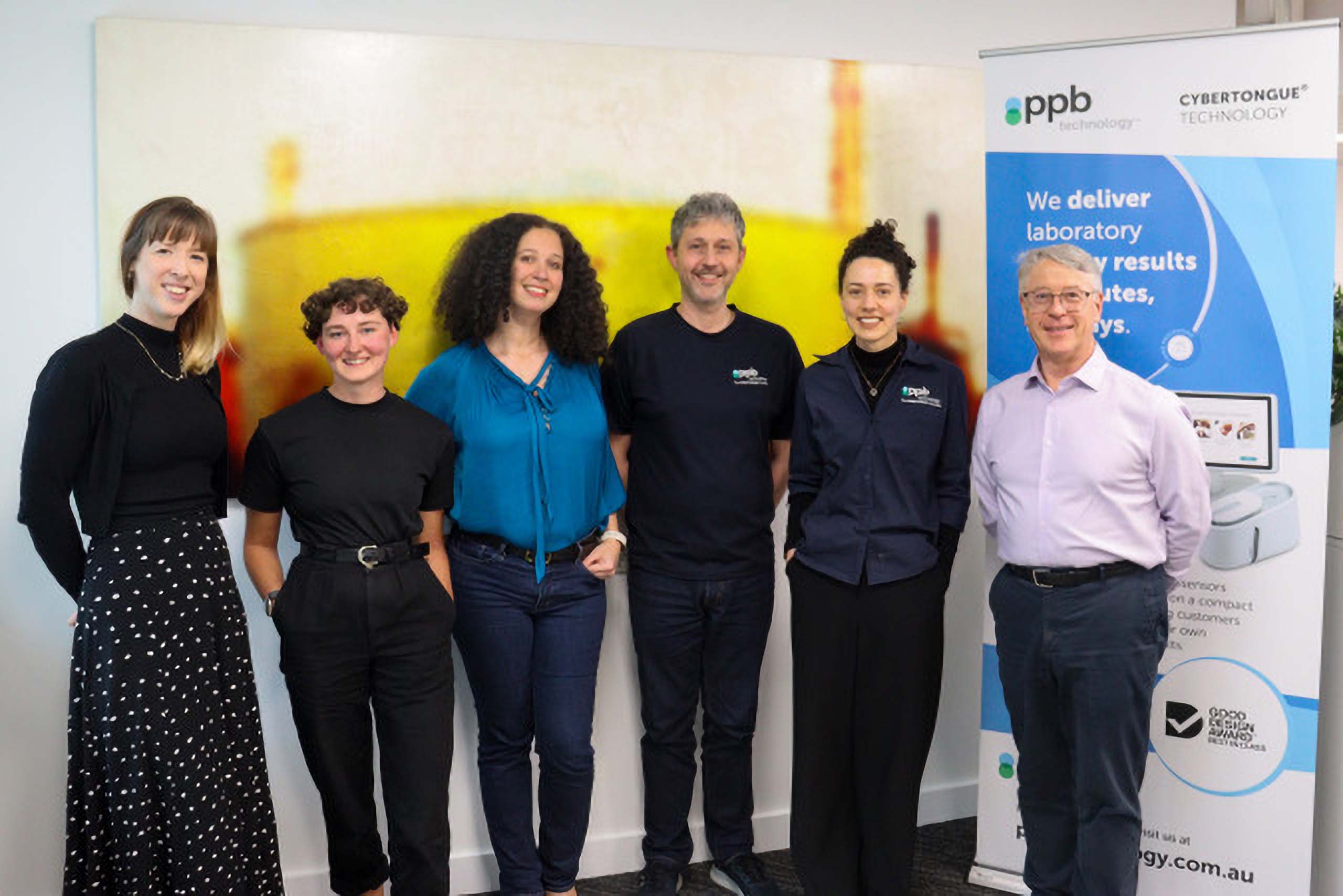
PPB initially developed its technology to measure plasmin, an enzyme derived from cows. After feedback from the dairy industry, the company shifted its focus to bacterial proteases, which were identified as a more pressing spoilage problem. The platform can make some existing tests faster, but PPB chose to focus first on a measurement previously unavailable to processors.
“Where we’ve chosen to lead is with a measurement nobody else can do at all,” he said. “The blue ocean, if you like.”
That focused entry point shapes PPB’s wider strategy. CYBERTONGUE® could eventually test for lactose, allergens, microbial toxins and other targets. Yet launching everything at once would stretch a six-person company too far. Protease gives it a clear route into dairy, where the financial value is easier to demonstrate.
A processor that detects high protease activity may redirect a batch of milk away from long-life products and use it for yoghurt, curd or another product where the enzyme causes less damage. PPB also says its tests can help trace problems in the milk supply and detect biofilms on processing equipment, allowing factories to take corrective cleaning measures.
Fresh milk presents another sizeable opportunity, with the global market estimated at around US$81 billion in 2026 and projected to grow at 6.83% annually through 2035. At that scale, even small gains in shelf-life consistency could prevent substantial losses. Supermarkets often require milk to have a minimum amount of shelf life remaining on delivery. Products that fall short may be rejected, discounted or discarded at the processor’s expense. While Australian processors typically aim for a shelf life of 19 to 21 days, they do not always achieve it. CYBERTONGUE® could help them reach that target more consistently.
Cheese producers face a related issue. Protease can create bitter flavours in hard cheeses and reduce production yield. Cheesemakers add another enzyme, chymosin, during production, often without knowing how much protease activity is already present in the milk. Better information could help them adjust the process and get more value from the same raw material.
PPB sells the reader as laboratory equipment, but its long-term business model centres on repeat testing. Customers buy the machine, then purchase a PPB reagent cartridge each time they run an assay. Future tests are intended to work on the same reader, making the system more useful as the catalogue expands.
CYBERTONGUE®’s compact design reflects PPB’s focus on practical onsite testing. The device is small enough to fit into two cupped hands and comes with a tablet running PPB’s software.
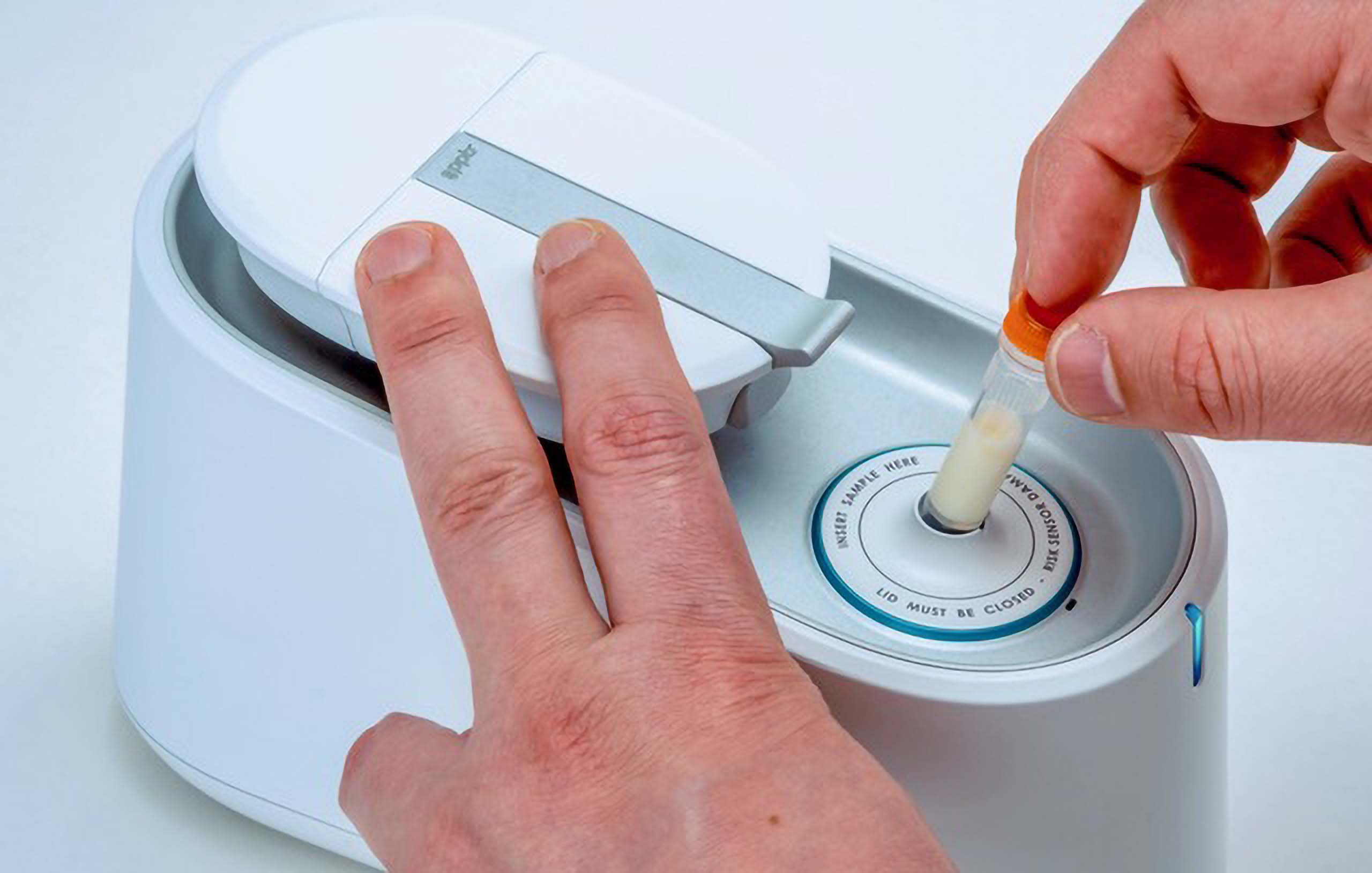
At the time of the interview, 13 to 15 systems had been installed with paying customers. PPB had made sales in 11 countries across five continents, with Europe as its largest market.
Trowell describes PPB as “born global”. While Australia and New Zealand have sophisticated dairy industries, Trowell thinks CYBERTONGUE® may offer even more value in regions where milk quality is less consistent, transport routes are longer or refrigeration is harder to maintain.
Trowell also believes PPB has a strong competitive moat, with the combination of manufacturing both the hardware and consumable reagents. Patents form one layer, but he does not consider legal protection sufficient on its own. A competitor would need expertise in protein engineering, reagent production, optical hardware, software and dairy processing.
Calibration adds another barrier. For each new box of reagents, PPB securely uploads the required calibration data to the customer’s machine. A third party could not simply manufacture a cartridge with the same dimensions and expect it to work correctly.
“We own the whole stack,” Trowell said, referring to everything from the sensing molecule to the hardware, software and cloud platform.
That said, he accepts that no technology is impossible to copy. His view is that PPB’s mix of scientific knowledge, integrated system and experience in dairy gives it enough of a head start to build a meaningful position before competitors catch up.
The technology could eventually reach beyond food. Trowell sees possible uses in environmental testing, veterinary care and medical diagnostics, including the analysis of blood, serum or saliva. PPB has already discussed potential applications with organisations outside the food industry.
For now, however, moving directly into clinical diagnostics would create more risk than opportunity. Medical products can require years of trials, extensive regulatory work and large development budgets. PPB would also need to build new sales channels and choose between many possible clinical uses without knowing which one would attract the strongest demand.
For these reasons, food testing offers PPB a clearer path. The regulatory barriers are generally lower, customers have immediate operational problems, and PPB has already built relationships in dairy. Once the platform has proved itself commercially, the company could enter other sectors through partnerships or licensing.
Trowell has held that view for years. The immediate goal is to build a successful food testing company rather than chase the prestige often attached to medical biotechnology.
The opportunity may also expand as food production becomes more complex. Dairy factories increasingly process oat, soy and other alternatives on equipment that also handles cow’s milk. This creates cross-contamination and allergen risks, offering another potential use for CYBERTONGUE®.
PPB still has plenty to prove. It must secure repeat reagent orders, convert early trials into wider deployments and expand its test catalogue without compromising accuracy. Scaling an integrated biotech hardware business across international markets will not be simple.
Still, its approach offers a useful lesson for other deep-tech startups. Instead of beginning with every possible application, PPB picked a specific problem that costs customers money today. It built a product around that pain point, then used the same technology as the foundation for a broader platform.
As Trowell put it, customers “need it fast, and they need it right.” CYBERTONGUE® is betting that food testing can deliver both.
Startups
August 5, 2026
The Hong Kong startup combines 3D-printed reef tiles, biodiversity monitoring and long-term data to help companies manage their impact on marine ecosystems.
Anyone who has snorkeled over a coral reef has probably admired its vibrant colours and the marine life swimming between its branches. What is less visible is how easily these ecosystems can be damaged. Rising ocean temperatures and pollution continue to put reefs under pressure, while coastal development creates another threat. Construction can stir up sediment that settles on corals, blocking the sunlight they need and making it harder for damaged reefs to recover.
Protecting marine ecosystems is becoming a shared responsibility. Alongside scientists, governments and conservation groups, businesses whose operations affect the ocean are increasingly expected to understand, manage and reduce their environmental impact. They must also show regulators, banks and investors that they are meeting their environmental commitments.
Archireef helps businesses meet those demands. Founded by Vriko Yu, the Hong Kong-rooted B2B startup specializes in marine ecosystem restoration and ocean nature risk management. Drawing on years of research at the University of Hong Kong, Yu built the company to help organisations understand, measure and reduce their impact on marine ecosystems.
Yu describes Archireef as an “end-to-end ocean nature risk management company”.
“What we offer them is a credible way to meet those obligations and stand behind the results,” she says.
One of the company’s main tools for restoring damaged marine ecosystems is its flagship 3D-printed terracotta reef tile. The tiles provide a stable foundation where young corals can attach, grow and survive over time.
Archireef chose terracotta instead of concrete and other conventional materials because it is pH-neutral and does not release harmful chemicals into the water. Its surface also gives corals a suitable place to attach naturally.
Before placing a single tile in the ocean, the team studies the proposed restoration site to determine whether recovery is possible. It assesses the water quality, biodiversity and general health of the ecosystem. As Yu explains, restoration should begin only where nature has a realistic chance to recover.
“Restoration isn’t about replacing nature or engineering a reef into existence. It is about removing the barriers and giving a degraded system the conditions it needs to begin recovering on its own”, she says.
Once the team selects a site, divers carefully place the tiles on the seabed. Their curves, ridges and crevices imitate the structure of a natural coral reef, creating sheltered spaces for marine species. The design also helps limit sediment build-up, which can block sunlight and smother young corals.
.webp)
Archireef adjusts the shape of its reef tiles for each project.
“There’s no universal reef, so there’s no universal tile”, Yu says.
Instead of producing one standard model, the company adapts each design to the coral species, water conditions and surrounding marine environment. A coral restoration project in Hong Kong may therefore require a different tile from one in Saudi Arabia, even when the same manufacturing process is used.
“The biggest adaptation from site to site is usually the match between design, species and environment, not the manufacturing itself ”, Yu explains.

Although the reef tile is Archireef’s most recognizable innovation, Yu sees it as one part of a much broader service.
“The reef tile gets the attention because it’s tangible,” she says. “But the real product is the proof — defensible, audit-ready evidence of nature recovery that an organization can put in a disclosure and stand behind under scrutiny”.
Producing that evidence requires years of biodiversity monitoring. Long after the reef tiles have been installed, Archireef continues to track coral survival and the health of the surrounding marine ecosystem. Its monitoring methods include ecological surveys, AI-assisted species recognition, photogrammetry and environmental DNA testing.

Photogrammetry uses photographs to produce detailed 3D models of the reef. These models allow the team to measure changes in coral growth and reef structure over time.
Environmental DNA, commonly known as eDNA, offers another way to monitor marine biodiversity. Traditional ecological surveys often depend on divers recording the species they can see. eDNA testing instead examines traces of genetic material left in the water by marine organisms, including skin cells, mucus and waste.
By analyzing these traces, Archireef can detect species that may be hidden, difficult to identify or absent during a dive. This gives the company a more complete picture of the ecosystem and how it is changing.
For Archireef, the success of a coral reef restoration project is determined by what happens several years after installation.
“The indicators that matter aren’t the ones that look good on deployment day”, Yu says. “They’re the ones that show, two, three and five years on, whether a genuine ecosystem is establishing and sustaining itself”.
At the company’s first restoration site in Hoi Ha Wan, Hong Kong, around 90% of the transplanted corals remained alive four years after deployment. The long-term survival rate suggests that the ecosystem is recovering rather than simply appearing healthy during the early stages of the project.
Results like these have helped Archireef move beyond academic research and secure collaborations across the public and private sectors. In Hong Kong, the company has worked with government departments and public organisations responsible for coastal infrastructure and marine conservation.
Startups
July 2, 2026
Merve Isler, Founder and CEO of Marvelous, sits down with Ventureport to discuss how AI can help revenue teams find the right rooms, guests and opportunities.
Most B2B sales teams spend their days inside software. They track leads in a customer relationship management (CRM) tool, send emails, build outbound lists and measure every digital touchpoint. Still, many important business relationships move forward in person. A dinner after a conference, a small founder roundtable or a private customer event can do what dozens of cold emails cannot: build trust quickly.
That is the gap Marvelous wants to fill. The bootstrapped San Francisco-based AI startup is building what founder and CEO Merve Isler calls “Salesforce, but for real life”. Her idea is simple: if companies already use software to manage digital sales, they should also have software to manage the real-world moments that help close deals.
Marvelous brings data, automation and targeting into in-person go-to-market (GTM) work. It helps B2B sales, revenue, marketing and growth teams plan in-person events such as curated dinners, launch events, mixers, happy hours and conference side events. These formats are already familiar to companies selling to enterprise buyers. The problem is that they are often managed through spreadsheets, venue calls, scattered guest lists and manual follow-ups.
That creates two problems. First, the process is slow. Teams can spend weeks figuring out who to invite, where to host and how to manage responses. Second, the return is hard to measure. Companies spend heavily on conferences, dinners and private events, yet they often do not have a clear way to know whether an event will influence pipeline before they commit the budget.
Marvelous wants to pull those pieces into one AI-powered event management platform.
“Our main target customer is revenue and sales teams,” Isler said. “Because about 40% of deals close in person, but there's no infrastructure built for that—so that's what we do.”
For Isler, the idea comes from experience. Before starting Marvelous, she worked at Google from Istanbul, managing developer product launches and go-to-market programs across Turkey, Central Asia and the Caucasus. During that time, she helped build more than 100 communities around the world and coordinated thousands of events a year across eleven time zones. The work was fast, local and very manual.
That experience shaped the foundation for Marvelous. Isler saw that building products had become easier, while distribution remained difficult. A startup can now ship software faster than ever. Reaching the right people, in the right setting, is still a different challenge.
At Google, Isler had to understand how people gathered, communicated and built trust in different markets. A product launch might require developer meetups in dozens of cities, but the right approach could change from country to country. In Kazakhstan, she said, Telegram worked better than WhatsApp. In Afghanistan, Facebook mattered more. Each market had its own habits, and growth depended on understanding those details. Those details and adapt quickly.
Marvelous grew out of that playbook. Isler saw that offline distribution had patterns, even when it looked chaotic from the outside. The right guest list, the right room, the right timing and the right follow-up could change the outcome of a sales conversation. Most of that knowledge, however, lived in people’s heads. Marvelous is her attempt to turn it into software.
Inside the platform, a company can start by choosing the kind of satellite event it wants to host: a launch event, a mixer, a happy hour, a brunch, a lunch or a dinner. From there, users can connect their CRM. When Salesforce is connected, Marvelous analyzes contacts and creates relationship scores based on signals such as buying intent, past event activity and how warm a relationship appears to be. If a team also uses an event platform such as Luma or Eventbrite, Marvelous can bring that event data into the picture as well.

The product is built around Maven, Marvelous’ AI assistant. Maven can help plan an event through Slack, iMessage or the Marvelous platform itself. For instance, a user might ask Maven to plan an executive dinner for 18 people within a set budget. From there, Maven can find warm contacts, estimate who is likely to attend, build a guest list, recommend venues, send invitations and run follow-up sequences across email, LinkedIn and SMS. The goal is to let sales teams focus on conversations and closing deals instead of worrying about logistics. Put simply, Marvelous helps a company find the right guests, secure the right venue and understand which event format is likely to work. Instead of guessing whether a US$10,000 dinner will pay off, the company gets a clearer view of the potential return.

AI Insiders, Marvelous’ invite-only network of verified AI and enterprise leaders, is also part of the company’s go-to-market strategy. Rather than asking every customer to build an event from scratch, Marvelous can group several companies that want to reach the same audience into one curated event. Such a setting creates revenue, product feedback and fresh data about what works in different markets. The network spans verticals such as cybersecurity, fintech, robotics, healthcare AI and enterprise SaaS. It now includes members from more than 475 companies, with C-level executives making up nearly half of the community. So far, AI Insiders has facilitated more than 2,000 introductions and contributed to over US$560 million in deals. Isler describes it as one of Marvelous’ strongest go-to-market channels.
The first AI Insiders event took place at AWS GenAI Loft in San Francisco in March 2025. It brought together 150 curated guests, including AI founders, tier-one investors, enterprise executives and researchers for an evening focused on high-impact conversations and collaboration.
The timing may work in Marvelous’ favor: Digital outreach is getting louder, and AI will make it easier for companies to send more emails, messages and automated pitches. That may make high-trust in-person conversations more valuable, especially in enterprise sales where relationships take time. At the same time, event budgets need proof. Revenue leaders want to know whether a dinner, roadshow or customer event is worth the cost.
Marvelous is betting that offline sales will become a measurable category for software. If the company can prove that its relationship scores, event intelligence and AI agent help teams create a stronger pipeline, it could become an important tool for B2B go-to-market teams. The core message of Marvelous is easy to understand: the deals may happen in the room, but data can still power the room.
Artificial Intelligence
June 10, 2026
Not elected, not human—Albania’s AI minister sparks a new governance debate.
Artificial intelligence already supports a wide range of applications, from medical diagnostics and financial systems to logistics, manufacturing, defence and public service delivery. Now, it is starting to move closer to public office.
In January 2025, Albania introduced Diella, an AI-powered virtual assistant developed by the National Agency for Information Society, known as AKSHI, with support from Microsoft. Launched on the e-Albania platform, the government’s digital services portal, Diella helps citizens and businesses access official documents and services through voice assistance. She can also issue electronically stamped documents, which helps speed up administrative processes.
Then, in September 2025, Prime Minister Edi Rama announced that Diella would join his cabinet as the “Minister of State for Artificial Intelligence”. This move drew global attention. It also raised a simple question: what does it actually mean for a government to appoint an AI minister?
The case raises bigger questions for governments everywhere. Can an AI minister make public services faster and cleaner? Or does it create new risks around transparency, accountability and control?
Diella is not a humanoid robot sitting in a cabinet room. On screen, she appears as a digitally rendered woman wearing traditional-style Albanian clothing. Her name means “sun” in Albanian, a deliberate choice for a system meant to bring more light into public administration.
Her face and voice have become part of the controversy. Albanian actor Anila Bisha has said she agreed for her likeness to be used for the e-Albania public services platform, but not for a cabinet-level political role. In 2026, she took legal action to stop the government from using her image and voice for Diella. For now, the government has denied wrongdoing.
Diella began as a digital assistant on e-Albania. In that role, she helps users find services, request documents and navigate government processes online. For citizens, that can make public services feel less confusing. Businesses may also spend less time dealing with paperwork.
Her cabinet role is more political. The government wants Diella to support public procurement, where companies compete for government contracts. This is one of the most important areas of public spending. It is also one of the easiest places for corruption, favouritism and hidden influence to enter. The goal is to use AI to process information, check documents, support tender procedures and make the system more traceable.
That said, the government has emphasized that Diella is not replacing elected officials or civil servants. As per Enio Kaso, director of AI at AKSHI, each stage will be monitored and approved by human experts.
In May 2026, the Albanian government said it had completed the technical groundwork for the AI-powered public procurement system under the Diella project. The planned system would pull data from more than 40 digital public registries, reduce paperwork for businesses and support parts of the tender process. Earlier reports said the government hoped to have the full system ready by the end of 2026.
The government’s case for Diella is built around anti-corruption reform. Rama has said the goal is to “wipe out every potential influence on public biddings” and thus make public tenders “100% free of corruption”. That is a bold promise, especially in a country where procurement scandals have long damaged public confidence and complicated Albania’s path toward European Union membership.
At first glance, the logic is easy to understand. AI does not ask for bribes or favour a cousin—a big problem in the country, according to Rama—a friend or a political ally. It can apply the same rules across a large number of applications. Moreover, it can also leave a digital trail, which should make later review easier.
Some anti-corruption and governance experts see real potential in that approach. Dr. Andi Hoxhaj of King’s College London has said that if used well and programmed properly, AI could help procurement officials spot missing documents, check whether companies meet eligibility requirements and flag unusual patterns in bids. In practice, that could make the process more consistent and make it harder for individual officials to quietly bend rules.
Diella’s appeal is speed and consistency. Her weakness is dependence.
Like any AI system, Diella relies on the quality of the data, rules and models behind her. Erjon Curraj, an expert in digital transformation and cybersecurity, has warned that incomplete, outdated or biased data can lead to flawed results. Poor design could also cause the system to reject a valid supplier, miss signs of collusion or treat similar cases differently for reasons that are hard to explain.
In public procurement, those mistakes can have serious consequences. A wrongly flagged company could lose a major contract, and a corrupt bidder could slip through. Government agencies could hide behind the AI and say the system made the recommendation.
That leads to the biggest question: who is accountable when something goes wrong?
The answer cannot be “the AI” because Diella cannot resign. She cannot face voters. Nor can she be cross-examined in any meaningful human sense. Accountability has to sit with ministers, agencies, auditors and courts.
There is also the issue of transparency. If Diella is helping screen tenders, businesses need to know what criteria are being used. They also need a way to challenge incorrect decisions. Citizens should be told whether the AI is making recommendations or merely organizing information. Independent auditors need access to logs, data sources and decision pathways.
Without those safeguards, AI in government can become a black box. It may look modern from the outside, while making power harder to question.
Diella has also become a political symbol. Supporters see her as proof that a small country can move quickly and experiment with new forms of digital government. Critics see her as a distraction from deeper problems in Albania’s institutions.
Both readings can be true at the same time: Diella may help modernize public services, but she may also be used to project reform while older problems continue in the background.
That tension became clearer after the recent procurement investigations involving senior officials since Diella’s appointment. Deputy Prime Minister Belinda Balluku has been accused by prosecutors of alleged misconduct linked to infrastructure tenders, which she denies. Senior figures at AKSHI, the agency behind Diella and e-Albania, have also been placed under house arrest as part of a separate public procurement investigation.
While these developments do not automatically discredit Diella, they may strengthen the argument for better digital oversight. More importantly, they also show that technology cannot carry the whole burden of reform.
If the institutions around an AI system are weak, the AI will not magically make them strong. Unclear procurement rules will still cause problems, and the process will still be compromised when political pressure shapes the data, the model or the final decision.
After all, AI can support integrity; it cannot replace it.
While Diella is already a public symbol of AI in government, her most important procurement role is still taking shape. This makes Albania’s experiment both ambitious and unfinished.
The more realistic model is simple: let AI handle repetitive, data-heavy administrative work. Let humans retain authority where judgment, context and public accountability matter.
That means AI can help draft tender criteria, check documents, summarise bids and flag risks. Human officials should still make final decisions, explain those decisions and take responsibility for them. Meanwhile, independent bodies should be able to audit the process, and businesses should have a clear appeal route when they believe the system has made a mistake.
Diella once said she felt “hurt” while responding in parliament to claims that her role was unconstitutional. While this made for a memorable moment, it is important to remember simulated emotion is not consciousness, speed is not wisdom, and pattern recognition is not moral judgment.
Albania’s AI minister is therefore neither a triumph nor a failure at this stage. She is a live test case. Other governments will be watching closely, especially as public services become more digital and more automated.
The lesson is not that AI should stay out of government, but that AI must enter government carefully. The technology needs clear limits, public oversight and human accountability.
Diella may help Albania build a faster and cleaner procurement system—or she may become a warning about giving too much symbolic power to systems people do not fully understand. The final judgment will not come from the title “AI minister”. It will come from what the system does, who controls it and whether citizens can trust the results.
M&A & IPOs
June 4, 2026
Why More Growth Companies Are Looking Beyond the Traditional IPO
Enhanced Games reached the public markets in less than six months.
In an era where traditional IPOs can take more than a year to complete, the speed of the company’s merger with A Paradise Acquisition Corp. (NASDAQ: APAD) stands out, particularly given the significantly tighter regulatory scrutiny surrounding SPAC transactions since 2021.
The transaction highlights why some growth-stage companies are evaluating special-purpose acquisition companies (SPACs) as a viable alternative to the traditional IPO process.
Led by Dr. Aron D’Souza and backed by investors including Peter Thiel and Christian Angermayer, Enhanced Games announced its Business Combination Agreement with APAD in November 2025. The transaction closed in May 2026, bringing the company to the public markets materially faster than the timeline typically associated with a conventional IPO.
For decades, the traditional IPO has been considered the default route for private companies entering the public markets. But for many high-growth businesses today, the process has become increasingly slow, expensive, and difficult to execute efficiently.
A conventional IPO can take well over a year to prepare, involving extensive audits, regulatory reviews, underwriter coordination, investor roadshows, and careful timing against market conditions. During that period, companies remain exposed to volatility, shifting investor sentiment, and delayed access to capital. According to EY, many companies postponed planned IPOs amid market volatility and uncertainty surrounding U.S. tariff announcements, highlighting how sensitive IPO execution can be to broader market conditions.
For businesses operating in fast-moving industries, timing matters. Delayed access to liquidity can slow expansion, hiring, acquisitions, partnerships, and product development at critical stages of growth.
That is one reason why the merger between Enhanced Games and APAD is notable. The SPAC structure allowed Enhanced Games to negotiate valuation, governance terms, and financing arrangements early in the process, compressing many of the steps normally associated with a conventional IPO into a single transaction.
Enhanced Games operates across sports, media, performance science, and wellness, sectors that require significant upfront investment and rapid execution. Earlier access to public capital provided the company with liquidity, visibility, and strategic flexibility at an important stage of growth.
The public listing also gives the company tradable equity that can potentially support acquisitions, partnerships, athlete compensation structures, sponsorship arrangements, and future fundraising initiatives. These capabilities are particularly relevant in industries evolving as rapidly as sports entertainment, wellness, and human-performance science, where speed itself can become a competitive advantage.
The deal also highlights one of the SPAC market’s core advantages: the ability to combine capital raising and public-market entry within a single process.
Beyond speed, the SPAC structure offered Enhanced Games another major advantage: earlier visibility into valuation.
In a traditional IPO, pricing is largely determined near the end of the process through institutional book-building and investor demand during the roadshow phase. Even late-stage IPO candidates can face valuation cuts, downsized offerings, or postponed listings if market conditions weaken.
Recent IPO markets have repeatedly demonstrated this risk. Instacart went public in 2023 at an approximate US$9.9 billion valuation, which is dramatically below the US$39 billion private valuation it achieved during the 2021 market peak. Similarly, WeWork’s failed IPO attempt became one of the clearest examples of how rapidly investor sentiment can shift during the IPO process.
SPAC mergers operate differently.
Enhanced Games secured an implied enterprise valuation of approximately US$1.2 billion months before closing the transaction. While the merger still required SEC review and shareholder approval, the company gained significantly greater visibility into deal economics much earlier in the process.
That certainty is particularly valuable for growth companies whose valuations are tied more closely to long-term platform potential than near-term profitability.
Rather than relying entirely on shifting IPO market sentiment, the SPAC structure allowed Enhanced Games to negotiate around its broader growth strategy and future expansion plans from the outset.
The Enhanced Games transaction also reinforces why some growth-stage companies evaluate SPACs as an alternative to the traditional IPO process.
Traditional IPO investors often prefer businesses with long operating histories, stable earnings, and predictable growth profiles. Many expansion-stage companies simply do not fit that model yet, even if their long-term opportunities are substantial.
SPACs offer a different pathway.
Instead of waiting years to achieve the operational maturity typically expected in a conventional IPO, companies can access public-market capital earlier while still in growth mode.
For Enhanced Games, early access to the public markets provides more than capital. Public equity can support acquisitions, partnerships, athlete compensation structures, sponsorship arrangements, and future fundraising efforts. These capabilities are particularly important in sectors evolving as rapidly as sports entertainment, wellness, and human-performance science, where speed itself can become a competitive advantage.
The transaction also highlights how the SPAC market has evolved since the speculative boom of 2020 and 2021.
Today’s de-SPAC environment operates under significantly tighter regulatory scrutiny, including enhanced disclosure requirements, greater SEC oversight, and stricter treatment of projections and liability standards.
The Harvard Law School Forum on Corporate Governance noted that redemption rates spiked in 2022, in some cases approaching 100%, contributing to a significant slowdown of the SPAC activity.
In response to rising investor concerns and regulatory pressure, the U.S. Securities and Exchange Commission adopted enhanced SPAC disclosure and liability rules in 2024 designed to align de-SPAC transactions more closely with traditional IPO standards. Sponsors also faced greater pressure to demonstrate financing certainty, stronger disclosures, and more credible post-merger execution.
Enhanced Games completed its transaction within this more disciplined environment.
Its Form S-4 included audited financial statements, governance disclosures, transaction details, and extensive risk-factor analysis subject to SEC review. The company also supplemented SPAC trust proceeds with a separately arranged US$40 million PIPE financing commitment designed to strengthen liquidity and improve deal certainty.
That structure reflects a more institutional and disciplined SPAC market than the speculative wave seen several years ago.
The Enhanced Games transaction demonstrates that, despite tighter regulation and a far more selective market environment, SPACs can offer certain growth companies a practical alternative to the traditional IPO.
For businesses prioritising speed, capital access, and execution certainty, a well-structured de-SPAC transaction may provide a more efficient route to the public markets, particularly when supported by credible financing, disciplined structuring, and strong investor backing.
Ecosystem Spotlights
June 1, 2026
An interview with Tengin founder Madhu on turning coconuts into a business built around farmers, villages and communities.
In Southern India, coconuts are part of daily life. They are used in food, rituals, farming and home remedies. For Tengin, a social startup whose name means “coconut” in Kannada—a South Indian language—the crop also offers a way to build a rural business with deeper local impact.
Founded by Madhu Kargunda in 2017, Tengin works with farmers, artisans and women’s collectives in Karnataka to make products from almost every part of the coconut. Its range includes virgin coconut oil, desiccated coconut powder, shell-based handicrafts, candles, home décor items and other coconut-based goods.
The larger idea is simple. Farmers should play a bigger role in the value created from the crops they grow. Tengin is trying to help rural communities move beyond supplying raw produce and take part in processing, branding, packaging and sales.
Madhu grew up in an agricultural family. Over the years, he saw many young people move away from farming to look for stable jobs in cities. To him, the problem was not farming itself. The bigger issue was that farmers often missed out on the value created after crops left the farm.
A coconut might be grown in a village, but much of the income comes later through processing, branding and retail. That gap stayed with him, eventually leading him to leave his eight-year career in IT and return to agriculture full-time.
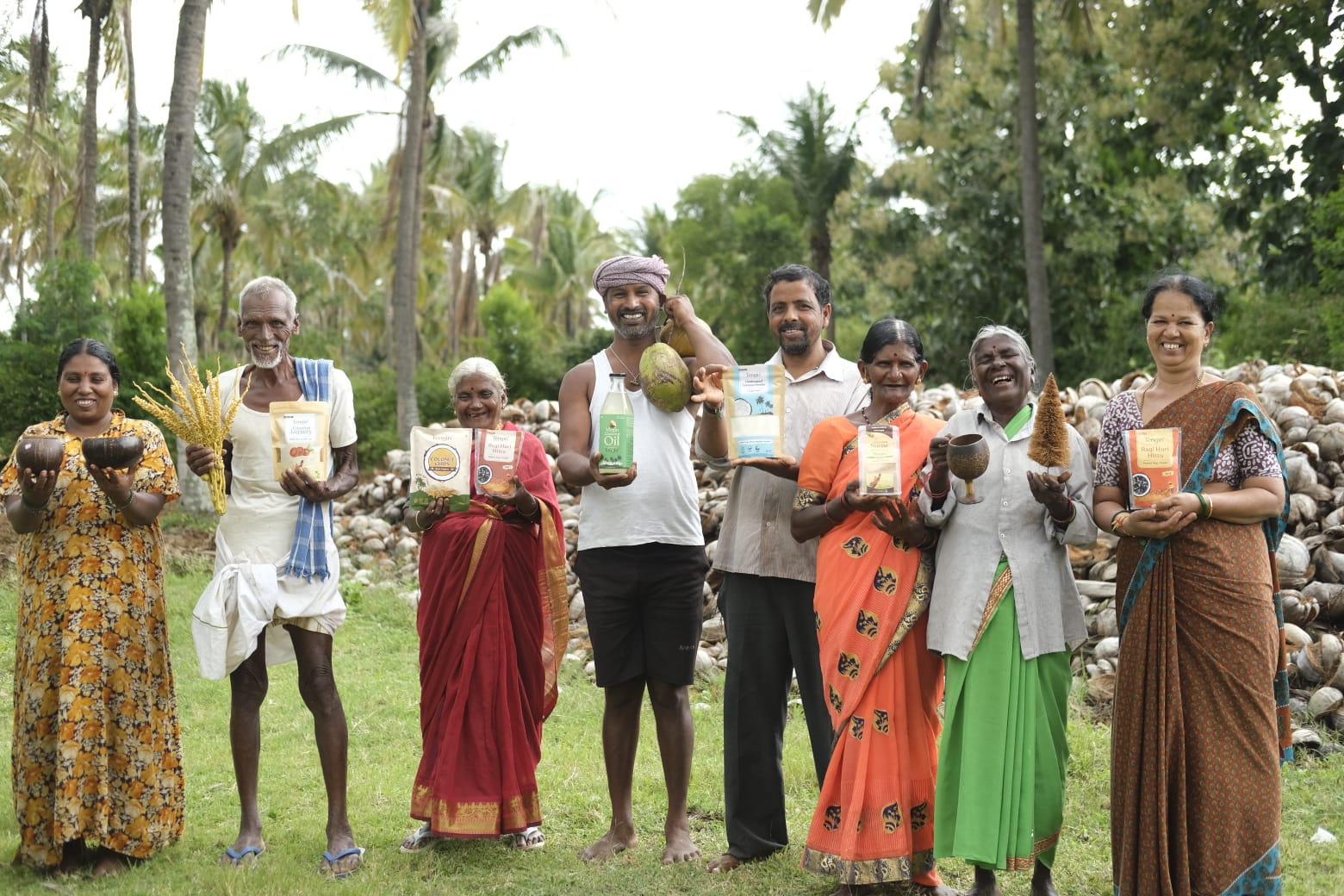
Started with just making virgin coconut oil, Tengin has grown into a wider coconut products business. The startup is now working with around 15 to 20 farmers and artisan groups across Karnataka. It is also building production capacity for larger retail and B2B partnerships.
Today, Tengin generates annual revenue of roughly ₹50-60 lakh, or around US$52,000 to US$62,000. It has also started testing international demand, including a recent export of around 200 kilograms of desiccated coconut powder to Texas.
As Tengin expanded, the team began looking more closely at parts of the coconut that were usually treated as waste or low-value byproducts, such as coconut shells and coir. At first, Tengin treated them that way too.
“When we started, we used to burn some of the shells”, Madhu said. “Later, we realized it was an economic opportunity”.
That changed the company’s product strategy. Local artisans working with Tengin now are turning coconut shells into bowls, incense holders, candles, coffee mugs, mobile stands and handcrafted décor items.

This gives Tengin a place in the circular economy, where waste materials are reused instead of thrown away. For Madhu, though, sustainability has to do more than reduce waste. It should also create income in the community.
“We wanted to minimize waste and maximize wealth locally”, he said.
Tengin does not depend only on one central factory. Instead, it works with smaller village-level production groups that connect to a larger business network. This helps farmers stay close to their land while also taking part in processing and manufacturing. It also creates local jobs, which can reduce the pressure to migrate to cities.
Yet, the model is not always easy. In the early days, Tengin had to convince some farmers to move from chemical farming to natural farming. Moreover, the weather has also become harder to predict. Irregular rainfall and changing harvest cycles can affect coconut prices and production consistency.
Still, Madhu sees the village-based model as central to Tengin’s identity. For him, villages are living systems built on shared work, local knowledge and interdependence.
“The definition of a village is inclusiveness”, he said.
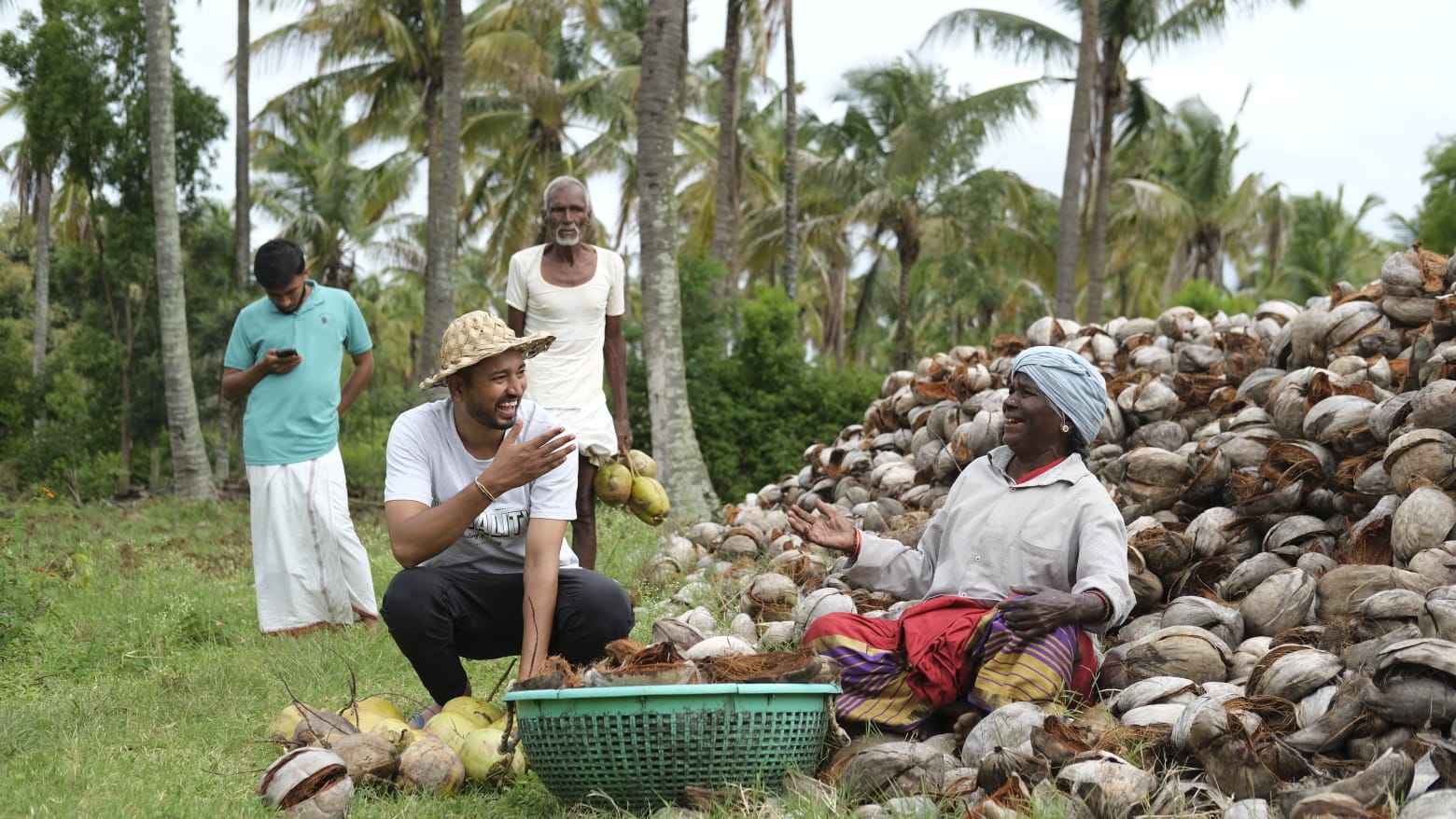
That belief also shaped Tengin’s “coco tourism” initiative. Through the program, visitors meet farmers, learn about farming practices and see how coconut products are made.
During one visit by MBA students from Indiana State University, an unexpected spell of rain gave the group a closer look at village life. Farmers gathered and began singing traditional folk songs to express gratitude to nature. For the students, it became a lesson in culture as much as business.
Madhu sees these moments as part of what rural entrepreneurship can protect.
“If villages become empty, we lose language, traditions and local knowledge too”, he said.
Tengin’s model is not difficult to copy on paper. Madhu is open about that.
“Anyone can do it”, he said, “but what matters is how you work with people”.
For him, the harder part is building long-term trust with farming communities. Tengin works through relationships more than rigid contracts. This encourages farmers and local groups to participate in the system in a more collaborative way.
That trust has become one of the startup’s strongest assets. It shapes how Tengin works with producers and how it presents its products to customers.
For Madhu, it is not enough to call a product sustainable. Customers should be able to understand where it came from, who made it and how their purchase supports the people behind it.

That matters even more in a market where terms like “eco-friendly” and “organic” have become buzzwords. Madhu knows that these words can feel empty when brands do not show what they actually mean.
“Anyone can use these words today,” he said. “What matters is whether consumers can actually see what you are doing”.
This is why Tengin focuses on transparency and storytelling. The startup wants customers to see the full journey of each coconut product, from the farm to the finished item. It also wants them to understand whose livelihood is connected to that journey.
Madhu also believes small brands cannot depend on products alone. Products can be copied, but a clear story, a trusted community and a visible impact are harder to replicate.
“Don’t try to sell only the product,” he said. “When you try to sell the product, you are being sold once”.
Each Tengin product includes details about the people behind it and how profits are shared. In that way, the company connects its coconut products to the farmers, artisans and village systems that make them possible.
For Madhu, entrepreneurship starts with the problem. Founders, he believes, should understand the problem deeply before thinking about scale and revenue.
“An entrepreneur is someone trying to solve an existing problem”, he said. “Sometimes it may be a small problem, sometimes a niche one. It could be in technology, energy, farming or any other sector—but first understand what problem you are trying to solve”.
Farming has also taught him patience. He gives the example of coffee.
“When you plant coffee, you know it may take five years before you see results”, he said, “but you still [have to] water it every day”.
He sees entrepreneurship the same way. Building systems, communities and trust takes time. Growth may be slow at first, but daily work matters.
Adaptability is another lesson he returns to often. Farming conditions change constantly, and so do markets. In both cases, people have to keep learning, unlearning and adjusting.
“Entrepreneurship is about constantly learning new things because the world is changing all the time”, he said. “You need to stay relevant, understand what connects with [your customers] and adapt accordingly”.
Looking ahead, Tengin plans to grow its farmer network, strengthen production capacity and expand its export business. Madhu is also looking to collaborate with more platforms, storytellers and communities that can help amplify the voices behind the products.
The startup is also involved in rural community initiatives, including support for government schools and menstrual health awareness programs.
For Madhu, giving back is part of how he defines success. With more resources, he would invest further in farmer education, village-level production systems and community development.
By building a business around coconuts, Tengin is also making a larger case for rural entrepreneurship. Its work shows that a modern consumer brand can grow without losing its connection to the farmers, traditions and village ecosystems that make that growth possible. For Madhu, that is the real measure of progress: creating value that stays rooted in the community.
Operations & Scale
May 29, 2026
The CE approval opens Europe for Cornerstone Robotics as the company expands its global surgical robotics business
As surgical robotics companies expand beyond domestic markets, regulatory approvals are becoming a critical part of global growth. Companies are no longer competing only on hardware and clinical performance. They are also competing on their ability to enter tightly regulated healthcare systems and build long-term hospital partnerships.
Hong Kong-based Cornerstone Robotics is now moving further into that phase of expansion after its Sentire Endoscopic Surgical System received CE Mark certification under the European Union’s Medical Device Regulation framework.
The approval allows the company to commercialize the system across European markets for minimally invasive procedures in general surgery, gynecology, thoracic surgery and urology. For surgical robotics companies, regulatory approvals often represent more than product validation. They also determine market access, hospital adoption opportunities and long-term commercial scale.
Cornerstone Robotics has already been building clinical operations in the UK ahead of the approval. Since 2025, the company has worked with Portsmouth Hospitals University NHS Trust on clinical investigations involving the Sentire Surgical System. According to the company, the system has been used across procedures involving urology, gynecology and gastrointestinal surgery. The company says the clinical investigation helped generate real-world data to support physician training, research and future adoption efforts.
Alongside the regulatory approval, Cornerstone Robotics is also expanding its local operations in Europe. The company established a UK subsidiary in 2025 and has been developing training, clinical support and after-sales service capabilities for hospitals using the system.
That operational buildout reflects a larger challenge inside surgical robotics. Hospitals adopting robotic systems often require ongoing clinical training, technical support and workflow integration alongside the hardware itself.
Cornerstone Robotics says its strategy centers around vertically integrated development across engineering, software, imaging and robotics systems. The company argues that this structure gives it greater control over product development, supply chain management and long-term operational stability.
Professor Samuel Au, Founder and CEO of Cornerstone Robotics, said: "Receiving CE Certification marks a major milestone in Cornerstone Robotics' evolution from a technology innovator to a global clinical solutions provider. From our first clinical investigation in Portsmouth, UK, to achieving European regulatory approval, each step of the journey reflects our commitment to proprietary innovation, product excellence, and clinical value. Looking ahead, we will continue expanding into key global markets and partnering with leading medical institutions to bring high-quality surgical robotic solutions to more physicians and patients worldwide."
The CE approval also comes several months after the company completed an oversubscribed financing round of approximately US$200 million in November 2025.
The funding and regulatory expansion together signal how surgical robotics companies are increasingly entering a more commercially focused stage of growth. Beyond research and development, companies are now investing more heavily in regulatory approvals, hospital partnerships, physician training and international operational infrastructure as competition expands across global healthcare markets.