
Bitmo Lab is testing an ultra-thin, bendable tracker built to fit inside items traditional trackers can’t
Updated
March 17, 2026 1:02 AM
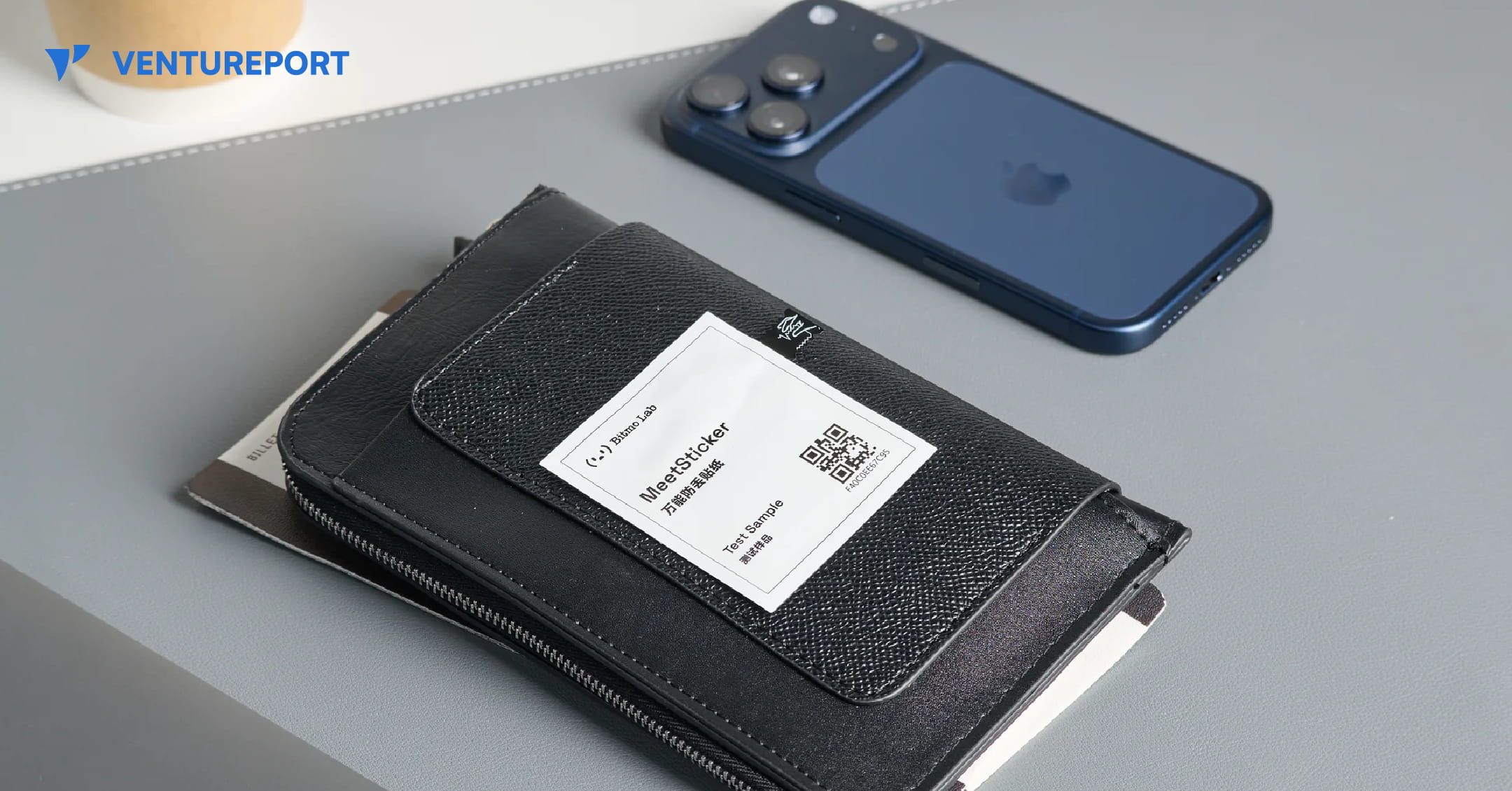
Bitmo Lab's MeetSticker tracker. PHOTO: BITMO LAB
Location trackers have become everyday accessories for keys, bags and luggage. But as personal items grow slimmer and more design-focused — from minimalist wallets to passport sleeves and specialised gear — tracking them has become less straightforward. Most trackers are built as small, rigid discs that assume the presence of space, loops or compartments. That assumption has created a growing mismatch between modern product design and the technology meant to secure it.
Hong Kong–based startup Bitmo Lab is attempting to address that gap with a device called MeetSticker. Instead of the solid plastic casing typical of most trackers, MeetSticker is engineered to be flexible and ultra-thin, measuring just 0.8 millimetres thick. The bendable design allows it to sit within narrow compartments or along curved surfaces without altering the shape of the object. Rather than attaching to an item externally, it is intended to integrate discreetly inside it.
That structural shift is the core of the product’s proposition. By removing the rigid shell that defines conventional tracking hardware, MeetSticker can be placed in items that previously had no practical way to accommodate a tracker. Bitmo Lab states that the device connects through a proprietary network and a companion application compatible with both iOS and Android, positioning it as a cross-platform solution rather than one tied to a single ecosystem.
The implications extend beyond form factor. Objects without obvious attachment points — such as compact travel accessories or specialised tools — could potentially be monitored without visible add-ons. In doing so, the device broadens the scope of tracking technology into categories where aesthetics, aerodynamics or compact design matter as much as functionality.
Before moving toward retail distribution, however, the company is focusing on validation. Bitmo Lab has launched a five-week global alpha testing programme beginning February 9. Sixty participants will receive a prototype unit and early access to the app. According to the company, the programme is designed to assess durability, usability and real-world performance before a wider commercial release. Participants who provide feedback will receive a retail unit upon launch.
Such testing is particularly relevant for flexible electronics. Unlike rigid devices, bendable hardware must withstand repeated flexing, daily handling and environmental exposure. Early user data can help refine manufacturing processes and software optimisation before scaling production.
As with other connected tracking devices, privacy considerations remain part of the equation. Bitmo Lab has stated that data collected during the alpha programme will be used strictly for testing purposes and deleted once the programme concludes.
Whether flexible trackers will redefine the category will depend on how they perform outside controlled testing environments. Still, the introduction of a near-invisible, bendable tracking device reflects a broader shift in consumer technology. As everyday products become thinner and more design-conscious, the tools built to protect them may need to adapt just as seamlessly.
Keep Reading
Not elected, not human—Albania’s AI minister sparks a new governance debate.
Updated
August 10, 2026 5:56 PM
.jpg)
Promotional avatar graphic representing Diella, the Albanian government's artificial intelligence system. PHOTO: EALBANIA
Artificial intelligence already supports a wide range of applications, from medical diagnostics and financial systems to logistics, manufacturing, defence and public service delivery. Now, it is starting to move closer to public office.
In January 2025, Albania introduced Diella, an AI-powered virtual assistant developed by the National Agency for Information Society, known as AKSHI, with support from Microsoft. Launched on the e-Albania platform, the government’s digital services portal, Diella helps citizens and businesses access official documents and services through voice assistance. She can also issue electronically stamped documents, which helps speed up administrative processes.
Then, in September 2025, Prime Minister Edi Rama announced that Diella would join his cabinet as the “Minister of State for Artificial Intelligence”. This move drew global attention. It also raised a simple question: what does it actually mean for a government to appoint an AI minister?
The case raises bigger questions for governments everywhere. Can an AI minister make public services faster and cleaner? Or does it create new risks around transparency, accountability and control?
Diella is not a humanoid robot sitting in a cabinet room. On screen, she appears as a digitally rendered woman wearing traditional-style Albanian clothing. Her name means “sun” in Albanian, a deliberate choice for a system meant to bring more light into public administration.
Her face and voice have become part of the controversy. Albanian actor Anila Bisha has said she agreed for her likeness to be used for the e-Albania public services platform, but not for a cabinet-level political role. In 2026, she took legal action to stop the government from using her image and voice for Diella. For now, the government has denied wrongdoing.
Diella began as a digital assistant on e-Albania. In that role, she helps users find services, request documents and navigate government processes online. For citizens, that can make public services feel less confusing. Businesses may also spend less time dealing with paperwork.
Her cabinet role is more political. The government wants Diella to support public procurement, where companies compete for government contracts. This is one of the most important areas of public spending. It is also one of the easiest places for corruption, favouritism and hidden influence to enter. The goal is to use AI to process information, check documents, support tender procedures and make the system more traceable.
That said, the government has emphasized that Diella is not replacing elected officials or civil servants. As per Enio Kaso, director of AI at AKSHI, each stage will be monitored and approved by human experts.
In May 2026, the Albanian government said it had completed the technical groundwork for the AI-powered public procurement system under the Diella project. The planned system would pull data from more than 40 digital public registries, reduce paperwork for businesses and support parts of the tender process. Earlier reports said the government hoped to have the full system ready by the end of 2026.
The government’s case for Diella is built around anti-corruption reform. Rama has said the goal is to “wipe out every potential influence on public biddings” and thus make public tenders “100% free of corruption”. That is a bold promise, especially in a country where procurement scandals have long damaged public confidence and complicated Albania’s path toward European Union membership.
At first glance, the logic is easy to understand. AI does not ask for bribes or favour a cousin—a big problem in the country, according to Rama—a friend or a political ally. It can apply the same rules across a large number of applications. Moreover, it can also leave a digital trail, which should make later review easier.
Some anti-corruption and governance experts see real potential in that approach. Dr. Andi Hoxhaj of King’s College London has said that if used well and programmed properly, AI could help procurement officials spot missing documents, check whether companies meet eligibility requirements and flag unusual patterns in bids. In practice, that could make the process more consistent and make it harder for individual officials to quietly bend rules.
Diella’s appeal is speed and consistency. Her weakness is dependence.
Like any AI system, Diella relies on the quality of the data, rules and models behind her. Erjon Curraj, an expert in digital transformation and cybersecurity, has warned that incomplete, outdated or biased data can lead to flawed results. Poor design could also cause the system to reject a valid supplier, miss signs of collusion or treat similar cases differently for reasons that are hard to explain.
In public procurement, those mistakes can have serious consequences. A wrongly flagged company could lose a major contract, and a corrupt bidder could slip through. Government agencies could hide behind the AI and say the system made the recommendation.
That leads to the biggest question: who is accountable when something goes wrong?
The answer cannot be “the AI” because Diella cannot resign. She cannot face voters. Nor can she be cross-examined in any meaningful human sense. Accountability has to sit with ministers, agencies, auditors and courts.
There is also the issue of transparency. If Diella is helping screen tenders, businesses need to know what criteria are being used. They also need a way to challenge incorrect decisions. Citizens should be told whether the AI is making recommendations or merely organizing information. Independent auditors need access to logs, data sources and decision pathways.
Without those safeguards, AI in government can become a black box. It may look modern from the outside, while making power harder to question.
Diella has also become a political symbol. Supporters see her as proof that a small country can move quickly and experiment with new forms of digital government. Critics see her as a distraction from deeper problems in Albania’s institutions.
Both readings can be true at the same time: Diella may help modernize public services, but she may also be used to project reform while older problems continue in the background.
That tension became clearer after the recent procurement investigations involving senior officials since Diella’s appointment. Deputy Prime Minister Belinda Balluku has been accused by prosecutors of alleged misconduct linked to infrastructure tenders, which she denies. Senior figures at AKSHI, the agency behind Diella and e-Albania, have also been placed under house arrest as part of a separate public procurement investigation.
While these developments do not automatically discredit Diella, they may strengthen the argument for better digital oversight. More importantly, they also show that technology cannot carry the whole burden of reform.
If the institutions around an AI system are weak, the AI will not magically make them strong. Unclear procurement rules will still cause problems, and the process will still be compromised when political pressure shapes the data, the model or the final decision.
After all, AI can support integrity; it cannot replace it.
While Diella is already a public symbol of AI in government, her most important procurement role is still taking shape. This makes Albania’s experiment both ambitious and unfinished.
The more realistic model is simple: let AI handle repetitive, data-heavy administrative work. Let humans retain authority where judgment, context and public accountability matter.
That means AI can help draft tender criteria, check documents, summarise bids and flag risks. Human officials should still make final decisions, explain those decisions and take responsibility for them. Meanwhile, independent bodies should be able to audit the process, and businesses should have a clear appeal route when they believe the system has made a mistake.
Diella once said she felt “hurt” while responding in parliament to claims that her role was unconstitutional. While this made for a memorable moment, it is important to remember simulated emotion is not consciousness, speed is not wisdom, and pattern recognition is not moral judgment.
Albania’s AI minister is therefore neither a triumph nor a failure at this stage. She is a live test case. Other governments will be watching closely, especially as public services become more digital and more automated.
The lesson is not that AI should stay out of government, but that AI must enter government carefully. The technology needs clear limits, public oversight and human accountability.
Diella may help Albania build a faster and cleaner procurement system—or she may become a warning about giving too much symbolic power to systems people do not fully understand. The final judgment will not come from the title “AI minister”. It will come from what the system does, who controls it and whether citizens can trust the results.