
Join us at CVCF 2026 to explore how startups can scale and win in the age of AI.
Updated
October 29, 2026 11:39 PM

CVCF 2026 takes place on 4–5 November at Cyberport, Hong Kong. IMAGE: CYBERPORT
AI can help you build a startup, but it won’t automatically make you stand out. When everyone has access to similar tools, you need to give customers a reason to choose you and investors a reason to back you. So, how do you turn innovation into a competitive edge?
That question sits at the heart of Cyberport Venture & Capital Forum (CVCF) 2026, taking place on 4–5 November under the theme “Scaling in a Changing World: Winning the Next Competitive Cycle” and the message “Scale Up & Win.”
The two-day forum will feature more than 80 speakers discussing venture investment, AI-driven growth, emerging technologies and expansion into new markets. Day 1 will explore global investment trends and the next wave of innovation. Day 2 will feature CVCF 2026’s spotlight event, the Agentic Economy Summit, examining how agentic AI and digital assets could reshape business and finance. The wider programme will also include investor matching, founder pitches, 100+ Innovator Showcase, startup workshops and clinics.
With founders and investors navigating a fast-changing technology landscape, CVCF 2026 will explore what it takes to stay competitive, scale into new markets and turn emerging opportunities into business growth. Here’s a look at the key programmes lined up for this year’s forum.

Keynotes and Panels: Finding the Next Big Opportunity
Taara founder and CEO Mahesh Krishnaswamy will deliver the keynote The Innovation Playbook: Capitalizing on Moonshots and Faster Cycles in the Age of AI. The wider Day 1 programme will cover global investment trends, expansion into new markets, agentic AI and one-person companies.
For startups navigating the AI market, the panel Mastering the AI Bubble: Capital Rerouting and How Global Champions Stand Out will bring together panellists from Quona Capital, Alumni Ventures, FOV Ventures and Capital6 to discuss how investors assess startups and distinguish commercial potential from market hype. Other sessions will explore emerging technologies beyond AI software, including embodied AI, advanced computing and commercial aerospace.

Investor Matching and Networking: Connecting with Capital
Away from the conference sessions, MatchEasy will help founders and investors arrange one-to-one meetings, either onsite or online. Confirmed participants will receive access to the platform to explore potential matches and schedule meetings.
Investors can also discover local and international startups through the Founder Pitch programme, where entrepreneurs present their projects and ventures. Meanwhile, the Innovator Showcase offers a separate opportunity to explore emerging technology solutions through a virtual platform and selected on-site exhibits.
For founders seeking more tailored guidance, the Startup Clinics will offer one-to-one discussions with industry experts and experienced entrepreneurs on business challenges, fundraising and growth. Advance registration is required.
Hands-On Workshops: Strengthening Your Investment Pitch
Turning an innovative idea into a business that investors can back takes more than a strong pitch. CVCF 2026 will host practical workshops to help founders strengthen their fundraising strategies and make a stronger case to investors.
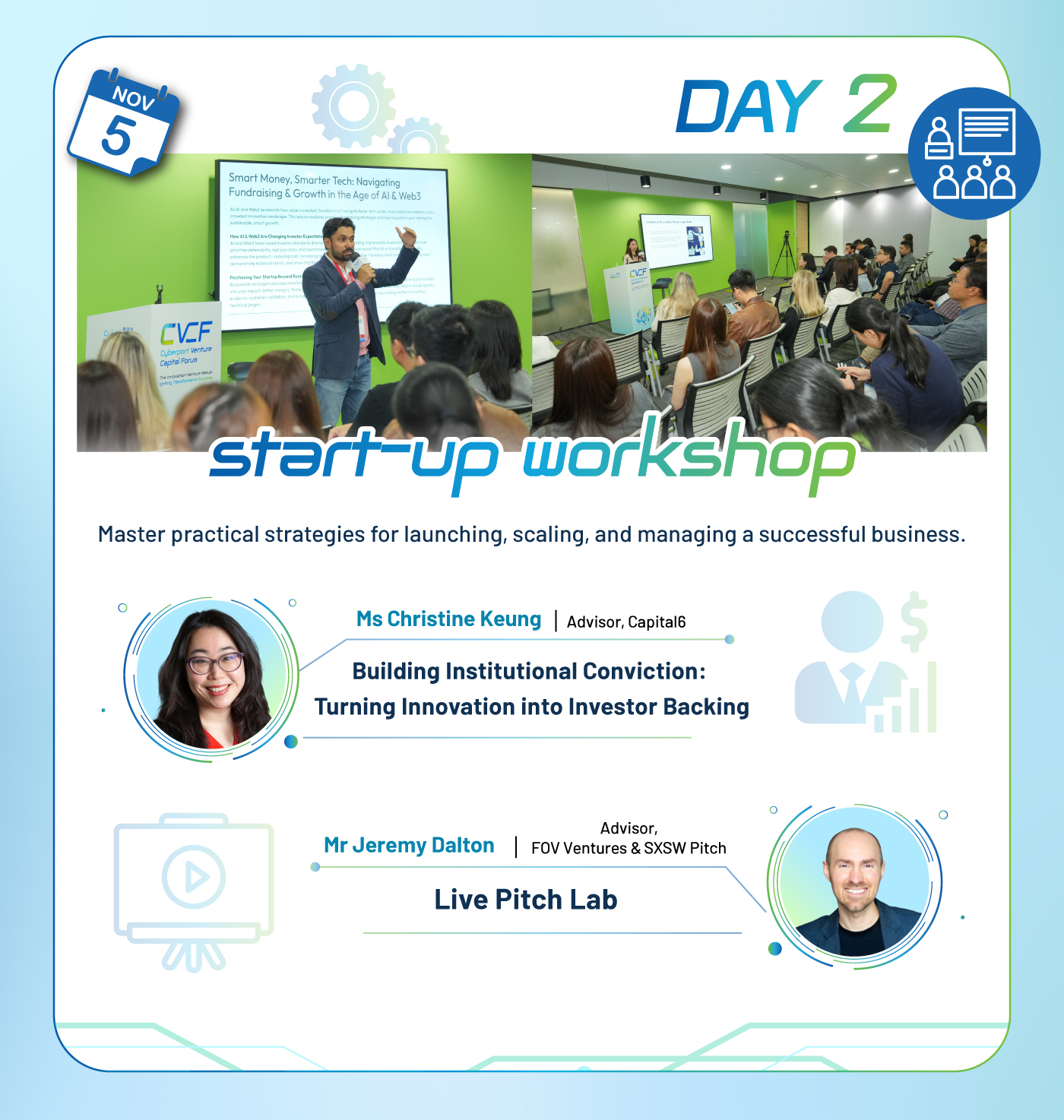
Led by Capital6 advisor Christine Keung, one workshop will explore how founders can align technical innovation with business goals, communicate their product’s value and prepare for fundraising. Another, led by Jeremy Dalton, advisor at FOV Ventures and SXSW Pitch, will help founders understand how investors assess startups, with opportunities to pitch live and receive direct feedback.

CVCF 2026’s spotlight event, the Agentic Economy Summit, will take place on 5 November under the theme “Intelligent Frontiers, Tokenised Horizons: Where Agentic AI Reshapes Business and Digital Assets Redefine How Value Moves.”
The summit will bring together technology and finance leaders to explore how agentic AI and digital assets could change the way businesses operate. Wolf Ruzicka, chief commercial officer at Unlimit, a global payments company, will discuss building and scaling agentic AI applications. Dr Feng Xiao, chairman and CEO of HashKey Group, will examine how digital identity, tokenised assets and money connect on-chain.
The discussions will also look at agent-led commerce, including how AI agents could help customers choose products and make purchases, and the payment systems needed to support these transactions. Other topics include Hong Kong dollar stablecoins and their potential role in payments and settlement, as well as the rise of one-person companies. The summit will also explore how founders can use AI agents to run their businesses with smaller teams, find customers and generate recurring revenue.
From AI-driven growth and cross-border investment to agentic AI and digital assets, CVCF 2026 brings together the people and ideas shaping the next phase of business. Whether you're preparing to raise capital, exploring new markets or assessing emerging technologies, the forum offers an opportunity to gain fresh perspectives and connect with investors, founders and industry leaders.
Exclusive for Ventureport readers: Use the promotional code cvcf26vp to access a Full Access Pass for HK$300, subject to confirmation of the offer by the organiser.
Date: 4–5 November 2026
Function Rooms, Level 3, Core E, Cyberport 3, Hong Kong
Keep Reading
Can innovation truly deliver affordable housing to those who need it most?
Updated
January 8, 2026 6:35 PM

Close up of a 3D printer nozzle pouring concrete. PHOTO: ICON
The affordable housing crisis has become one of the most pressing challenges of our time. Across the globe, millions of people are struggling to secure a roof over their heads. In cities like San Francisco, housing prices are so high that even middle-income families find themselves shut out of the market.
The root of this crisis lies in a persistent imbalance: the supply of housing has failed to keep pace with growing demand. Factors such as high construction costs, bureaucratic hurdles, and limited available land in urban areas have made it increasingly difficult to build enough homes quickly and affordably. The result is a market where housing remains inaccessible to millions, even as the need becomes more urgent.
Technology is now stepping in to address these challenges in ways that were unimaginable just a decade ago. From streamlining construction processes to introducing new financing models and data-driven tools, tech innovations are rethinking how homes are built, financed, and accessed. But while these advancements offer hope, they also raise important questions: can they truly address the root causes of the housing crisis, or are they simply patching up a fractured system?
The housing crisis begins with supply shortage: we simply aren’t building enough homes. Traditional construction methods are expensive, slow, and reliant on labor that is increasingly hard to find. This is where technology is making its most significant impact. Startups likeICON and Veev are leading the charge, using cutting-edge solutions to make housing more efficient and affordable.
ICON, for instance, uses 3D printing to build homes faster and at a lower cost. By printing the structure of a house directly on-site, ICON reduces waste, labor requirements, and construction time. Entire neighborhoods of 3D-printed homes are already being built, showcasing how this technology can scale.
Veev, on the other hand, focuses on prefabricated construction. By manufacturing high-quality components like walls and steel frames in a controlled factory environment, Veev eliminates inefficiencies associated with on-site building. These components are then assembled on location, drastically reducing construction time and costs. This approach mirrors the principles of mass production seen in industries like automotive manufacturing, where efficiency and scalability are key.
While building more homes is essential, access to housing often depend son financing. For many people, especially those with low or irregular incomes, the traditional mortgage system presents insurmountable barriers. Fintech innovations are stepping in to make housing financing more inclusive and flexible.
Access to affordable housing often hinges on financing, and innovative financial technology (fintech) solutions are beginning to change the landscape. Some platforms are offering new ways for individuals to transition from renting to owning, while others are introducing shared equity models that reduce the traditional barriers of large down payments and strict credit requirements. For example, companies like Point use shared-equity financing, where homeowners receive funds in exchange for a percentage of their home’s future value instead of taking on traditional debt. Meanwhile, startups are building tools that automate and simplify and revolutionizing the mortgage process, making it easier for underserved populations to access loans tailored to their needs.
Blockchain technology is also changing the game. By digitizing land titles and creating secure records of financial transactions, blockchain reduces the complexity and difficulty of accessing credit, especially for those with limited traditional credit. This is particularly impactful in regions where informal economies dominate and traditional proof of income is scarce. These tools create a pathway to homeownership for individuals who would otherwise be excluded from the system.
Beyond building and financing, technology is transforming how we understand and address housing needs. Artificial intelligence (AI) is revolutionizing risk assessment in the mortgage industry by analyzing a broader range of financial behaviors, such as rent and utility payments, to provide a more inclusive picture of creditworthiness.
At the same time, AI and big data are helping policymakers and developers make smarter decisions about where and how to build. By analyzing population trends, commuting patterns, and infrastructure needs, these tools ensure that new housing developments are built in the right places, reducing wasteful construction and improving urban planning.
For example, startups are using 3D scanning and machine learning to map informal settlements and identify buildings at risk of collapse. These insights not only improve safety but also guide investment toward areas where housing is most desperately needed.
The housing crisis is one of the most complex challenges of our time, and technology alone cannot solve it. But it can provide powerful tools to address specific pain points, from streamlining construction to expanding access to financing. Startups like ICON, Veev, and Landis are proving that innovation can lower costs, improve efficiency, and make housing more inclusive.
However, the ultimate solution lies in a combination of technology, policy reform, and community engagement. Governments must work alongside tech innovators to create urban environments that prioritize affordability, sustainability, and accessibility.
The future of housing isn’t just about building more homes; it’s about building smarter, greener, and fairer cities where everyone has a place to call home. By integrating cutting-edge technologies with forward-thinking policies, we can move closer to a world where affordable housing is not an aspiration but a reality.
The question is no longer whether technology can solve the housing crisis—it’s how we will use it wisely to create lasting change.