
As industrial drone adoption grows, startups are finding bigger opportunities in infrastructure, inspections and field operations.
Updated
August 10, 2026 5:56 PM

An oil pump on a field. PHOTO: UNSPLASH
As drone adoption grows across industrial sectors, more startups are moving beyond hardware sales and into service-based business models. Instead of simply selling drones, companies are increasingly trying to build recurring revenue through inspection, mapping and infrastructure-monitoring services. That shift is shaping ZenaTech’s latest expansion strategy.
ZenaTech is a Vancouver-based startup that develops AI drone and Drone as a Service (DaaS) technologies. The company has signed an offer to acquire an Alberta-based land surveying and geomatics business operating across Western Canada. If completed, the deal would mark ZenaTech’s first land surveying acquisition in Canada and its first major push into the oil and gas sector.
The move gives the startup something more valuable than just another acquisition target. It provides direct access to an industry where drones are already becoming part of everyday operations.
The Alberta surveying company works with oil and gas producers across Alberta, Eastern British Columbia and Saskatchewan. Its services include land surveying, geomatics, mapping and environmental support for infrastructure and energy development projects.
According to ZenaTech, drones are already used in roughly 80 percent of the target company’s existing projects. That matters because it reduces the operational gap between traditional surveying work and AI-powered automation.
Rather than introducing drones into a completely manual workflow, ZenaTech is entering a business where drone-based data collection is already established. The startup says it plans to build on that foundation by integrating more AI-powered capabilities across surveying, mapping, inspections and infrastructure monitoring.
Shaun Passley, Ph.D., CEO of ZenaTech, said: "This proposed acquisition represents an important strategic expansion of our Drone as a Service business into Canada’s oil and gas sector, one of the most significant energy markets in North America. This company brings an established commercial customer base, strong regional expertise, and extensive experience supporting surveying and geomatics projects including for some large producers. We believe there is a significant opportunity to further enhance these services through AI-powered drone technology for surveying, mapping, inspections, and infrastructure monitoring applications, enabling us to establish a core expertise that we can bring to this fast-growing global industry."
The timing is also significant. ZenaTech pointed to estimates showing the global oil and gas drone inspection services market is currently valued at around US$ 2.3 billion and projected to grow at a compound annual growth rate of roughly 28.5 percent.
Much of that growth is being driven by energy companies looking for faster ways to inspect infrastructure, monitor remote sites and reduce manual field operations.
ZenaTech’s broader strategy centers around building a global DaaS network through acquisitions. Instead of creating local operations from scratch, the startup is acquiring existing service businesses with established customers and then layering drone automation and AI systems into those operations.
The company says its DaaS platform offers businesses and government clients subscription-based or on-demand drone services across areas such as inspections, surveying, maintenance, inventory management and precision agriculture.
The larger opportunity for startups in this space may not be drone manufacturing alone. Increasingly, the focus is shifting toward startups that can build scalable drone service networks and integrate them into industries that already rely on large-scale field operations. Oil and gas appear to be one of the next major targets for that expansion.
Keep Reading
How a Korean biotech startup is using AI to move drug discovery from trial-and-error to precision design
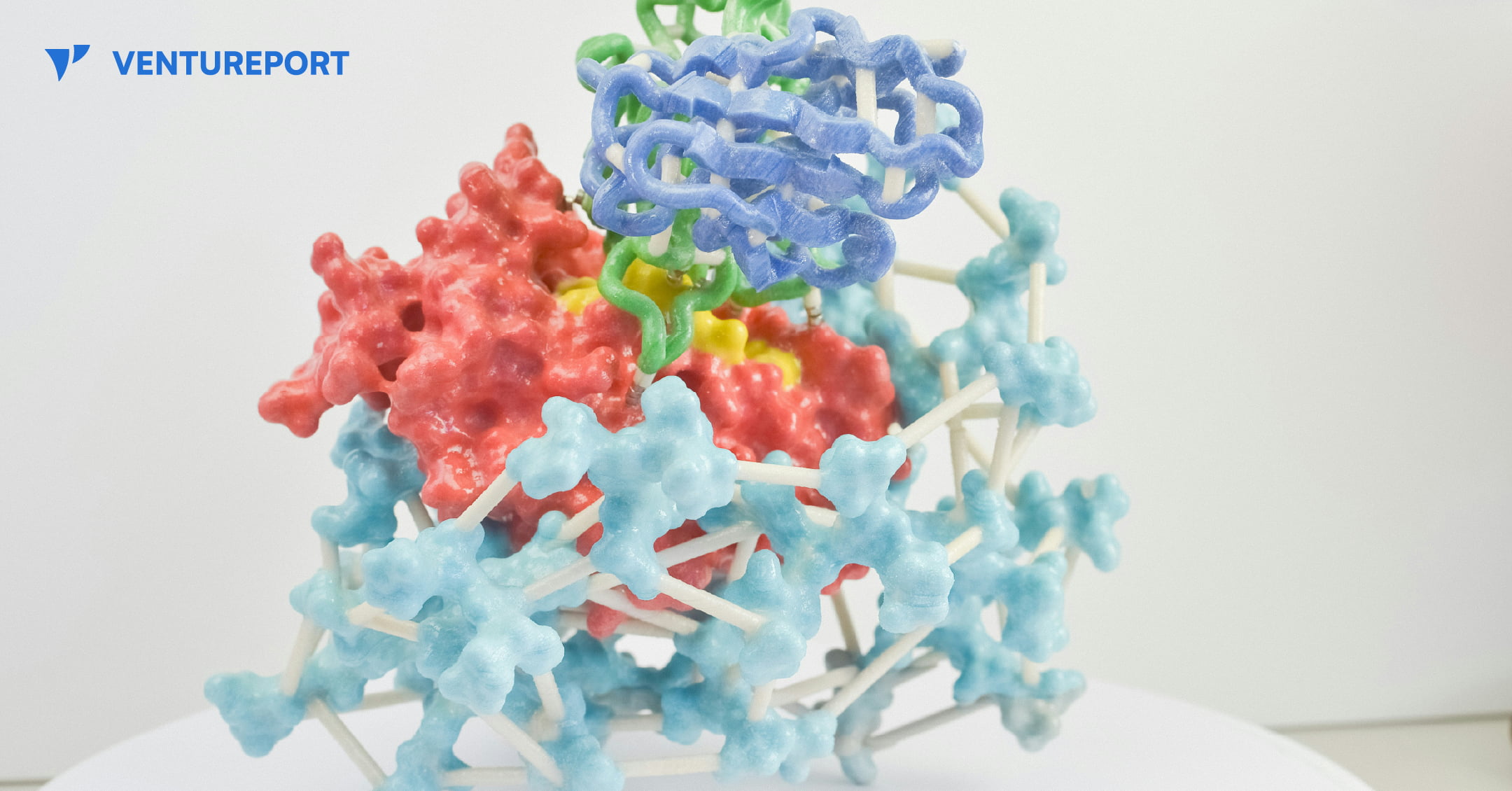
A close up of a protein structure model. PHOTO: UNSPLASH
For decades, drug discovery has relied on trial and error, with scientists testing thousands of molecules to find one that works. Galux, a South Korean biotech startup, is changing that by using AI to design proteins from scratch. This method, called “de novo” design, makes it possible to build precise new therapies instead of searching through existing ones.
The company recently announced a US$29 million Series B funding round, bringing its total capital to US$47 million.This significant investment attracted a substantial roster of institutional backers, including the Korea Development Bank (KDB), Yuanta Investment, SL Investment and NCORE Ventures. These firms joined existing investors such as InterVest, DAYLI Partners and PATHWAY Investment, as well as new participants including SneakPeek Investments, Korea Investment & Securities and Mirae Asset Securities.
At the core of the company’s work is a platform called GaluxDesign. Unlike many AI tools that only predict how existing proteins fold, this system uses deep learning and physics to create entirely new therapeutic antibodies. This “from scratch” approach lets the team go after so-called “undruggable” proteins. These are targets that traditional small-molecule drugs can’t reach because they lack clear binding pockets. By designing proteins to fit these complex shapes, Galux aims to unlock treatments that have stayed out of reach for decades. And that’s exactly why investors are paying attention.
The pharmaceutical industry is actively looking for faster and more efficient ways to develop new drugs, and Galux is built for exactly that. The company connects its AI platform directly to its own wet lab, where designs can be tested in real time. Each result feeds straight back into the system, sharpening the next round of models. This continuous loop speeds up discovery and improves precision at every step. It’s also why partners like Celltrion, LG Chem and Boehringer Ingelheim are already working with Galux.
Galux is no longer just trying to make drugs that stick to a target. The company now wants its AI to design medicines that actually work in the body and can be made at scale. In simple terms, a drug has to do more than bind to a disease—it must be stable, safe and strong enough to change how the illness behaves. Galux is moving into tougher targets such as ion channels and GPCRs. These play key roles in heart function and sensory signals. Ultimately, the goal is to show that AI-driven design can turn complex biology into real treatments. And instead of hunting blindly for a solution, the team is building exactly what they need.