
As industrial drone adoption grows, startups are finding bigger opportunities in infrastructure, inspections and field operations.
Updated
August 10, 2026 5:56 PM

An oil pump on a field. PHOTO: UNSPLASH
As drone adoption grows across industrial sectors, more startups are moving beyond hardware sales and into service-based business models. Instead of simply selling drones, companies are increasingly trying to build recurring revenue through inspection, mapping and infrastructure-monitoring services. That shift is shaping ZenaTech’s latest expansion strategy.
ZenaTech is a Vancouver-based startup that develops AI drone and Drone as a Service (DaaS) technologies. The company has signed an offer to acquire an Alberta-based land surveying and geomatics business operating across Western Canada. If completed, the deal would mark ZenaTech’s first land surveying acquisition in Canada and its first major push into the oil and gas sector.
The move gives the startup something more valuable than just another acquisition target. It provides direct access to an industry where drones are already becoming part of everyday operations.
The Alberta surveying company works with oil and gas producers across Alberta, Eastern British Columbia and Saskatchewan. Its services include land surveying, geomatics, mapping and environmental support for infrastructure and energy development projects.
According to ZenaTech, drones are already used in roughly 80 percent of the target company’s existing projects. That matters because it reduces the operational gap between traditional surveying work and AI-powered automation.
Rather than introducing drones into a completely manual workflow, ZenaTech is entering a business where drone-based data collection is already established. The startup says it plans to build on that foundation by integrating more AI-powered capabilities across surveying, mapping, inspections and infrastructure monitoring.
Shaun Passley, Ph.D., CEO of ZenaTech, said: "This proposed acquisition represents an important strategic expansion of our Drone as a Service business into Canada’s oil and gas sector, one of the most significant energy markets in North America. This company brings an established commercial customer base, strong regional expertise, and extensive experience supporting surveying and geomatics projects including for some large producers. We believe there is a significant opportunity to further enhance these services through AI-powered drone technology for surveying, mapping, inspections, and infrastructure monitoring applications, enabling us to establish a core expertise that we can bring to this fast-growing global industry."
The timing is also significant. ZenaTech pointed to estimates showing the global oil and gas drone inspection services market is currently valued at around US$ 2.3 billion and projected to grow at a compound annual growth rate of roughly 28.5 percent.
Much of that growth is being driven by energy companies looking for faster ways to inspect infrastructure, monitor remote sites and reduce manual field operations.
ZenaTech’s broader strategy centers around building a global DaaS network through acquisitions. Instead of creating local operations from scratch, the startup is acquiring existing service businesses with established customers and then layering drone automation and AI systems into those operations.
The company says its DaaS platform offers businesses and government clients subscription-based or on-demand drone services across areas such as inspections, surveying, maintenance, inventory management and precision agriculture.
The larger opportunity for startups in this space may not be drone manufacturing alone. Increasingly, the focus is shifting toward startups that can build scalable drone service networks and integrate them into industries that already rely on large-scale field operations. Oil and gas appear to be one of the next major targets for that expansion.
Keep Reading
A humanoid robot being escorted away by police in Macau has gone viral online, prompting jokes about what some called the world’s first “robot arrest.”
Updated
April 1, 2026 8:55 AM
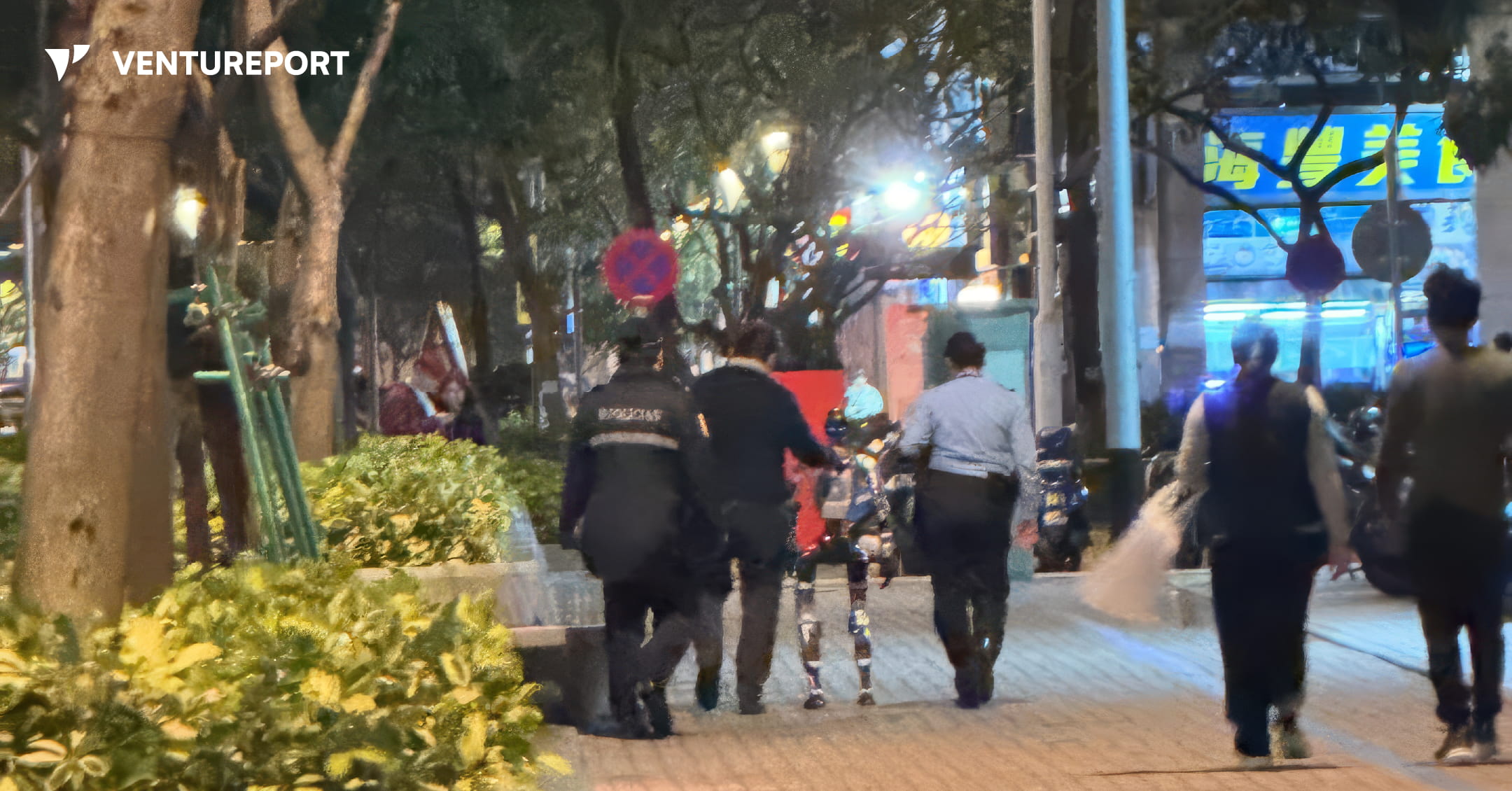
Macau police officer accompanying the humanoid robot. PHOTO: THREADS@BOXOF_CHOCOLATE
Police in Macau recently detained a humanoid robot after it frightened an elderly woman on a public street. The unusual encounter quickly spread online, prompting jokes about what some called the world’s first “robot arrest”.
On the evening of March 5, the robot was taken away by officers after the encounter triggered alarm among bystanders. Videos circulating on social media show an elderly woman confronting the robot on a sidewalk, visibly distressed and shouting that her “heart is pounding” while demanding to know why such “nonsense” was happening on the street. In the clip, the robot raises both hands toward the woman after she lashes out in fear — a gesture many viewers interpreted as a sign of apology.
Shortly afterwards, two officers from the Macau Public Security Police Force were seen escorting the robot and a man believed to be its operator away from the area. An officer is seen placing his right hand on the robot’s shoulder — the same posture police often use when presenting arrested suspects in official photographs.
That scene quickly spread online, fuelling jokes about what some called the world’s first “robot arrest”.
Photos shared online show a humanoid robot with long limbs and exposed mechanical joints, built from a black metallic frame without an outer shell. In dim lighting, several commenters said it resembled a “moving skeleton” — a striking sight for pedestrians encountering it unexpectedly on the street.
Witnesses said the woman appeared severely shaken and an ambulance was eventually called to take her to the hospital.
The incident also sparked discussion online about robots operating in public spaces. Some commenters argued that experimental technologies should be tested in controlled environments, while others said machines moving through public areas should have clearer designs or safety measures to avoid alarming pedestrians.
It remains unclear who deployed the robot or what purpose it was serving in the area at the time of the incident. Authorities have not released further details about the device or whether any action was taken following the encounter.