
Six technology companies showcased solutions for financial research, wealth management, consumer insight and security to investors and institutions.
Updated
November 14, 2026 11:54 PM

Arnold Lau and King Leung (back row, fourth and fifth from left), Associate Directors-General of Investment Promotion at InvestHK, join the Ventureport team and representatives from the six technology companies. PHOTO: VENTUREPORT
Ventureport hosted the soft launch of InvestHK’s Fast-Track Connect at its AI+ Tech+ Finance+ gathering on 30 October, bringing more than 100 guests to Pier 1929 in Wan Chai.
Sponsored by InvestHK, the event brought investors, institutional representatives and technology companies together to explore investment and business partnerships. Six companies took the stage to showcase software solutions for financial professionals, consumer research, local AI computing and digital asset security.

The Acting Head of Startups, at InvestHK, Chin-yung (CY), and the Senior Vice President (Fintech), Pauline Fan, introduced Fast-Track Connect. They explained how the agency’s international network connects it with technology companies seeking investment, customers and business opportunities in Hong Kong.

Their remarks also highlight the need for a more structured approach to build these connections. Investors need easier ways to identify companies that match their interests, while institutions seeking new technology need access to businesses whose products could support their operations or benefit their customers.
To address this need, Fast-Track Connect provides an online platform where technology companies can publish profiles outlining their products and funding needs. Investors and corporate participants can identify relevant businesses and contact them to explore potential investments or collaborations. Service providers and community partners are also part of the platform. Alongside investors and corporate participants, these groups are designated as Champions on the platform.
Curated by InvestHK and supported by the Financial Services and the Treasury Bureau, Fast-Track Connect builds on the Global Fast Track Programme. It aims to help local enterprises expand into Chinese Mainland, Southeast Asia and other markets.

AlphaPai, an AI-powered investment research platform developed by financial technology company RabyteTech, presented tools for financial research, including gathering data, monitoring financial instruments and comparing information from corporate earnings calls.

At the event, the team explained how users can give research instructions in everyday language, while the software retrieves and processes information to prepare reports and presentation materials. Examples included tracking market developments and comparing company statements over time. The team also emphasised the importance of traceable sources, allowing analysts to verify the information behind their research.
A2B2.AI, a fintech startup, presented AI- powered tools designed to support investors and wealth advisers. Its specialist AI agents—software designed to carry out particular tasks—help prepare client meeting briefings, monitor financial products approaching maturity and identify market developments relevant to individual clients, according to the team.

For investors, the tool can help make sense of lengthy documents provided by advisers and bring information from different accounts together to assess risk exposure. For wealth professionals, the tools support preparation and follow-up around client meetings.
The team described its approach as combining AI with human expertise to support financial decision- making. It also clarified that the platform does not execute investment transactions on behalf of clients, leaving those decisions and actions in their hands.
Preferences AI, an AI startup specialising in synthetic consumer research, presented simulated consumer profiles that businesses can use to explore how different audiences might respond to products, pricing and marketing messages. These profiles generate modelled responses rather than feedback from people directly interviewed or surveyed.

The company described that its profiles are grounded in population data and account for differences between local audiences Businesses can use them to explore pricing or packaging options, as well as ask follow-up questions to understand the reasons behind a particular response. The team also discussed testing its models and working with academics to help validate the approach. It said the technology could help businesses explore consumer preferences more quickly.
ByteFuture, an AI infrastructure startup, focused on running AI on users’ own hardware. It introduced Olares, its operating system, and Olares One, a device designed to run AI models and applications locally.

Its applications included personal assistance, financial research and content creation. The team argued that users handling private documents or proprietary trading strategies may prefer to retain that material on equipment they control.
A demonstration of AI-generated video illustrated creative work the team said could run locally. It also described applications and agents available through its software marketplace.
PureGlobal, a fintech company, addressed digital asset custody: the systems used to safeguard access to digital assets. Its team described technology for protecting access credentials and supporting offline transactions without a conventional internet connection.

The presentation focused on infrastructure for institutions holding and transferring digital assets, including security under different operating conditions.
SlowMist, a blockchain security firm, examined the risks of giving AI agents permission to read information and perform tasks. Its examples included malicious instructions concealed in material an agent might encounter and attacks exploiting access granted to software.

The team discussed security auditing, monitoring and investigations alongside risks arising from third-party tools and an agent’s stored information. One scenario involved exposing a wallet’s recovery phrase, which can give someone control over its assets.
Keep Reading
An interview with Tengin founder Madhu on turning coconuts into a business built around farmers, villages and communities.
Updated
August 10, 2026 5:56 PM

Workers of Tengin. PHOTO: TENGIN
In Southern India, coconuts are part of daily life. They are used in food, rituals, farming and home remedies. For Tengin, a social startup whose name means “coconut” in Kannada—a South Indian language—the crop also offers a way to build a rural business with deeper local impact.
Founded by Madhu Kargunda in 2017, Tengin works with farmers, artisans and women’s collectives in Karnataka to make products from almost every part of the coconut. Its range includes virgin coconut oil, desiccated coconut powder, shell-based handicrafts, candles, home décor items and other coconut-based goods.
The larger idea is simple. Farmers should play a bigger role in the value created from the crops they grow. Tengin is trying to help rural communities move beyond supplying raw produce and take part in processing, branding, packaging and sales.
Madhu grew up in an agricultural family. Over the years, he saw many young people move away from farming to look for stable jobs in cities. To him, the problem was not farming itself. The bigger issue was that farmers often missed out on the value created after crops left the farm.
A coconut might be grown in a village, but much of the income comes later through processing, branding and retail. That gap stayed with him, eventually leading him to leave his eight-year career in IT and return to agriculture full-time.
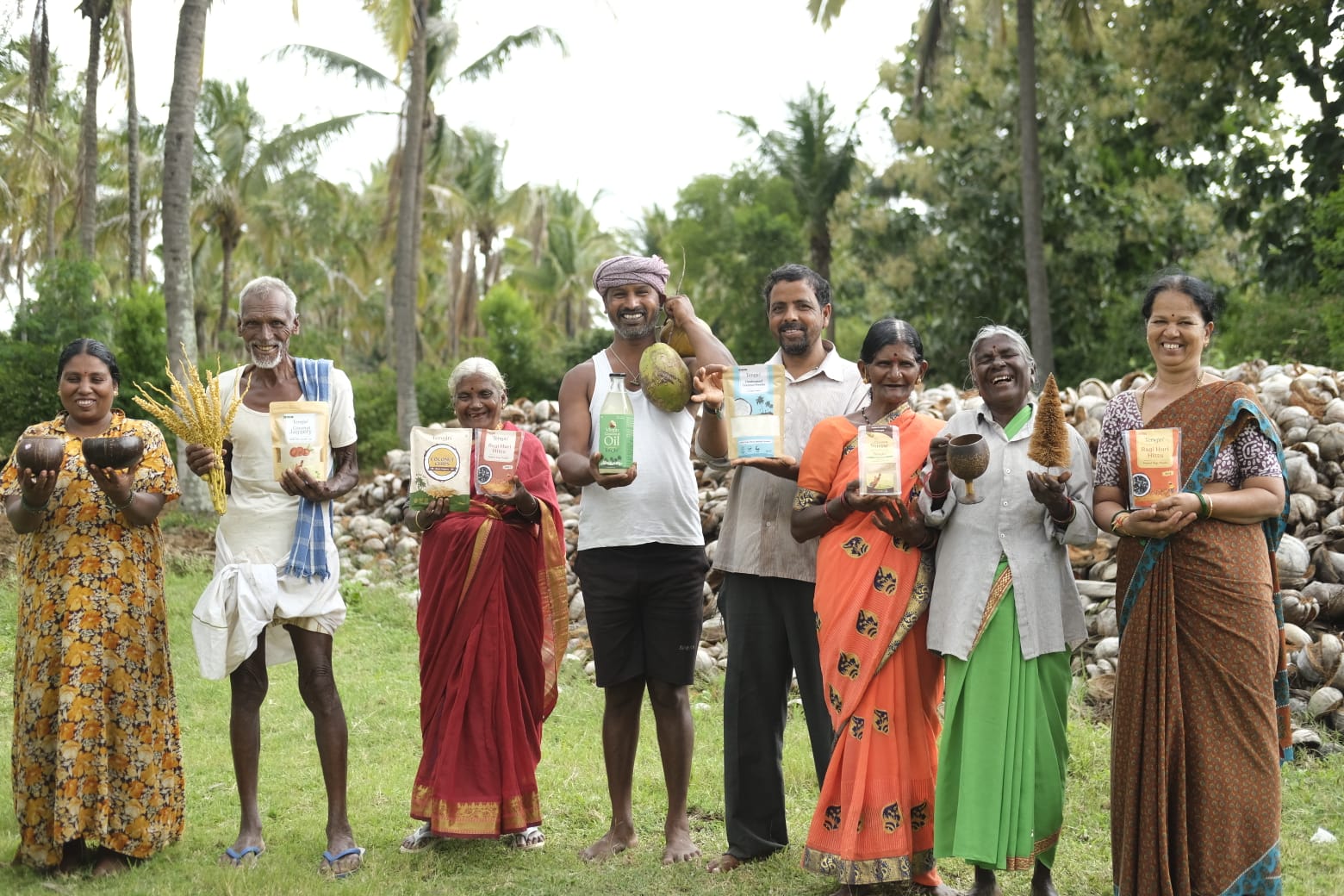
Started with just making virgin coconut oil, Tengin has grown into a wider coconut products business. The startup is now working with around 15 to 20 farmers and artisan groups across Karnataka. It is also building production capacity for larger retail and B2B partnerships.
Today, Tengin generates annual revenue of roughly ₹50-60 lakh, or around US$52,000 to US$62,000. It has also started testing international demand, including a recent export of around 200 kilograms of desiccated coconut powder to Texas.
As Tengin expanded, the team began looking more closely at parts of the coconut that were usually treated as waste or low-value byproducts, such as coconut shells and coir. At first, Tengin treated them that way too.
“When we started, we used to burn some of the shells”, Madhu said. “Later, we realized it was an economic opportunity”.
That changed the company’s product strategy. Local artisans working with Tengin now are turning coconut shells into bowls, incense holders, candles, coffee mugs, mobile stands and handcrafted décor items.
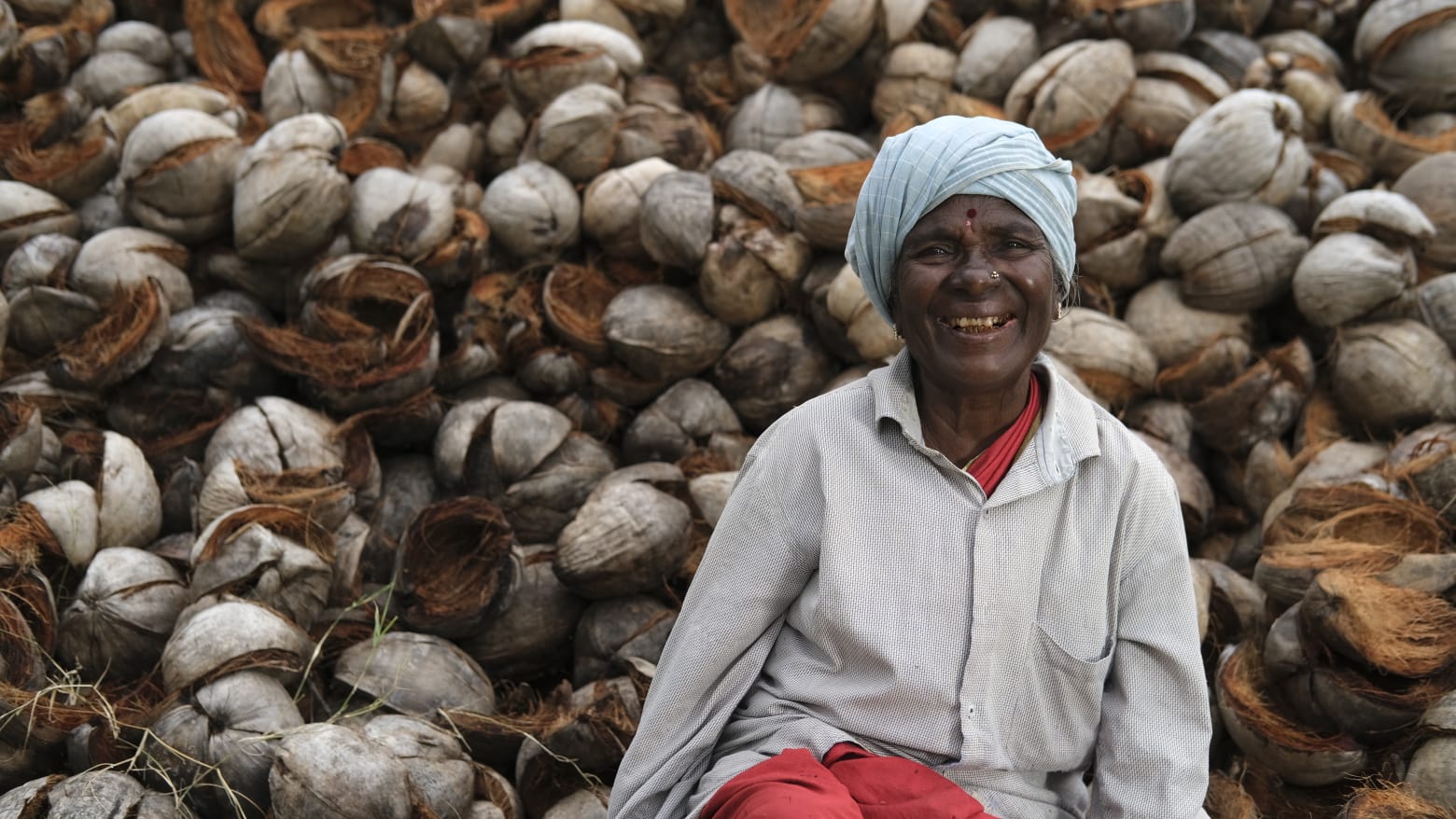
This gives Tengin a place in the circular economy, where waste materials are reused instead of thrown away. For Madhu, though, sustainability has to do more than reduce waste. It should also create income in the community.
“We wanted to minimize waste and maximize wealth locally”, he said.
Tengin does not depend only on one central factory. Instead, it works with smaller village-level production groups that connect to a larger business network. This helps farmers stay close to their land while also taking part in processing and manufacturing. It also creates local jobs, which can reduce the pressure to migrate to cities.
Yet, the model is not always easy. In the early days, Tengin had to convince some farmers to move from chemical farming to natural farming. Moreover, the weather has also become harder to predict. Irregular rainfall and changing harvest cycles can affect coconut prices and production consistency.
Still, Madhu sees the village-based model as central to Tengin’s identity. For him, villages are living systems built on shared work, local knowledge and interdependence.
“The definition of a village is inclusiveness”, he said.
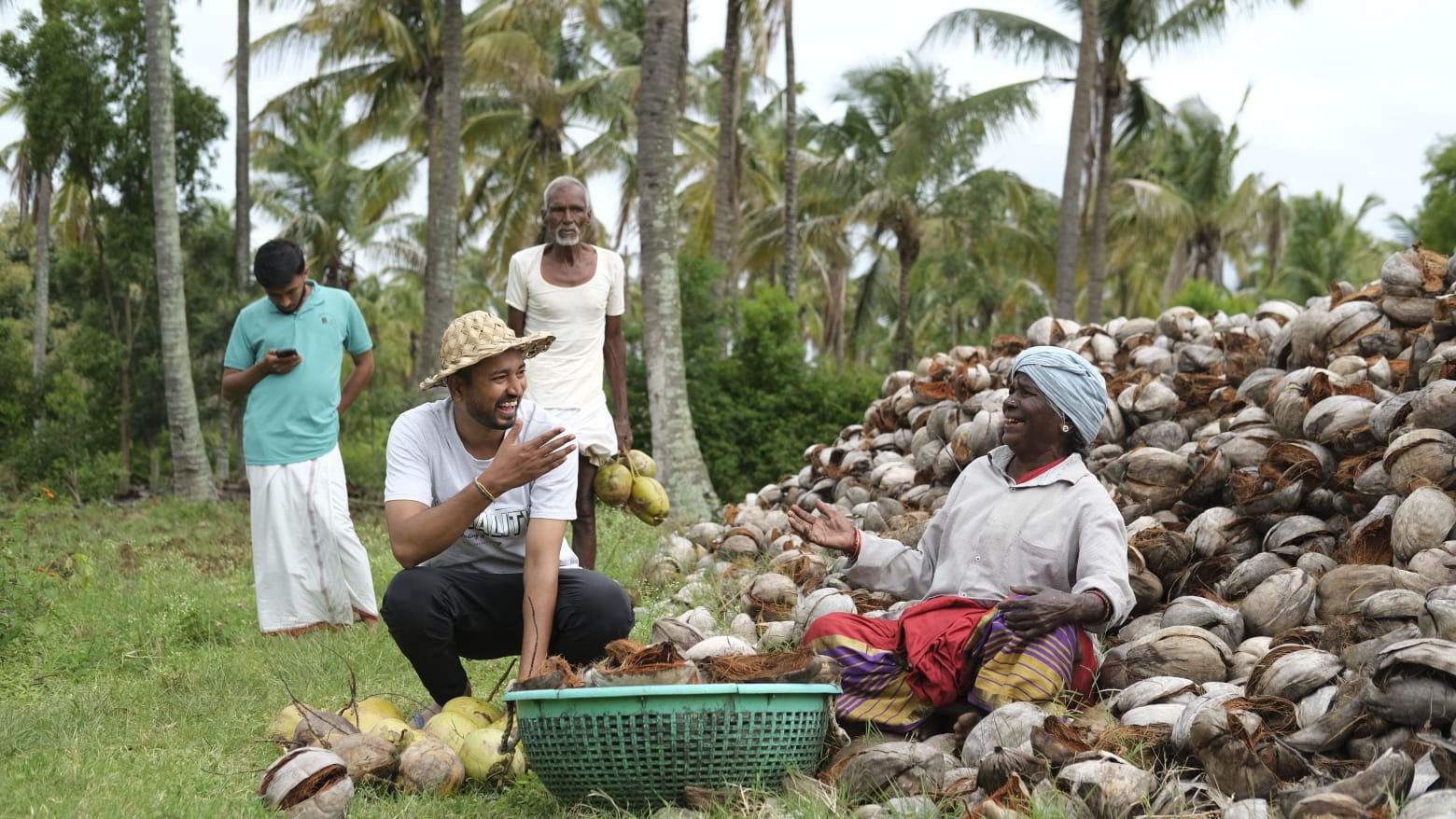
That belief also shaped Tengin’s “coco tourism” initiative. Through the program, visitors meet farmers, learn about farming practices and see how coconut products are made.
During one visit by MBA students from Indiana State University, an unexpected spell of rain gave the group a closer look at village life. Farmers gathered and began singing traditional folk songs to express gratitude to nature. For the students, it became a lesson in culture as much as business.
Madhu sees these moments as part of what rural entrepreneurship can protect.
“If villages become empty, we lose language, traditions and local knowledge too”, he said.
Tengin’s model is not difficult to copy on paper. Madhu is open about that.
“Anyone can do it”, he said, “but what matters is how you work with people”.
For him, the harder part is building long-term trust with farming communities. Tengin works through relationships more than rigid contracts. This encourages farmers and local groups to participate in the system in a more collaborative way.
That trust has become one of the startup’s strongest assets. It shapes how Tengin works with producers and how it presents its products to customers.
For Madhu, it is not enough to call a product sustainable. Customers should be able to understand where it came from, who made it and how their purchase supports the people behind it.
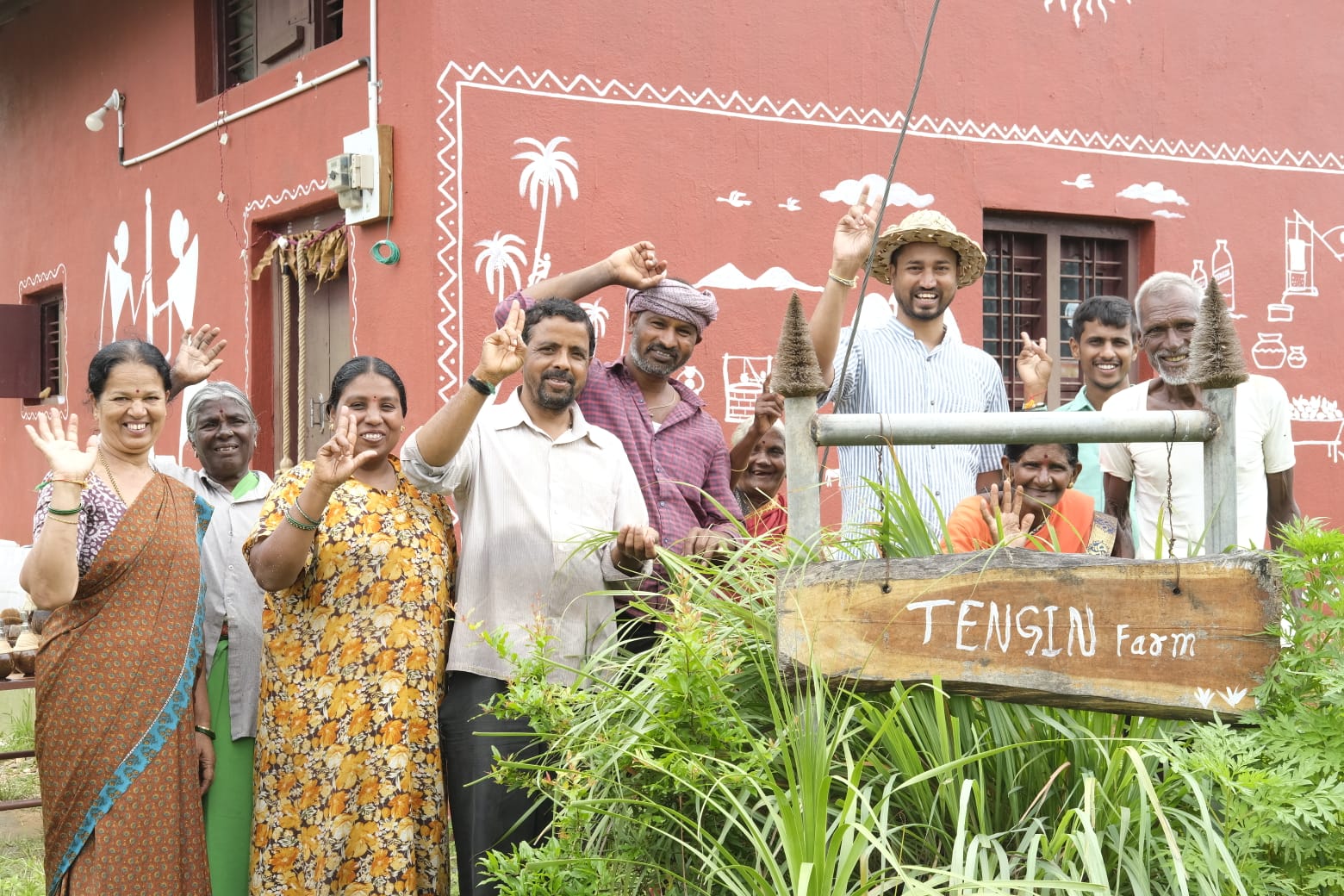
That matters even more in a market where terms like “eco-friendly” and “organic” have become buzzwords. Madhu knows that these words can feel empty when brands do not show what they actually mean.
“Anyone can use these words today,” he said. “What matters is whether consumers can actually see what you are doing”.
This is why Tengin focuses on transparency and storytelling. The startup wants customers to see the full journey of each coconut product, from the farm to the finished item. It also wants them to understand whose livelihood is connected to that journey.
Madhu also believes small brands cannot depend on products alone. Products can be copied, but a clear story, a trusted community and a visible impact are harder to replicate.
“Don’t try to sell only the product,” he said. “When you try to sell the product, you are being sold once”.
Each Tengin product includes details about the people behind it and how profits are shared. In that way, the company connects its coconut products to the farmers, artisans and village systems that make them possible.
For Madhu, entrepreneurship starts with the problem. Founders, he believes, should understand the problem deeply before thinking about scale and revenue.
“An entrepreneur is someone trying to solve an existing problem”, he said. “Sometimes it may be a small problem, sometimes a niche one. It could be in technology, energy, farming or any other sector—but first understand what problem you are trying to solve”.
Farming has also taught him patience. He gives the example of coffee.
“When you plant coffee, you know it may take five years before you see results”, he said, “but you still [have to] water it every day”.
He sees entrepreneurship the same way. Building systems, communities and trust takes time. Growth may be slow at first, but daily work matters.
Adaptability is another lesson he returns to often. Farming conditions change constantly, and so do markets. In both cases, people have to keep learning, unlearning and adjusting.
“Entrepreneurship is about constantly learning new things because the world is changing all the time”, he said. “You need to stay relevant, understand what connects with [your customers] and adapt accordingly”.
Looking ahead, Tengin plans to grow its farmer network, strengthen production capacity and expand its export business. Madhu is also looking to collaborate with more platforms, storytellers and communities that can help amplify the voices behind the products.
The startup is also involved in rural community initiatives, including support for government schools and menstrual health awareness programs.
For Madhu, giving back is part of how he defines success. With more resources, he would invest further in farmer education, village-level production systems and community development.
By building a business around coconuts, Tengin is also making a larger case for rural entrepreneurship. Its work shows that a modern consumer brand can grow without losing its connection to the farmers, traditions and village ecosystems that make that growth possible. For Madhu, that is the real measure of progress: creating value that stays rooted in the community.