
WIRobotics is betting that years of real-world movement data could shape the next generation of humanoid robots
Updated
August 10, 2026 5:56 PM

3D render of a person in various colours. PHOTO: UNSPLASH
Investor interest in humanoid robotics is continuing to grow as startups race to build systems capable of working alongside humans in real-world environments. That momentum was reflected after WIRobotics announced a KRW 95 billion (USD 68 million) Series B funding round to accelerate development of its humanoid robotics platform, ALLEX.
The Seoul-based startup said the funding comes roughly two years after its KRW 13 billion Series A round in 2024. JB Investment led the financing alongside investors including InterVest, Hana Ventures, Smilegate Investment, SBVA, NH Investment & Securities, Company K Partners, GU Investment and FuturePlay.
WIRobotics has spent the past several years building wearable robotics systems designed to assist human movement. The startup is now using that foundation to expand deeper into humanoid robotics and Physical AI, a category focused on AI systems that can interact with the physical world through movement, perception and manipulation.
Its humanoid platform, ALLEX, is being developed to support human-level object manipulation and interaction capabilities. The startup was recently selected for NVIDIA’s Physical AI Fellowship, a global robotics and AI development initiative aimed at supporting next-generation robotics research.
Rather than building humanoid systems entirely from scratch, WIRobotics is drawing on movement data collected through its wearable walking-assist robot, WIM. Over the past three years, the startup says it has built large real-world datasets around gait patterns, mobility and human movement control.
That wearable robotics business has also started showing commercial traction. WIM has sold more than 3,000 cumulative units and expanded into overseas markets including Europe, China, Türkiye and Japan. Revenue grew from KRW 560 million in 2023 to KRW 1.3 billion in 2024, then to KRW 2.79 billion in 2025. According to the startup, first-quarter 2026 revenue has already surpassed its full-year 2024 total.
The startup believes that real-world movement data collected through wearable robotics could become a competitive advantage as humanoid systems move closer to commercial deployment. WIRobotics is also expanding its global footprint alongside its robotics development efforts. The startup said it is establishing a North American entity in California while growing partnerships with overseas distributors and healthcare networks.
Its humanoid ambitions are moving into a more operational phase as well. Beginning later this year, WIRobotics plans to supply a research-focused version of its Mobile ALLEX platform to global research institutions and international partners for testing and collaborative development. The startup is also in discussions with a global automotive manufacturer around manufacturing-focused platform validation projects.
Yeonbaek Lee said: "This investment represents global recognition that the real-world movement data and control technologies accumulated through wearable robotics can evolve into next-generation humanoid robotics. We aim to accelerate the arrival of humanoid robots capable of interacting naturally with people".
Yongjae Kim added: "All investors from our previous Series A round participated again in this Series B financing, demonstrating strong confidence in WIRobotics' technological capabilities and growth potential amid intensifying global humanoid competition. Our mission is to realize humanoids capable of fundamentally human-like interaction and force control, driving a paradigm shift in high-performance manipulation technologies".
As competition intensifies across humanoid robotics, startups are increasingly trying to differentiate themselves through real-world deployment data rather than simulation alone. WIRobotics is positioning its wearable robotics business as the foundation for that transition, betting that years of human movement data could help shape the next generation of humanoid systems.
Keep Reading
A humanoid robot being escorted away by police in Macau has gone viral online, prompting jokes about what some called the world’s first “robot arrest.”
Updated
April 1, 2026 8:55 AM
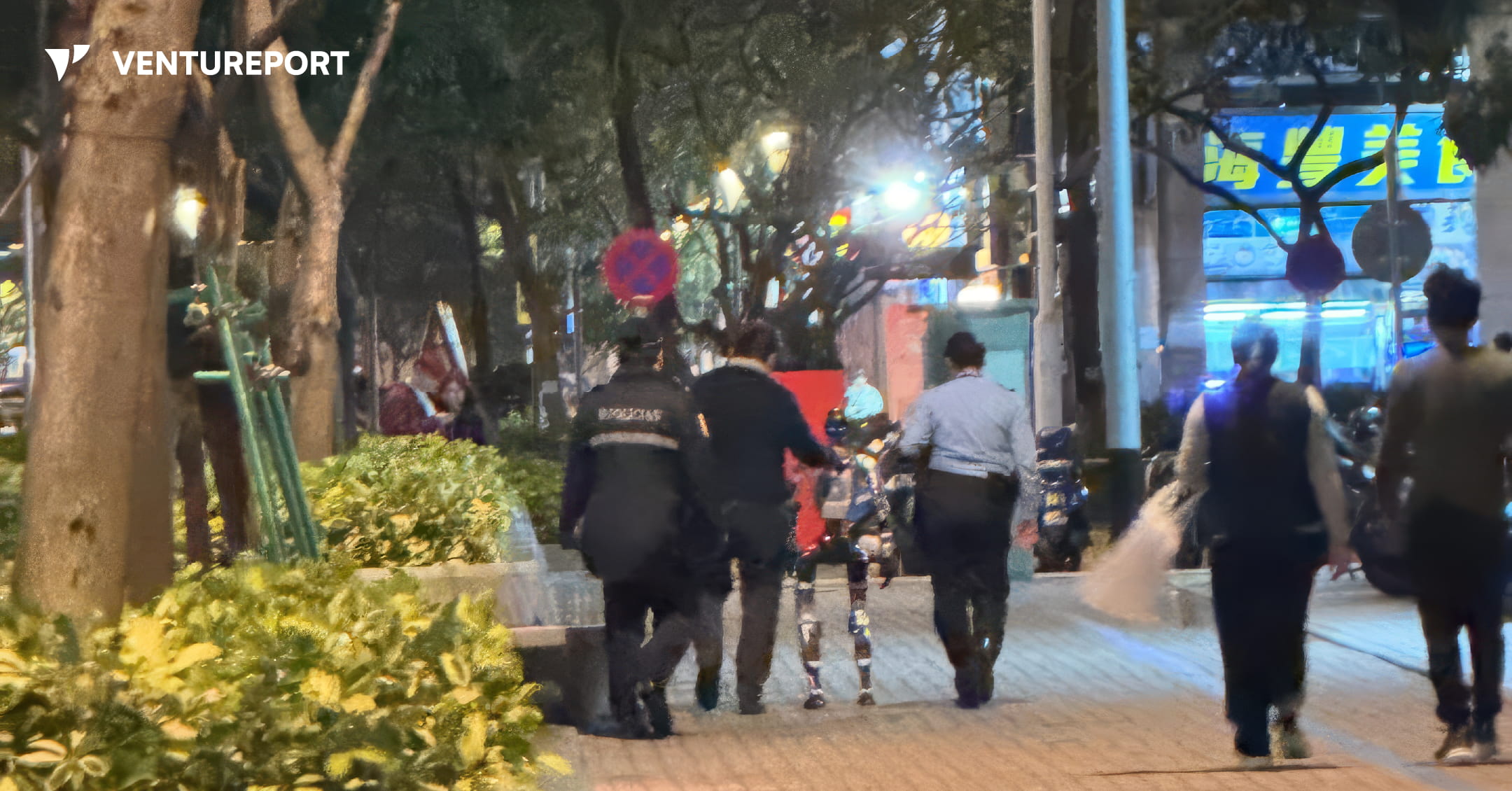
Macau police officer accompanying the humanoid robot. PHOTO: THREADS@BOXOF_CHOCOLATE
Police in Macau recently detained a humanoid robot after it frightened an elderly woman on a public street. The unusual encounter quickly spread online, prompting jokes about what some called the world’s first “robot arrest”.
On the evening of March 5, the robot was taken away by officers after the encounter triggered alarm among bystanders. Videos circulating on social media show an elderly woman confronting the robot on a sidewalk, visibly distressed and shouting that her “heart is pounding” while demanding to know why such “nonsense” was happening on the street. In the clip, the robot raises both hands toward the woman after she lashes out in fear — a gesture many viewers interpreted as a sign of apology.
Shortly afterwards, two officers from the Macau Public Security Police Force were seen escorting the robot and a man believed to be its operator away from the area. An officer is seen placing his right hand on the robot’s shoulder — the same posture police often use when presenting arrested suspects in official photographs.
That scene quickly spread online, fuelling jokes about what some called the world’s first “robot arrest”.
Photos shared online show a humanoid robot with long limbs and exposed mechanical joints, built from a black metallic frame without an outer shell. In dim lighting, several commenters said it resembled a “moving skeleton” — a striking sight for pedestrians encountering it unexpectedly on the street.
Witnesses said the woman appeared severely shaken and an ambulance was eventually called to take her to the hospital.
The incident also sparked discussion online about robots operating in public spaces. Some commenters argued that experimental technologies should be tested in controlled environments, while others said machines moving through public areas should have clearer designs or safety measures to avoid alarming pedestrians.
It remains unclear who deployed the robot or what purpose it was serving in the area at the time of the incident. Authorities have not released further details about the device or whether any action was taken following the encounter.