
The funding highlights how service robotics is shifting from niche deployments to scaled commercial use across global markets
Updated
May 14, 2026 3:02 PM

An autonomous service robot with a cat face design standing inside a McDonalds restaurant. PHOTO: ADOBE STOCK
Pudu Robotics, a Shenzhen-based startup building robots for commercial environments, has raised nearly US$150 million in a new funding round, pushing its valuation past US$1.5 billion. The raise brings the company’s total funding to more than US$300 million.
The company focuses on service robotics across sectors such as delivery, cleaning and industrial logistics. Its systems are used in places like retail stores, warehouses and public venues where routine tasks can be automated. Over time, Pudu has expanded from single-purpose machines to a broader portfolio that combines hardware with AI-driven navigation and coordination.
The funding is expected to support several areas of growth. These include further development of its AI systems, expansion of its product range and continued international rollout. The company also plans to invest in manufacturing and supply chain capacity, suggesting a focus on scaling production alongside demand.
Pudu’s recent growth provides some context for the raise. The company reported a doubling of revenue by 2025, with its cleaning robots now accounting for the majority of its business. Its industrial delivery robots have also seen early traction, with thousands of units deployed within a year of launch.
Its products are already in use with large global retailers including Carrefour, Walmart and EDEKA. Industry estimates place Pudu among the largest players in commercial service robotics, with a leading share of the global market.
Technically, the company develops much of its core stack in-house, including navigation systems, multi-robot coordination software and motion control. This allows its robots to operate in complex real-world environments where multiple machines need to move and work together.
“This financial milestone is a powerful confirmation of Pudu’s industry leadership, the strength of its products and technology, its global brand, and its commercial infrastructure. With the support of our strategic investors and industry partners, Pudu will continue to push the boundaries of embedded AI and business service robotics. We remain committed to innovating with an inventor’s spirit and leveraging a global vision to accelerate robot adoption, thereby elevating the industry to new heights in the global value chain”. said Felix Zhang, founder and CEO of Pudu Robotics.
The funding round points to a broader shift in the sector. As service robotics moves from pilot deployments to wider adoption, companies are increasingly being judged on their ability to scale production and operate across markets, not just on the novelty of their technology.
Keep Reading
Rethinking 3D modelling for a world that generates too much, too quickly.
Updated
January 8, 2026 6:32 PM
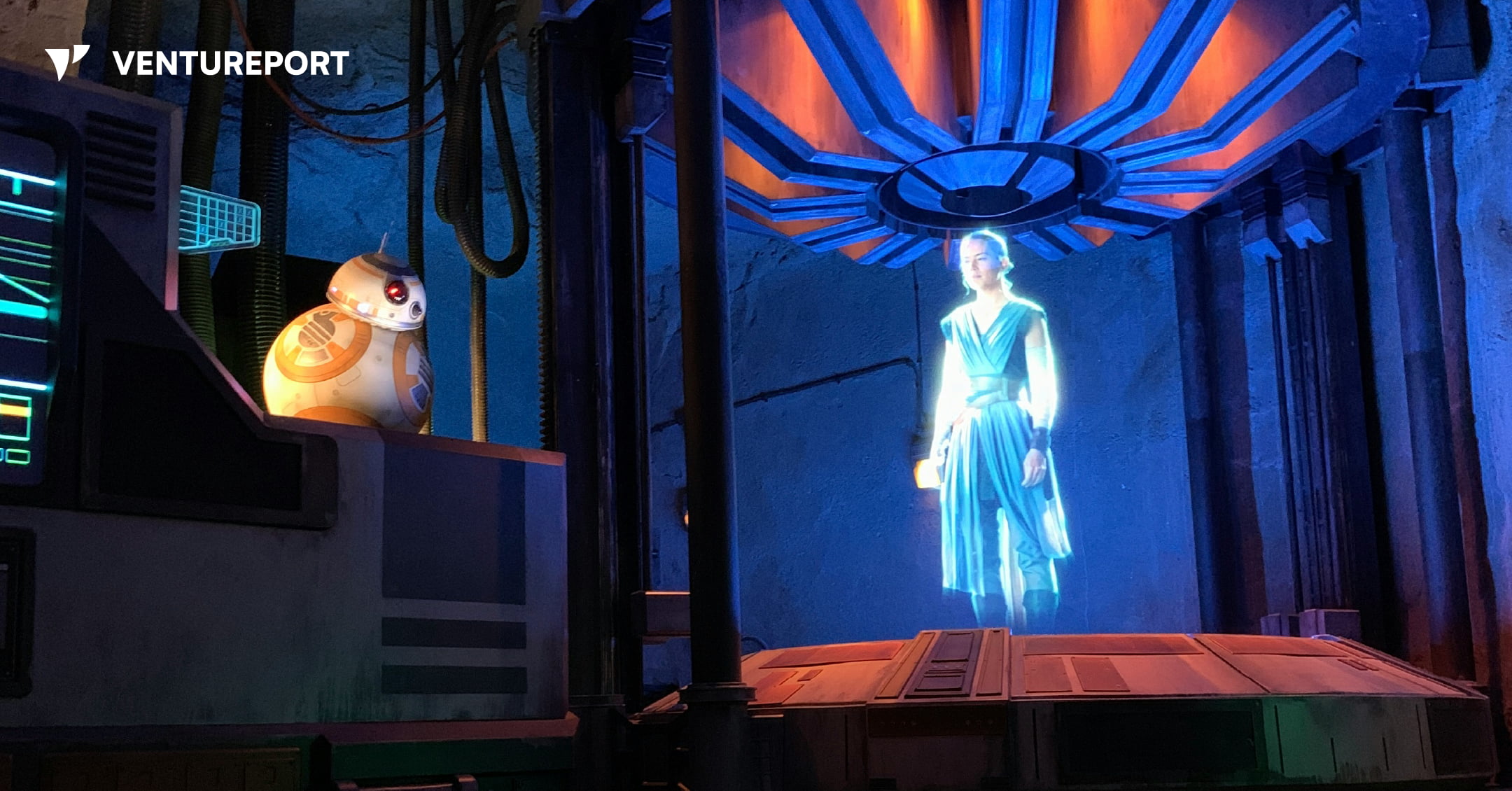
A hologram in the franchise Star Wars, in Walt Disney World Resort, Orlando. PHOTO: UNSPLASH
MicroCloud Hologram Inc. (NASDAQ: HOLO), a technology service provider recognized for its holography and imaging systems, is now expanding into a more advanced realm: a quantum-driven 3D intelligent model. The goal is to generate detailed 3D models and images with far less manual effort — a need that has only grown as industries flood the world with more visual data every year.
The concept is straightforward, even if the technology behind it isn’t. Traditional 3D modeling workflows are slow, fragmented and depend on large teams to clean datasets, train models, adjust parameters and fine-tune every output. HOLO is trying to close that gap by combining quantum computing with AI-powered 3D modeling, enabling the system to process massive datasets quickly and automatically produce high-precision 3D assets with much less human involvement.
To achieve this, the company developed a distributed architecture comprising of several specialized subsystems. One subsystem collects and cleans raw visual data from different sources. Another uses quantum deep learning to understand patterns in that data. A third converts the trained model into ready-to-use 3D assets based on user inputs. Additional modules manage visualization, secure data storage and system-wide protection — all supported by quantum-level encryption. Each subsystem runs in its own container and communicates through encrypted interfaces, allowing flexible upgrades and scaling without disrupting the entire system.
Why this matters: Industries ranging from gaming and film to manufacturing, simulation and digital twins are rapidly increasing their reliance on 3D content. The real bottleneck isn’t creativity — it’s time. Producing accurate, high-quality 3D assets still requires a huge amount of manual processing. HOLO’s approach attempts to lighten that workload by utilizing quantum tools to speed up data processing, model training, generation and scaling, while keeping user data secure.
According to the company, the system’s biggest advantages include its ability to handle massive datasets more efficiently, generate precise 3D models with fewer manual steps, and scale easily thanks to its modular, quantum-optimized design. Whether quantum computing will become a mainstream part of 3D production remains an open question. Still, the model shows how companies are beginning to rethink traditional 3D workflows as demand for high-quality digital content continues to surge.