
Led by co-founders Andrew Raslan and Keyvan Jodeiri, Pipeline Organics is developing microbial fuel cells to help food and beverage manufacturers treat wastewater and recover energy as electricity.
Updated
November 16, 2026 12:32 PM

Concept visualisation of Pipeline Organics’ planned TankArc wastewater treatment and energy recovery system at a brewery. IMAGE: PIPELINE ORGANICS
A glass of beer or a bottle of soft drink leaves plenty behind before it reaches the shelf. Producing it requires water and electricity, then creates wastewater that manufacturers must pay to treat. For breweries and other food and beverage manufacturers working with tight margins, those bills can leave less money for new equipment, products and people.
Pipeline Organics, led by Andrew Raslan (commercial) and Dr Keyvan Jodeiri (technology), sees a resource in that waste. The Nottingham-based cleantech startup, Pipeline Organics, is developing microbial fuel cells that treat food and beverage wastewater while generating electricity. The aim is to help factories lower their operating costs by recovering value from a stream they already produce every day.
Founded in August 2021, Pipeline Organics grew out of the University of Nottingham’s Young Entrepreneurs Scheme, YES20. The founding team won its Engineering, Energy and Environment stream before establishing the company. Andrew, now CEO, brought a background in molecular microbiology and antimicrobial research, later moving into project management and commercialization.
Co-founder and chief scientific officer Keyvan Jodeiri brought a different piece of the puzzle. His research explored biofuel cells that could use sugars in blood to generate electricity for medical implants. The team began asking whether related principles could work outside the body, using organic material in industrial wastewater as fuel. Turning that idea into a business meant finding an application where the environmental benefits came with a clear financial incentive.
Food and beverage manufacturing offered that opportunity. Breweries and other food and beverage manufacturers produce wastewater rich in biodegradable organic material such as leftover carbs and fats or dead proteins, making it suitable food for microorganisms. Treating it at the factory also gives the company a more predictable waste stream than the mixture arriving at a general sewage treatment plant.
“What is filthy for you as a manufacturer is food for the bacteria,” Andrew explains.
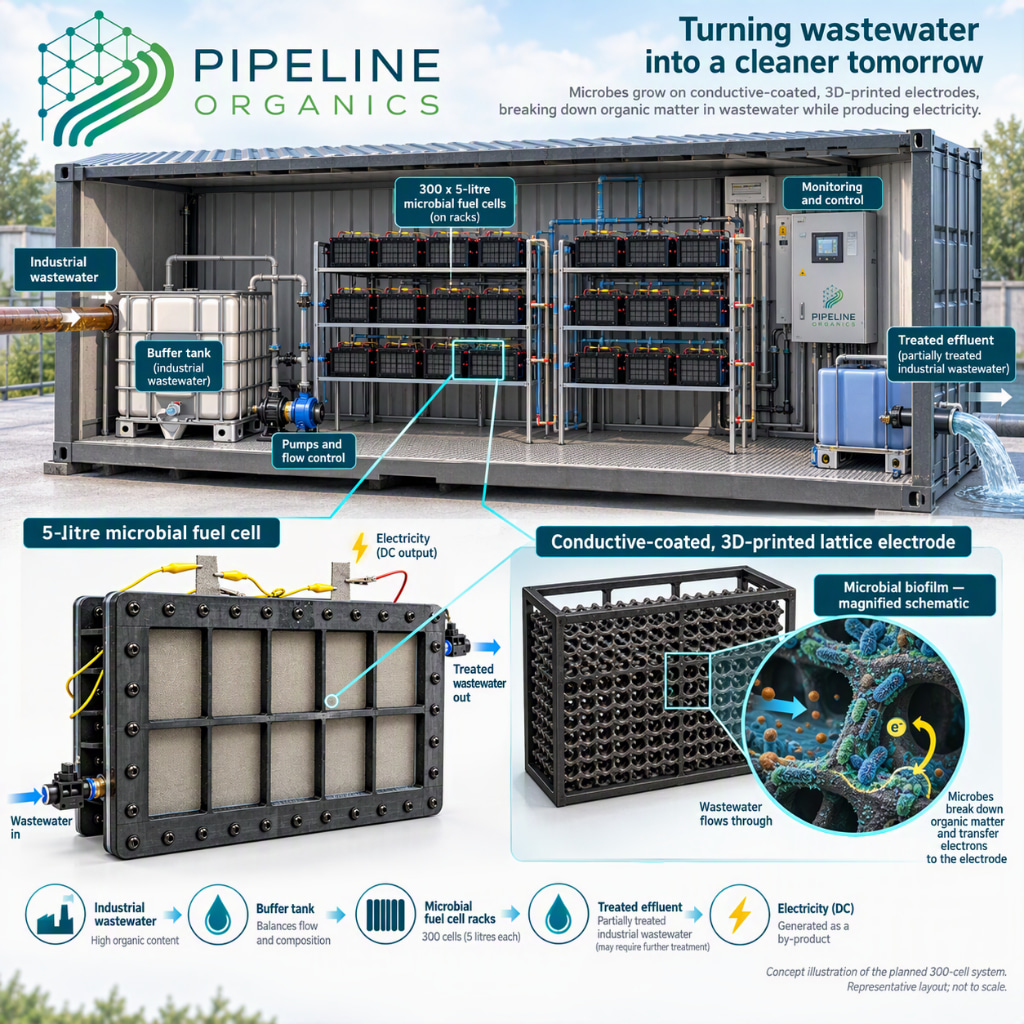
The company’s system, TankArc, contains reactors with specially designed, 3D-printed lattices. Microorganisms growing on the anode break down organic material in wastewater, releasing electrons that electrodes capture as electrical current. This reduces the organic pollution load while recovering some of its energy. Reactors can be grouped into racks or, eventually, containers equipped with plumbing, batteries and controls to serve different factory sizes.
Andrew describes the system as being designed to become self-powering, provided its electricity output scales as expected, with surplus energy available for use on site. At the moment, replacing a brewery’s entire electricity supply is beyond the immediate promise, Andrew admits. The more practical proposition is reducing the amount of power a manufacturer needs to buy through site efficiency upgrades, while cutting its wastewater treatment burden.
The treated wastewater would then go into the sewer for further treatment. Since it contains fewer pollutants, manufacturers could pay less in treatment charges or, in some cases, avoid them altogether. Pipeline Organics is also exploring ways to take the process further by working with partners to make water reuse possible. This could allow manufacturers to reuse the treated water for tasks that do not require high-purity water, such as post-production washing, which accounts for a large share of fresh-water use in the industry.
Much of TankArc’s engineering sits in the lattice itself. It needs sufficient surface area for the biological process while allowing wastewater to flow through without clogging. Different waste streams require different designs. Pipeline Organics combines engineering calculations with proprietary AI-assisted algorithms to adapt the geometry for applications such as beer, wine or fruit juice production.
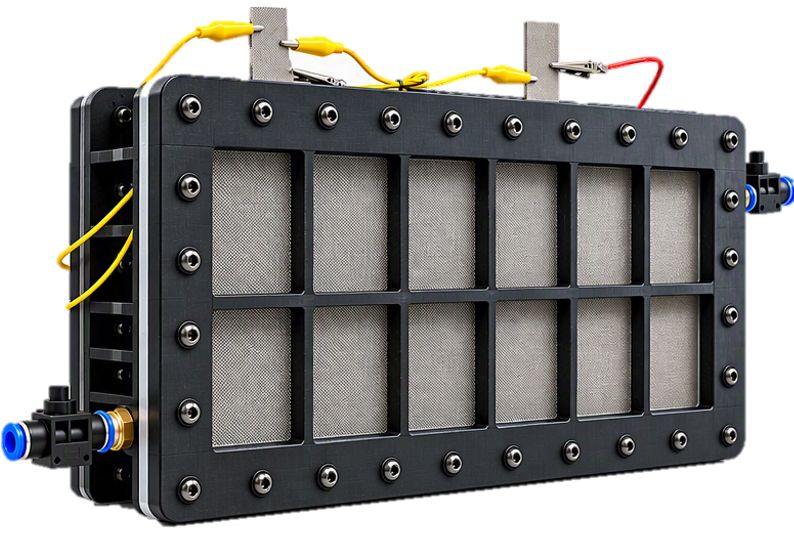
Andrew sees this design process as a competitive advantage. Once the geometry has been developed, components can be manufactured from the resulting 3D models. The difficult part is knowing how to design a cell that performs in a particular environment.
The company is competing with established wastewater treatment and energy recovery methods. Anaerobic digestion, for example, produces biogas that can subsequently generate heat and electricity. Pipeline Organics is pursuing direct electricity recovery through compact, modular equipment. Its suitability will depend on the site, the wastewater and the savings it can deliver.
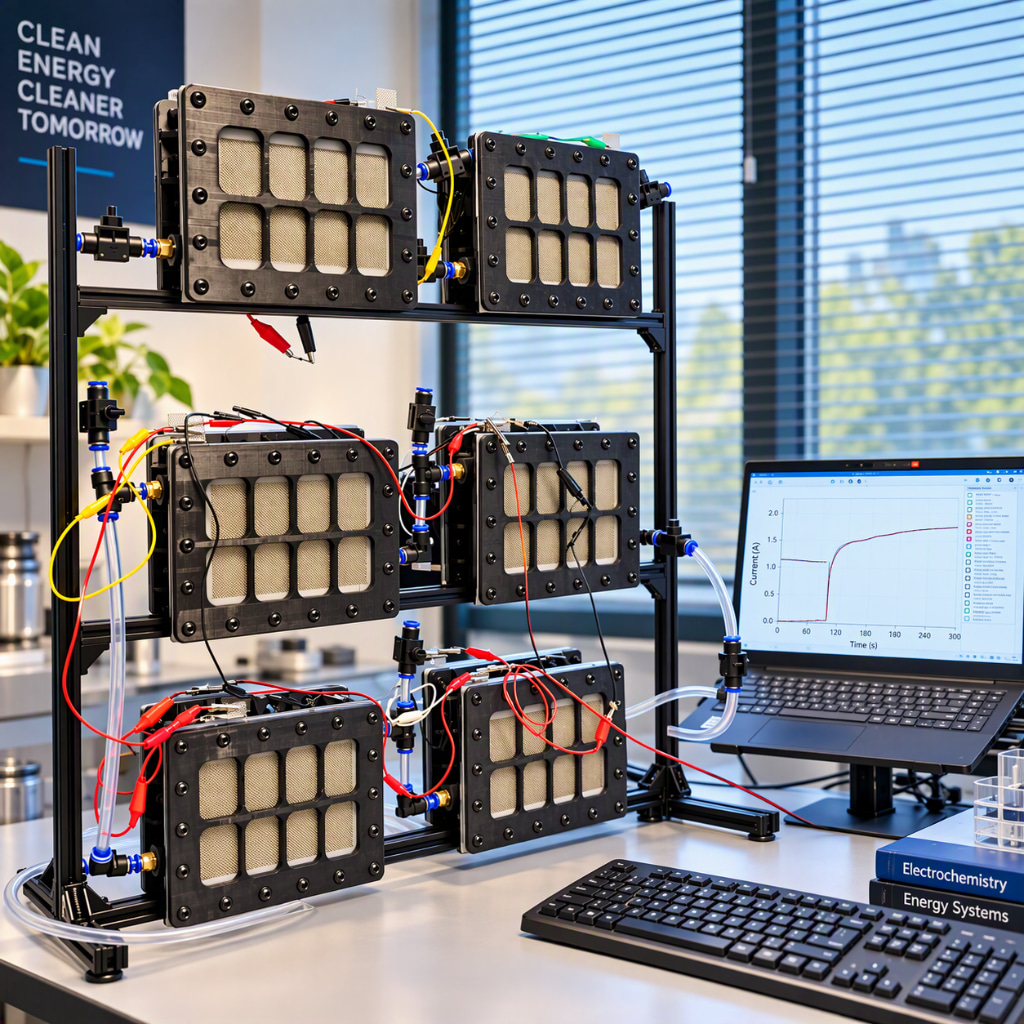
Early brewery trials have helped the team test those assumptions. At Little Ox Brewery, Pipeline Organics used a compact four-reactor system with real wastewater to assess compatibility and electrical output. The trial also provided practical lessons about monitoring, handling and operating equipment around a working production site. The company is working with Castle Rock Brewery in Nottingham as another development partner and have achieved onsite results that are close to commercial readiness.
These demonstrations represent an early step towards industrial deployment. During our interview, Andrew said Pipeline Organics had begun selling paid feasibility pilots that measure performance using customers’ wastewater under actual operating conditions. Larger reactor racks would be at the next stage, followed by containerised systems for facilities producing much greater volumes of effluent. They expect to deploy full-scale containers in 2027.
Scaling brings another set of challenges. The team is developing repeatable methods for producing conductive electrodes, maintaining wastewater flow and assembling larger systems. Reducing manufacturing costs while maintaining treatment performance is a central part of this work.
There will also be useful discoveries along the way: Chief Scientific Officer Keyvan says longer-term ambitions include developing the technology for wastewater sensing and exploring how recovered electricity could support electrochemical production of higher-value chemicals. These could open additional applications for the platform, while the immediate priority remains manufacturing and scaling the wastewater treatment system.
The proposed leasing model reflects the focus on customer economics. Manufacturers would rent equipment rather than purchase it upfront, retaining part of the savings after paying Pipeline Organics. Making that arrangement attractive requires dependable treatment, manageable maintenance and savings that hold up over time.
Andrew’s and Keyvan’s longer-term vision includes a wider portfolio of environmental technologies. For now, the next test is closer to the brewery floor: can the company turn promising small reactors into equipment food and beverage manufacturers can rely on?
“One man’s waste is another man’s raw material if you’re smart about it,” Andrew says. Pipeline Organics is building its business around that possibility, starting with the water left behind by a drink.
Keep Reading
Inside the funding round driving the shift to intelligent construction fleets
Updated
March 17, 2026 1:02 AM

Aerial shot of an excavator. PHOTO: UNSPLASH
Bedrock Robotics has raised US$270 million in Series B funding as it works to integrate greater automation into the construction industry. The round, co-led by CapitalG and the Valor Atreides AI Fund, values the San Francisco-based company at US$1.75 billion, bringing its total funding to more than US$350 million.
The size of the investment reflects growing interest in technologies that can change how large infrastructure and industrial projects are built. Bedrock is not trying to reinvent construction from scratch. Instead, it is focused on upgrading the machines contractors already use—so they can work more efficiently, safely and consistently.
Founded in 2024 by former Waymo engineers, Bedrock develops systems that allow heavy equipment to operate with increasing levels of autonomy. Its software and hardware can be retrofitted onto machines such as excavators, bulldozers and loaders. Rather than relying on one-off robotic tools, the company is building a connected platform that lets fleets of machines understand their surroundings and coordinate with one another on job sites.
This is what Bedrock calls “system-level autonomy”. Its technology combines cameras, lidar and AI models to help machines perceive terrain, detect obstacles, track work progress and carry out tasks like digging and grading with precision. Human supervisors remain in control, monitoring operations and stepping in when needed. Over time, Bedrock aims to reduce the amount of direct intervention those machines require.
The funding comes as contractors face rising pressure to deliver projects faster and with fewer available workers. In the press release, Bedrock notes that the industry needs nearly 800,000 additional workers over the next two years and that project backlogs have grown to more than eight months. These constraints are pushing firms to explore new ways to keep sites productive without compromising safety or quality.
Bedrock states that autonomy can help address those challenges. Not by removing people from the equation—but by allowing crews to supervise more equipment at once and reduce idle time. If machines can operate longer, with better awareness of their environment, sites can run more smoothly and with fewer disruptions.
The company has already started deploying its system in large-scale excavation work, including manufacturing and infrastructure projects. Contractors are using Bedrock’s platform to test how autonomous equipment can support real-world operations at scale, particularly in earthmoving tasks that demand precision and consistency.
From a business standpoint, the Series B funding will allow Bedrock to expand both its technology and its customer deployments. The company has also strengthened its leadership team with senior hires from Meta and Waymo, deepening its focus on AI evaluation, safety and operational growth. Bedrock says it is targeting its first fully operator-less excavator deployments with customers in 2026—a milestone for autonomy in complex construction equipment.
In that context, this round is not just about capital. It is about giving Bedrock the runway to prove that autonomous systems can move from controlled pilots into everyday use on job sites. The company bets that the future of construction will be shaped less by individual machines—and more by coordinated, intelligent systems that work alongside human crews.