
Led by co-founders Andrew Raslan and Keyvan Jodeiri, Pipeline Organics is developing microbial fuel cells to help food and beverage manufacturers treat wastewater and recover energy as electricity.
Updated
November 16, 2026 12:32 PM

Concept visualisation of Pipeline Organics’ planned TankArc wastewater treatment and energy recovery system at a brewery. IMAGE: PIPELINE ORGANICS
A glass of beer or a bottle of soft drink leaves plenty behind before it reaches the shelf. Producing it requires water and electricity, then creates wastewater that manufacturers must pay to treat. For breweries and other food and beverage manufacturers working with tight margins, those bills can leave less money for new equipment, products and people.
Pipeline Organics, led by Andrew Raslan (commercial) and Dr Keyvan Jodeiri (technology), sees a resource in that waste. The Nottingham-based cleantech startup, Pipeline Organics, is developing microbial fuel cells that treat food and beverage wastewater while generating electricity. The aim is to help factories lower their operating costs by recovering value from a stream they already produce every day.
Founded in August 2021, Pipeline Organics grew out of the University of Nottingham’s Young Entrepreneurs Scheme, YES20. The founding team won its Engineering, Energy and Environment stream before establishing the company. Andrew, now CEO, brought a background in molecular microbiology and antimicrobial research, later moving into project management and commercialization.
Co-founder and chief scientific officer Keyvan Jodeiri brought a different piece of the puzzle. His research explored biofuel cells that could use sugars in blood to generate electricity for medical implants. The team began asking whether related principles could work outside the body, using organic material in industrial wastewater as fuel. Turning that idea into a business meant finding an application where the environmental benefits came with a clear financial incentive.
Food and beverage manufacturing offered that opportunity. Breweries and other food and beverage manufacturers produce wastewater rich in biodegradable organic material such as leftover carbs and fats or dead proteins, making it suitable food for microorganisms. Treating it at the factory also gives the company a more predictable waste stream than the mixture arriving at a general sewage treatment plant.
“What is filthy for you as a manufacturer is food for the bacteria,” Andrew explains.
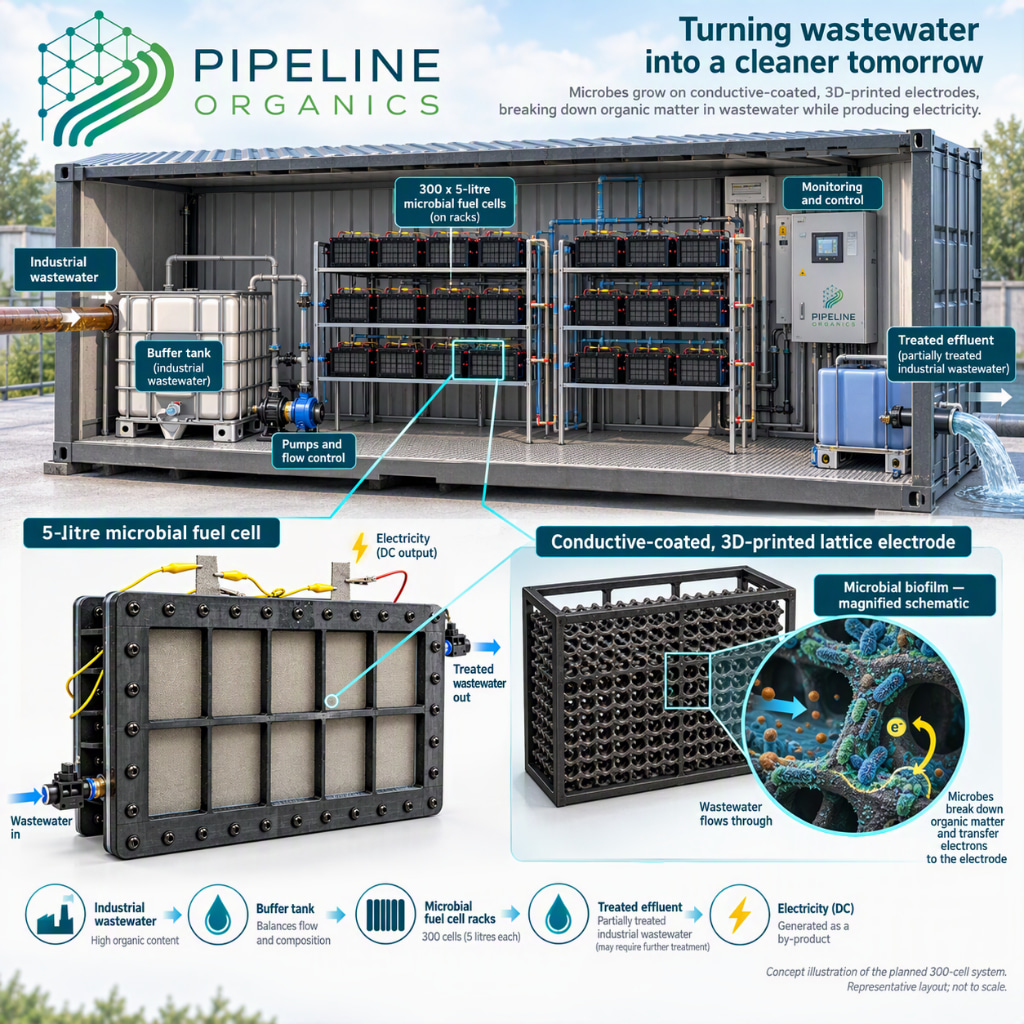
The company’s system, TankArc, contains reactors with specially designed, 3D-printed lattices. Microorganisms growing on the anode break down organic material in wastewater, releasing electrons that electrodes capture as electrical current. This reduces the organic pollution load while recovering some of its energy. Reactors can be grouped into racks or, eventually, containers equipped with plumbing, batteries and controls to serve different factory sizes.
Andrew describes the system as being designed to become self-powering, provided its electricity output scales as expected, with surplus energy available for use on site. At the moment, replacing a brewery’s entire electricity supply is beyond the immediate promise, Andrew admits. The more practical proposition is reducing the amount of power a manufacturer needs to buy through site efficiency upgrades, while cutting its wastewater treatment burden.
The treated wastewater would then go into the sewer for further treatment. Since it contains fewer pollutants, manufacturers could pay less in treatment charges or, in some cases, avoid them altogether. Pipeline Organics is also exploring ways to take the process further by working with partners to make water reuse possible. This could allow manufacturers to reuse the treated water for tasks that do not require high-purity water, such as post-production washing, which accounts for a large share of fresh-water use in the industry.
Much of TankArc’s engineering sits in the lattice itself. It needs sufficient surface area for the biological process while allowing wastewater to flow through without clogging. Different waste streams require different designs. Pipeline Organics combines engineering calculations with proprietary AI-assisted algorithms to adapt the geometry for applications such as beer, wine or fruit juice production.
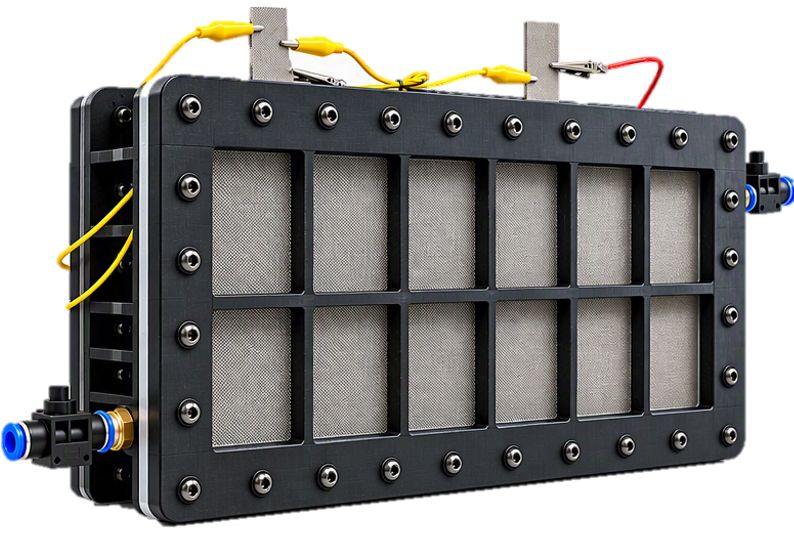
Andrew sees this design process as a competitive advantage. Once the geometry has been developed, components can be manufactured from the resulting 3D models. The difficult part is knowing how to design a cell that performs in a particular environment.
The company is competing with established wastewater treatment and energy recovery methods. Anaerobic digestion, for example, produces biogas that can subsequently generate heat and electricity. Pipeline Organics is pursuing direct electricity recovery through compact, modular equipment. Its suitability will depend on the site, the wastewater and the savings it can deliver.
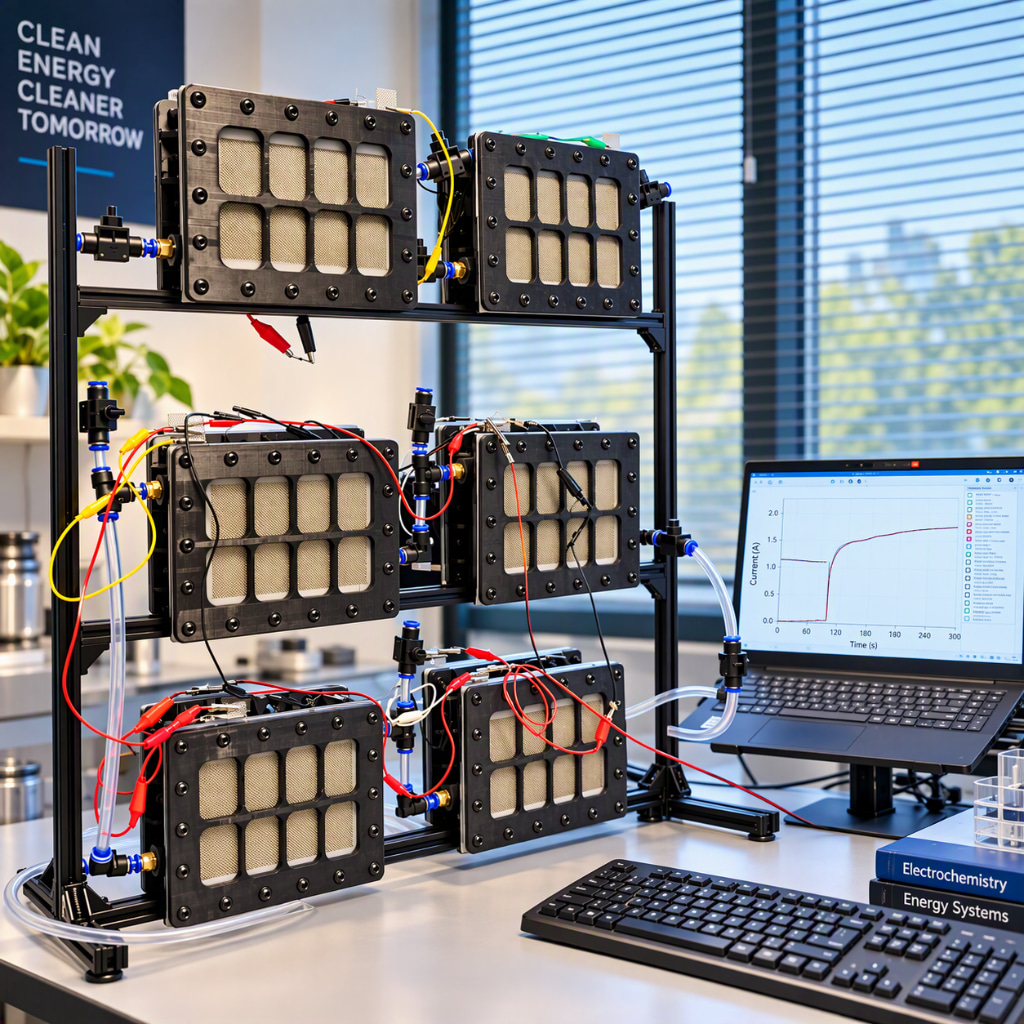
Early brewery trials have helped the team test those assumptions. At Little Ox Brewery, Pipeline Organics used a compact four-reactor system with real wastewater to assess compatibility and electrical output. The trial also provided practical lessons about monitoring, handling and operating equipment around a working production site. The company is working with Castle Rock Brewery in Nottingham as another development partner and have achieved onsite results that are close to commercial readiness.
These demonstrations represent an early step towards industrial deployment. During our interview, Andrew said Pipeline Organics had begun selling paid feasibility pilots that measure performance using customers’ wastewater under actual operating conditions. Larger reactor racks would be at the next stage, followed by containerised systems for facilities producing much greater volumes of effluent. They expect to deploy full-scale containers in 2027.
Scaling brings another set of challenges. The team is developing repeatable methods for producing conductive electrodes, maintaining wastewater flow and assembling larger systems. Reducing manufacturing costs while maintaining treatment performance is a central part of this work.
There will also be useful discoveries along the way: Chief Scientific Officer Keyvan says longer-term ambitions include developing the technology for wastewater sensing and exploring how recovered electricity could support electrochemical production of higher-value chemicals. These could open additional applications for the platform, while the immediate priority remains manufacturing and scaling the wastewater treatment system.
The proposed leasing model reflects the focus on customer economics. Manufacturers would rent equipment rather than purchase it upfront, retaining part of the savings after paying Pipeline Organics. Making that arrangement attractive requires dependable treatment, manageable maintenance and savings that hold up over time.
Andrew’s and Keyvan’s longer-term vision includes a wider portfolio of environmental technologies. For now, the next test is closer to the brewery floor: can the company turn promising small reactors into equipment food and beverage manufacturers can rely on?
“One man’s waste is another man’s raw material if you’re smart about it,” Andrew says. Pipeline Organics is building its business around that possibility, starting with the water left behind by a drink.
Keep Reading
Two-Day Event to be Held on 4-5 November. Bringing Together Global Investors and Entrepreneurs to Explore New Frontiers in Agentic AI, One-Person Companies (OPCs), and Hong Kong’s Role as an International Innovation, Funding, and Technology Hub
Updated
October 30, 2026 9:22 PM

Hong Kong, 26 October 2026 – As the global venture capital market evolves amid economic shifts, investment flows are increasingly concentrated, particularly in artificial intelligence (AI), which continues to drive significant momentum. The annual flagship event, Cyberport Venture & Capital Forum (CVCF), will take place on 4-5 November 2026 at Cyberport. Themed “Scaling in a Changing World: Winning the Next Competitive Cycle”, this year’s CVCF will unite influential global investors and entrepreneurs to explore key themes including Enterprise and Agentic AI, One-Person Companies (OPCs), frontier technologies, and spotlight Hong Kong's unique position as a strategic gateway connecting Chinese Mainland, ASEAN, the Middle East, global innovation and funding networks. The forum aims to empower start-ups and investors to break through financing and market expansion barriers, seizing new market opportunities.

Dr Rocky Cheng, CEO of Cyberport, said, “As global innovation and capital markets undergo accelerated reshaping, AI, data technology, and emerging industries have become crucial engines driving economic growth. CVCF is dedicated to building a bridge between innovation and capital. This year’s forum focuses on new trends such as AI, digital assets, and One-Person Companies (OPCs), exploring emerging market opportunities and global expansion strategies. It decodes how enterprises can drive scalable growth with speed and resilience in a rapidly changing market. Through our investor matching activities, we aim to facilitate the commercialisation of innovations and cross-regional collaboration. Cyberport will continue to leverage its role as Hong Kong’s digital tech flagship and AI accelerator to foster a thriving I&T ecosystem and inject new momentum into building Hong Kong as an international innovation and technology hub.”
Cyberport’s start-ups have demonstrated robust fundraising performance over the past year. With 481 companies joining the community during this period, Cyberport start-ups have raised over HK$74.5 billion in funding. During the year, 19 Cyberport companies successfully listed, alongside the addition of 2 new unicorns. Recent high-value fundraising rounds include Finloop, Qupital, Premialab, and Buy&Ship, many of which leverage AI, blockchain, and digital assets - reflecting sustained market confidence in these emerging technologies and underscoring Cyberport's success in fostering their development.

Hendrick Sin, Chairman of Cyberport Investors Network (CIN) Steering Group; Co-Founder of CMGE Technology Group Limited; Chairman of China Prosperity Capital, said, “Cyberport Investors Network (CIN) has come to its 9th anniversary this year, and our network of over 240 global investors has successfully facilitated more than HK$6 billion across over 133 project matchings, representing an increase of over 19 projects compared to last year. Simultaneously, the Cyberport Macro Fund (CMF), alongside co-investments, has directed HK$2.7 billion into high-potential ventures, with a co-investment ratio of 1:9:3., reflecting strong investor confidence in Cyberport companies. Through dedicated initiatives and our targeted investor matching sessions, CVCF continues to bridge high-growth ventures with institutional co-investment partners, public-private funds and foster collaboration across government, industry, academia, research, investment, and users, propelling enterprise scale across regional corridors.”
As Hong Kong’s digital tech hub, AI accelerator and key incubator, Cyberport leverages the Cyberport Investors Network (CIN) to attract influential investment units from around the world to connect with high-potential Cyberport enterprises to accelerate their development. Since its inception in 2017, the total investments facilitated by CIN have reached over HK$6 billion across a cumulative total of 133 project matchings. CIN’s investment units have surpassed 240, with 15% from the Greater Bay Area and 14% from the Asia-Pacific region, alongside continuous expansion into the Middle East and ASEAN, successfully aggregating global venture capital.
Another key financing channel, Cyberport Macro Fund (CMF), continues to invest in high-potential start-ups while enhancing their fundraising capabilities. As of September 2026, CMF has invested in 30 start-up projects, with the total investment, including co-investments, exceeding HK$2.7 billion, with a co-investment ratio of 1:9.3 — meaning every HK$1 invested by Cyberport attracts an additional HK$9.3 in co-investment. Further augmenting ecosystem liquidity, Cyberport, BOCHK Asset Management, and BOC Group Investment have formed a strategic partnership in May 2026 around a completed venture capital fund to back promising Hong Kong I&T start-ups. This demonstrates Cyberport’s sustained ability to attract and secure capital in a challenging environment.
Cyberport companies have recently achieved remarkable success across venture capital fundraising, advanced technology commercialisation, and international market expansion. Among them, leading Cyberport community members, including global Web5 wealth technology platform Finloop, independent fintech and data analytics platform Premialab, and cross-border fintech platform Qupital, shared their insights on navigating capital cycles, deploying next-generation financial architectures, and scaling from Hong Kong into regional and global markets.
Zhao Yang, Deputy CEO of Finloop, said, “While originating from an established corporate background, we strategically chose Cyberport as the ideal launchpad to spin off our project and scale our vision. Cyberport has been an indispensable catalyst for Finloop’s growth as we develop our AI-driven, one-stop Web5 wealth technology and RWA issuance platform, delivering AI-native liquidity solutions to institutions and SMEs. Beyond providing a vibrant community of innovators, Cyberport’s dynamic ecosystem provides an invaluable springboard for us with leading commercial banks, brokerages, and External Asset Managers (EAMs) across Hong Kong and Singapore, accelerating our mission to build compliant and institutional-grade infrastructure that unlocks new liquidity and value flows across the region.”
Pierre Trecourt, Co-Founder and Chief Operating Officer of Premialab, emphasized the growing importance of advanced data analytics in multi-asset investing, “In an increasingly complex and volatile market environment, institutional investors need greater transparency and sophisticated analytics to construct resilient portfolios, benchmark systematic investment strategies, and manage risk. Hong Kong’s unique position as a global financial hub, combined with its exceptional talent pool and Cyberport’s extensive ecosystem, provides an ideal environment for fintech companies to innovate, expand internationally, and scale their businesses.”
Winston Wong, Co-Founder and CEO of Qupital, discussed their milestone achievements in digital economy lending and underscored Cyberport’s long-standing backing throughout their journey, “Cyberport has played an integral role throughout Qupital’s journey from a homegrown startup to a profitable Series C fintech company. Under the support of Cyberport’s investor networks and platforms, we are proud to have become the first platform in Asia to securitise e-commerce merchant loans while sustaining industry-leading credit performance and profitability. Our journey truly reflects how Cyberport empowers homegrown fintech pioneers to scale sustainable cross-border supply chain financing across the Greater Bay Area and global markets.”
Cyberport Venture & Capital Forum 2026 will feature opening remarks by Lillian Cheong, Acting Secretary for Innovation, Technology and Industry, and bring together venture capital leaders, including representatives from Taara, Gobi Partners, Alumni Ventures, Rasmal Ventures, Primavera Capital, Draper Dragon, Pegasus Tech Ventures, Plug & Play and more to discuss the latest technology and market focus:
CVCF 2026 will continue to feature the popular “Investor Matching” session, offering face-to-face and online interactions to pair investors with start-ups based on their technological focus and investment preferences, enhancing collaboration efficiency. Additional highlights include over 80 physical showcase booths, funder power pitches, start-up clinic & workshop, providing attendees with practical insights and strategic advice. Memorandum of Understanding (MoU) signing ceremonies between Cyberport and international partners including Gobi Partners and Thailand’s National Innovation Agency (NIA) will also be held on the day.
The Agentic Economy Summit, a key highlight of the forum, will feature a keynote speech from Mr Joseph CHAN, JP, Under Secretary for Financial Services and the Treasury, bringing together AI pioneers, regulators, and financial giants to examine how digital identity, institutional tokenisation, HKD stablecoin issuance, programmable payments and machine-to-machine commerce are building the financial rails of the future. Featured speakers will also include representatives from HashKey, Cobo, Unlimit, Anchorpoint, UBS, Monk’s Hill Ventures, and more. The summit will also be exploring the emerging phenomenon of One-Person Companies (OPCs), highlighting how AI agents enable lean entrepreneurial ventures to achieve unprecedented operational scale.
As Cyberport’s flagship venture capital event, CVCF connects investors and entrepreneurs in the global digital technology. In 2025, the hybrid event attracted over 2,700 participants, achieved more than 180,000 views and facilitated more than 500 deal flows, fostering partnerships and investment opportunities. For more details, please visit the website: http://cvcf.cyberport.hk/.
The annual flagship event, Cyberport Venture Capital Forum (CVCF) 2026, will take place on 4-5 November 2026 at Cyberport. Themed “Scaling in a Changing World: Winning the Next Competitive Cycle”, this year’s CVCF will unite influential global investors and entrepreneurs to explore key themes include Enterprise AI, One-Person Companies (OPCs), frontier technologies, and spotlight Hong Kong's unique position as a strategic gateway connecting Chinese Mainland, ASEAN, the Middle East, global innovation and funding networks. The forum aims to empower start-ups and investors to break through financing and market expansion barriers, seizing new market opportunities. Dr Rocky Cheng, CEO of Cyberport (third right), Hendrick Sin, Chairman of Cyberport Investors Network (CIN) Steering Group (third left); Ir Eric Chan, Chief Public Mission Officer of Cyberport (second right), and Cyberport community members, Zhao Yang, Deputy CEO of Finloop (second left), Pierre Trecourt, Co-Founder and Chief Operating Officer of Premialab (first right), and Winston Wong, Co-Founder and CEO of Qupital (first left), attended the media briefing.

Ir Eric Chan, Chief Public Mission Officer of Cyberport introduced the speakers and highlights of the two-day Cyberport Venture Capital Forum 2025, as well as the Web3.0 Innovation Expo.

Ir Eric Chan, Chief Public Mission Officer of Cyberport (first left) and Cyberport community members, Zhao Yang, Deputy CEO of Finloop (second left), Pierre Trecourt, Co-Founder and Chief Operating Officer of Premialab (second right), and Winston Wong, Co-Founder and CEO of Qupital (first right), shared investment insights and experiences in facilitating fundraising during the discussion session.