
At under US$1,000, Hypernova isn’t just eyewear—it’s Meta’s push to make AR feel ordinary.
Updated
January 8, 2026 6:34 PM

Closeup of the Ray-Ban logo and the built-in ultra-wide 12 MP camera on a pair of new Ray-Ban Meta Wayfarer smart glasses. PHOTO: ADOBE STOCK
Meta is preparing to launch its next big wearable: the Hypernova smart glasses. Unlike earlier experiments like the Ray-Ban Stories, these new glasses promise more advanced features at a price point under US$1,000. With a launch set for September 17 at Meta’s annual Connect conference, the Hypernova is already drawing attention for blending design, technology and accessibility.
In this article, let’s take a closer look at Hypernova’s design, features, pricing and the challenges Meta faces as it tries to bring smart glasses into everyday life.
Meta’s earlier Ray-Ban glasses offered cameras and audio but no display. Hypernova changes that: The glasses will ship with a built-in micro-display, giving wearers quick access to maps, messages, notifications and even Meta’s AI assistant. It’s a step toward everyday AR that feels useful and natural, not experimental.
Perhaps most importantly, the price makes them attainable. While early estimates placed the cost above US$1,000, Meta has committed to a launch price of around US$800. That’s still premium, but it moves AR smart glasses into reach for more consumers.
Hypernova weighs about 70 grams, roughly 20 grams heavier than the Ray-Ban Meta models. The added weight likely comes from added components like the new display and extra sensors.
To keep the glasses stylish, Meta continues its partnership with EssilorLuxottica, the company behind Ray-Ban and Prada eyewear. Thicker frames—especially Prada’s designs—help hide the hardware like chips, microphones and batteries without making the glasses look oversized.
The glasses stick close to the classic Ray-Ban silhouette but feature slightly bulkier arms. On the left side, a touch-sensitive bar lets users control functions with taps and swipes. For example, a two-finger tap can trigger a photo or start video recording.
Hypernova introduces something the earlier Ray-Ban glasses never had: a display built right into the lens. In the bottom-right corner of the right lens, a small micro-screen uses waveguide optics to project a digital overlay with about a 20° field of view. This means you can glance at turn-by-turn directions, check a notification or quickly consult Meta’s AI assistant without pulling out your phone. It’s discreet, practical and a major step up from the older models, which were limited to capturing photos and videos, handling calls and playing music via speakers.
Alongside the glasses comes the Ceres wristband, a companion device powered by electromyography (EMG). The band picks up the tiny electrical signals in your wrist and fingers, translating them into commands. A pinch might let you select something, a wrist flick could scroll a page, and a swipe could move between screens. The idea is to avoid clunky buttons or having to talk to your glasses in public. Meta has also been experimenting with handwriting recognition through the band, though it’s not clear if that feature will be ready in time for launch.
Meta doesn’t just want Hypernova to be useful—it wants it to be fun. Code found in leaked firmware revealed a small game called Hypertrail. It looks to borrow ideas from the 1981 arcade shooter Galaga, letting wearers play a simple, retro-inspired game right through their glasses. It’s not the main attraction, but it shows Meta is trying to make Hypernova feel more like a playful everyday gadget rather than just a piece of serious tech.
Hypernova runs on a customized version of Android and pairs with smartphones through the Meta View app. Out of the box, it should support the basics: calls, music and message notifications. Leaks suggest several apps will come preinstalled, including Camera, Gallery, Maps, WhatsApp, Messenger and Meta AI. A Qualcomm processor powers the whole setup, helping it run smoothly while keeping energy demands reasonable.
Meta is also trying to bring in outside developers. In August 2025, CNBC reported that the company invited third-party developers—especially in generative AI—to build experimental apps for Hypernova and the Ceres wristband. The Meta Connect 2025 agenda even highlights sessions on a new smart glasses SDK and toolkit. The push shows Meta’s interest in making Hypernova more than just a device; it wants a broader platform with apps that go beyond its own first-party software.
During development, Hypernova was rumored to cost as much as US$1,400. By pricing it around US$800, Meta signals that it wants adoption more than profit. The company is keeping production limited (around 150,000 units), showing it sees this as a market test rather than a mass rollout. Still, the sub-US$1,000 price tag makes advanced AR far more accessible than before.
Despite its promise, Hypernova may still face hurdles. The Ceres wristband can struggle if worn loosely, and some testers have reported issues based on which arm it’s worn on or even when wearing long sleeves. In short, getting EMG input right for everyone will be critical.
Privacy is another major concern. In past experiments, researchers hacked Ray-Ban Meta glasses to run facial recognition, instantly identifying strangers and pulling personal info. Meta has added guidelines, like a recording indicator light, but critics argue these measures are too easy to ignore. Moreover, data captured by smart glasses can feed into AI training, raising questions about consent and surveillance.
The Meta Hypernova smart glasses mark a turning point in wearable tech. They’re lighter and more stylish than bulky AR headsets, while offering real-world features like navigation, messaging and hands-free control. At under US$1,000, they aim to make AR glasses more than a luxury gadget—they’re a step toward everyday use.
Whether Hypernova succeeds will depend on how well it balances style, usability and privacy. But one thing is clear: Meta is betting that always-on, glanceable AR can move from science fiction to daily life.
Keep Reading
An interview with Tengin founder Madhu on turning coconuts into a business built around farmers, villages and communities.
Updated
August 10, 2026 5:56 PM

Workers of Tengin. PHOTO: TENGIN
In Southern India, coconuts are part of daily life. They are used in food, rituals, farming and home remedies. For Tengin, a social startup whose name means “coconut” in Kannada—a South Indian language—the crop also offers a way to build a rural business with deeper local impact.
Founded by Madhu Kargunda in 2017, Tengin works with farmers, artisans and women’s collectives in Karnataka to make products from almost every part of the coconut. Its range includes virgin coconut oil, desiccated coconut powder, shell-based handicrafts, candles, home décor items and other coconut-based goods.
The larger idea is simple. Farmers should play a bigger role in the value created from the crops they grow. Tengin is trying to help rural communities move beyond supplying raw produce and take part in processing, branding, packaging and sales.
Madhu grew up in an agricultural family. Over the years, he saw many young people move away from farming to look for stable jobs in cities. To him, the problem was not farming itself. The bigger issue was that farmers often missed out on the value created after crops left the farm.
A coconut might be grown in a village, but much of the income comes later through processing, branding and retail. That gap stayed with him, eventually leading him to leave his eight-year career in IT and return to agriculture full-time.
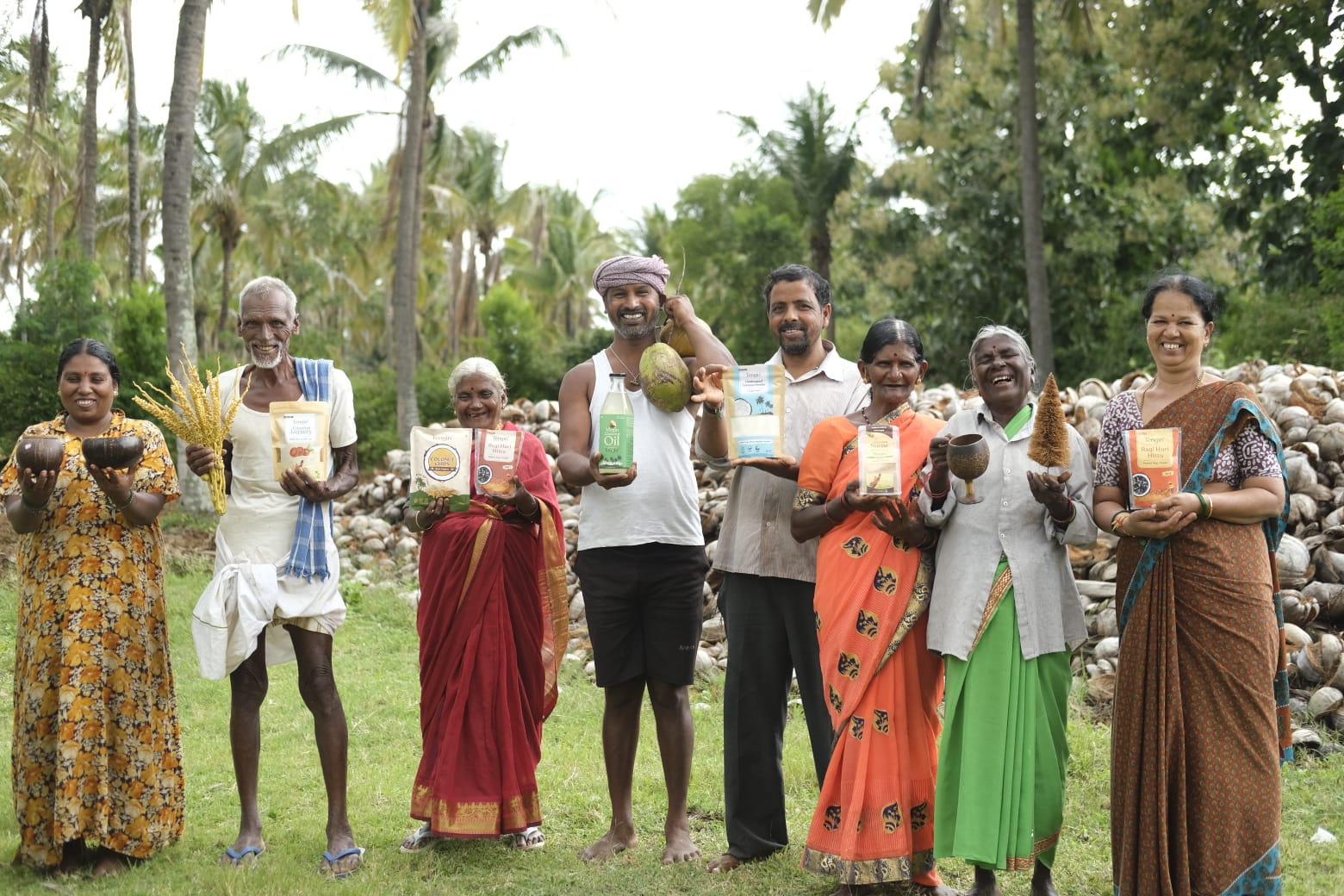
Started with just making virgin coconut oil, Tengin has grown into a wider coconut products business. The startup is now working with around 15 to 20 farmers and artisan groups across Karnataka. It is also building production capacity for larger retail and B2B partnerships.
Today, Tengin generates annual revenue of roughly ₹50-60 lakh, or around US$52,000 to US$62,000. It has also started testing international demand, including a recent export of around 200 kilograms of desiccated coconut powder to Texas.
As Tengin expanded, the team began looking more closely at parts of the coconut that were usually treated as waste or low-value byproducts, such as coconut shells and coir. At first, Tengin treated them that way too.
“When we started, we used to burn some of the shells”, Madhu said. “Later, we realized it was an economic opportunity”.
That changed the company’s product strategy. Local artisans working with Tengin now are turning coconut shells into bowls, incense holders, candles, coffee mugs, mobile stands and handcrafted décor items.
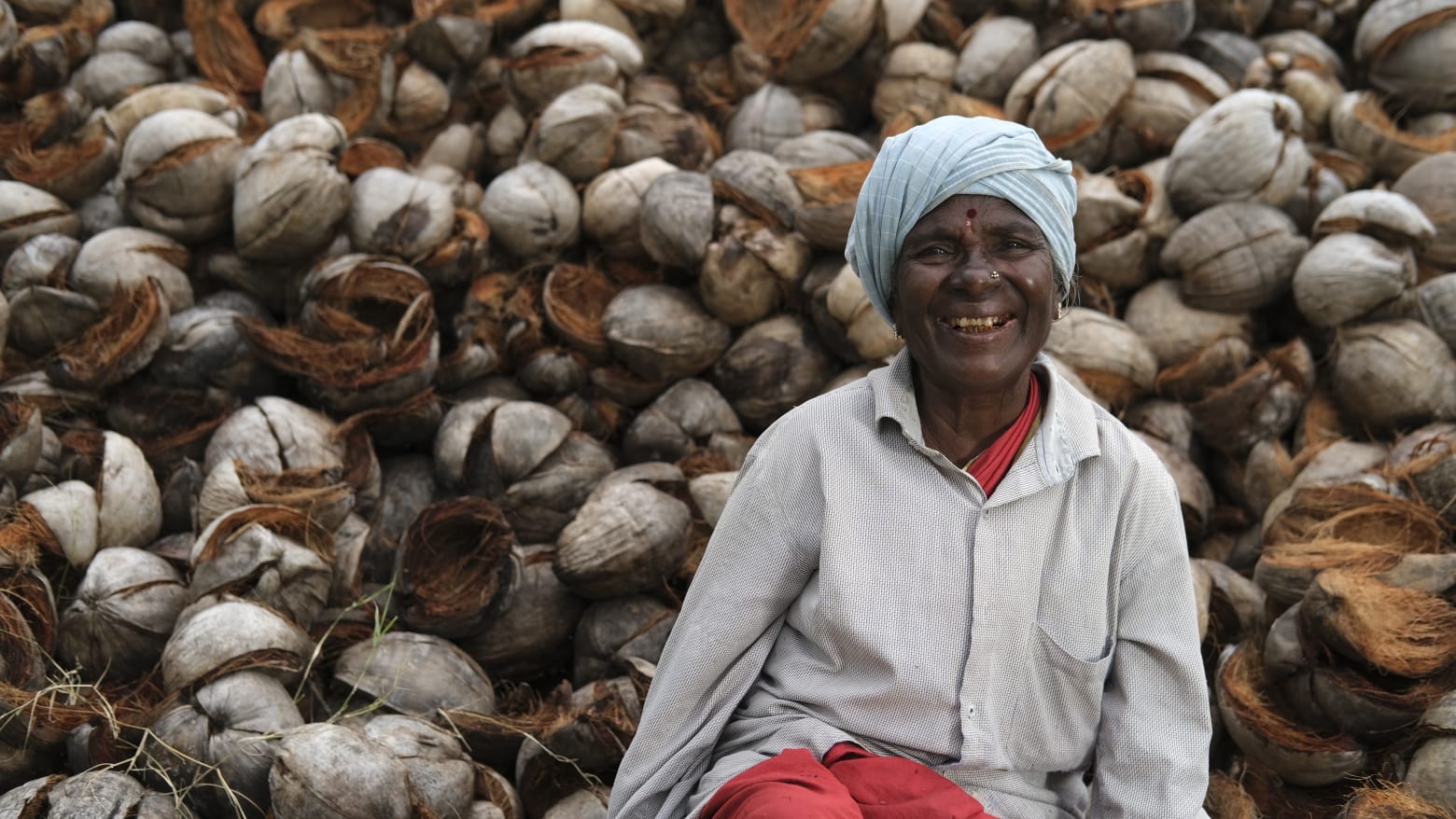
This gives Tengin a place in the circular economy, where waste materials are reused instead of thrown away. For Madhu, though, sustainability has to do more than reduce waste. It should also create income in the community.
“We wanted to minimize waste and maximize wealth locally”, he said.
Tengin does not depend only on one central factory. Instead, it works with smaller village-level production groups that connect to a larger business network. This helps farmers stay close to their land while also taking part in processing and manufacturing. It also creates local jobs, which can reduce the pressure to migrate to cities.
Yet, the model is not always easy. In the early days, Tengin had to convince some farmers to move from chemical farming to natural farming. Moreover, the weather has also become harder to predict. Irregular rainfall and changing harvest cycles can affect coconut prices and production consistency.
Still, Madhu sees the village-based model as central to Tengin’s identity. For him, villages are living systems built on shared work, local knowledge and interdependence.
“The definition of a village is inclusiveness”, he said.
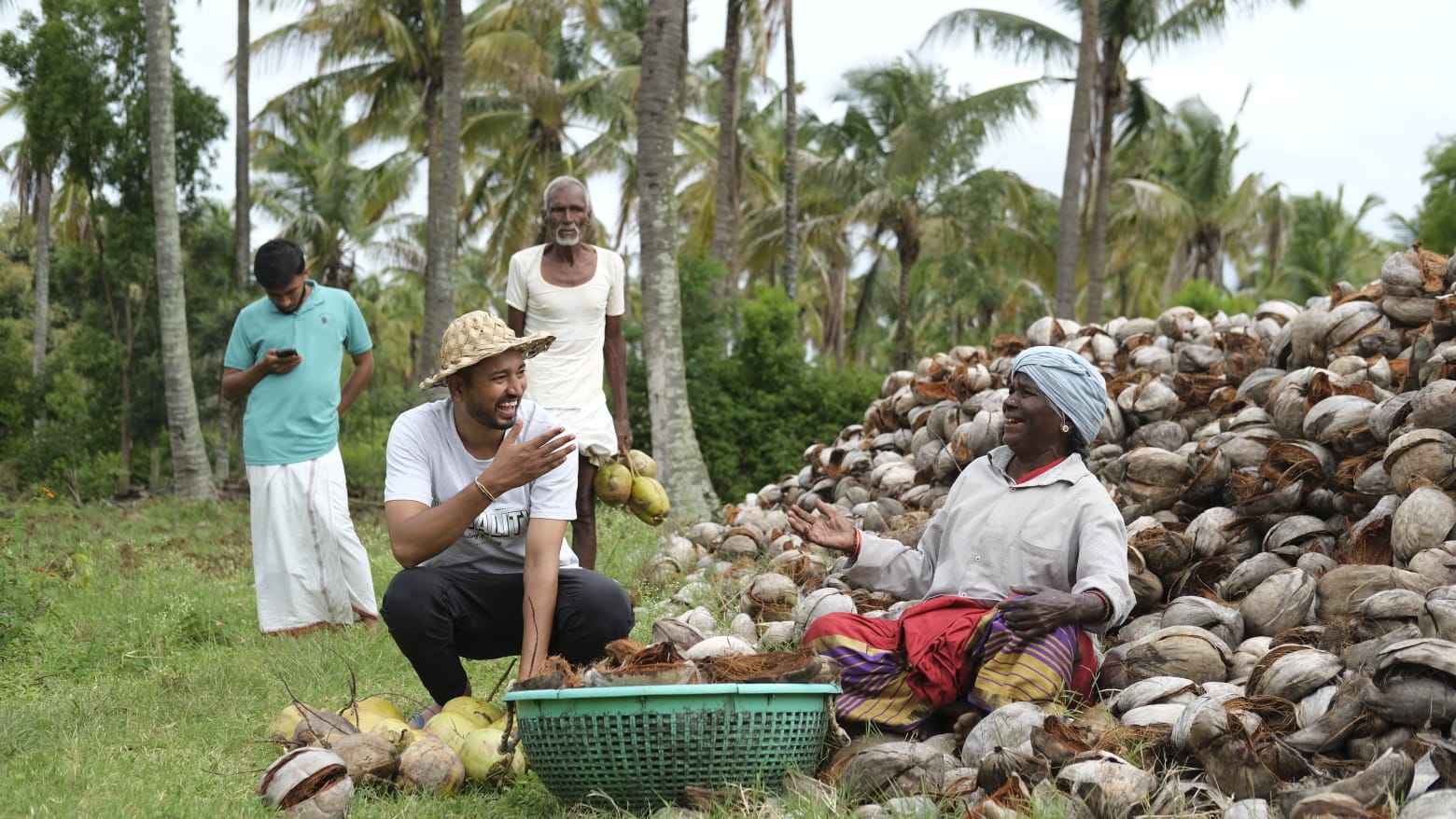
That belief also shaped Tengin’s “coco tourism” initiative. Through the program, visitors meet farmers, learn about farming practices and see how coconut products are made.
During one visit by MBA students from Indiana State University, an unexpected spell of rain gave the group a closer look at village life. Farmers gathered and began singing traditional folk songs to express gratitude to nature. For the students, it became a lesson in culture as much as business.
Madhu sees these moments as part of what rural entrepreneurship can protect.
“If villages become empty, we lose language, traditions and local knowledge too”, he said.
Tengin’s model is not difficult to copy on paper. Madhu is open about that.
“Anyone can do it”, he said, “but what matters is how you work with people”.
For him, the harder part is building long-term trust with farming communities. Tengin works through relationships more than rigid contracts. This encourages farmers and local groups to participate in the system in a more collaborative way.
That trust has become one of the startup’s strongest assets. It shapes how Tengin works with producers and how it presents its products to customers.
For Madhu, it is not enough to call a product sustainable. Customers should be able to understand where it came from, who made it and how their purchase supports the people behind it.
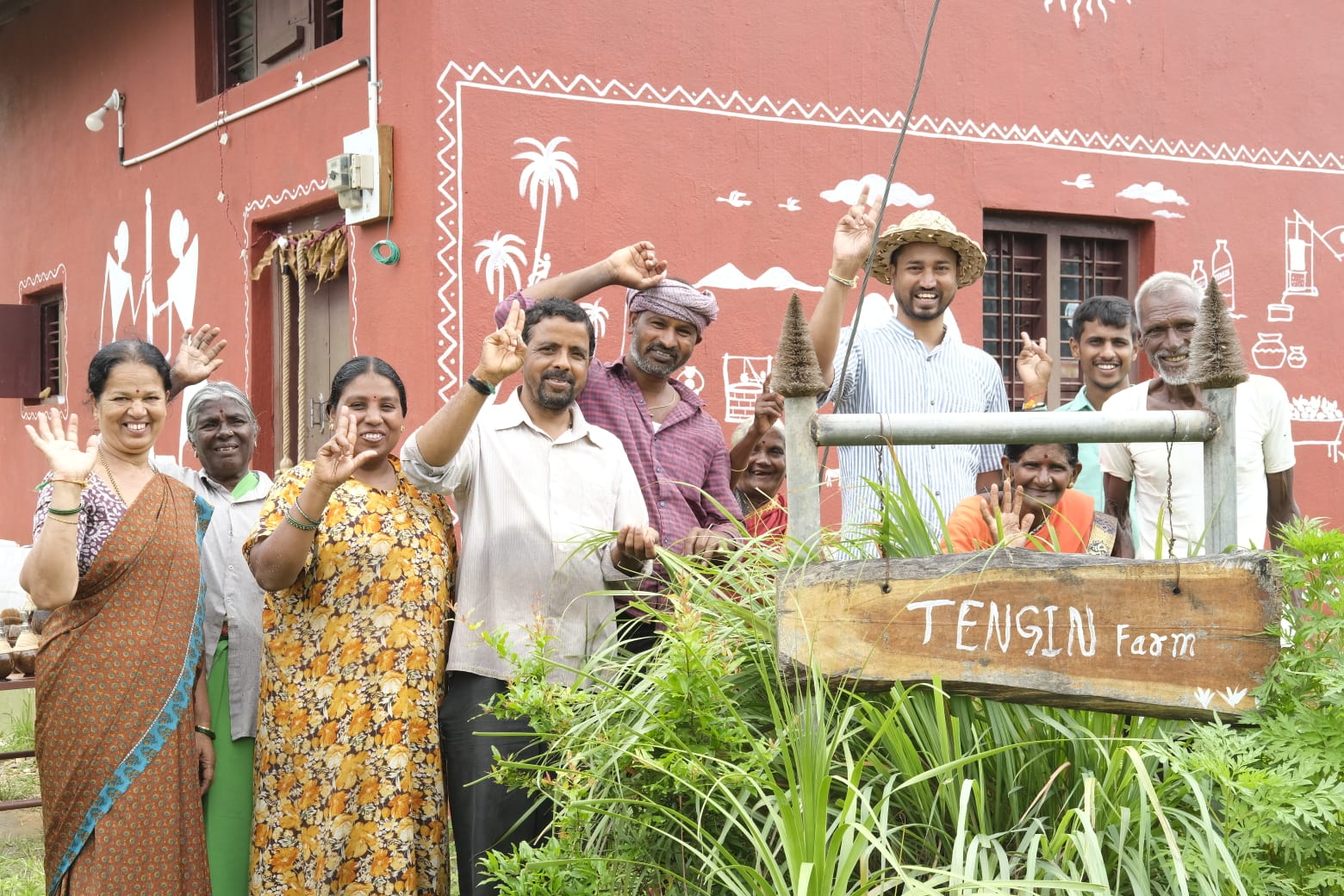
That matters even more in a market where terms like “eco-friendly” and “organic” have become buzzwords. Madhu knows that these words can feel empty when brands do not show what they actually mean.
“Anyone can use these words today,” he said. “What matters is whether consumers can actually see what you are doing”.
This is why Tengin focuses on transparency and storytelling. The startup wants customers to see the full journey of each coconut product, from the farm to the finished item. It also wants them to understand whose livelihood is connected to that journey.
Madhu also believes small brands cannot depend on products alone. Products can be copied, but a clear story, a trusted community and a visible impact are harder to replicate.
“Don’t try to sell only the product,” he said. “When you try to sell the product, you are being sold once”.
Each Tengin product includes details about the people behind it and how profits are shared. In that way, the company connects its coconut products to the farmers, artisans and village systems that make them possible.
For Madhu, entrepreneurship starts with the problem. Founders, he believes, should understand the problem deeply before thinking about scale and revenue.
“An entrepreneur is someone trying to solve an existing problem”, he said. “Sometimes it may be a small problem, sometimes a niche one. It could be in technology, energy, farming or any other sector—but first understand what problem you are trying to solve”.
Farming has also taught him patience. He gives the example of coffee.
“When you plant coffee, you know it may take five years before you see results”, he said, “but you still [have to] water it every day”.
He sees entrepreneurship the same way. Building systems, communities and trust takes time. Growth may be slow at first, but daily work matters.
Adaptability is another lesson he returns to often. Farming conditions change constantly, and so do markets. In both cases, people have to keep learning, unlearning and adjusting.
“Entrepreneurship is about constantly learning new things because the world is changing all the time”, he said. “You need to stay relevant, understand what connects with [your customers] and adapt accordingly”.
Looking ahead, Tengin plans to grow its farmer network, strengthen production capacity and expand its export business. Madhu is also looking to collaborate with more platforms, storytellers and communities that can help amplify the voices behind the products.
The startup is also involved in rural community initiatives, including support for government schools and menstrual health awareness programs.
For Madhu, giving back is part of how he defines success. With more resources, he would invest further in farmer education, village-level production systems and community development.
By building a business around coconuts, Tengin is also making a larger case for rural entrepreneurship. Its work shows that a modern consumer brand can grow without losing its connection to the farmers, traditions and village ecosystems that make that growth possible. For Madhu, that is the real measure of progress: creating value that stays rooted in the community.