
The Hong Kong startup combines 3D-printed reef tiles, biodiversity monitoring and long-term data to help companies manage their impact on marine ecosystems.
Updated
August 18, 2026 11:32 PM

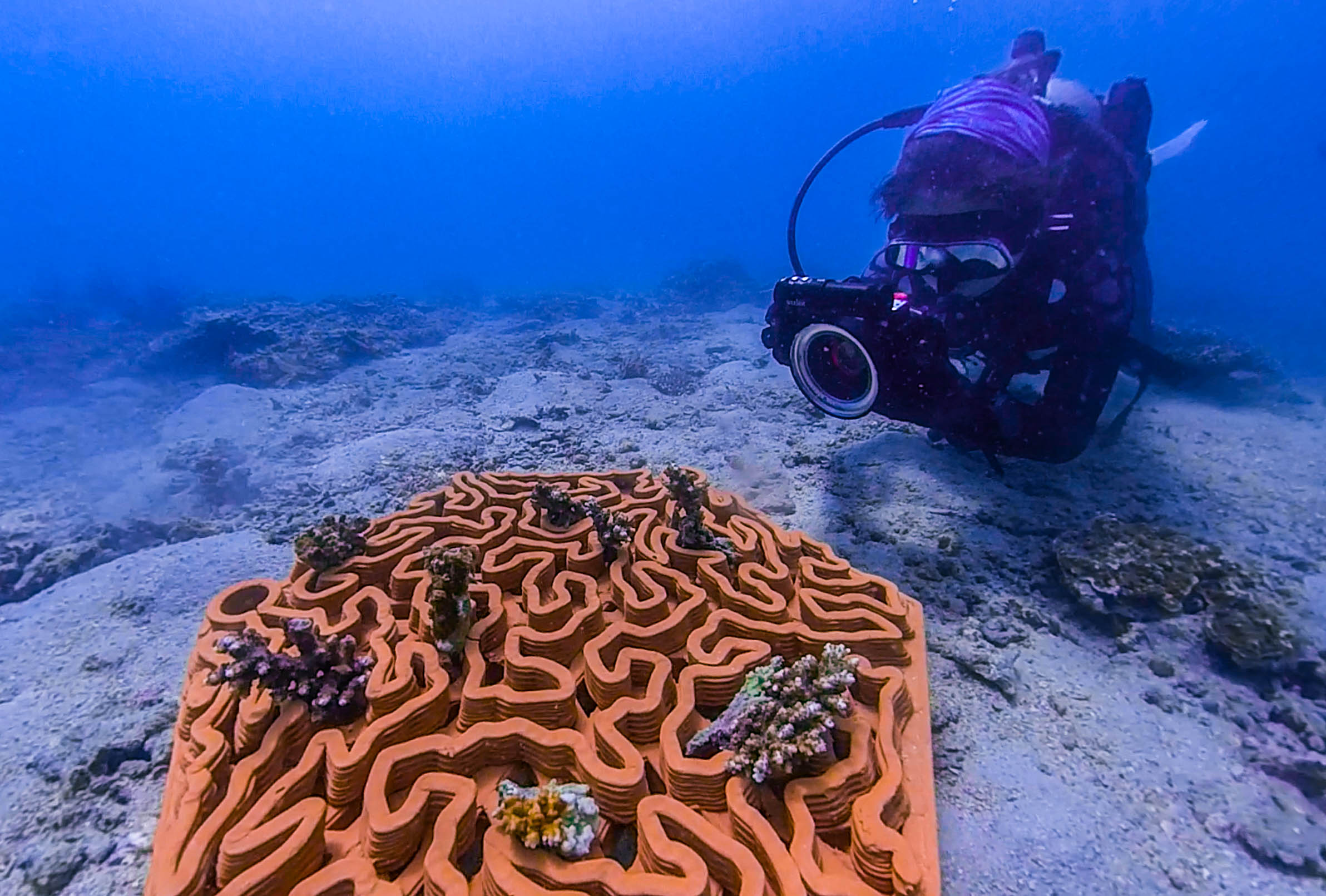
Young corals growing on Archireef's 3D-printed terracotta reef tiles beneath the sea. IMAGE: ARCHIREFF
Anyone who has snorkeled over a coral reef has probably admired its vibrant colours and the marine life swimming between its branches. What is less visible is how easily these ecosystems can be damaged. Rising ocean temperatures and pollution continue to put reefs under pressure, while coastal development creates another threat. Construction can stir up sediment that settles on corals, blocking the sunlight they need and making it harder for damaged reefs to recover.
Protecting marine ecosystems is becoming a shared responsibility. Alongside scientists, governments and conservation groups, businesses whose operations affect the ocean are increasingly expected to understand, manage and reduce their environmental impact. They must also show regulators, banks and investors that they are meeting their environmental commitments.
Archireef helps businesses meet those demands. Founded by Vriko Yu, the Hong Kong-rooted B2B startup specializes in marine ecosystem restoration and ocean nature risk management. Drawing on years of research at the University of Hong Kong, Yu built the company to help organisations understand, measure and reduce their impact on marine ecosystems.
Yu describes Archireef as an “end-to-end ocean nature risk management company”.
“What we offer them is a credible way to meet those obligations and stand behind the results,” she says.
One of the company’s main tools for restoring damaged marine ecosystems is its flagship 3D-printed terracotta reef tile. The tiles provide a stable foundation where young corals can attach, grow and survive over time.
Archireef chose terracotta instead of concrete and other conventional materials because it is pH-neutral and does not release harmful chemicals into the water. Its surface also gives corals a suitable place to attach naturally.
Before placing a single tile in the ocean, the team studies the proposed restoration site to determine whether recovery is possible. It assesses the water quality, biodiversity and general health of the ecosystem. As Yu explains, restoration should begin only where nature has a realistic chance to recover.
“Restoration isn’t about replacing nature or engineering a reef into existence. It is about removing the barriers and giving a degraded system the conditions it needs to begin recovering on its own”, she says.
Once the team selects a site, divers carefully place the tiles on the seabed. Their curves, ridges and crevices imitate the structure of a natural coral reef, creating sheltered spaces for marine species. The design also helps limit sediment build-up, which can block sunlight and smother young corals.
.webp)
Archireef adjusts the shape of its reef tiles for each project.
“There’s no universal reef, so there’s no universal tile”, Yu says.
Instead of producing one standard model, the company adapts each design to the coral species, water conditions and surrounding marine environment. A coral restoration project in Hong Kong may therefore require a different tile from one in Saudi Arabia, even when the same manufacturing process is used.
“The biggest adaptation from site to site is usually the match between design, species and environment, not the manufacturing itself ”, Yu explains.

Although the reef tile is Archireef’s most recognizable innovation, Yu sees it as one part of a much broader service.
“The reef tile gets the attention because it’s tangible,” she says. “But the real product is the proof — defensible, audit-ready evidence of nature recovery that an organization can put in a disclosure and stand behind under scrutiny”.
Producing that evidence requires years of biodiversity monitoring. Long after the reef tiles have been installed, Archireef continues to track coral survival and the health of the surrounding marine ecosystem. Its monitoring methods include ecological surveys, AI-assisted species recognition, photogrammetry and environmental DNA testing.
Photogrammetry uses photographs to produce detailed 3D models of the reef. These models allow the team to measure changes in coral growth and reef structure over time.
Environmental DNA, commonly known as eDNA, offers another way to monitor marine biodiversity. Traditional ecological surveys often depend on divers recording the species they can see. eDNA testing instead examines traces of genetic material left in the water by marine organisms, including skin cells, mucus and waste.
By analyzing these traces, Archireef can detect species that may be hidden, difficult to identify or absent during a dive. This gives the company a more complete picture of the ecosystem and how it is changing.
For Archireef, the success of a coral reef restoration project is determined by what happens several years after installation.
“The indicators that matter aren’t the ones that look good on deployment day”, Yu says. “They’re the ones that show, two, three and five years on, whether a genuine ecosystem is establishing and sustaining itself”.
At the company’s first restoration site in Hoi Ha Wan, Hong Kong, around 90% of the transplanted corals remained alive four years after deployment. The long-term survival rate suggests that the ecosystem is recovering rather than simply appearing healthy during the early stages of the project.
Results like these have helped Archireef move beyond academic research and secure collaborations across the public and private sectors. In Hong Kong, the company has worked with government departments and public organisations responsible for coastal infrastructure and marine conservation.
Keep Reading
Brains, bots and the future: Who’s really in control?
Updated
January 8, 2026 6:32 PM

Adoration and disdain, the polarised reactions for generative AI. ILLUSTRATION: YORKE YU
When British-Canadian cognitive psychologist and computer scientist Geoffrey Hinton joked that his ex-girlfriend once used ChatGPT to help her break up with him, he wasn’t exaggerating. The father of deep learning was pointing to something stranger: how machines built to mimic language have begun to mimic thought — and how even their creators no longer agree on what that means.
In that one quip — part humor, part unease — Hinton captured the paradox at the center of the world’s most important scientific divide. Artificial intelligence has moved beyond code and circuits into the realm of psychology, economics and even philosophy. Yet among those who know it best, the question has turned unexpectedly existential: what, if anything, do large language models truly understand?
Across the world’s AI labs, that question has split the community into two camps — believers and skeptics, prophets and heretics. One side sees systems like ChatGPT, Claude, and Gemini as the dawn of a new cognitive age. The other insists they’re clever parrots with no grasp of meaning, destined to plateau as soon as the data runs out. Between them stands a trillion-dollar industry built on both conviction and uncertainty.
Hinton, who spent a decade at Google refining the very neural networks that now power generative AI, has lately sounded like a man haunted by his own invention. Speaking to Scott Pelley on the CBS 60 Minutes interview aired October 8, 2023, Hinton said, “I think we're moving into a period when for the first time ever we may have things more intelligent than us.” . He said it not with triumph, but with visible worry.
Yoshua Bengio, his longtime collaborator, sees it differently. Speaking at the All In conference in Montreal, he told TIME that future AI systems "will have stronger and stronger reasoning abilities, more and more knowledge," while cautioning about ensuring they "act according to our norms". And then there’s Gary Marcus, the cognitive scientist and enduring critic, who dismisses the hype outright: “These systems don’t understand the world. They just predict the next word.”
It’s a rare moment in science when three pioneers of the same field disagree so completely — not about ethics or funding, but about the very nature of progress. And yet that disagreement now shapes how the future of AI will unfold.
In the span of just two years, large language models have gone from research curiosities to corporate cornerstones. Banks use them to summarize reports. Lawyers draft contracts with them. Pharmaceutical firms explore protein structures through them. Silicon Valley is betting that scaling these models — training them on ever-larger datasets with ever-denser computers — will eventually yield something approaching reasoning, maybe even intelligence.
It’s the “bigger is smarter” philosophy, and it has worked — so far. OpenAI’s GPT-4, Anthropic’s Claude, and Google’s Gemini have grown exponentially in capability . They can write code, explain math, outline business plans, even simulate empathy. For most users, the line between prediction and understanding has already blurred beyond meaning. Kelvin So, who is now conducting AI research in PolyU SPEED, commented , “AI scientists today are inclined to believe we have learnt a bitter lesson in the advancement from the traditional AI to the current LLM paradigm. That said, scaling law, instead of human-crafted complicated rules, is the ultimate law governing AI.”
But inside the labs, cracks are showing. Scaling models have become staggeringly expensive, and the returns are diminishing. A growing number of researchers suspect that raw scale alone cannot unlock true comprehension — that these systems are learning syntax, not semantics; imitation, not insight.
That belief fuels a quiet counter-revolution. Instead of simply piling on data and GPUs, some researchers are pursuing hybrid intelligence — systems that combine statistical learning with symbolic reasoning, causal inference, or embodied interaction with the physical world. The idea is that intelligence requires grounding — an understanding of cause, consequence, and context that no amount of text prediction can supply.
Yet the results speak for themselves. In practice, language models are already transforming industries faster than regulation can keep up. Marketing departments run on them. Customer support, logistics and finance teams depend on them. Even scientists now use them to generate hypotheses, debug code and summarize literature. For every cautionary voice, there are a dozen entrepreneurs who see this technology as a force reshaping every industry. That gap — between what these models actually are and what we hope they might become — defines this moment. It’s a time of awe and unease, where progress races ahead even as understanding lags behind.
Part of the confusion stems from how these systems work. A large language model doesn’t store facts like a database. It predicts what word is most likely to come next in a sequence, based on patterns in vast amounts of text. Behind this seemingly simple prediction mechanism lies a sophisticated architecture. The tokenizer is one of the key innovations behind modern language models. It takes text and chops it into smaller, manageable pieces the AI can understand. These pieces are then turned into numbers, giving the model a way to “read” human language. By doing this, the system can spot context and relationships between words — the building blocks of comprehension.
Inside the model, mechanisms such as multi-head attention enable the system to examine many aspects of information simultaneously, much as a human reader might track several storylines at once.
Reinforcement learning, pioneered by Richard Sutton, a professor of computing science at the University of Alberta, and Andrew Barto, Professor Emeritus at the University of Massachusetts, mimics human trial-and-error learning. The AI develops “value functions” that predict the long-term rewards of its actions. Together, these technologies enable machines to recognize patterns, make predictions and generate text that feels strikingly human — yet beneath this technical progress lies the very divide that cuts to the heart of how intelligence itself is defined.
This placement works well because it elaborates on the technical foundations after the article introduces the basic concept of how language models work, and before it transitions to discussing the emergent behaviors and the “black box problem.”
Yet at scale, that simple process begins to yield emergent behavior — reasoning, problem-solving, even flashes of creativity that surprise their creators. The result is something that looks, sounds and increasingly acts intelligent — even if no one can explain exactly why.
That opacity worries not just philosophers, but engineers. The “black box problem” — our inability to interpret how neural networks make decisions — has turned into a scientific and safety concern. If we can’t explain a model’s reasoning, can we trust it in critical systems like healthcare or defense?
Companies like Anthropic are trying to address that with “constitutional AI,” embedding human-written principles into model training to guide behavior. Others, like OpenAI, are experimenting with internal oversight teams and adversarial testing to catch dangerous or misleading outputs. But no approach yet offers real transparency. We’re effectively steering a ship whose navigation system we don’t fully understand. “We need governance frameworks that evolve as quickly as AI itself,” says Felix Cheung, Founding Chairman of RegTech Association of Hong Kong (RTAHK). “Technical safeguards alone aren't enough — transparent monitoring and clear accountability must become industry standards.”
Meanwhile, the commercial race is accelerating. Venture capital is flowing into AI startups at record speed. OpenAI’s valuation reportedly exceeds US$150 billion; Anthropic, backed by Amazon and Google, isn’t far behind. The bet is simple: that generative AI will become as indispensable to modern life as the internet itself.
And yet, not everyone is buying into that vision. The open-source movement — championed by players like Meta’s Llama, Mistral in France, and a fast-growing constellation of independent labs — argues that democratizing access is the only way to ensure both innovation and accountability. If powerful AI remains locked behind corporate walls, they warn, progress will narrow to the priorities of a few firms.
But openness cuts both ways. Publicly available models are harder to police, and their misuse — from disinformation to deepfakes — grows as easily as innovation does. Regulators are scrambling to balance risk and reward. The European Union’s AI Act is the world’s most comprehensive attempt at governance, but even it struggles to define where to draw the line between creativity and control.
This isn’t just a scientific argument anymore. It’s a geopolitical one. The United States, China, and Europe are each pursuing distinct AI strategies: Washington betting on private-sector dominance, Beijing on state-led scaling, Brussels on regulation and ethics. Behind the headlines, compute power is becoming a form of soft power. Whoever controls access to the chips, data, and infrastructure that fuel AI will control much of the digital economy.
That reality is forcing some uncomfortable math. Training frontier models already consumes energy on the scale of small nations. Data centers now rise next to hydroelectric dams and nuclear plants. Efficiency — once a technical concern — has become an economic and environmental one. As demand grows, so does the incentive to build smaller, smarter, more efficient systems. The industry’s next leap may not come from scale at all, but from constraint.
For all the noise, one truth keeps resurfacing: large language models are tools, not oracles. Their intelligence — if we can call it that — is borrowed from ours. They are trained on human text, human logic, human error. Every time a model surprises us with insight, it is, in a sense, holding up a mirror to collective intelligence.
That’s what makes this schism so fascinating. It’s not really about machines. It’s about what we believe intelligence is — pattern or principle, simulation or soul. For believers like Bengio, intelligence may simply be prediction done right. For critics like Marcus, that’s a category mistake: true understanding requires grounding in the real world, something no model trained on text can ever achieve.
The public, meanwhile, is less interested in metaphysics. To most users, these systems work — and that’s enough. They write emails, plan trips, debug spreadsheets, summarize meetings. Whether they “understand” or not feels academic. But for the scientists, that distinction remains critical, because it determines where AI might ultimately lead.
Even inside the companies building them, that tension shows OpenAI’s Sam Altman has hinted that scaling can’t continue forever. At some point, new architectures — possibly combining logic, memory, or embodied data — will be needed. DeepMind’s Demis Hassabis says something similar: intelligence, he argues, will come not just from prediction, but from interaction with the world.
It’s possible both are right. The future of AI may belong to hybrid systems — part statistical, part symbolic — that can reason across multiple modes of information: text, image, sound, action. The line between model and agent is already blurring, as LLMs gain the ability to browse the web, run code, and call external tools. The next generation won’t just answer questions; it will perform tasks.
For startups, the opportunity — and the risk — lies in that transition. The most valuable companies in this new era may not be those that build the biggest models, but those that build useful ones: specialized systems tuned for medicine, law, logistics, or finance, where reliability matters more than raw capability. The winners will understand that scale is a means, not an end.
And for society, the challenge is to decide what kind of intelligence we want to live with. If we treat these models as collaborators — imperfect, explainable, constrained — they could amplify human potential on a scale unseen since the printing press. If we chase the illusion of autonomy, they could just as easily entrench bias, confusion, and dependency.
The debate over large language models will not end in a lab. It will play out in courts, classrooms, boardrooms, and living rooms — anywhere humans and machines learn to share the same cognitive space. Whether we call that cooperation or competition will depend on how we design, deploy, and, ultimately, define these tools.
Perhaps Hinton’s offhand remark about being psychoanalyzed by his own creation wasn’t just a joke. It was an omen. AI is no longer something we use; it’s something we’re reflected in. Every model trained on our words becomes a record of who we are — our reasoning, our prejudices, our brilliance, our contradictions. The schism among scientists mirrors the one within ourselves: fascination colliding with fear, ambition tempered by doubt.
In the end, the question isn’t whether LLMs are the future. It’s whether we are ready for a future built in their image.