
The Hong Kong startup combines 3D-printed reef tiles, biodiversity monitoring and long-term data to help companies manage their impact on marine ecosystems.
Updated
August 18, 2026 11:32 PM
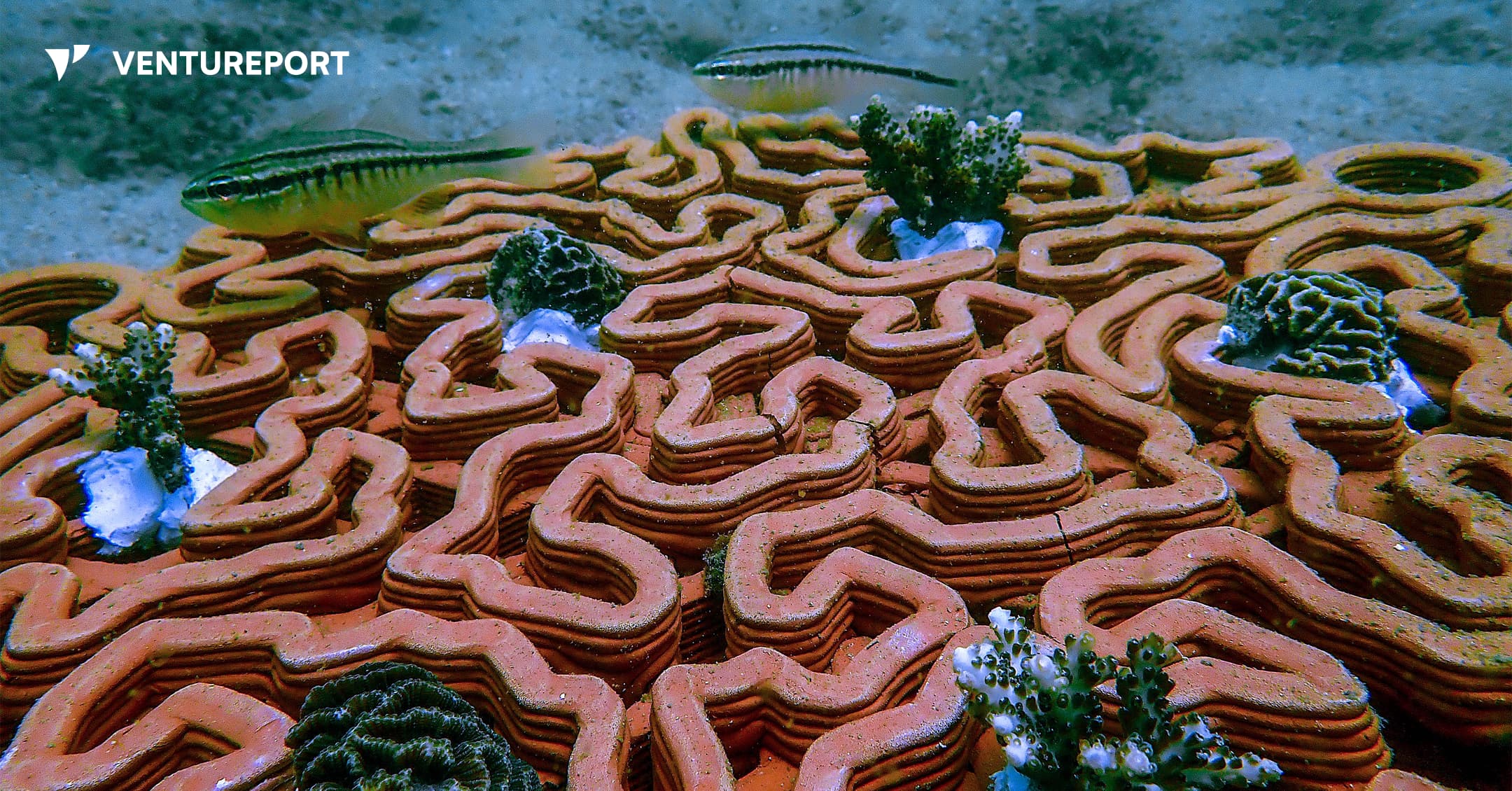
Young corals growing on Archireef's 3D-printed terracotta reef tiles beneath the sea. IMAGE: ARCHIREFF
Anyone who has snorkeled over a coral reef has probably admired its vibrant colours and the marine life swimming between its branches. What is less visible is how easily these ecosystems can be damaged. Rising ocean temperatures and pollution continue to put reefs under pressure, while coastal development creates another threat. Construction can stir up sediment that settles on corals, blocking the sunlight they need and making it harder for damaged reefs to recover.
Protecting marine ecosystems is becoming a shared responsibility. Alongside scientists, governments and conservation groups, businesses whose operations affect the ocean are increasingly expected to understand, manage and reduce their environmental impact. They must also show regulators, banks and investors that they are meeting their environmental commitments.
Archireef helps businesses meet those demands. Founded by Vriko Yu, the Hong Kong-rooted B2B startup specializes in marine ecosystem restoration and ocean nature risk management. Drawing on years of research at the University of Hong Kong, Yu built the company to help organisations understand, measure and reduce their impact on marine ecosystems.
Yu describes Archireef as an “end-to-end ocean nature risk management company”.
“What we offer them is a credible way to meet those obligations and stand behind the results,” she says.
One of the company’s main tools for restoring damaged marine ecosystems is its flagship 3D-printed terracotta reef tile. The tiles provide a stable foundation where young corals can attach, grow and survive over time.
Archireef chose terracotta instead of concrete and other conventional materials because it is pH-neutral and does not release harmful chemicals into the water. Its surface also gives corals a suitable place to attach naturally.
Before placing a single tile in the ocean, the team studies the proposed restoration site to determine whether recovery is possible. It assesses the water quality, biodiversity and general health of the ecosystem. As Yu explains, restoration should begin only where nature has a realistic chance to recover.
“Restoration isn’t about replacing nature or engineering a reef into existence. It is about removing the barriers and giving a degraded system the conditions it needs to begin recovering on its own”, she says.
Once the team selects a site, divers carefully place the tiles on the seabed. Their curves, ridges and crevices imitate the structure of a natural coral reef, creating sheltered spaces for marine species. The design also helps limit sediment build-up, which can block sunlight and smother young corals.
.webp)
Archireef adjusts the shape of its reef tiles for each project.
“There’s no universal reef, so there’s no universal tile”, Yu says.
Instead of producing one standard model, the company adapts each design to the coral species, water conditions and surrounding marine environment. A coral restoration project in Hong Kong may therefore require a different tile from one in Saudi Arabia, even when the same manufacturing process is used.
“The biggest adaptation from site to site is usually the match between design, species and environment, not the manufacturing itself ”, Yu explains.

Although the reef tile is Archireef’s most recognizable innovation, Yu sees it as one part of a much broader service.
“The reef tile gets the attention because it’s tangible,” she says. “But the real product is the proof — defensible, audit-ready evidence of nature recovery that an organization can put in a disclosure and stand behind under scrutiny”.
Producing that evidence requires years of biodiversity monitoring. Long after the reef tiles have been installed, Archireef continues to track coral survival and the health of the surrounding marine ecosystem. Its monitoring methods include ecological surveys, AI-assisted species recognition, photogrammetry and environmental DNA testing.
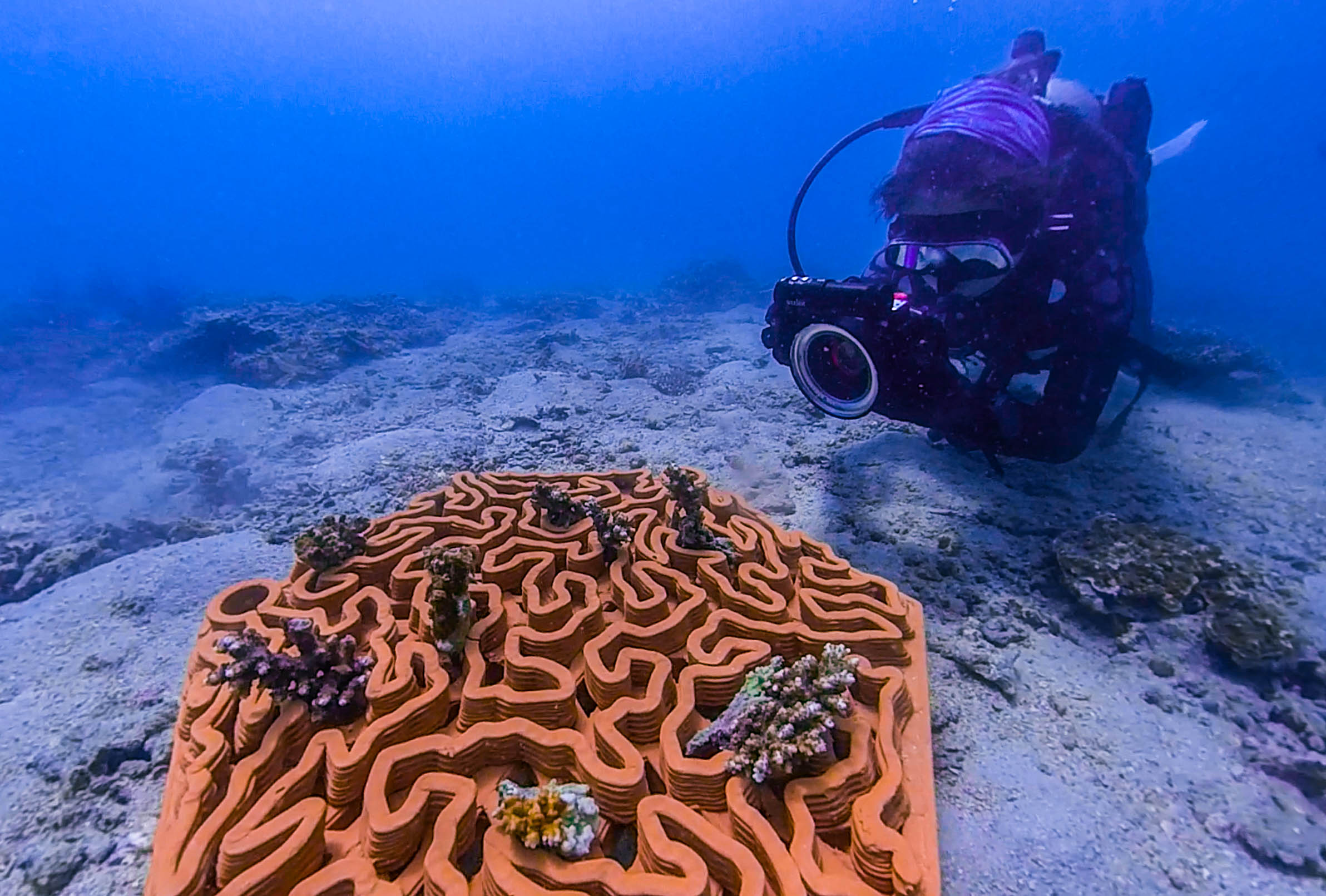
Photogrammetry uses photographs to produce detailed 3D models of the reef. These models allow the team to measure changes in coral growth and reef structure over time.
Environmental DNA, commonly known as eDNA, offers another way to monitor marine biodiversity. Traditional ecological surveys often depend on divers recording the species they can see. eDNA testing instead examines traces of genetic material left in the water by marine organisms, including skin cells, mucus and waste.
By analyzing these traces, Archireef can detect species that may be hidden, difficult to identify or absent during a dive. This gives the company a more complete picture of the ecosystem and how it is changing.
For Archireef, the success of a coral reef restoration project is determined by what happens several years after installation.
“The indicators that matter aren’t the ones that look good on deployment day”, Yu says. “They’re the ones that show, two, three and five years on, whether a genuine ecosystem is establishing and sustaining itself”.
At the company’s first restoration site in Hoi Ha Wan, Hong Kong, around 90% of the transplanted corals remained alive four years after deployment. The long-term survival rate suggests that the ecosystem is recovering rather than simply appearing healthy during the early stages of the project.
Results like these have helped Archireef move beyond academic research and secure collaborations across the public and private sectors. In Hong Kong, the company has worked with government departments and public organisations responsible for coastal infrastructure and marine conservation.
Keep Reading
Examining how robots are moving from demonstrations to daily use.
Updated
January 28, 2026 5:53 PM

An industrial robotic arm capable of autonomous welding. PHOTO: ADOBE STOCK
CES 2026 did not frame robotics as a distant future or a technological spectacle. Instead, it highlighted machines designed for the slow, practical work of fitting into human systems. Across the show floor, robots were no longer performing for attention but being shaped by real-world constraints—space, safety, fatigue and repetition.
They appeared in factories, homes, emergency settings and industrial sites, each responding to a specific kind of human limitation. Together, these four robots reveal how robotics is being redefined: not as a replacement for people, but as infrastructure that quietly takes on work humans are least meant to carry alone.
Hyundai Motor unveiled its electric humanoid robot, Atlas, during a media day on January 5, 2026, at the Mandalay Bay Convention Center in Las Vegas as part of CES 2026. Developed with Boston Dynamics, Hyundai’s U.S.-based robotics subsidiary, Atlas was presented in two forms: a research prototype and a commercial model designed for real factory environments.
Shown under the theme “AI Robotics, Beyond the Lab to Life: Partnering Human Progress,” Atlas is designed to work alongside humans rather than replace them. The premise is straightforward—robots take on physically demanding and repetitive tasks such as sorting and assembly, while people focus on work requiring judgment, creativity and decision-making.
Built for industrial use, the commercial version of Atlas is designed to adapt quickly, with Hyundai stating it can learn new tasks within a day. Its adult-sized humanoid form features 56 degrees of freedom, enabling flexible, human-like movement. Tactile sensors in its hands and a 360-degree vision system support spatial awareness and precise operation.
Atlas is also engineered for demanding conditions. It can lift up to 50 kilograms, operate in temperatures ranging from –20°C to 40°C and is waterproof, making it suitable for challenging factory settings.
Looking ahead, Hyundai expects Atlas to begin with parts sorting and sequencing by 2028, move into assembly by 2030 and later take on precision tasks that require sustained physical effort and focus.
Widemount’s Smart Firefighting Robot is designed to operate in environments that are difficult and dangerous for humans to enter. Developed by Widemount Dynamics, a spinout from the Hong Kong Polytechnic University, the robot is built to support emergency teams during fires, particularly in enclosed and smoke-filled spaces.
The robot can move through buildings and industrial facilities even when visibility is near zero. Rather than relying on cameras or GPS, it uses radar-based mapping to understand its surroundings and determine a safe path forward. This allows it to continue operating when smoke, heat or debris would normally restrict access.
As it approaches a fire, the robot analyses the burning object. Its onboard AI helps identify the material involved and selects an appropriate extinguishing method. Sensors simultaneously assess flame intensity and send real-time updates to command centres, giving responders clearer situational awareness.
When actively fighting a fire, the robot can aim directly at the source and deploy extinguishing agents autonomously. The system continuously adjusts its actions based on incoming sensor data, reducing the need for constant human intervention during high-risk situations.
At CES 2026, LG Electronics offered a glimpse into how household work could gradually shift from people to machines. The company introduced LG CLOiD, an AI-powered home robot designed to manage everyday chores by working directly with connected appliances within LG’s ThinQ ecosystem.
Designed for indoor living spaces, CLOiD features a compact upper body with two articulated arms, a head unit and a wheeled base that enables steady movement across floors. Its torso can tilt to adjust height, allowing it to reach items placed low or on kitchen counters. The arms and hands are built for careful handling, enabling the robot to grip common household objects rather than heavy tools. The head also functions as a mobile control unit, housing cameras, sensors, a display and voice interaction capabilities for communication and monitoring.
In practice, CLOiD acts as a task coordinator. It can retrieve items from appliances, operate ovens and washing machines and manage laundry cycles from start to finish, including folding and stacking clothes. By connecting multiple devices through the ThinQ system, the robot turns separate appliances into a single, coordinated workflow.
These capabilities are supported by LG’s Physical AI system. CLOiD uses vision to recognise objects and interpret its surroundings, language processing to understand instructions and action control to execute tasks step by step. Together, these systems allow the robot to follow routines, respond to user input and adjust task execution over time.
Doosan Robotics introduced Scan & Go at CES 2026, an AI-driven robotic system designed to automate large-scale surface repair and inspection. The solution targets environments with complex, irregular surfaces that are difficult to pre-program, such as aircraft structures, wind turbine blades and large industrial installations.
Scan & Go operates by scanning surfaces on site and building an understanding of their shape in real time. Instead of relying on detailed digital models or manual coding, the system plans its movements based on live data. This enables it to adapt to variations in size, curvature and surface condition without extensive setup.
The underlying technology combines 3D sensing with AI-based motion planning. The system interprets surface data, generates tool paths and refines its actions as work progresses. In practical terms, this reduces manual intervention while maintaining consistency across large work areas.
By handling surface preparation and inspection tasks that are time-consuming and physically demanding, Scan & Go is positioned as a support tool for industrial teams operating at scale.
Taken together, these robots signal a clear shift in how machines are being designed and deployed. Across factories, homes, emergency sites and industrial infrastructure, robotics is moving beyond demonstrations and into practical roles that support human work.
The unifying theme is not replacement, but relief—robots taking on tasks that are repetitive, hazardous or physically demanding. CES 2026 suggests that robotics is evolving from spectacle to utility, with a growing focus on systems that adapt to real environments, respond to genuine constraints and integrate into everyday workflows.