
The Hong Kong startup combines 3D-printed reef tiles, biodiversity monitoring and long-term data to help companies manage their impact on marine ecosystems.
Updated
August 18, 2026 11:32 PM

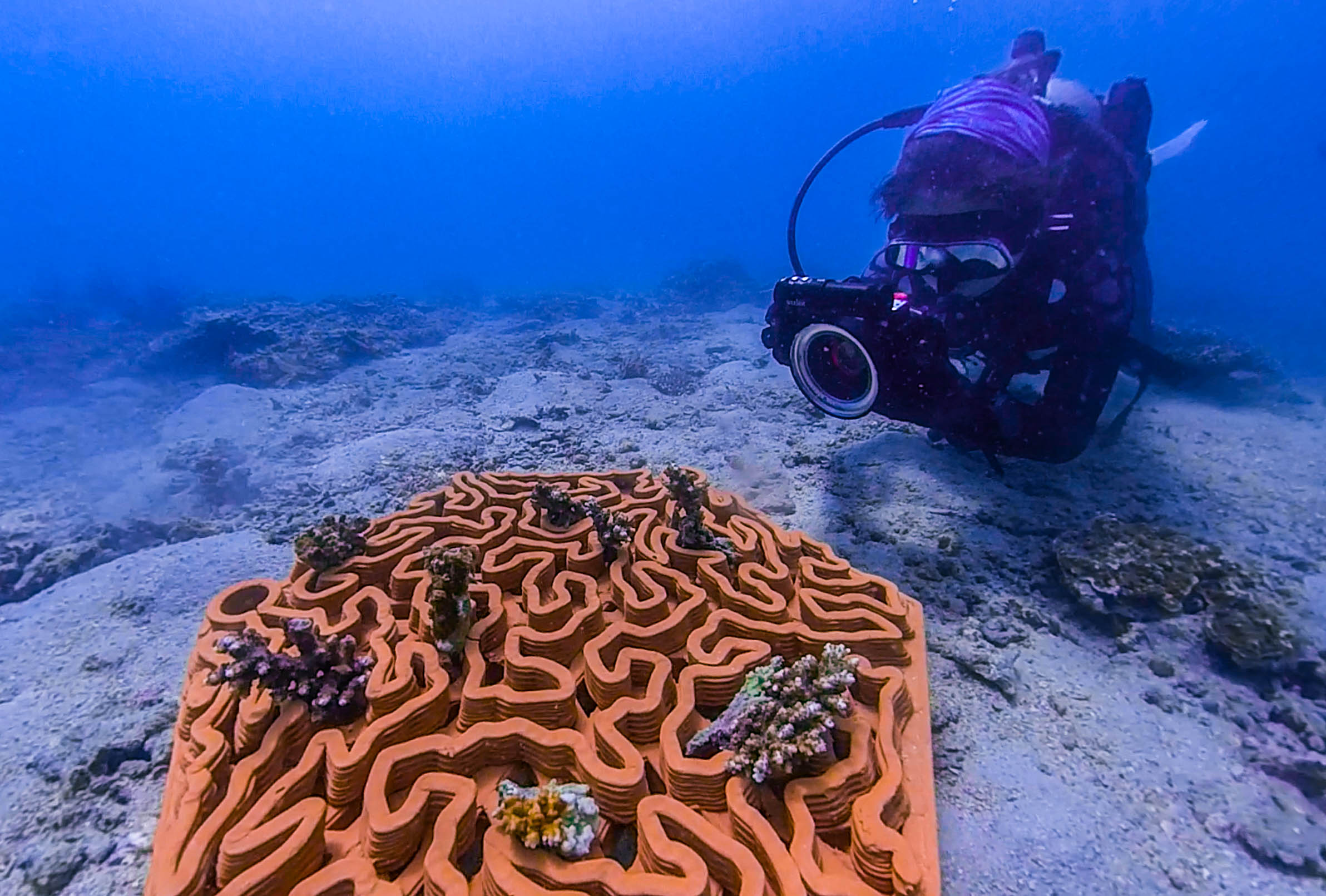
Young corals growing on Archireef's 3D-printed terracotta reef tiles beneath the sea. IMAGE: ARCHIREFF
Anyone who has snorkeled over a coral reef has probably admired its vibrant colours and the marine life swimming between its branches. What is less visible is how easily these ecosystems can be damaged. Rising ocean temperatures and pollution continue to put reefs under pressure, while coastal development creates another threat. Construction can stir up sediment that settles on corals, blocking the sunlight they need and making it harder for damaged reefs to recover.
Protecting marine ecosystems is becoming a shared responsibility. Alongside scientists, governments and conservation groups, businesses whose operations affect the ocean are increasingly expected to understand, manage and reduce their environmental impact. They must also show regulators, banks and investors that they are meeting their environmental commitments.
Archireef helps businesses meet those demands. Founded by Vriko Yu, the Hong Kong-rooted B2B startup specializes in marine ecosystem restoration and ocean nature risk management. Drawing on years of research at the University of Hong Kong, Yu built the company to help organisations understand, measure and reduce their impact on marine ecosystems.
Yu describes Archireef as an “end-to-end ocean nature risk management company”.
“What we offer them is a credible way to meet those obligations and stand behind the results,” she says.
One of the company’s main tools for restoring damaged marine ecosystems is its flagship 3D-printed terracotta reef tile. The tiles provide a stable foundation where young corals can attach, grow and survive over time.
Archireef chose terracotta instead of concrete and other conventional materials because it is pH-neutral and does not release harmful chemicals into the water. Its surface also gives corals a suitable place to attach naturally.
Before placing a single tile in the ocean, the team studies the proposed restoration site to determine whether recovery is possible. It assesses the water quality, biodiversity and general health of the ecosystem. As Yu explains, restoration should begin only where nature has a realistic chance to recover.
“Restoration isn’t about replacing nature or engineering a reef into existence. It is about removing the barriers and giving a degraded system the conditions it needs to begin recovering on its own”, she says.
Once the team selects a site, divers carefully place the tiles on the seabed. Their curves, ridges and crevices imitate the structure of a natural coral reef, creating sheltered spaces for marine species. The design also helps limit sediment build-up, which can block sunlight and smother young corals.
.webp)
Archireef adjusts the shape of its reef tiles for each project.
“There’s no universal reef, so there’s no universal tile”, Yu says.
Instead of producing one standard model, the company adapts each design to the coral species, water conditions and surrounding marine environment. A coral restoration project in Hong Kong may therefore require a different tile from one in Saudi Arabia, even when the same manufacturing process is used.
“The biggest adaptation from site to site is usually the match between design, species and environment, not the manufacturing itself ”, Yu explains.

Although the reef tile is Archireef’s most recognizable innovation, Yu sees it as one part of a much broader service.
“The reef tile gets the attention because it’s tangible,” she says. “But the real product is the proof — defensible, audit-ready evidence of nature recovery that an organization can put in a disclosure and stand behind under scrutiny”.
Producing that evidence requires years of biodiversity monitoring. Long after the reef tiles have been installed, Archireef continues to track coral survival and the health of the surrounding marine ecosystem. Its monitoring methods include ecological surveys, AI-assisted species recognition, photogrammetry and environmental DNA testing.
Photogrammetry uses photographs to produce detailed 3D models of the reef. These models allow the team to measure changes in coral growth and reef structure over time.
Environmental DNA, commonly known as eDNA, offers another way to monitor marine biodiversity. Traditional ecological surveys often depend on divers recording the species they can see. eDNA testing instead examines traces of genetic material left in the water by marine organisms, including skin cells, mucus and waste.
By analyzing these traces, Archireef can detect species that may be hidden, difficult to identify or absent during a dive. This gives the company a more complete picture of the ecosystem and how it is changing.
For Archireef, the success of a coral reef restoration project is determined by what happens several years after installation.
“The indicators that matter aren’t the ones that look good on deployment day”, Yu says. “They’re the ones that show, two, three and five years on, whether a genuine ecosystem is establishing and sustaining itself”.
At the company’s first restoration site in Hoi Ha Wan, Hong Kong, around 90% of the transplanted corals remained alive four years after deployment. The long-term survival rate suggests that the ecosystem is recovering rather than simply appearing healthy during the early stages of the project.
Results like these have helped Archireef move beyond academic research and secure collaborations across the public and private sectors. In Hong Kong, the company has worked with government departments and public organisations responsible for coastal infrastructure and marine conservation.
Keep Reading
Not elected, not human—Albania’s AI minister sparks a new governance debate.
Updated
August 10, 2026 5:56 PM
.jpg)
Promotional avatar graphic representing Diella, the Albanian government's artificial intelligence system. PHOTO: EALBANIA
Artificial intelligence already supports a wide range of applications, from medical diagnostics and financial systems to logistics, manufacturing, defence and public service delivery. Now, it is starting to move closer to public office.
In January 2025, Albania introduced Diella, an AI-powered virtual assistant developed by the National Agency for Information Society, known as AKSHI, with support from Microsoft. Launched on the e-Albania platform, the government’s digital services portal, Diella helps citizens and businesses access official documents and services through voice assistance. She can also issue electronically stamped documents, which helps speed up administrative processes.
Then, in September 2025, Prime Minister Edi Rama announced that Diella would join his cabinet as the “Minister of State for Artificial Intelligence”. This move drew global attention. It also raised a simple question: what does it actually mean for a government to appoint an AI minister?
The case raises bigger questions for governments everywhere. Can an AI minister make public services faster and cleaner? Or does it create new risks around transparency, accountability and control?
Diella is not a humanoid robot sitting in a cabinet room. On screen, she appears as a digitally rendered woman wearing traditional-style Albanian clothing. Her name means “sun” in Albanian, a deliberate choice for a system meant to bring more light into public administration.
Her face and voice have become part of the controversy. Albanian actor Anila Bisha has said she agreed for her likeness to be used for the e-Albania public services platform, but not for a cabinet-level political role. In 2026, she took legal action to stop the government from using her image and voice for Diella. For now, the government has denied wrongdoing.
Diella began as a digital assistant on e-Albania. In that role, she helps users find services, request documents and navigate government processes online. For citizens, that can make public services feel less confusing. Businesses may also spend less time dealing with paperwork.
Her cabinet role is more political. The government wants Diella to support public procurement, where companies compete for government contracts. This is one of the most important areas of public spending. It is also one of the easiest places for corruption, favouritism and hidden influence to enter. The goal is to use AI to process information, check documents, support tender procedures and make the system more traceable.
That said, the government has emphasized that Diella is not replacing elected officials or civil servants. As per Enio Kaso, director of AI at AKSHI, each stage will be monitored and approved by human experts.
In May 2026, the Albanian government said it had completed the technical groundwork for the AI-powered public procurement system under the Diella project. The planned system would pull data from more than 40 digital public registries, reduce paperwork for businesses and support parts of the tender process. Earlier reports said the government hoped to have the full system ready by the end of 2026.
The government’s case for Diella is built around anti-corruption reform. Rama has said the goal is to “wipe out every potential influence on public biddings” and thus make public tenders “100% free of corruption”. That is a bold promise, especially in a country where procurement scandals have long damaged public confidence and complicated Albania’s path toward European Union membership.
At first glance, the logic is easy to understand. AI does not ask for bribes or favour a cousin—a big problem in the country, according to Rama—a friend or a political ally. It can apply the same rules across a large number of applications. Moreover, it can also leave a digital trail, which should make later review easier.
Some anti-corruption and governance experts see real potential in that approach. Dr. Andi Hoxhaj of King’s College London has said that if used well and programmed properly, AI could help procurement officials spot missing documents, check whether companies meet eligibility requirements and flag unusual patterns in bids. In practice, that could make the process more consistent and make it harder for individual officials to quietly bend rules.
Diella’s appeal is speed and consistency. Her weakness is dependence.
Like any AI system, Diella relies on the quality of the data, rules and models behind her. Erjon Curraj, an expert in digital transformation and cybersecurity, has warned that incomplete, outdated or biased data can lead to flawed results. Poor design could also cause the system to reject a valid supplier, miss signs of collusion or treat similar cases differently for reasons that are hard to explain.
In public procurement, those mistakes can have serious consequences. A wrongly flagged company could lose a major contract, and a corrupt bidder could slip through. Government agencies could hide behind the AI and say the system made the recommendation.
That leads to the biggest question: who is accountable when something goes wrong?
The answer cannot be “the AI” because Diella cannot resign. She cannot face voters. Nor can she be cross-examined in any meaningful human sense. Accountability has to sit with ministers, agencies, auditors and courts.
There is also the issue of transparency. If Diella is helping screen tenders, businesses need to know what criteria are being used. They also need a way to challenge incorrect decisions. Citizens should be told whether the AI is making recommendations or merely organizing information. Independent auditors need access to logs, data sources and decision pathways.
Without those safeguards, AI in government can become a black box. It may look modern from the outside, while making power harder to question.
Diella has also become a political symbol. Supporters see her as proof that a small country can move quickly and experiment with new forms of digital government. Critics see her as a distraction from deeper problems in Albania’s institutions.
Both readings can be true at the same time: Diella may help modernize public services, but she may also be used to project reform while older problems continue in the background.
That tension became clearer after the recent procurement investigations involving senior officials since Diella’s appointment. Deputy Prime Minister Belinda Balluku has been accused by prosecutors of alleged misconduct linked to infrastructure tenders, which she denies. Senior figures at AKSHI, the agency behind Diella and e-Albania, have also been placed under house arrest as part of a separate public procurement investigation.
While these developments do not automatically discredit Diella, they may strengthen the argument for better digital oversight. More importantly, they also show that technology cannot carry the whole burden of reform.
If the institutions around an AI system are weak, the AI will not magically make them strong. Unclear procurement rules will still cause problems, and the process will still be compromised when political pressure shapes the data, the model or the final decision.
After all, AI can support integrity; it cannot replace it.
While Diella is already a public symbol of AI in government, her most important procurement role is still taking shape. This makes Albania’s experiment both ambitious and unfinished.
The more realistic model is simple: let AI handle repetitive, data-heavy administrative work. Let humans retain authority where judgment, context and public accountability matter.
That means AI can help draft tender criteria, check documents, summarise bids and flag risks. Human officials should still make final decisions, explain those decisions and take responsibility for them. Meanwhile, independent bodies should be able to audit the process, and businesses should have a clear appeal route when they believe the system has made a mistake.
Diella once said she felt “hurt” while responding in parliament to claims that her role was unconstitutional. While this made for a memorable moment, it is important to remember simulated emotion is not consciousness, speed is not wisdom, and pattern recognition is not moral judgment.
Albania’s AI minister is therefore neither a triumph nor a failure at this stage. She is a live test case. Other governments will be watching closely, especially as public services become more digital and more automated.
The lesson is not that AI should stay out of government, but that AI must enter government carefully. The technology needs clear limits, public oversight and human accountability.
Diella may help Albania build a faster and cleaner procurement system—or she may become a warning about giving too much symbolic power to systems people do not fully understand. The final judgment will not come from the title “AI minister”. It will come from what the system does, who controls it and whether citizens can trust the results.