
AI growth is increasingly becoming a manufacturing, packaging and deployment challenge — not just a computing one.
Updated
August 10, 2026 5:56 PM

Taipei 101 and Taipei Nan Shan Plaza, viewed from Elephant Mountain. PHOTO: UNSPLASH
As AI companies continue scaling larger models and data centers, the pressure is no longer falling only on chip design. Manufacturing capacity, advanced packaging and infrastructure deployment are becoming equally important parts of the AI race. AMD’s latest investment announcement reflects how quickly that shift is accelerating.
The US chipmaker announced plans to invest more than US$10 billion across Taiwan’s semiconductor and manufacturing ecosystem to support next-generation AI infrastructure. The investment focuses on expanding partnerships and increasing advanced packaging capacity needed for future AI systems.
The announcement highlights a growing reality across the AI industry. Building powerful AI chips is no longer enough on its own. Companies now also need the manufacturing networks, packaging technologies and supply chain coordination required to deploy AI infrastructure at global scale.
AMD’s investments center heavily around advanced chip packaging, an area becoming increasingly critical as AI systems demand higher performance and greater power efficiency. Traditional chip architectures are struggling to keep pace with the size and complexity of modern AI workloads. Advanced packaging helps connect processors, memory and computing systems more efficiently while managing power and cooling limitations inside large-scale AI environments.
The company said it is working with Taiwan-based partners including ASE, SPIL and PTI to develop next-generation packaging technologies for its upcoming 6th Gen AMD EPYC processors, codenamed “Venice.” AMD also said it had qualified what it described as the industry’s first 2.5D panel-based EFB interconnect technology alongside PTI.
At the center of the broader strategy is AMD Helios, the company’s rack-scale AI infrastructure platform scheduled for deployment beginning in the second half of 2026. The platform combines AMD Instinct MI450X GPUs, 6th Gen EPYC CPUs, networking systems and AMD’s ROCm software stack into integrated AI infrastructure systems designed for hyperscale deployment.
Rather than selling individual processors alone, companies are increasingly building complete AI infrastructure platforms that combine hardware, software, cooling systems and power management into unified deployments. That transition is reshaping how AI infrastructure is designed, manufactured and delivered.
Taiwan is also becoming more deeply embedded in that process. AMD’s investment spans not only semiconductor packaging companies but also manufacturing and system integration partners including Sanmina, Wiwynn, Wistron and Inventec. The partnerships reflect Taiwan’s growing role as one of the operational centers of the global AI infrastructure economy.
Dr. Lisa Su, Chair and CEO of AMD, said: “As AI adoption accelerates, our global customers are rapidly scaling AI infrastructure to meet growing compute demand. By combining AMD leadership in high-performance computing with the Taiwan ecosystem and our strategic global partners, we are enabling integrated, rack-scale AI infrastructure that helps customers accelerate deployment of next-generation AI systems”.
Power efficiency is becoming another major challenge shaping AI infrastructure decisions. As AI workloads consume more electricity and generate more heat, infrastructure providers are increasingly being forced to rethink cooling systems, interconnect technologies and deployment economics.
AMD’s announcement signals how the AI competition is evolving beyond model development and raw computing power. The next stage may depend just as heavily on who can manufacture, package and deploy AI infrastructure fast enough to support global demand.
Keep Reading
A humanoid robot being escorted away by police in Macau has gone viral online, prompting jokes about what some called the world’s first “robot arrest.”
Updated
April 1, 2026 8:55 AM
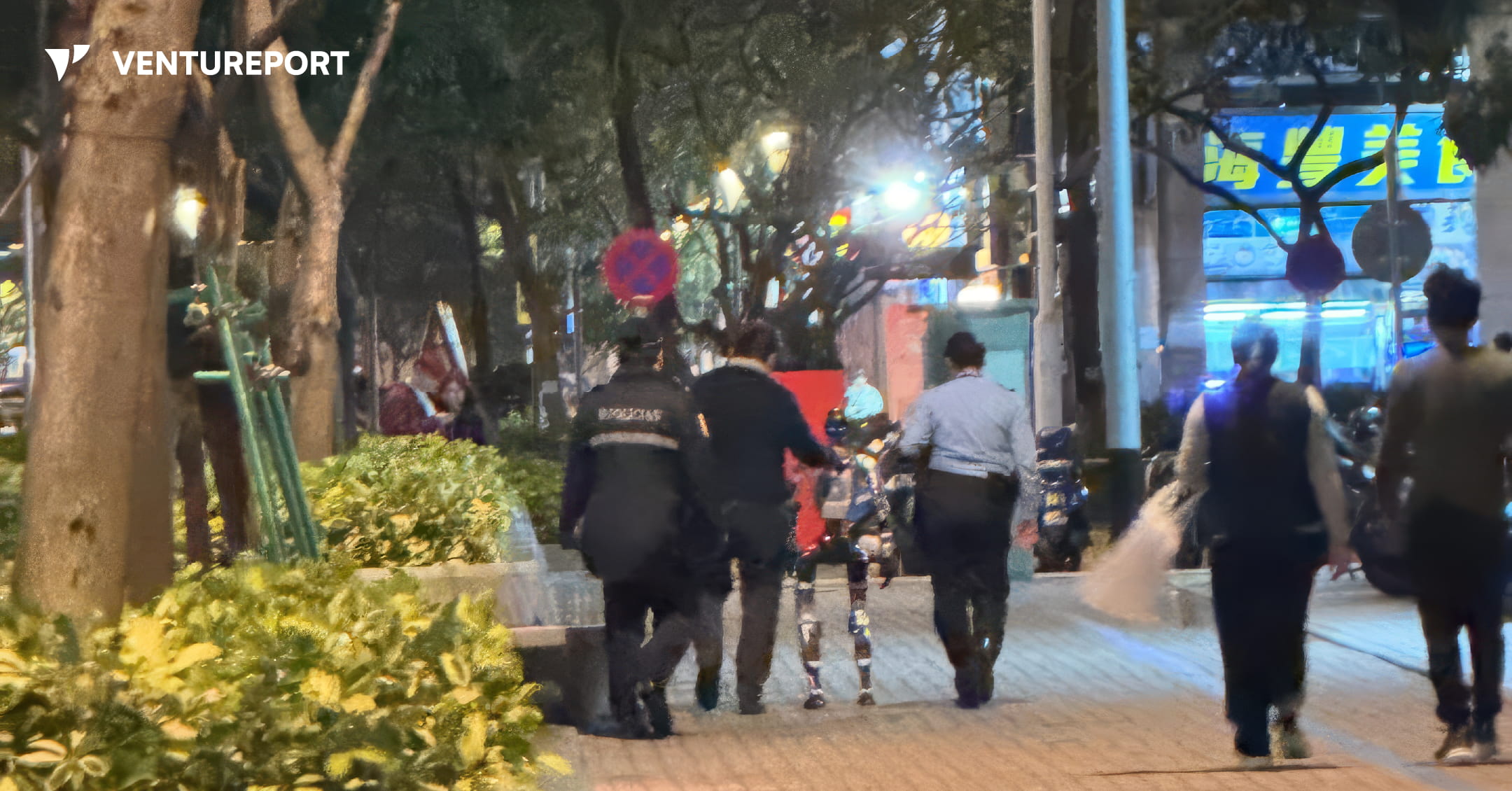
Macau police officer accompanying the humanoid robot. PHOTO: THREADS@BOXOF_CHOCOLATE
Police in Macau recently detained a humanoid robot after it frightened an elderly woman on a public street. The unusual encounter quickly spread online, prompting jokes about what some called the world’s first “robot arrest”.
On the evening of March 5, the robot was taken away by officers after the encounter triggered alarm among bystanders. Videos circulating on social media show an elderly woman confronting the robot on a sidewalk, visibly distressed and shouting that her “heart is pounding” while demanding to know why such “nonsense” was happening on the street. In the clip, the robot raises both hands toward the woman after she lashes out in fear — a gesture many viewers interpreted as a sign of apology.
Shortly afterwards, two officers from the Macau Public Security Police Force were seen escorting the robot and a man believed to be its operator away from the area. An officer is seen placing his right hand on the robot’s shoulder — the same posture police often use when presenting arrested suspects in official photographs.
That scene quickly spread online, fuelling jokes about what some called the world’s first “robot arrest”.
Photos shared online show a humanoid robot with long limbs and exposed mechanical joints, built from a black metallic frame without an outer shell. In dim lighting, several commenters said it resembled a “moving skeleton” — a striking sight for pedestrians encountering it unexpectedly on the street.
Witnesses said the woman appeared severely shaken and an ambulance was eventually called to take her to the hospital.
The incident also sparked discussion online about robots operating in public spaces. Some commenters argued that experimental technologies should be tested in controlled environments, while others said machines moving through public areas should have clearer designs or safety measures to avoid alarming pedestrians.
It remains unclear who deployed the robot or what purpose it was serving in the area at the time of the incident. Authorities have not released further details about the device or whether any action was taken following the encounter.