
Huawei is betting that the future of AI infrastructure will depend as much on energy systems as on computing power
Updated
August 10, 2026 5:56 PM

Blue light painting with a lightbulb. PHOTO: UNSPLASH
As AI companies build larger models and deploy more AI agents, the industry is running into a new constraint: electricity. The challenge is no longer just about computing power. It is increasingly about how to supply, manage and sustain the energy needed to run AI infrastructure at scale.
That was the central argument behind Huawei’s latest AI data center strategy unveiled at its Global AIDC Industry Summit in Dongguan.
The company introduced what it calls a grid-interactive AIDC strategy, focused on redesigning AI data centers around power supply, cooling systems and energy management. AIDC refers to AI data centers built specifically for large-scale AI computing workloads.
The announcement reflects a broader shift happening across the industry. As AI systems grow larger, data centers are consuming more electricity and generating more heat than traditional computing infrastructure was designed to handle. Companies are now being forced to rethink not just chips and servers, but the physical systems supporting them.
Huawei argues that future AI infrastructure will need closer coordination between computing systems and energy grids. The company says traditional data center designs are struggling to keep up with fluctuating AI workloads, rising power density and the growing use of renewable energy sources.
Hou Jinlong, Director of the Board of Huawei and President of Huawei Digital Power, said: "The booming AI industry, widely adopted large models, and numerous AI agents are creating huge energy demands, set to boost the global AIDC capacity. Electricity is essential for computing; energy is the foundation for AI long-term development. Computing and electricity will deeply synergize and empower each other, progressively building an integrated framework that brings together new power systems and AI infrastructure."
A large part of Huawei’s strategy focuses on power architecture. AI workloads can create sudden spikes in electricity demand, especially in high-density computing environments. To manage that, Huawei says it plans to develop new power systems that combine grid-friendly UPS infrastructure with energy storage technologies.
Cooling is becoming another major pressure point. AI servers generate significantly more heat than traditional enterprise systems and Huawei says liquid cooling is now becoming essential for large-scale AI deployments. The company introduced a liquid cooling system designed to improve long-term thermal management inside high-density AI environments.
Huawei is also pushing modular construction methods to reduce deployment times for AI data centers. Instead of building infrastructure entirely onsite, parts of the system can be prefabricated and tested in factories before installation.
Bob He, Vice President of Huawei Digital Power, said: "The global AI industry is booming, and the token demand surges. As such, the AIDC industry is entering the Token era."
As part of that shift, Huawei introduced a proposed measurement system called the TokEnergy Index. The company says the metric is designed to measure the relationship between energy consumption and AI computing output, rather than relying only on traditional data center efficiency metrics such as PUE.
The broader message behind the strategy is that AI infrastructure is becoming an energy engineering problem as much as a computing problem. As global demand for AI continues to rise, companies across the sector are beginning to realise that the future of AI may depend not only on better models, but also on whether power grids and data centers can keep up with them.
Keep Reading
Rethinking 3D modelling for a world that generates too much, too quickly.
Updated
January 8, 2026 6:32 PM
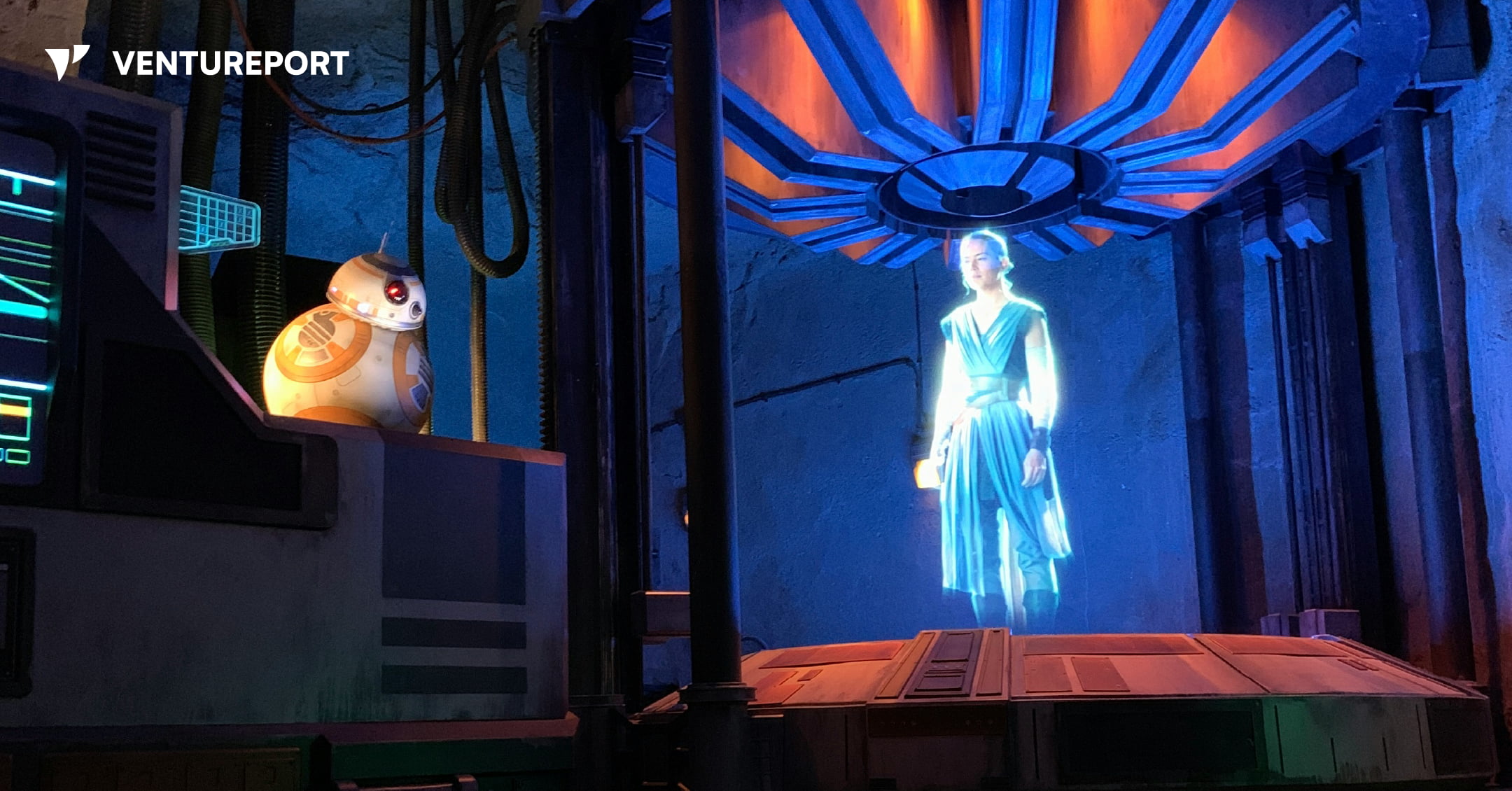
A hologram in the franchise Star Wars, in Walt Disney World Resort, Orlando. PHOTO: UNSPLASH
MicroCloud Hologram Inc. (NASDAQ: HOLO), a technology service provider recognized for its holography and imaging systems, is now expanding into a more advanced realm: a quantum-driven 3D intelligent model. The goal is to generate detailed 3D models and images with far less manual effort — a need that has only grown as industries flood the world with more visual data every year.
The concept is straightforward, even if the technology behind it isn’t. Traditional 3D modeling workflows are slow, fragmented and depend on large teams to clean datasets, train models, adjust parameters and fine-tune every output. HOLO is trying to close that gap by combining quantum computing with AI-powered 3D modeling, enabling the system to process massive datasets quickly and automatically produce high-precision 3D assets with much less human involvement.
To achieve this, the company developed a distributed architecture comprising of several specialized subsystems. One subsystem collects and cleans raw visual data from different sources. Another uses quantum deep learning to understand patterns in that data. A third converts the trained model into ready-to-use 3D assets based on user inputs. Additional modules manage visualization, secure data storage and system-wide protection — all supported by quantum-level encryption. Each subsystem runs in its own container and communicates through encrypted interfaces, allowing flexible upgrades and scaling without disrupting the entire system.
Why this matters: Industries ranging from gaming and film to manufacturing, simulation and digital twins are rapidly increasing their reliance on 3D content. The real bottleneck isn’t creativity — it’s time. Producing accurate, high-quality 3D assets still requires a huge amount of manual processing. HOLO’s approach attempts to lighten that workload by utilizing quantum tools to speed up data processing, model training, generation and scaling, while keeping user data secure.
According to the company, the system’s biggest advantages include its ability to handle massive datasets more efficiently, generate precise 3D models with fewer manual steps, and scale easily thanks to its modular, quantum-optimized design. Whether quantum computing will become a mainstream part of 3D production remains an open question. Still, the model shows how companies are beginning to rethink traditional 3D workflows as demand for high-quality digital content continues to surge.