
Huawei is betting that the future of AI infrastructure will depend as much on energy systems as on computing power
Updated
August 10, 2026 5:56 PM

Blue light painting with a lightbulb. PHOTO: UNSPLASH
As AI companies build larger models and deploy more AI agents, the industry is running into a new constraint: electricity. The challenge is no longer just about computing power. It is increasingly about how to supply, manage and sustain the energy needed to run AI infrastructure at scale.
That was the central argument behind Huawei’s latest AI data center strategy unveiled at its Global AIDC Industry Summit in Dongguan.
The company introduced what it calls a grid-interactive AIDC strategy, focused on redesigning AI data centers around power supply, cooling systems and energy management. AIDC refers to AI data centers built specifically for large-scale AI computing workloads.
The announcement reflects a broader shift happening across the industry. As AI systems grow larger, data centers are consuming more electricity and generating more heat than traditional computing infrastructure was designed to handle. Companies are now being forced to rethink not just chips and servers, but the physical systems supporting them.
Huawei argues that future AI infrastructure will need closer coordination between computing systems and energy grids. The company says traditional data center designs are struggling to keep up with fluctuating AI workloads, rising power density and the growing use of renewable energy sources.
Hou Jinlong, Director of the Board of Huawei and President of Huawei Digital Power, said: "The booming AI industry, widely adopted large models, and numerous AI agents are creating huge energy demands, set to boost the global AIDC capacity. Electricity is essential for computing; energy is the foundation for AI long-term development. Computing and electricity will deeply synergize and empower each other, progressively building an integrated framework that brings together new power systems and AI infrastructure."
A large part of Huawei’s strategy focuses on power architecture. AI workloads can create sudden spikes in electricity demand, especially in high-density computing environments. To manage that, Huawei says it plans to develop new power systems that combine grid-friendly UPS infrastructure with energy storage technologies.
Cooling is becoming another major pressure point. AI servers generate significantly more heat than traditional enterprise systems and Huawei says liquid cooling is now becoming essential for large-scale AI deployments. The company introduced a liquid cooling system designed to improve long-term thermal management inside high-density AI environments.
Huawei is also pushing modular construction methods to reduce deployment times for AI data centers. Instead of building infrastructure entirely onsite, parts of the system can be prefabricated and tested in factories before installation.
Bob He, Vice President of Huawei Digital Power, said: "The global AI industry is booming, and the token demand surges. As such, the AIDC industry is entering the Token era."
As part of that shift, Huawei introduced a proposed measurement system called the TokEnergy Index. The company says the metric is designed to measure the relationship between energy consumption and AI computing output, rather than relying only on traditional data center efficiency metrics such as PUE.
The broader message behind the strategy is that AI infrastructure is becoming an energy engineering problem as much as a computing problem. As global demand for AI continues to rise, companies across the sector are beginning to realise that the future of AI may depend not only on better models, but also on whether power grids and data centers can keep up with them.
Keep Reading
A humanoid robot being escorted away by police in Macau has gone viral online, prompting jokes about what some called the world’s first “robot arrest.”
Updated
April 1, 2026 8:55 AM
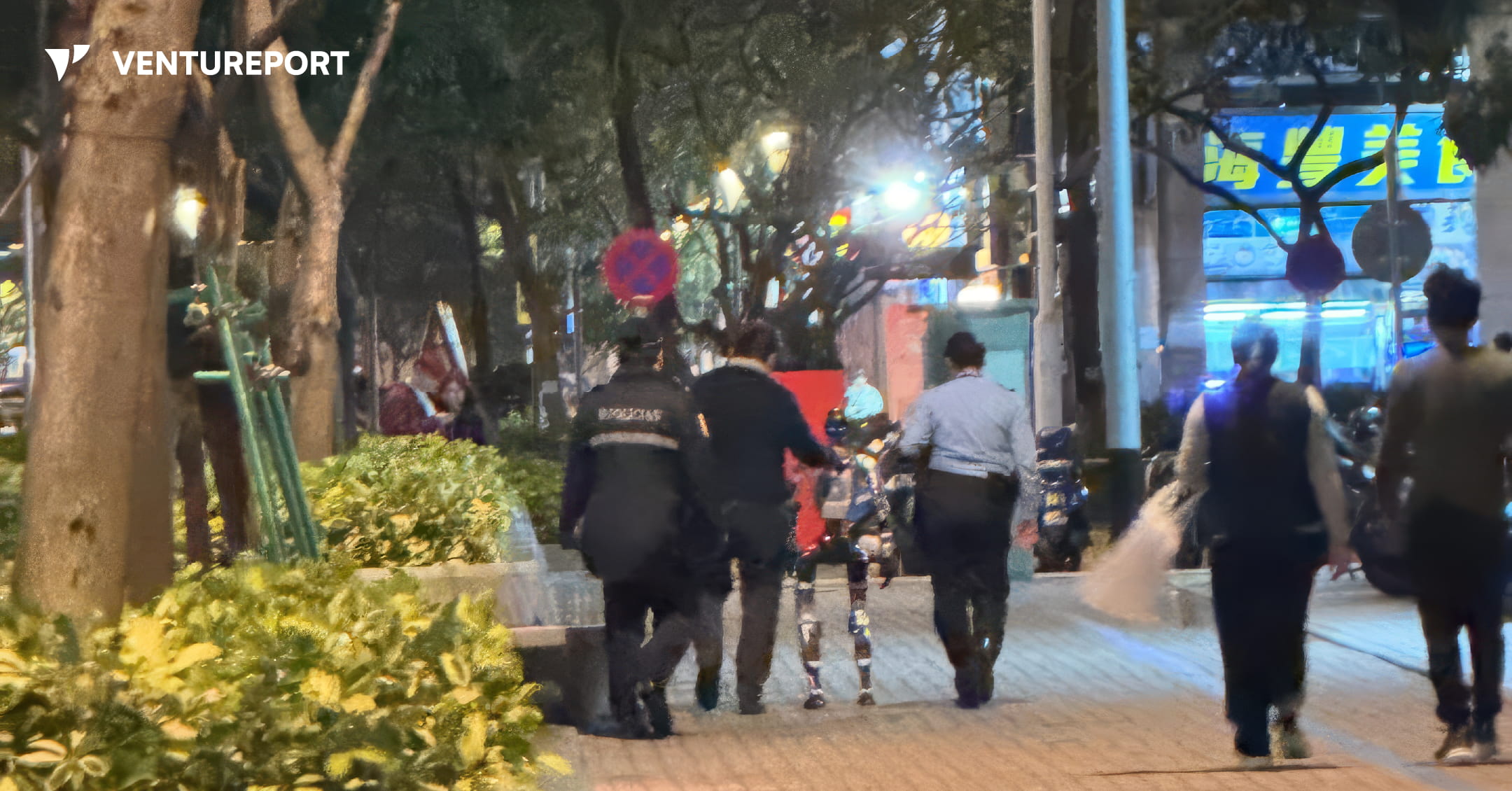
Macau police officer accompanying the humanoid robot. PHOTO: THREADS@BOXOF_CHOCOLATE
Police in Macau recently detained a humanoid robot after it frightened an elderly woman on a public street. The unusual encounter quickly spread online, prompting jokes about what some called the world’s first “robot arrest”.
On the evening of March 5, the robot was taken away by officers after the encounter triggered alarm among bystanders. Videos circulating on social media show an elderly woman confronting the robot on a sidewalk, visibly distressed and shouting that her “heart is pounding” while demanding to know why such “nonsense” was happening on the street. In the clip, the robot raises both hands toward the woman after she lashes out in fear — a gesture many viewers interpreted as a sign of apology.
Shortly afterwards, two officers from the Macau Public Security Police Force were seen escorting the robot and a man believed to be its operator away from the area. An officer is seen placing his right hand on the robot’s shoulder — the same posture police often use when presenting arrested suspects in official photographs.
That scene quickly spread online, fuelling jokes about what some called the world’s first “robot arrest”.
Photos shared online show a humanoid robot with long limbs and exposed mechanical joints, built from a black metallic frame without an outer shell. In dim lighting, several commenters said it resembled a “moving skeleton” — a striking sight for pedestrians encountering it unexpectedly on the street.
Witnesses said the woman appeared severely shaken and an ambulance was eventually called to take her to the hospital.
The incident also sparked discussion online about robots operating in public spaces. Some commenters argued that experimental technologies should be tested in controlled environments, while others said machines moving through public areas should have clearer designs or safety measures to avoid alarming pedestrians.
It remains unclear who deployed the robot or what purpose it was serving in the area at the time of the incident. Authorities have not released further details about the device or whether any action was taken following the encounter.