
A planned city explores how real-time data and automation can shape everyday urban systems
Updated
May 1, 2026 2:25 PM

A package being delivered by drone using the Meituan app. PHOTO: ADOBE STOCK
A newly built district in northern China is being used to test how cities function when infrastructure, data and automation are integrated from the ground up. In Xiong'an New Area, traffic systems, public monitoring and urban services are designed to respond in real time rather than operate on fixed rules.
At the centre of this is a traffic management system powered by more than 20,000 roadside sensors. These track traffic flow, vehicle types and congestion levels, feeding data into an AI system that adjusts signals in milliseconds. Official figures show this has reduced the average number of stops per vehicle by half. The system also detects equipment faults, sends alerts and generates maintenance requests without manual input.
Automation extends beyond roads. Drones are deployed across the city for routine monitoring. In the Rongdong district, roadside units release drones that follow fixed patrol routes of around 1.27 kilometres, completing each run in about five minutes. They are used to monitor traffic, detect illegal parking and inspect public spaces. Similar systems operate in parks to track water levels and issue flood alerts, while in some work zones, drones transport packages of up to five kilograms between buildings.
These applications reflect a broader approach: integrating multiple systems into a single, connected urban framework. Unlike older cities where infrastructure evolves in layers, Xiong’an has been built with coordinated digital systems from the outset. This allows transport, maintenance and public services to operate through shared data systems rather than in isolation.
Alongside this, the area is being developed as a technology and innovation hub. Since its establishment in 2017, it has attracted more than 400 branches of state-owned enterprises and over 200 companies working in sectors such as artificial intelligence, aerospace information and digital technology.
This ecosystem supports projects like the “Xiong’an-1” satellite, which completed research, design, production and testing within eight months of regulatory approval in 2025. The satellite is currently undergoing testing, with a planned launch expected in the second quarter of 2026. It forms part of a broader push to build an aerospace information industry in the region.
The area is also structured to bring companies, research and production closer together. At the Zhongguancun Science Park in Xiong’an, which spans 207,000 square metres, 269 technology companies operate across sectors including AI, robotics and biotechnology. The park hosts more than 2,700 researchers and industry professionals, with companies organised into sector-specific clusters.
Policy support continues to shape this development. In early 2026, the State Council approved the upgrade of Xiong’an’s high-tech industrial development zone to national level status, with a focus on attracting high-end research and strengthening links between scientific development and industrial output.
Xiong’an is positioned as a testing ground for how smart city systems can be deployed at scale. The model depends on coordinated planning, integrated infrastructure and sustained policy support. Whether these systems can be adapted to existing cities, where infrastructure and governance are more fragmented, remains an open question.
Keep Reading
How a Korean biotech startup is using AI to move drug discovery from trial-and-error to precision design
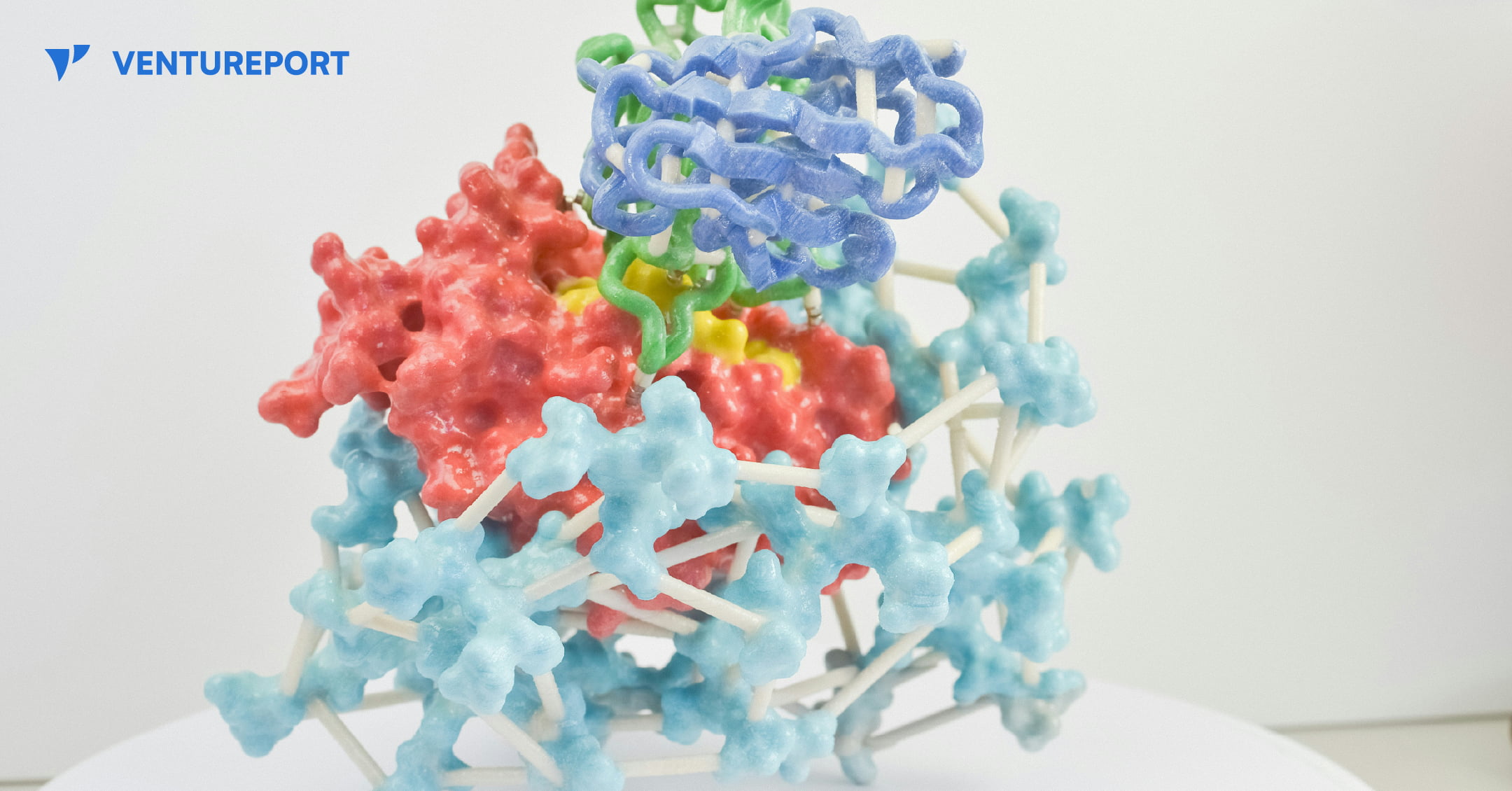
A close up of a protein structure model. PHOTO: UNSPLASH
For decades, drug discovery has relied on trial and error, with scientists testing thousands of molecules to find one that works. Galux, a South Korean biotech startup, is changing that by using AI to design proteins from scratch. This method, called “de novo” design, makes it possible to build precise new therapies instead of searching through existing ones.
The company recently announced a US$29 million Series B funding round, bringing its total capital to US$47 million.This significant investment attracted a substantial roster of institutional backers, including the Korea Development Bank (KDB), Yuanta Investment, SL Investment and NCORE Ventures. These firms joined existing investors such as InterVest, DAYLI Partners and PATHWAY Investment, as well as new participants including SneakPeek Investments, Korea Investment & Securities and Mirae Asset Securities.
At the core of the company’s work is a platform called GaluxDesign. Unlike many AI tools that only predict how existing proteins fold, this system uses deep learning and physics to create entirely new therapeutic antibodies. This “from scratch” approach lets the team go after so-called “undruggable” proteins. These are targets that traditional small-molecule drugs can’t reach because they lack clear binding pockets. By designing proteins to fit these complex shapes, Galux aims to unlock treatments that have stayed out of reach for decades. And that’s exactly why investors are paying attention.
The pharmaceutical industry is actively looking for faster and more efficient ways to develop new drugs, and Galux is built for exactly that. The company connects its AI platform directly to its own wet lab, where designs can be tested in real time. Each result feeds straight back into the system, sharpening the next round of models. This continuous loop speeds up discovery and improves precision at every step. It’s also why partners like Celltrion, LG Chem and Boehringer Ingelheim are already working with Galux.
Galux is no longer just trying to make drugs that stick to a target. The company now wants its AI to design medicines that actually work in the body and can be made at scale. In simple terms, a drug has to do more than bind to a disease—it must be stable, safe and strong enough to change how the illness behaves. Galux is moving into tougher targets such as ion channels and GPCRs. These play key roles in heart function and sensory signals. Ultimately, the goal is to show that AI-driven design can turn complex biology into real treatments. And instead of hunting blindly for a solution, the team is building exactly what they need.