
As workplace knowledge spreads across chats, AI firms are building systems that can structure, retrieve and preserve it over time.
Updated
August 10, 2026 5:56 PM

A messaging app on a phone. PHOTO: ADOBE STOCK
Votee AI, an enterprise AI company headquartered in Hong Kong, has partnered with its Toronto-based research lab Beever AI to launch Beever Atlas. The new platform is designed to turn workplace chats into searchable knowledge that AI systems can retrieve and understand.
The release focuses on a growing issue inside organisations. Much of today’s workplace knowledge now exists inside chat platforms such as Slack, Microsoft Teams, Discord and Telegram. Important discussions, project decisions and technical information often disappear into long message histories that are difficult to search later.
Beever AI developed the platform to organise those conversations into a structured system for AI assistants. The software connects with Telegram, Discord, Mattermost, Microsoft Teams and Slack, then converts conversations into linked records of people, projects, files and decisions.
The collaboration combines Votee AI’s enterprise infrastructure work with Beever AI’s research around AI memory systems. The companies are releasing two versions of the product. The open-source edition is aimed at individual developers, researchers and creators. The enterprise edition is designed for banks, government agencies and larger organisations with stricter security requirements.
The release also reflects a broader shift happening across the AI industry. Companies are increasingly looking at how AI systems store and retrieve long-term knowledge, rather than relying solely on large context windows or search-based retrieval.
Earlier this year, OpenAI founding member and former director of AI at Tesla Andrej Karpathy discussed the growing need for what he described as “LLM Knowledge Bases.” He argued that AI systems need structured and evolving memory rather than depending only on context windows and vector search.
Beever Atlas approaches that problem through workplace communication. Instead of focusing mainly on uploaded files, the system is designed around conversations that happen daily across team chat platforms. It can also process images, PDFs, voice notes and video files within the same searchable system.
The companies say the software is designed to work directly with AI assistants and coding tools such as Cursor, AWS Kiro and Qwen Code. Integrations for OpenClaw and Hermes Agent are expected later in 2026.
Pak-Sun Ting, Co-Founder and CEO of Votee AI said: "Hong Kong has always been known for property and finance. Beever Atlas is proof that world-class AI infrastructure can emerge from an HK-headquartered company and be shared openly with the world. Every growing organization faces the same silent liability: conversational knowledge loss. Beever Atlas turns this perishable resource into a compounding organizational asset."
A large part of the enterprise version focuses on privacy and access control. The system mirrors permissions from Slack and Microsoft Teams so users can only retrieve information they are already authorised to access. Permission updates are reflected automatically when access changes inside company systems.
The enterprise edition also includes audit logs, encryption controls and data retention settings for organisations handling sensitive internal data. Companies can run the software entirely inside their own infrastructure using Docker and connect it to their preferred AI models through LiteLLM.
The companies argue that organising information is more useful than simply storing chat archives. Jacky Chan Co-Founder and CTO of Votee AI said: "The key technical decision was to treat agent memory as a knowledge engineering problem, not a retrieval problem. Structure beats similarity — a typed graph of who works on what is more useful to an AI than vector search over a Slack archive."
The software also includes protections against prompt injection attacks and systems designed to reduce hallucinated responses. According to the companies, the AI is designed to return “I don't know” with citations when confidence is low instead of generating unsupported answers.
As workplace communication becomes increasingly fragmented across chat platforms, companies are beginning to treat internal conversations as information that AI systems can organise, retrieve and build on. Beever Atlas reflects a broader push to turn everyday workplace communication into long-term organisational memory.
Keep Reading
A new safety layer aims to help robots sense people in real time without slowing production
Updated
March 17, 2026 1:02 AM
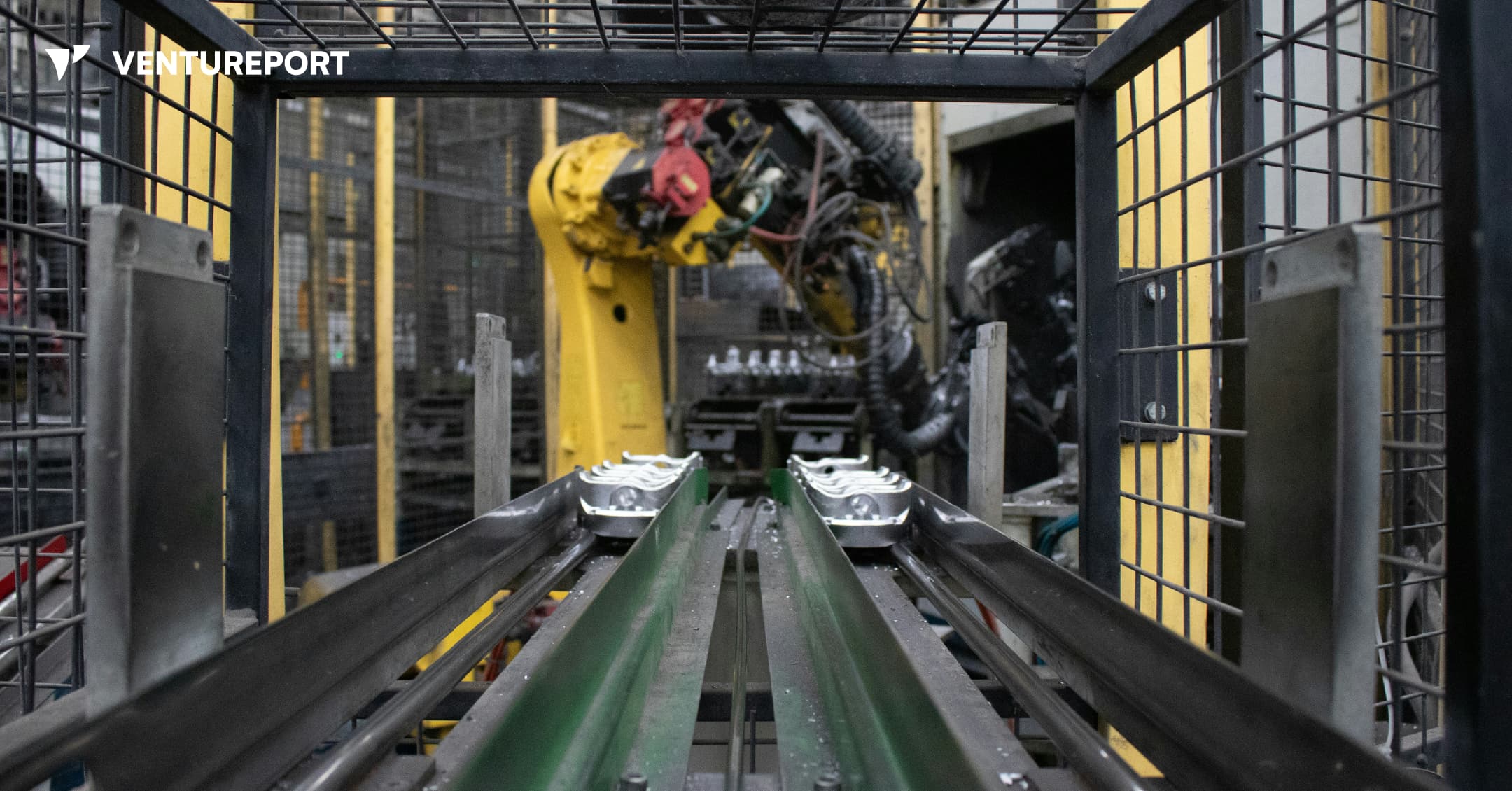
An industrial robot in a factory. PHOTO: UNSPLASH
Algorized has raised US$13 million in a Series A round to advance its AI-powered safety and sensing technology for factories and warehouses. The California- and Switzerland-based robotics startup says the funding will help expand a system designed to transform how robots interact with people. The round was led by Run Ventures, with participation from the Amazon Industrial Innovation Fund and Acrobator Ventures, alongside continued backing from existing investors.
At its core, Algorized is building what it calls an intelligence layer for “physical AI” — industrial robots and autonomous machines that function in real-world settings such as factories and warehouses. While generative AI has transformed software and digital workflows, bringing AI into physical environments presents a different challenge. In these settings, machines must not only complete tasks efficiently but also move safely around human workers.
This is where a clear gap exists. Today, most industrial robots rely on camera-based monitoring systems or predefined safety zones. For instance, when a worker steps into a marked area near a robotic arm, the system is programmed to slow down or stop the machine completely. This approach reduces the risk of accidents. However, it also means production lines can pause frequently, even when there is no immediate danger. In high-speed manufacturing environments, those repeated slowdowns can add up to significant productivity losses.
Algorized’s technology is designed to reduce that trade-off between safety and efficiency. Instead of relying solely on cameras, the company utilizes wireless signals — including Ultra-Wideband (UWB), mmWave, and Wi-Fi — to detect movement and human presence. By analysing small changes in these radio signals, the system can detect motion and breathing patterns in a space. This helps machines determine where people are and how they are moving, even in conditions where cameras may struggle, such as poor lighting, dust or visual obstruction.
Importantly, this data is processed locally at the facility itself — not sent to a remote cloud server for analysis. In practical terms, this means decisions are made on-site, within milliseconds. Reducing this delay, or latency, allows robots to adjust their movements immediately instead of defaulting to a full stop. The aim is to create machines that can respond smoothly and continuously, rather than reacting in a binary stop-or-go manner.
With the new funding, Algorized plans to scale commercial deployments of its platform, known as the Predictive Safety Engine. The company will also invest in refining its intent-recognition models, which are designed to anticipate how humans are likely to move within a workspace. In parallel, it intends to expand its engineering and support teams across Europe and the United States. These efforts build on earlier public demonstrations and ongoing collaborations with manufacturing partners, particularly in the automotive and industrial sectors.
For investors, the appeal goes beyond safety compliance. As factories become more automated, even small improvements in uptime and workflow continuity can translate into meaningful financial gains. Because Algorized’s system works with existing wireless infrastructure, manufacturers may be able to upgrade machine awareness without overhauling their entire hardware setup.
More broadly, the company is addressing a structural limitation in industrial automation. Robotics has advanced rapidly in precision and power, yet human-robot collaboration is still governed by rigid safety systems that prioritise stopping over adapting. By combining wireless sensing with edge-based AI models, Algorized is attempting to give machines a more continuous awareness of their surroundings from the start.