
How startups can use nostalgia marketing to build trust, spark loyalty and stand out with storytelling, vintage design and emotional connections.
Updated
January 8, 2026 6:35 PM
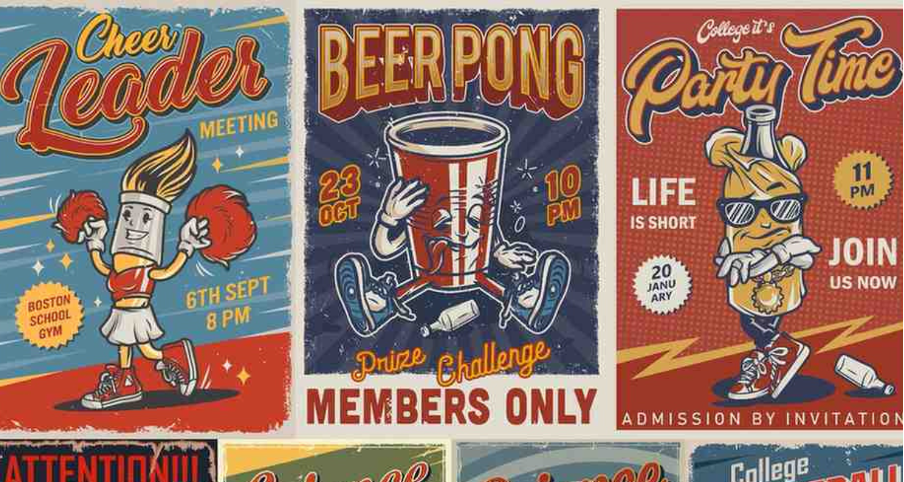
Vintage beer pong posters showcasing colorful, diverse designs from different eras in one collection. PHOTO: FREEPIK
Turning the subtle power of nostalgia into meaningful marketing.
Think of nostalgia as a time machine for brands—it doesn’t just take people back; it brings their emotions forward. And emotions sell. For those who are unfamiliar, nostalgia marketing is a strategy where brands use elements from the past—like familiar sights, sounds, or stories—to evoke warm memories and emotional connections with their audience.
This emotional pull isn’t just anecdotal—research shows its real impact: according to The Team and Forbes via The Drum, 80% of millennials and Gen Z are drawn to brands tapping into nostalgia, while 92% of consumers say nostalgic ads feel more relatable. And for startups competing in noisy markets, this is a goldmine.
In this article, we’ll explore why nostalgia marketing can be a game-changing strategy for your company.
Out of all the popular marketing methods—like influencer partnerships or attention-grabbing ad campaigns—nostalgia is unique because its impact starts intrinsically, in the brain. By triggering the release of dopamine, a reward-system neurotransmitter, Nostalgia evokes feelings of warmth, happiness and comfort. Consequently, people don’t just remember a moment—they relive it. Take, for instance, your favorite cereal brand bringing back childhood cartoon characters or using retro fonts and colors. You might choose it over a healthier breakfast option simply because it reminds you of the mornings you enjoyed as a kid. Similarly, speaking of stirring fond memories, Coca-Cola has mastered this effect, using classic holiday ads, vintage packaging, and iconic imagery. Those associations make people see Coke as more than a drink—it’s a familiar feeling they’re willing to pay extra for.
New marketing campaigns can spark curiosity but often trigger skepticism—especially when audiences lack prior connection to the brand. Nostalgia marketing breaks down this barrier by tapping into familiarity, using retro jingles, vintage fonts, pastel colors, or familiar packaging that immediately resonate. This recognition builds an emotional connection and trust with the brand. More importantly, it fosters social connectedness by making consumers feel part of a larger community—giving that reassuring “others remember this too” feeling. As a result, this sense of belonging reduces loneliness, strengthens warmth and trust, and encourages word-of-mouth sharing, naturally amplifying the campaign’s reach and impact.
While luxury brands can afford massive campaigns, startups and small businesses can tap into nostalgia as a cost-effective storytelling tool. In a world where marketing often chases the “next big thing”—from AI to futuristic tech—nostalgia offers the opposite: a chance to revisit the past. More importantly, nostalgia allows brands to stand out in a crowded, fast-scrolling feed by delivering something comfortingly familiar with a fresh twist. Think of Polaroid: in an age where smartphones boast crystal-clear cameras, it wins hearts with pastel hues, a vintage lens, and the tactile charm of instant prints—selling not just images, but a moment that feels straight out of the past.
The same principle worked brilliantly for Tiffany & Co., whose 185-year-old brand refresh featured Jay-Z and Beyoncé in a Breakfast at Tiffany’s-inspired campaign, blending timeless charm with contemporary star power and racking up millions of views. In essence, when done right, nostalgia doesn’t just market a product—it invites people to relive a story they already love.
Nostalgia resonates across generations speaking to diverse audiences. For Millennials, it’s a chance to relive the cultural touchpoints of their youth, while Gen Z approaches it with curiosity, eager to explore eras they never experienced firsthand. This crossover creates a unique marketing sweet spot: one group is driven by memory, the other by discovery. Pokémon proves this power by keeping lifelong fans engaged through retro trading cards while introducing younger audiences to its history. Similarly, Nike used nostalgia to bridge two different generations by reissuing retro classics, keeping both longtime fans and new sneakerheads excited. By appealing to both memory and curiosity, brands can create lasting connections that keep different generations engaged at once.
Nostalgia can be your startup’s non-cliché marketing mantra. Imagine a small bookstore that offers handwritten recommendation cards designed like vintage library checkout slips. This simple touch invites customers to slow down and rediscover the joy of reading. Or picture a local coffee shop serving drinks in mugs inspired by classic diner ware, evoking comforting memories of simpler times. Overall, the lesson is clear: combining nostalgic design with stories that connect people to shared moments creates emotional warmth and trust. Thoughtful nostalgia turns everyday products into meaningful experiences—building loyal communities eager to return.
Keep Reading
As workplace knowledge spreads across chats, AI firms are building systems that can structure, retrieve and preserve it over time.
Updated
August 10, 2026 5:56 PM

A messaging app on a phone. PHOTO: ADOBE STOCK
Votee AI, an enterprise AI company headquartered in Hong Kong, has partnered with its Toronto-based research lab Beever AI to launch Beever Atlas. The new platform is designed to turn workplace chats into searchable knowledge that AI systems can retrieve and understand.
The release focuses on a growing issue inside organisations. Much of today’s workplace knowledge now exists inside chat platforms such as Slack, Microsoft Teams, Discord and Telegram. Important discussions, project decisions and technical information often disappear into long message histories that are difficult to search later.
Beever AI developed the platform to organise those conversations into a structured system for AI assistants. The software connects with Telegram, Discord, Mattermost, Microsoft Teams and Slack, then converts conversations into linked records of people, projects, files and decisions.
The collaboration combines Votee AI’s enterprise infrastructure work with Beever AI’s research around AI memory systems. The companies are releasing two versions of the product. The open-source edition is aimed at individual developers, researchers and creators. The enterprise edition is designed for banks, government agencies and larger organisations with stricter security requirements.
The release also reflects a broader shift happening across the AI industry. Companies are increasingly looking at how AI systems store and retrieve long-term knowledge, rather than relying solely on large context windows or search-based retrieval.
Earlier this year, OpenAI founding member and former director of AI at Tesla Andrej Karpathy discussed the growing need for what he described as “LLM Knowledge Bases.” He argued that AI systems need structured and evolving memory rather than depending only on context windows and vector search.
Beever Atlas approaches that problem through workplace communication. Instead of focusing mainly on uploaded files, the system is designed around conversations that happen daily across team chat platforms. It can also process images, PDFs, voice notes and video files within the same searchable system.
The companies say the software is designed to work directly with AI assistants and coding tools such as Cursor, AWS Kiro and Qwen Code. Integrations for OpenClaw and Hermes Agent are expected later in 2026.
Pak-Sun Ting, Co-Founder and CEO of Votee AI said: "Hong Kong has always been known for property and finance. Beever Atlas is proof that world-class AI infrastructure can emerge from an HK-headquartered company and be shared openly with the world. Every growing organization faces the same silent liability: conversational knowledge loss. Beever Atlas turns this perishable resource into a compounding organizational asset."
A large part of the enterprise version focuses on privacy and access control. The system mirrors permissions from Slack and Microsoft Teams so users can only retrieve information they are already authorised to access. Permission updates are reflected automatically when access changes inside company systems.
The enterprise edition also includes audit logs, encryption controls and data retention settings for organisations handling sensitive internal data. Companies can run the software entirely inside their own infrastructure using Docker and connect it to their preferred AI models through LiteLLM.
The companies argue that organising information is more useful than simply storing chat archives. Jacky Chan Co-Founder and CTO of Votee AI said: "The key technical decision was to treat agent memory as a knowledge engineering problem, not a retrieval problem. Structure beats similarity — a typed graph of who works on what is more useful to an AI than vector search over a Slack archive."
The software also includes protections against prompt injection attacks and systems designed to reduce hallucinated responses. According to the companies, the AI is designed to return “I don't know” with citations when confidence is low instead of generating unsupported answers.
As workplace communication becomes increasingly fragmented across chat platforms, companies are beginning to treat internal conversations as information that AI systems can organise, retrieve and build on. Beever Atlas reflects a broader push to turn everyday workplace communication into long-term organisational memory.