
Vizrt shows how live video can be produced anywhere, without complex studio setups
Updated
August 10, 2026 5:56 PM

A camera filming a still life on a table. PHOTO: UNSPLASH
Vizrt, a media technology company, has introduced a new AI-powered tool to simplify the creation of virtual scenes in live production. Its latest release, the AI Keyer, is built around a simple idea: remove the need for green screens and make virtual production possible in almost any environment.
Traditionally, creating virtual backgrounds or augmented reality (AR) scenes requires controlled studio setups, green screens, precise lighting and skilled operators. That makes high-end visual production expensive and difficult to scale, especially for smaller teams or live, on-the-ground reporting.
The AI Keyer is designed to address that gap. It uses AI trained on real-world footage to identify people in a frame and separate them from the background in real time. This allows production teams to replace backgrounds, insert AR graphics or place presenters into virtual environments—whether they are indoors, outdoors or on location.
"Creating XR environments typically demands large infrastructure investments and requires specialized skills for daily operations. The Vizrt AI Keyer removes all these constraints, so high-quality virtual scenes and AR graphics become a reality for live productions of every size", says Edouard Griveaud, Senior Product Manager at Vizrt.
In practical terms, this means a presenter can appear in a different location without moving, a remote speaker can be placed inside a virtual event space or branded graphics can be added to live interviews without a complex setup. The system works without chroma keying, reducing both preparation time and production overhead.
This shift also reflects how the company is approaching AI more broadly. Instead of treating it as a background feature, Vizrt is positioning AI as a core part of the content creation and delivery process.
"AI is transforming the world, and the creative industries are no exception. At Vizrt, we have been on this journey for years, embedding intelligence into our solutions, empowering storytellers and delivering real, measurable impact for our customers", says Rohit Nagarajan, CEO of Vizrt. "That is not a vision for tomorrow. That is happening today. The Vizrt AI Keyer is the latest proof point of our relentless commitment to innovation. Putting breakthrough technology in the hands of every creative, at every level, everywhere in the world".
Beyond the product itself, the direction is clear. By removing the need for green screens and complex setups, tools like the AI Keyer make it easier to produce high-quality visual content in more flexible settings. The result is a production model that is less tied to physical studios and more adaptable to real-world environments, where content can be created and adjusted in real time.
Keep Reading
How a Korean biotech startup is using AI to move drug discovery from trial-and-error to precision design
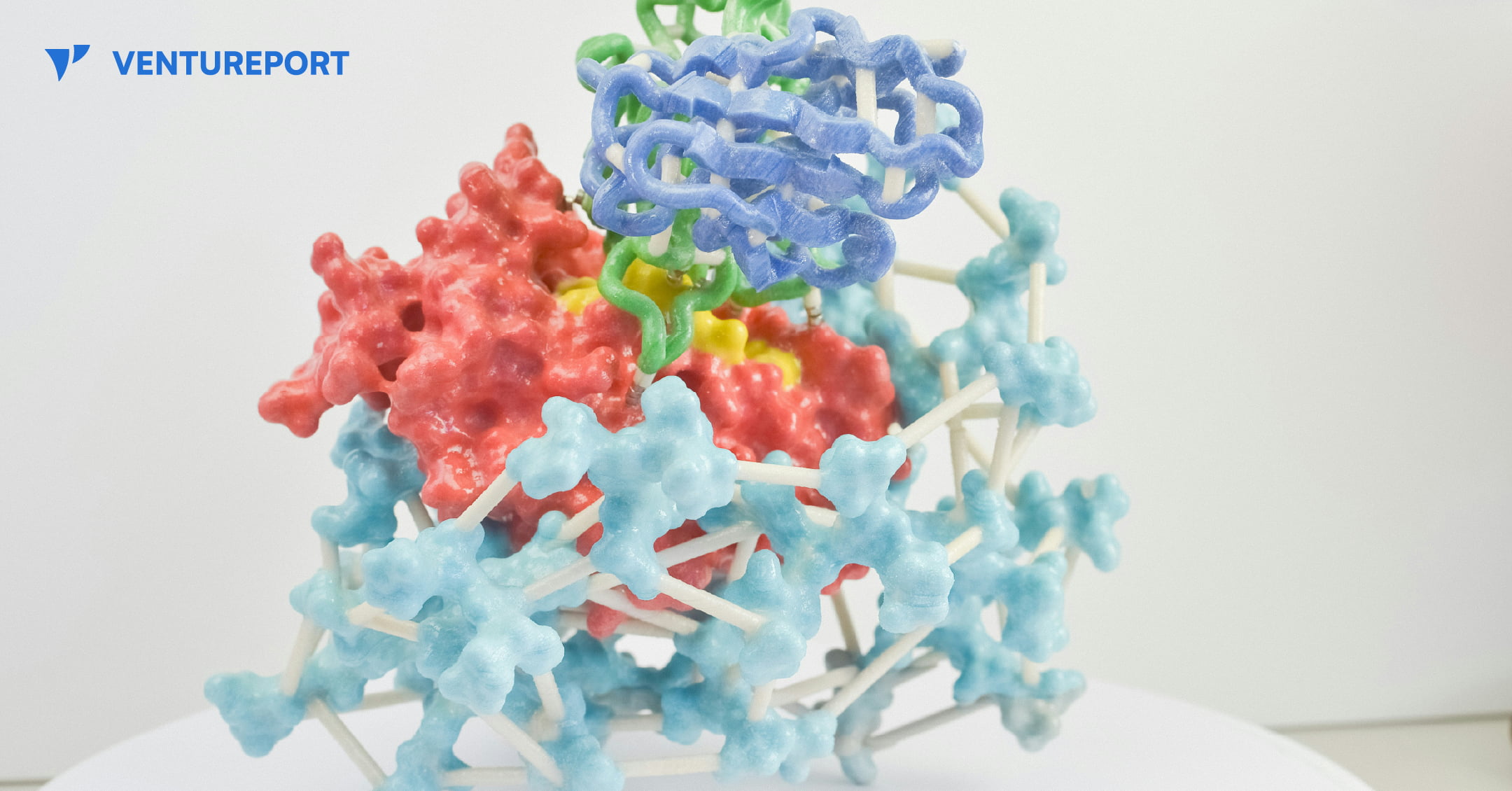
A close up of a protein structure model. PHOTO: UNSPLASH
For decades, drug discovery has relied on trial and error, with scientists testing thousands of molecules to find one that works. Galux, a South Korean biotech startup, is changing that by using AI to design proteins from scratch. This method, called “de novo” design, makes it possible to build precise new therapies instead of searching through existing ones.
The company recently announced a US$29 million Series B funding round, bringing its total capital to US$47 million.This significant investment attracted a substantial roster of institutional backers, including the Korea Development Bank (KDB), Yuanta Investment, SL Investment and NCORE Ventures. These firms joined existing investors such as InterVest, DAYLI Partners and PATHWAY Investment, as well as new participants including SneakPeek Investments, Korea Investment & Securities and Mirae Asset Securities.
At the core of the company’s work is a platform called GaluxDesign. Unlike many AI tools that only predict how existing proteins fold, this system uses deep learning and physics to create entirely new therapeutic antibodies. This “from scratch” approach lets the team go after so-called “undruggable” proteins. These are targets that traditional small-molecule drugs can’t reach because they lack clear binding pockets. By designing proteins to fit these complex shapes, Galux aims to unlock treatments that have stayed out of reach for decades. And that’s exactly why investors are paying attention.
The pharmaceutical industry is actively looking for faster and more efficient ways to develop new drugs, and Galux is built for exactly that. The company connects its AI platform directly to its own wet lab, where designs can be tested in real time. Each result feeds straight back into the system, sharpening the next round of models. This continuous loop speeds up discovery and improves precision at every step. It’s also why partners like Celltrion, LG Chem and Boehringer Ingelheim are already working with Galux.
Galux is no longer just trying to make drugs that stick to a target. The company now wants its AI to design medicines that actually work in the body and can be made at scale. In simple terms, a drug has to do more than bind to a disease—it must be stable, safe and strong enough to change how the illness behaves. Galux is moving into tougher targets such as ion channels and GPCRs. These play key roles in heart function and sensory signals. Ultimately, the goal is to show that AI-driven design can turn complex biology into real treatments. And instead of hunting blindly for a solution, the team is building exactly what they need.