
The funding highlights how service robotics is shifting from niche deployments to scaled commercial use across global markets
Updated
August 10, 2026 5:56 PM

An autonomous service robot with a cat face design standing inside a McDonalds restaurant. PHOTO: ADOBE STOCK
Pudu Robotics, a Shenzhen-based startup building robots for commercial environments, has raised nearly US$150 million in a new funding round, pushing its valuation past US$1.5 billion. The raise brings the company’s total funding to more than US$300 million.
The company focuses on service robotics across sectors such as delivery, cleaning and industrial logistics. Its systems are used in places like retail stores, warehouses and public venues where routine tasks can be automated. Over time, Pudu has expanded from single-purpose machines to a broader portfolio that combines hardware with AI-driven navigation and coordination.
The funding is expected to support several areas of growth. These include further development of its AI systems, expansion of its product range and continued international rollout. The company also plans to invest in manufacturing and supply chain capacity, suggesting a focus on scaling production alongside demand.
Pudu’s recent growth provides some context for the raise. The company reported a doubling of revenue by 2025, with its cleaning robots now accounting for the majority of its business. Its industrial delivery robots have also seen early traction, with thousands of units deployed within a year of launch.
Its products are already in use with large global retailers including Carrefour, Walmart and EDEKA. Industry estimates place Pudu among the largest players in commercial service robotics, with a leading share of the global market.
Technically, the company develops much of its core stack in-house, including navigation systems, multi-robot coordination software and motion control. This allows its robots to operate in complex real-world environments where multiple machines need to move and work together.
“This financial milestone is a powerful confirmation of Pudu’s industry leadership, the strength of its products and technology, its global brand, and its commercial infrastructure. With the support of our strategic investors and industry partners, Pudu will continue to push the boundaries of embedded AI and business service robotics. We remain committed to innovating with an inventor’s spirit and leveraging a global vision to accelerate robot adoption, thereby elevating the industry to new heights in the global value chain”. said Felix Zhang, founder and CEO of Pudu Robotics.
The funding round points to a broader shift in the sector. As service robotics moves from pilot deployments to wider adoption, companies are increasingly being judged on their ability to scale production and operate across markets, not just on the novelty of their technology.
Keep Reading
A humanoid robot being escorted away by police in Macau has gone viral online, prompting jokes about what some called the world’s first “robot arrest.”
Updated
April 1, 2026 8:55 AM
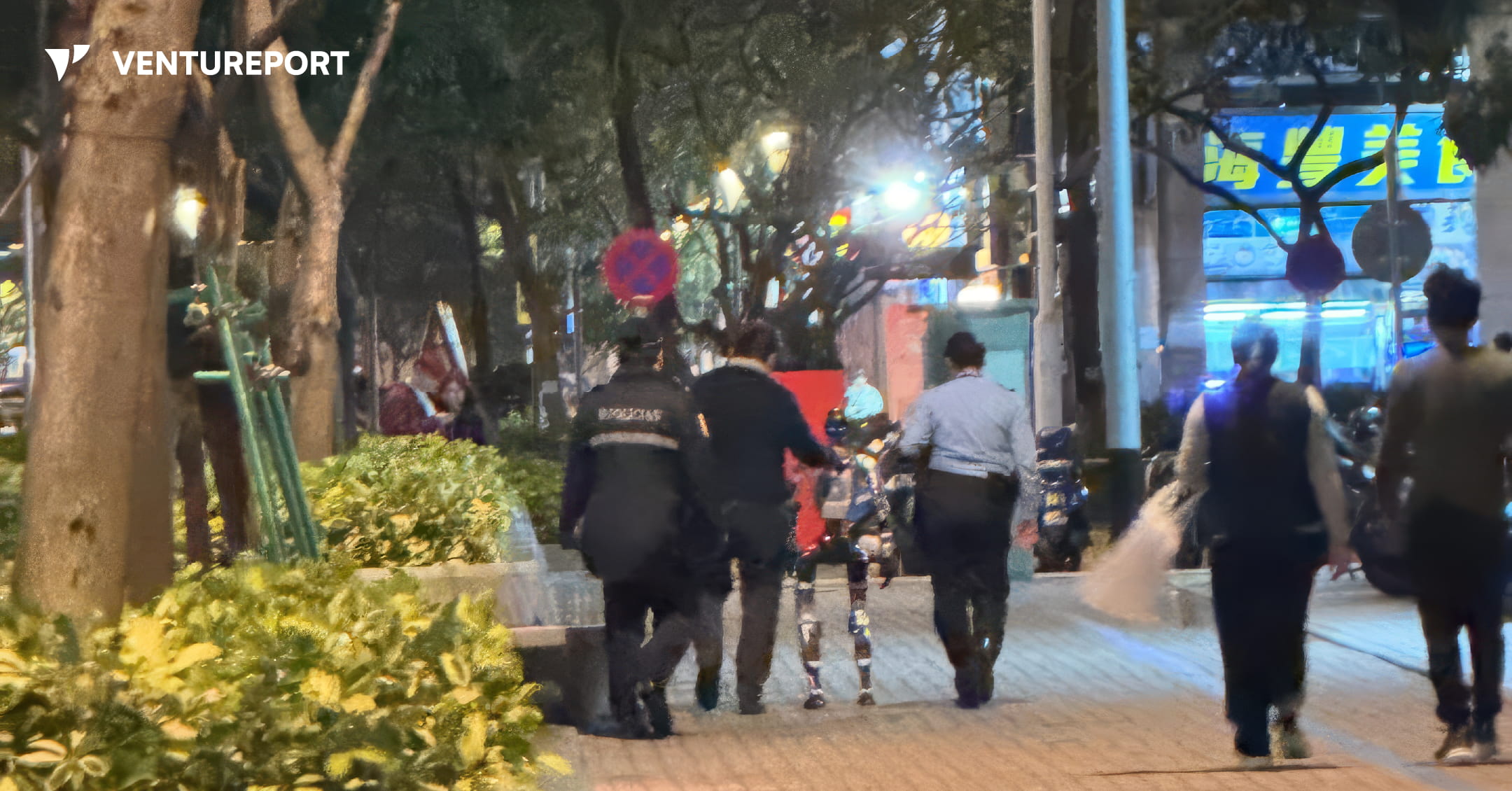
Macau police officer accompanying the humanoid robot. PHOTO: THREADS@BOXOF_CHOCOLATE
Police in Macau recently detained a humanoid robot after it frightened an elderly woman on a public street. The unusual encounter quickly spread online, prompting jokes about what some called the world’s first “robot arrest”.
On the evening of March 5, the robot was taken away by officers after the encounter triggered alarm among bystanders. Videos circulating on social media show an elderly woman confronting the robot on a sidewalk, visibly distressed and shouting that her “heart is pounding” while demanding to know why such “nonsense” was happening on the street. In the clip, the robot raises both hands toward the woman after she lashes out in fear — a gesture many viewers interpreted as a sign of apology.
Shortly afterwards, two officers from the Macau Public Security Police Force were seen escorting the robot and a man believed to be its operator away from the area. An officer is seen placing his right hand on the robot’s shoulder — the same posture police often use when presenting arrested suspects in official photographs.
That scene quickly spread online, fuelling jokes about what some called the world’s first “robot arrest”.
Photos shared online show a humanoid robot with long limbs and exposed mechanical joints, built from a black metallic frame without an outer shell. In dim lighting, several commenters said it resembled a “moving skeleton” — a striking sight for pedestrians encountering it unexpectedly on the street.
Witnesses said the woman appeared severely shaken and an ambulance was eventually called to take her to the hospital.
The incident also sparked discussion online about robots operating in public spaces. Some commenters argued that experimental technologies should be tested in controlled environments, while others said machines moving through public areas should have clearer designs or safety measures to avoid alarming pedestrians.
It remains unclear who deployed the robot or what purpose it was serving in the area at the time of the incident. Authorities have not released further details about the device or whether any action was taken following the encounter.