
A rare policy consensus emerges as AI’s impact moves beyond innovation into governance and societal risk
Updated
August 10, 2026 5:56 PM

A mechanical hand reaching for the hand of flesh. PHOTO: UNSPLASH
A new survey from Povaddo, a policy research firm, suggests that concern about artificial intelligence is no longer limited to industry or academia. It is now firmly present within the policy community.
The survey draws on responses from 301 public policy professionals across the United States and Europe, including lawmakers, staffers and analysts involved in shaping and evaluating public policy. A majority of respondents—61%—say governments are falling short in addressing the negative impacts of AI.
There is also broad agreement that regulation needs to increase. In the United States, 92% of respondents support stronger AI regulation, compared to 70% in Europe. At a time when consensus is often difficult, the findings point to a shared view across policy circles that current frameworks are not keeping pace with technological development.
Differences emerge when looking at how AI is affecting national contexts. In the U.S., 57% of policy experts believe AI is already harming the labor market. In Europe, 34% say the same. U.S. respondents are also more likely to see AI as a greater threat to jobs than immigration, with 63% holding that view compared to 47% in Europe.
On misinformation, responses are closely aligned. A large majority of policy experts in both regions expect an AI-driven misinformation crisis within the next one to two years—87% in the U.S. and 82% in Europe. Many also believe that AI-generated or AI-amplified misinformation could affect elections and public health information.
Some respondents frame the risks in more fundamental terms. In the United States, 41% of policy experts say AI poses an existential threat to humanity. In Europe, 29% share that view. U.S. respondents are also more likely to believe that advances in AI could harm global security and stability.
The findings come as policymakers begin to respond more actively. In the U.S., Senators Josh Hawley, Richard Blumenthal and Mark Warner have introduced bipartisan legislation focused on AI accountability, including measures aimed at protecting workers and children.
In Europe, the introduction of the EU AI Act marks a more advanced regulatory approach. The framework sets out rules based on levels of risk and is widely seen as the first comprehensive attempt to govern AI at scale.
William Stewart, President and Founder of Povaddo, said: "What makes these findings so significant is who is saying it. These are the practitioners who work inside the policy process every day, spanning every corner of the policy world from defense to healthcare to finance, not activists or everyday citizens. These findings foreshadow real action. The current path of governments accelerating AI deployment while falling short on governance is not sustainable, and the people who know that best are the ones in this survey. You cannot have nine-in-ten policy insiders demanding more regulation and four-in-ten calling AI an existential threat without that eventually moving the needle in Washington and Brussels in terms of legislative or regulatory action".
Taken together, the survey reflects a shift in how AI is being discussed within policymaking circles. Concern is no longer limited to future risks. It is increasingly tied to current gaps in governance and the pace of deployment.
Keep Reading
A humanoid robot being escorted away by police in Macau has gone viral online, prompting jokes about what some called the world’s first “robot arrest.”
Updated
April 1, 2026 8:55 AM
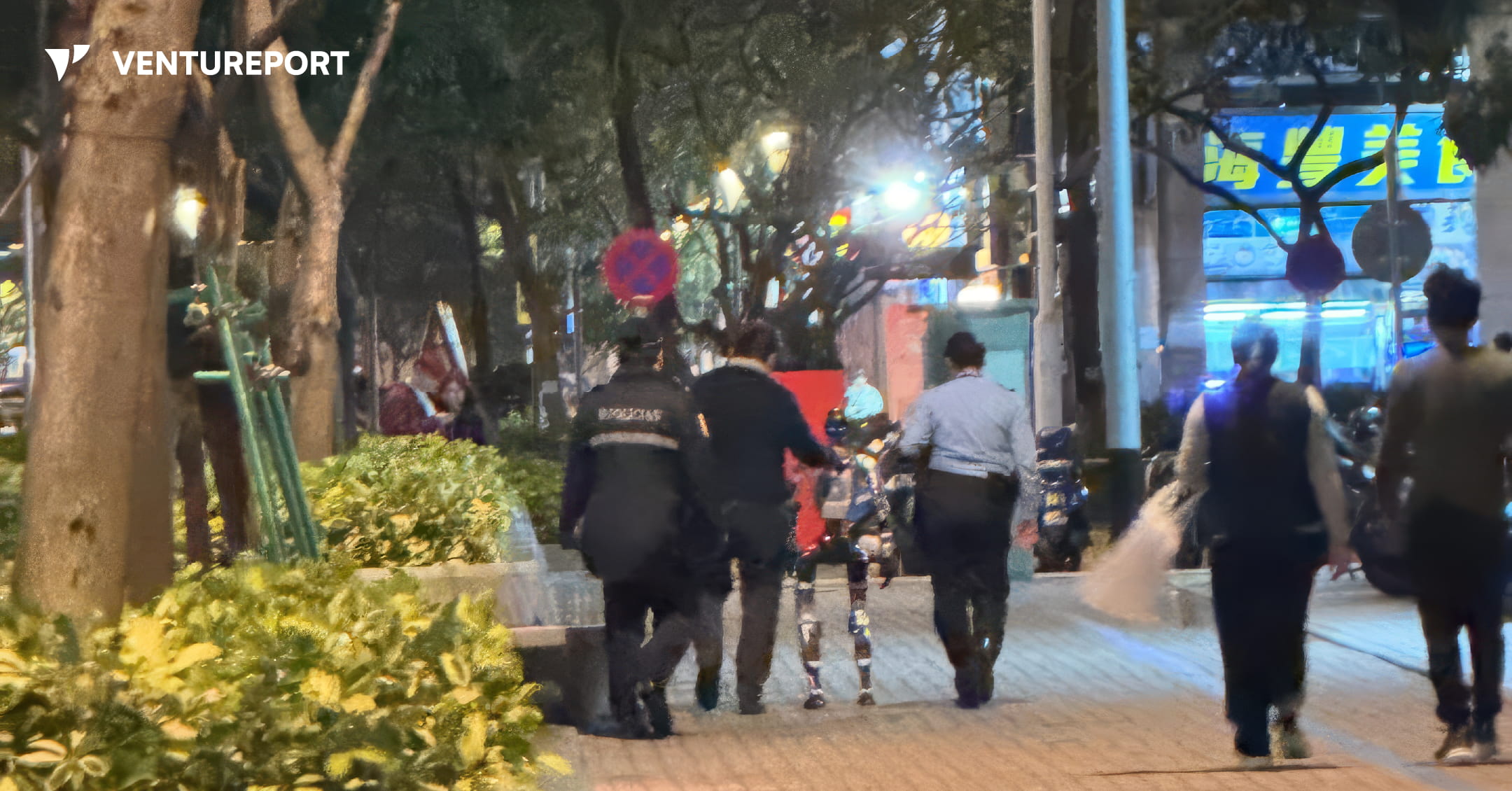
Macau police officer accompanying the humanoid robot. PHOTO: THREADS@BOXOF_CHOCOLATE
Police in Macau recently detained a humanoid robot after it frightened an elderly woman on a public street. The unusual encounter quickly spread online, prompting jokes about what some called the world’s first “robot arrest”.
On the evening of March 5, the robot was taken away by officers after the encounter triggered alarm among bystanders. Videos circulating on social media show an elderly woman confronting the robot on a sidewalk, visibly distressed and shouting that her “heart is pounding” while demanding to know why such “nonsense” was happening on the street. In the clip, the robot raises both hands toward the woman after she lashes out in fear — a gesture many viewers interpreted as a sign of apology.
Shortly afterwards, two officers from the Macau Public Security Police Force were seen escorting the robot and a man believed to be its operator away from the area. An officer is seen placing his right hand on the robot’s shoulder — the same posture police often use when presenting arrested suspects in official photographs.
That scene quickly spread online, fuelling jokes about what some called the world’s first “robot arrest”.
Photos shared online show a humanoid robot with long limbs and exposed mechanical joints, built from a black metallic frame without an outer shell. In dim lighting, several commenters said it resembled a “moving skeleton” — a striking sight for pedestrians encountering it unexpectedly on the street.
Witnesses said the woman appeared severely shaken and an ambulance was eventually called to take her to the hospital.
The incident also sparked discussion online about robots operating in public spaces. Some commenters argued that experimental technologies should be tested in controlled environments, while others said machines moving through public areas should have clearer designs or safety measures to avoid alarming pedestrians.
It remains unclear who deployed the robot or what purpose it was serving in the area at the time of the incident. Authorities have not released further details about the device or whether any action was taken following the encounter.