
Robots enter the World Cup, shifting how large-scale events are run and experienced
Updated
April 20, 2026 1:40 PM

Hyundai Motor Company Dealership, Alabama, US. PHOTO: ADOBE STOCK
As the FIFA World Cup 2026 approaches, attention is beginning to shift beyond the matches themselves to how an event of this scale is organised and run. Managing teams, coordinating venues and handling large crowds requires a system that works with precision. This time, robotics is set to become part of that system.
Hyundai Motor Company, a long-time FIFA partner, is expanding its role for the 2026 tournament. Alongside its traditional responsibility of providing vehicles for teams, officials and media, the company will introduce robotics in collaboration with Boston Dynamics. Robots including Atlas and Spot are expected to be deployed at selected venues.
According to the announcement, these systems will be used to support tournament operations while contributing to safety and efficiency. They will also play a role in shaping how fans experience the event, indicating a broader use of technology within the tournament environment. While specific use cases have not been detailed, the inclusion of robotics reflects a growing effort to integrate advanced systems into large-scale public events.
The direction was introduced through the company’s global campaign, “Next Starts Now,” unveiled at the 2026 New York International Auto Show. The campaign is positioned around its wider focus on innovation across mobility and robotics, aligning with its long-standing partnership with FIFA, which now spans more than two decades. As part of the 2026 tournament, the company will also deploy its largest mobility fleet to date, working alongside these newer systems across venues.
Beyond operations, the initiative extends into community engagement. Youth football camps are set to take place across four host cities in the United States—Atlanta, Miami, New Jersey and Los Angeles—targeting children between the ages of six and twelve. A global drawing programme will also invite young fans to submit artwork supporting their national teams, with selected designs to be featured on official team buses during the tournament.
Taken together, the introduction of robotics alongside existing infrastructure points to a gradual shift in how major events are supported. Rather than operating only behind the scenes, technology is becoming more visible within the event itself. How these systems perform in a live, large-scale setting will become clearer once the tournament begins.
Keep Reading
Rethinking 3D modelling for a world that generates too much, too quickly.
Updated
January 8, 2026 6:32 PM
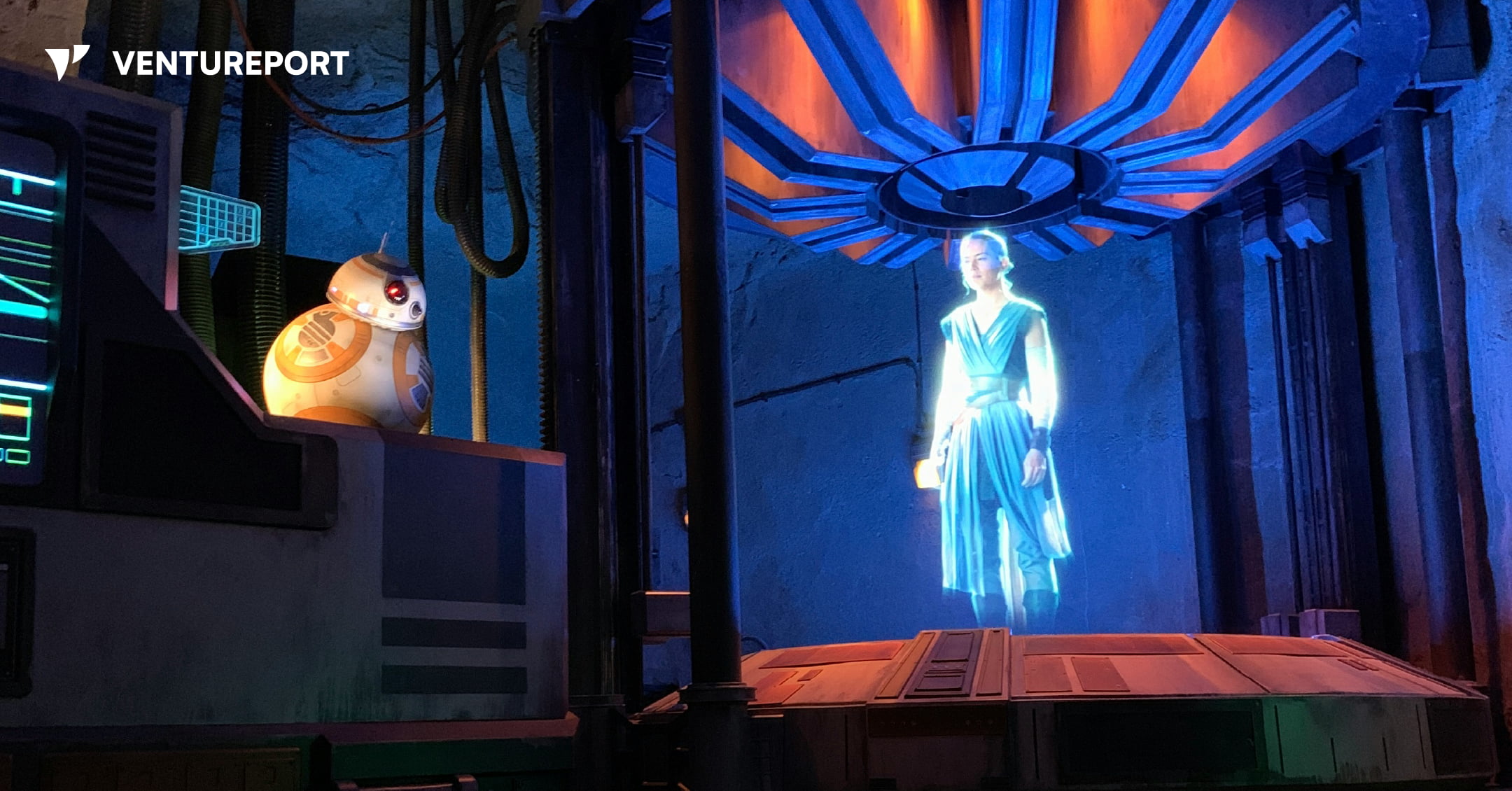
A hologram in the franchise Star Wars, in Walt Disney World Resort, Orlando. PHOTO: UNSPLASH
MicroCloud Hologram Inc. (NASDAQ: HOLO), a technology service provider recognized for its holography and imaging systems, is now expanding into a more advanced realm: a quantum-driven 3D intelligent model. The goal is to generate detailed 3D models and images with far less manual effort — a need that has only grown as industries flood the world with more visual data every year.
The concept is straightforward, even if the technology behind it isn’t. Traditional 3D modeling workflows are slow, fragmented and depend on large teams to clean datasets, train models, adjust parameters and fine-tune every output. HOLO is trying to close that gap by combining quantum computing with AI-powered 3D modeling, enabling the system to process massive datasets quickly and automatically produce high-precision 3D assets with much less human involvement.
To achieve this, the company developed a distributed architecture comprising of several specialized subsystems. One subsystem collects and cleans raw visual data from different sources. Another uses quantum deep learning to understand patterns in that data. A third converts the trained model into ready-to-use 3D assets based on user inputs. Additional modules manage visualization, secure data storage and system-wide protection — all supported by quantum-level encryption. Each subsystem runs in its own container and communicates through encrypted interfaces, allowing flexible upgrades and scaling without disrupting the entire system.
Why this matters: Industries ranging from gaming and film to manufacturing, simulation and digital twins are rapidly increasing their reliance on 3D content. The real bottleneck isn’t creativity — it’s time. Producing accurate, high-quality 3D assets still requires a huge amount of manual processing. HOLO’s approach attempts to lighten that workload by utilizing quantum tools to speed up data processing, model training, generation and scaling, while keeping user data secure.
According to the company, the system’s biggest advantages include its ability to handle massive datasets more efficiently, generate precise 3D models with fewer manual steps, and scale easily thanks to its modular, quantum-optimized design. Whether quantum computing will become a mainstream part of 3D production remains an open question. Still, the model shows how companies are beginning to rethink traditional 3D workflows as demand for high-quality digital content continues to surge.