
Robots enter the World Cup, shifting how large-scale events are run and experienced
Updated
April 20, 2026 1:40 PM

Hyundai Motor Company Dealership, Alabama, US. PHOTO: ADOBE STOCK
As the FIFA World Cup 2026 approaches, attention is beginning to shift beyond the matches themselves to how an event of this scale is organised and run. Managing teams, coordinating venues and handling large crowds requires a system that works with precision. This time, robotics is set to become part of that system.
Hyundai Motor Company, a long-time FIFA partner, is expanding its role for the 2026 tournament. Alongside its traditional responsibility of providing vehicles for teams, officials and media, the company will introduce robotics in collaboration with Boston Dynamics. Robots including Atlas and Spot are expected to be deployed at selected venues.
According to the announcement, these systems will be used to support tournament operations while contributing to safety and efficiency. They will also play a role in shaping how fans experience the event, indicating a broader use of technology within the tournament environment. While specific use cases have not been detailed, the inclusion of robotics reflects a growing effort to integrate advanced systems into large-scale public events.
The direction was introduced through the company’s global campaign, “Next Starts Now,” unveiled at the 2026 New York International Auto Show. The campaign is positioned around its wider focus on innovation across mobility and robotics, aligning with its long-standing partnership with FIFA, which now spans more than two decades. As part of the 2026 tournament, the company will also deploy its largest mobility fleet to date, working alongside these newer systems across venues.
Beyond operations, the initiative extends into community engagement. Youth football camps are set to take place across four host cities in the United States—Atlanta, Miami, New Jersey and Los Angeles—targeting children between the ages of six and twelve. A global drawing programme will also invite young fans to submit artwork supporting their national teams, with selected designs to be featured on official team buses during the tournament.
Taken together, the introduction of robotics alongside existing infrastructure points to a gradual shift in how major events are supported. Rather than operating only behind the scenes, technology is becoming more visible within the event itself. How these systems perform in a live, large-scale setting will become clearer once the tournament begins.
Keep Reading
How a Korean biotech startup is using AI to move drug discovery from trial-and-error to precision design
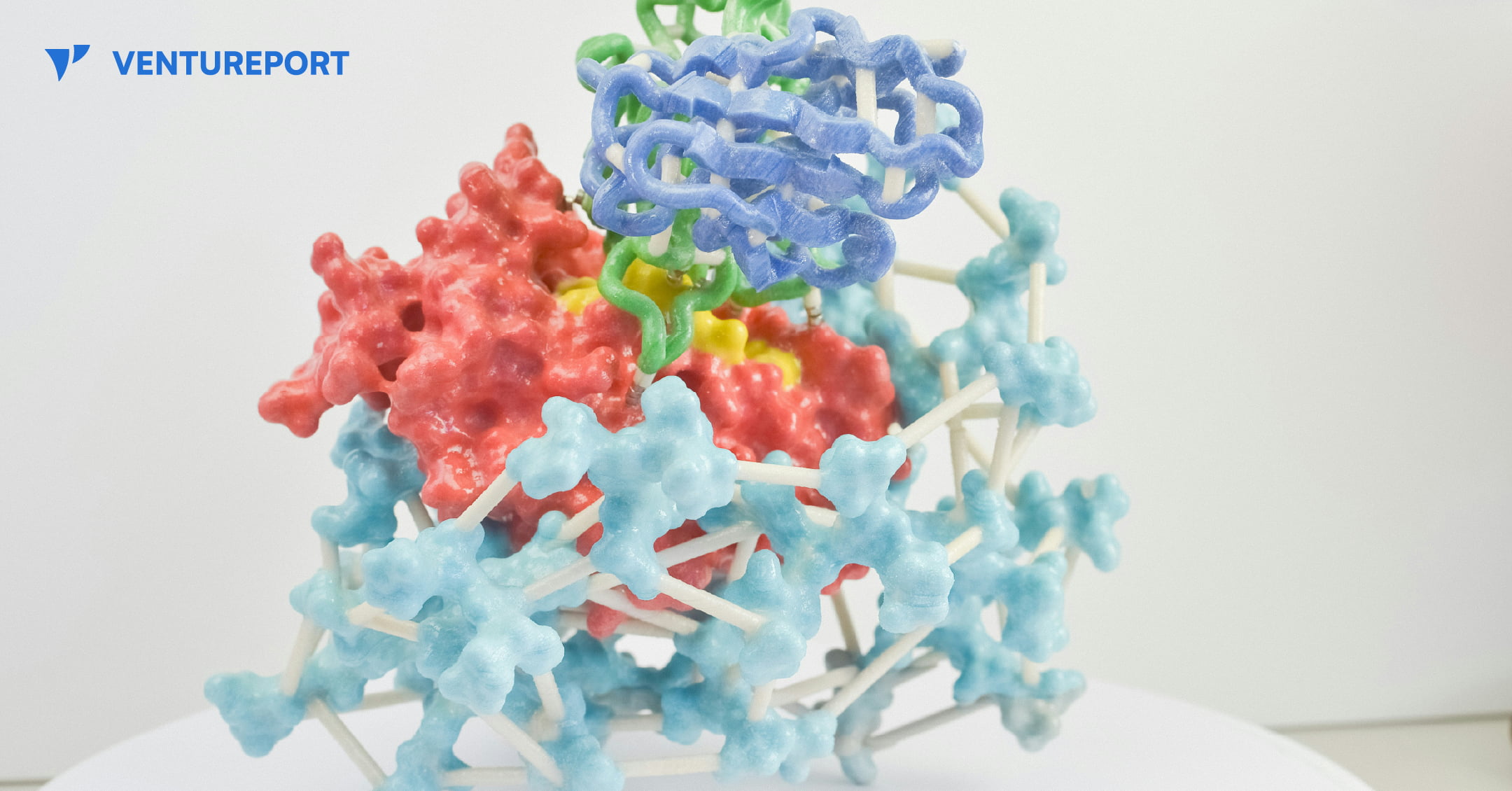
A close up of a protein structure model. PHOTO: UNSPLASH
For decades, drug discovery has relied on trial and error, with scientists testing thousands of molecules to find one that works. Galux, a South Korean biotech startup, is changing that by using AI to design proteins from scratch. This method, called “de novo” design, makes it possible to build precise new therapies instead of searching through existing ones.
The company recently announced a US$29 million Series B funding round, bringing its total capital to US$47 million.This significant investment attracted a substantial roster of institutional backers, including the Korea Development Bank (KDB), Yuanta Investment, SL Investment and NCORE Ventures. These firms joined existing investors such as InterVest, DAYLI Partners and PATHWAY Investment, as well as new participants including SneakPeek Investments, Korea Investment & Securities and Mirae Asset Securities.
At the core of the company’s work is a platform called GaluxDesign. Unlike many AI tools that only predict how existing proteins fold, this system uses deep learning and physics to create entirely new therapeutic antibodies. This “from scratch” approach lets the team go after so-called “undruggable” proteins. These are targets that traditional small-molecule drugs can’t reach because they lack clear binding pockets. By designing proteins to fit these complex shapes, Galux aims to unlock treatments that have stayed out of reach for decades. And that’s exactly why investors are paying attention.
The pharmaceutical industry is actively looking for faster and more efficient ways to develop new drugs, and Galux is built for exactly that. The company connects its AI platform directly to its own wet lab, where designs can be tested in real time. Each result feeds straight back into the system, sharpening the next round of models. This continuous loop speeds up discovery and improves precision at every step. It’s also why partners like Celltrion, LG Chem and Boehringer Ingelheim are already working with Galux.
Galux is no longer just trying to make drugs that stick to a target. The company now wants its AI to design medicines that actually work in the body and can be made at scale. In simple terms, a drug has to do more than bind to a disease—it must be stable, safe and strong enough to change how the illness behaves. Galux is moving into tougher targets such as ion channels and GPCRs. These play key roles in heart function and sensory signals. Ultimately, the goal is to show that AI-driven design can turn complex biology into real treatments. And instead of hunting blindly for a solution, the team is building exactly what they need.