
A closer look at how machine intelligence is helping doctors see cancer in an entirely new light.
Updated
January 8, 2026 6:33 PM

Serratia marcescens colonies on BTB agar medium. PHOTO: UNSPLASH
Artificial intelligence is beginning to change how scientists understand cancer at the cellular level. In a new collaboration, Bio-Techne Corporation, a global life sciences tools provider, and Nucleai, an AI company specializing in spatial biology for precision medicine, have unveiled data from the SECOMBIT clinical trial that could reshape how doctors predict cancer treatment outcomes. The results, presented at the Society for Immunotherapy of Cancer (SITC) 2025 Annual Meeting, highlight how AI-powered analysis of tumor environments can reveal which patients are more likely to benefit from specific therapies.
Led in collaboration with Professor Paolo Ascierto of the University of Napoli Federico II and Istituto Nazionale Tumori IRCCS Fondazione Pascale, the study explores how spatial biology — the science of mapping where and how cells interact within tissue — can uncover subtle immune behaviors linked to survival in melanoma patients.
Using Bio-Techne’s COMET platform and a 28-plex multiplex immunofluorescence panel, researchers analyzed 42 pre-treatment biopsies from patients with metastatic melanoma, an advanced stage of skin cancer. Nucleai’s multimodal AI platform integrated these imaging results with pathology and clinical data to trace patterns of immune cell interactions inside tumors.
The findings revealed that therapy sequencing significantly influences immune activity and patient outcomes. Patients who received targeted therapy followed by immunotherapy showed stronger immune activation, marked by higher levels of PD-L1+ CD8 T-cells and ICOS+ CD4 T-cells. Those who began with immunotherapy benefited most when PD-1+ CD8 T-cells engaged closely with PD-L1+ CD4 T-cells along the tumor’s invasive edge. Meanwhile, in patients alternating between targeted and immune treatments, beneficial antigen-presenting cell (APC) and T-cell interactions appeared near tumor margins, whereas macrophage activity in the outer tumor environment pointed to poorer prognosis.
“This study exemplifies how our innovative spatial imaging and analysis workflow can be applied broadly to clinical research to ultimately transform clinical decision-making in immuno-oncology”, said Matt McManus, President of the Diagnostics and Spatial Biology Segment at Bio-Techne.
The collaboration between the two companies underscores how AI and high-plex imaging together can help decode complex biological systems. As Avi Veidman, CEO of Nucleai, explained, “Our multimodal spatial operating system enables integration of high-plex imaging, data and clinical information to identify predictive biomarkers in clinical settings. This collaboration shows how precision medicine products can become more accurate, explainable and differentiated when powered by high-plex spatial proteomics – not limited by low-plex or H&E data alone”.
Dr. Ascierto described the SECOMBIT trial as “a milestone in demonstrating the possible predictive power of spatial biomarkers in patients enrolled in a clinical study”.
The study’s broader message is clear: understanding where immune cells are and how they interact inside a tumor could become just as important as knowing what they are. As AI continues to map these microscopic landscapes, oncology may move closer to genuinely personalized treatment — one patient, and one immune network, at a time.
Keep Reading
METiS TechBio’s blockbuster IPO signals rising investor interest in AI startups focused on how drugs are delivered inside the body
Updated
August 10, 2026 5:56 PM
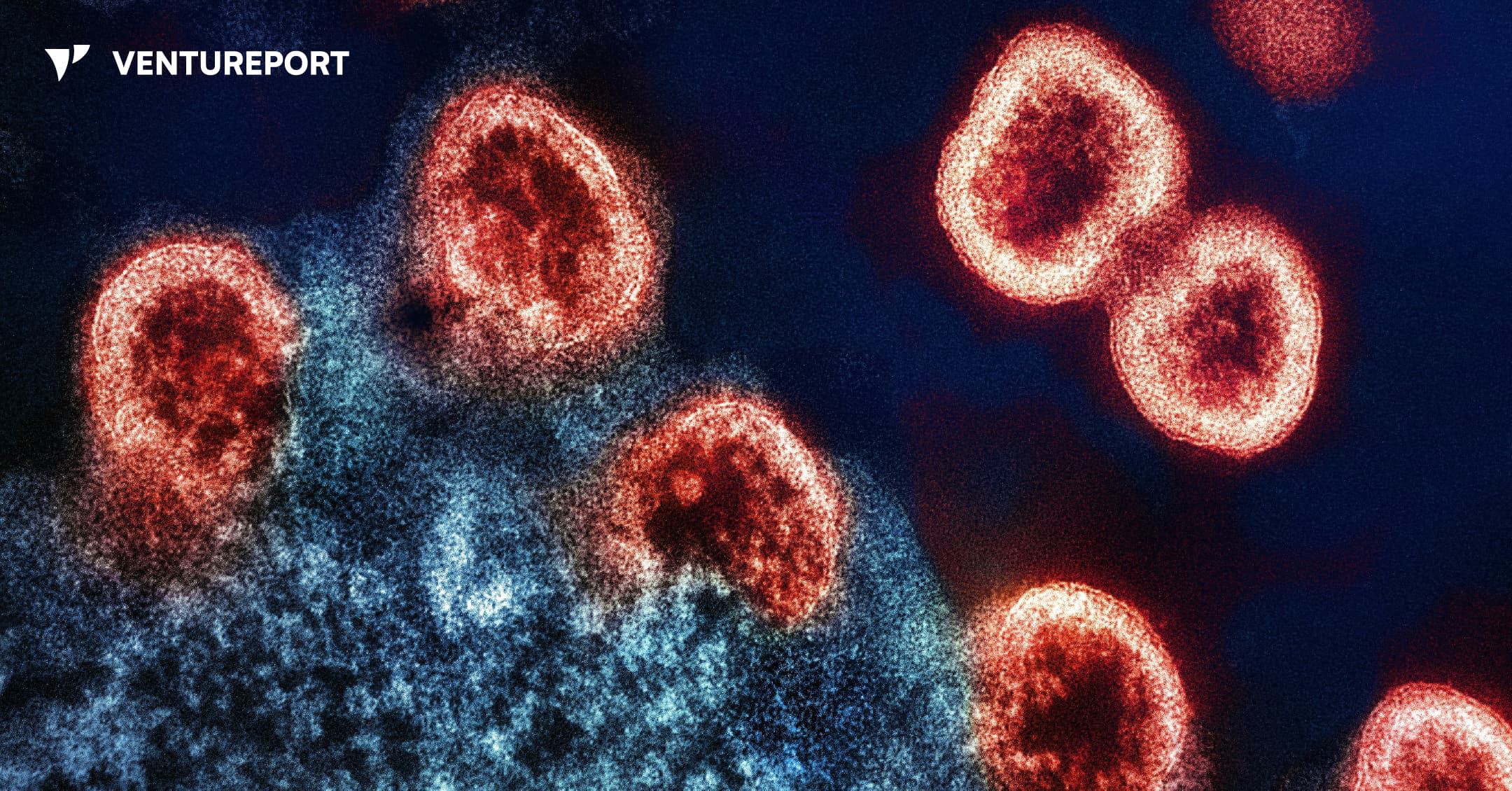
HIV-1 virus particles, coloured red. PHOTO: UNSPLASH
Investors are beginning to place bigger bets on AI startups focused on drug delivery infrastructure rather than drug discovery alone. That shift was on display this week after METiS TechBio, a Hong Kong tech-bio startup focused on AI-powered drug delivery systems, debuted on the Hong Kong Stock Exchange.
The listing made METiS TechBio the world’s first publicly traded AI-powered drug delivery startup and the first AI-powered large-molecule biopharmaceutical startup listed in Hong Kong. The startup raised more than HKD 2.1 billion through its IPO, making it the largest healthcare listing in Hong Kong so far in 2026.
Investor demand was unusually strong. The Hong Kong public offering was oversubscribed by more than 6,900 times while the international tranche recorded 82 times oversubscription. More than 280 institutional investors participated in the international placing.
The strong demand reflects a wider shift in AI biotech. Over the past few years, much of the sector’s attention has focused on using AI to discover new drugs or molecules. METiS is taking a different approach. The startup focuses on how medicines are delivered inside the body after they are developed.
That challenge is becoming harder to ignore in biotech. Designing a therapy is only one part of the process. Delivering it precisely to specific organs, tissues or cells remains a major hurdle, especially for newer therapies involving RNA, proteins and large-molecule drugs.
METiS is trying to solve that problem through its proprietary NanoForge platform. The system uses AI to design and test nanodelivery systems that help medicines reach targeted areas inside the body more efficiently. The platform combines AI models, simulation systems and high-throughput screening tools to speed up formulation development and improve delivery precision.
The startup says it has already achieved targeted delivery across eight organs and tissue systems including the liver, lungs, heart, muscles and central nervous system.
One of its lead programs, MTS-004, became China’s first AI-enabled formulation drug to complete a Phase III clinical trial. The drug is being developed for pseudobulbar affect, a neurological condition that affects emotional expression. According to the startup, AI tools helped reduce preclinical formulation development time from up to two years to less than three months.
Investor interest in the IPO also came from some of the world’s largest asset managers and healthcare funds. BlackRock led the cornerstone investments with a USD 50 million subscription. Other participating investors included UBS Asset Management Singapore, Mirae Asset, ORIX Corporation, Deerfield, RTW, Hillhouse Capital and IDG Capital.
METiS is also building what it describes as a “platform collaboration + product partnership” business model. The startup currently works with more than 30 pharmaceutical and biotechnology partners globally, including large pharmaceutical companies and medical research institutions.
The company reported RMB 105 million in revenue in 2025, largely tied to upfront payments connected to its MTS-004 partnership agreements. It also said some platform collaboration contracts could reach milestone values of up to USD 109 million.
Chris Lai said: "The future of biomedicine will no longer be simply about 'taking medicine when one falls ill.' METiS TechBio's ambition is to harness AI to build nano-rockets that can navigate with precision through the inner space of the human body's 30 trillion cells, write the code of nucleic acids and proteins into cells, and reprogram diseased and aging cells into healthy cells. This was our founding aspiration, and it is the mission to which we will dedicate our lives. The IPO marks a new starting point for us to accelerate forward, and we will strive to live up to the support and trust we have received from all sectors."
The IPO also highlights how Hong Kong is increasingly positioning itself as a hub for next-generation biotech and AI healthcare startups. While investor excitement around AI drug discovery has cooled in parts of the market, startups focused on delivery systems and biotech infrastructure are beginning to attract stronger institutional backing.
For METiS, the challenge now will be turning that investor confidence into commercially viable therapies and long-term partnerships. But the listing suggests that AI-driven drug delivery is starting to emerge as a category investors are willing to treat as core biotech infrastructure rather than a niche research experiment.