
METiS TechBio’s blockbuster IPO signals rising investor interest in AI startups focused on how drugs are delivered inside the body
Updated
August 10, 2026 5:56 PM
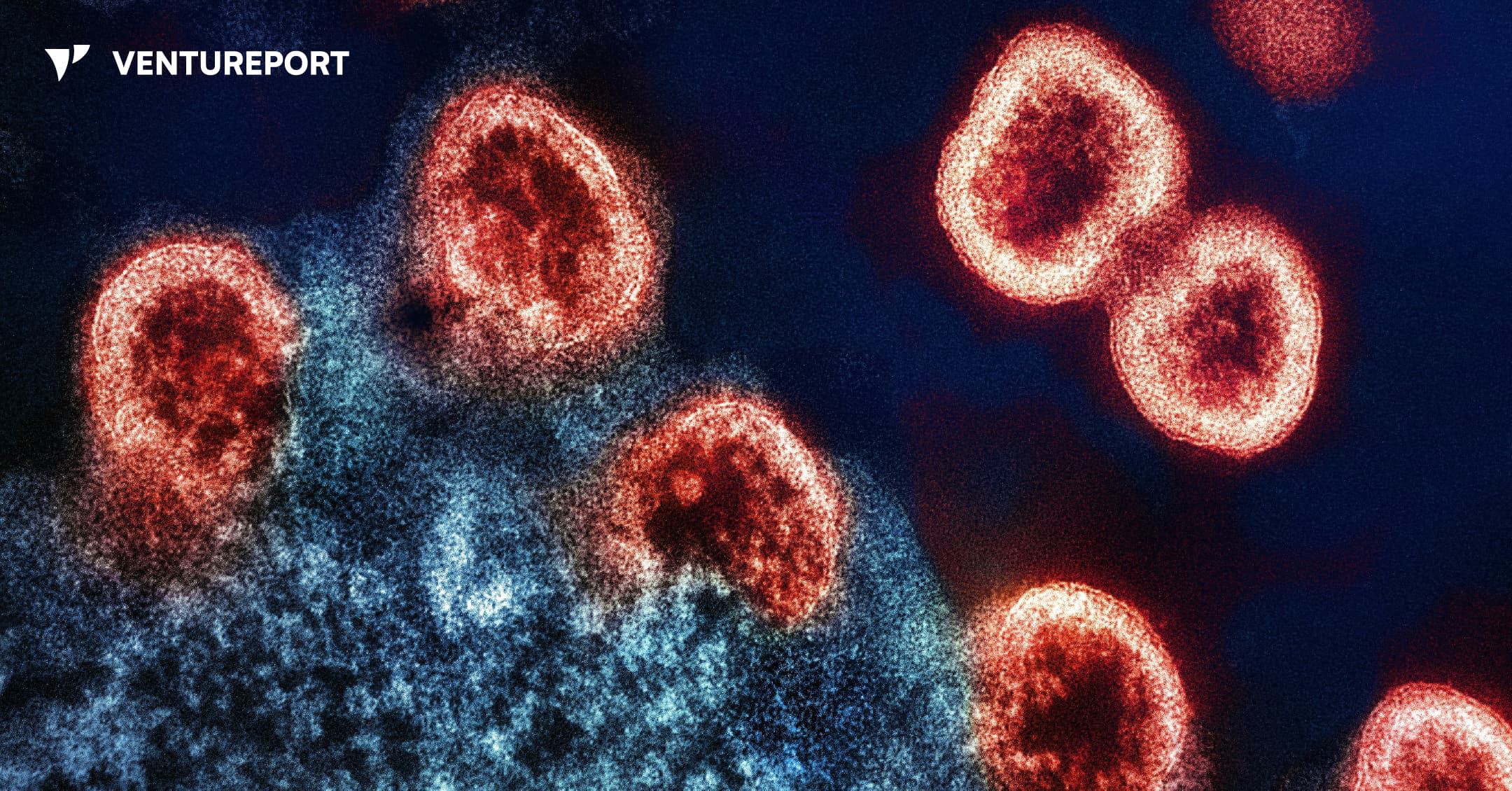
HIV-1 virus particles, coloured red. PHOTO: UNSPLASH
Investors are beginning to place bigger bets on AI startups focused on drug delivery infrastructure rather than drug discovery alone. That shift was on display this week after METiS TechBio, a Hong Kong tech-bio startup focused on AI-powered drug delivery systems, debuted on the Hong Kong Stock Exchange.
The listing made METiS TechBio the world’s first publicly traded AI-powered drug delivery startup and the first AI-powered large-molecule biopharmaceutical startup listed in Hong Kong. The startup raised more than HKD 2.1 billion through its IPO, making it the largest healthcare listing in Hong Kong so far in 2026.
Investor demand was unusually strong. The Hong Kong public offering was oversubscribed by more than 6,900 times while the international tranche recorded 82 times oversubscription. More than 280 institutional investors participated in the international placing.
The strong demand reflects a wider shift in AI biotech. Over the past few years, much of the sector’s attention has focused on using AI to discover new drugs or molecules. METiS is taking a different approach. The startup focuses on how medicines are delivered inside the body after they are developed.
That challenge is becoming harder to ignore in biotech. Designing a therapy is only one part of the process. Delivering it precisely to specific organs, tissues or cells remains a major hurdle, especially for newer therapies involving RNA, proteins and large-molecule drugs.
METiS is trying to solve that problem through its proprietary NanoForge platform. The system uses AI to design and test nanodelivery systems that help medicines reach targeted areas inside the body more efficiently. The platform combines AI models, simulation systems and high-throughput screening tools to speed up formulation development and improve delivery precision.
The startup says it has already achieved targeted delivery across eight organs and tissue systems including the liver, lungs, heart, muscles and central nervous system.
One of its lead programs, MTS-004, became China’s first AI-enabled formulation drug to complete a Phase III clinical trial. The drug is being developed for pseudobulbar affect, a neurological condition that affects emotional expression. According to the startup, AI tools helped reduce preclinical formulation development time from up to two years to less than three months.
Investor interest in the IPO also came from some of the world’s largest asset managers and healthcare funds. BlackRock led the cornerstone investments with a USD 50 million subscription. Other participating investors included UBS Asset Management Singapore, Mirae Asset, ORIX Corporation, Deerfield, RTW, Hillhouse Capital and IDG Capital.
METiS is also building what it describes as a “platform collaboration + product partnership” business model. The startup currently works with more than 30 pharmaceutical and biotechnology partners globally, including large pharmaceutical companies and medical research institutions.
The company reported RMB 105 million in revenue in 2025, largely tied to upfront payments connected to its MTS-004 partnership agreements. It also said some platform collaboration contracts could reach milestone values of up to USD 109 million.
Chris Lai said: "The future of biomedicine will no longer be simply about 'taking medicine when one falls ill.' METiS TechBio's ambition is to harness AI to build nano-rockets that can navigate with precision through the inner space of the human body's 30 trillion cells, write the code of nucleic acids and proteins into cells, and reprogram diseased and aging cells into healthy cells. This was our founding aspiration, and it is the mission to which we will dedicate our lives. The IPO marks a new starting point for us to accelerate forward, and we will strive to live up to the support and trust we have received from all sectors."
The IPO also highlights how Hong Kong is increasingly positioning itself as a hub for next-generation biotech and AI healthcare startups. While investor excitement around AI drug discovery has cooled in parts of the market, startups focused on delivery systems and biotech infrastructure are beginning to attract stronger institutional backing.
For METiS, the challenge now will be turning that investor confidence into commercially viable therapies and long-term partnerships. But the listing suggests that AI-driven drug delivery is starting to emerge as a category investors are willing to treat as core biotech infrastructure rather than a niche research experiment.
Keep Reading
With operations across 50 countries, MagicLab is pairing new robot systems with a platform strategy aimed at wider commercial adoption
Updated
August 10, 2026 5:56 PM
.jpg)
A standing yellow robotic arm. PHOTO: UNSPLASH
MagicLab Robotics is a Chinese startup that describes itself as an embodied AI company. At an event in Silicon Valley this week, it outlined its global ambitions and introduced new products designed for real-world use. The company said its international business now spans more than 50 countries and regions, with overseas markets accounting for 60% of total sales in 2025. That gives some indication of how quickly Chinese robotics firms are expanding beyond their home market.
At the centre of the announcement was MagicLab’s latest product line-up. It included Magic-Mix, described as a foundational world model for robots, the H01 dexterous robotic hand and its humanoid robot, MagicBot X1. In practical terms, the company is trying to build robots that can better understand their surroundings and perform physical tasks with greater precision. That is the core idea behind embodied AI, where intelligence is combined with movement and interaction in the real world rather than limited to software alone.
MagicLab says it develops both hardware and software internally. Its product range includes humanoid robots and four-legged machines, with systems designed for factories, commercial services and home use. The company also outlined where it sees demand emerging. It listed sectors such as healthcare, manufacturing, logistics, security, public safety, education and household assistance.
That wide spread of target markets reflects a broader challenge in robotics. Building capable machines is only one part of the equation. The harder task is finding enough practical uses where customers are willing to pay for them.
MagicLab also used the summit to set out a long-term commercial goal. It projected a path toward US$14 billion in annual revenue by 2036 through wider adoption of embodied AI systems. It also announced what it calls the “Co-Create 1000 Initiative”, a plan to work with external developers and partner companies.
As part of that effort, the startup said it plans to invest US$1 billion over the next five years to build a developer ecosystem that would allow third parties to create new applications for its robots. The strategy mirrors what happened in smartphones and cloud software, where ecosystems often mattered as much as the original hardware. If robotics follows a similar path, companies that attract developers could gain an advantage over those selling machines alone.
For now, MagicLab’s announcement is less about immediate breakthroughs and more about positioning. The company is presenting itself not simply as a robot maker, but as a platform business seeking a role in the next phase of intelligent machines.