
A new AI model replaces months of simulation with near-instant predictions, changing how spacecraft operations are prepared
Updated
August 10, 2026 5:56 PM

Northrop Grumman Stargaze serves as the mother ship for the Pegasus, an air-launched orbital rocket. PHOTO: UNSPLASH
Flexcompute, a startup that builds software to simulate real-world physics, is working with Northrop Grumman to change how space missions are prepared. Together, they have developed an AI-based system that can predict how spacecraft respond during critical manoeuvres such as docking—when one spacecraft moves in and connects with another in orbit. These steps have traditionally taken months of preparation.
At the centre of this work is a long-standing problem in space operations. When a spacecraft fires its thrusters, the exhaust plume interacts with nearby surfaces. These interactions can affect movement, temperature and stability. Because these effects are difficult to test in real conditions, engineers have relied on large volumes of computer simulations to estimate outcomes before a mission. That process is slow and resource-intensive.
The new system replaces much of that workflow with a trained AI model. Instead of running millions of simulations, the model learns patterns from physics-based data and can make predictions in seconds. It also provides a measure of uncertainty, which helps engineers understand how reliable those predictions are when making decisions.
"At Northrop Grumman, we're pioneering physics AI to accelerate design and solve complex simulation and modelling problems like plume impingement—critical for station keeping, rendezvous and space robotics. Simply put: we're pushing the boundaries of advanced space operations", said Fahad Khan, Director of AI Foundations at Northrop Grumman. "Partnering with Flexcompute and NVIDIA, we're accelerating innovation and mission timelines to deliver superior space capabilities for customers at the speed they need".
The system is built using technology from NVIDIA, which provides the computing framework behind the model. Flexcompute has adapted it to handle the specific challenges of spaceflight, including how gases expand and interact in a vacuum. The result is a tool that can simulate complex scenarios much faster while maintaining the level of accuracy needed for mission planning.
By shortening preparation time, the model changes how engineers approach spacecraft design and operations. Faster predictions mean teams can test more scenarios and adjust plans more quickly. It also helps improve fuel use and extend the lifespan of spacecraft.
"Northrop Grumman's confidence reflects what sets Flexcompute apart", said Vera Yang, President and Co-Founder of Flexcompute. "We are able to take the most accurate and scalable physics foundations and evolve them into highly trained, customized Physics AI solutions that engineers can rely on. This work shows how we are transforming the role of simulation, not just speeding it up, but expanding what engineers can confidently solve and how quickly they can act".
The collaboration points to a broader shift in how engineering problems are being handled. Instead of relying only on detailed simulations that take time to run, companies are beginning to use AI systems that can approximate those results quickly while still reflecting the underlying physics.
"The industry's most ambitious space missions now demand a level of speed and precision that traditional engineering cycles can no longer sustain", said Tim Costa, vice president and general manager of computational engineering at NVIDIA. "By integrating NVIDIA PhysicsNeMo, Northrop Grumman and Flexcompute are transforming complex simulations like plume impingement from days of compute into seconds of insight, drastically accelerating the path from mission concept to orbit".
What emerges from this work is a shift in how missions are prepared. When prediction cycles move from months to seconds, testing and decision-making can happen faster. For space operations, where timing and precision are closely linked, that change could reshape how systems are built and run.
Keep Reading
Rethinking 3D modelling for a world that generates too much, too quickly.
Updated
January 8, 2026 6:32 PM
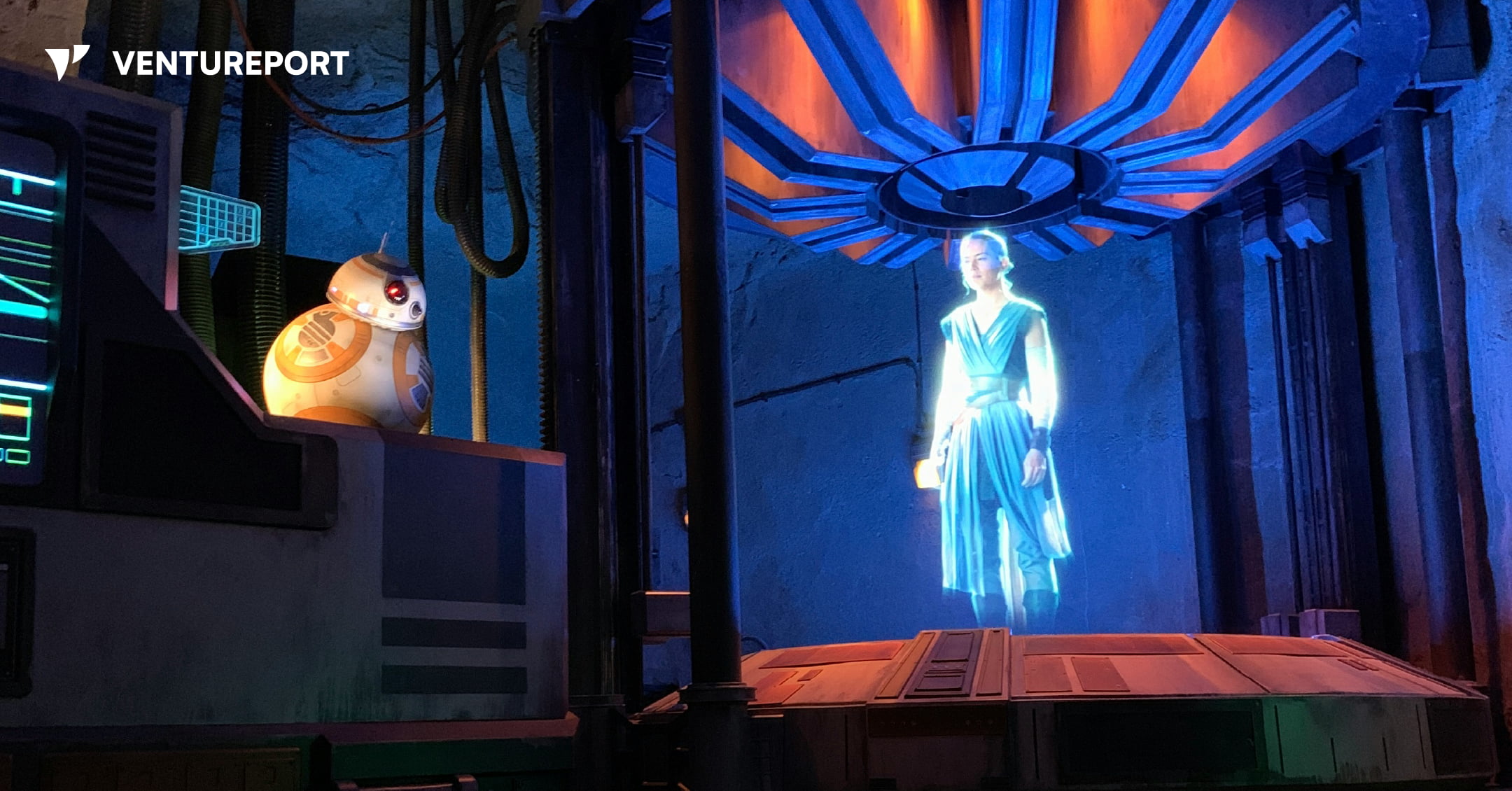
A hologram in the franchise Star Wars, in Walt Disney World Resort, Orlando. PHOTO: UNSPLASH
MicroCloud Hologram Inc. (NASDAQ: HOLO), a technology service provider recognized for its holography and imaging systems, is now expanding into a more advanced realm: a quantum-driven 3D intelligent model. The goal is to generate detailed 3D models and images with far less manual effort — a need that has only grown as industries flood the world with more visual data every year.
The concept is straightforward, even if the technology behind it isn’t. Traditional 3D modeling workflows are slow, fragmented and depend on large teams to clean datasets, train models, adjust parameters and fine-tune every output. HOLO is trying to close that gap by combining quantum computing with AI-powered 3D modeling, enabling the system to process massive datasets quickly and automatically produce high-precision 3D assets with much less human involvement.
To achieve this, the company developed a distributed architecture comprising of several specialized subsystems. One subsystem collects and cleans raw visual data from different sources. Another uses quantum deep learning to understand patterns in that data. A third converts the trained model into ready-to-use 3D assets based on user inputs. Additional modules manage visualization, secure data storage and system-wide protection — all supported by quantum-level encryption. Each subsystem runs in its own container and communicates through encrypted interfaces, allowing flexible upgrades and scaling without disrupting the entire system.
Why this matters: Industries ranging from gaming and film to manufacturing, simulation and digital twins are rapidly increasing their reliance on 3D content. The real bottleneck isn’t creativity — it’s time. Producing accurate, high-quality 3D assets still requires a huge amount of manual processing. HOLO’s approach attempts to lighten that workload by utilizing quantum tools to speed up data processing, model training, generation and scaling, while keeping user data secure.
According to the company, the system’s biggest advantages include its ability to handle massive datasets more efficiently, generate precise 3D models with fewer manual steps, and scale easily thanks to its modular, quantum-optimized design. Whether quantum computing will become a mainstream part of 3D production remains an open question. Still, the model shows how companies are beginning to rethink traditional 3D workflows as demand for high-quality digital content continues to surge.