
A new AI model replaces months of simulation with near-instant predictions, changing how spacecraft operations are prepared
Updated
August 10, 2026 5:56 PM

Northrop Grumman Stargaze serves as the mother ship for the Pegasus, an air-launched orbital rocket. PHOTO: UNSPLASH
Flexcompute, a startup that builds software to simulate real-world physics, is working with Northrop Grumman to change how space missions are prepared. Together, they have developed an AI-based system that can predict how spacecraft respond during critical manoeuvres such as docking—when one spacecraft moves in and connects with another in orbit. These steps have traditionally taken months of preparation.
At the centre of this work is a long-standing problem in space operations. When a spacecraft fires its thrusters, the exhaust plume interacts with nearby surfaces. These interactions can affect movement, temperature and stability. Because these effects are difficult to test in real conditions, engineers have relied on large volumes of computer simulations to estimate outcomes before a mission. That process is slow and resource-intensive.
The new system replaces much of that workflow with a trained AI model. Instead of running millions of simulations, the model learns patterns from physics-based data and can make predictions in seconds. It also provides a measure of uncertainty, which helps engineers understand how reliable those predictions are when making decisions.
"At Northrop Grumman, we're pioneering physics AI to accelerate design and solve complex simulation and modelling problems like plume impingement—critical for station keeping, rendezvous and space robotics. Simply put: we're pushing the boundaries of advanced space operations", said Fahad Khan, Director of AI Foundations at Northrop Grumman. "Partnering with Flexcompute and NVIDIA, we're accelerating innovation and mission timelines to deliver superior space capabilities for customers at the speed they need".
The system is built using technology from NVIDIA, which provides the computing framework behind the model. Flexcompute has adapted it to handle the specific challenges of spaceflight, including how gases expand and interact in a vacuum. The result is a tool that can simulate complex scenarios much faster while maintaining the level of accuracy needed for mission planning.
By shortening preparation time, the model changes how engineers approach spacecraft design and operations. Faster predictions mean teams can test more scenarios and adjust plans more quickly. It also helps improve fuel use and extend the lifespan of spacecraft.
"Northrop Grumman's confidence reflects what sets Flexcompute apart", said Vera Yang, President and Co-Founder of Flexcompute. "We are able to take the most accurate and scalable physics foundations and evolve them into highly trained, customized Physics AI solutions that engineers can rely on. This work shows how we are transforming the role of simulation, not just speeding it up, but expanding what engineers can confidently solve and how quickly they can act".
The collaboration points to a broader shift in how engineering problems are being handled. Instead of relying only on detailed simulations that take time to run, companies are beginning to use AI systems that can approximate those results quickly while still reflecting the underlying physics.
"The industry's most ambitious space missions now demand a level of speed and precision that traditional engineering cycles can no longer sustain", said Tim Costa, vice president and general manager of computational engineering at NVIDIA. "By integrating NVIDIA PhysicsNeMo, Northrop Grumman and Flexcompute are transforming complex simulations like plume impingement from days of compute into seconds of insight, drastically accelerating the path from mission concept to orbit".
What emerges from this work is a shift in how missions are prepared. When prediction cycles move from months to seconds, testing and decision-making can happen faster. For space operations, where timing and precision are closely linked, that change could reshape how systems are built and run.
Keep Reading
A humanoid robot being escorted away by police in Macau has gone viral online, prompting jokes about what some called the world’s first “robot arrest.”
Updated
April 1, 2026 8:55 AM
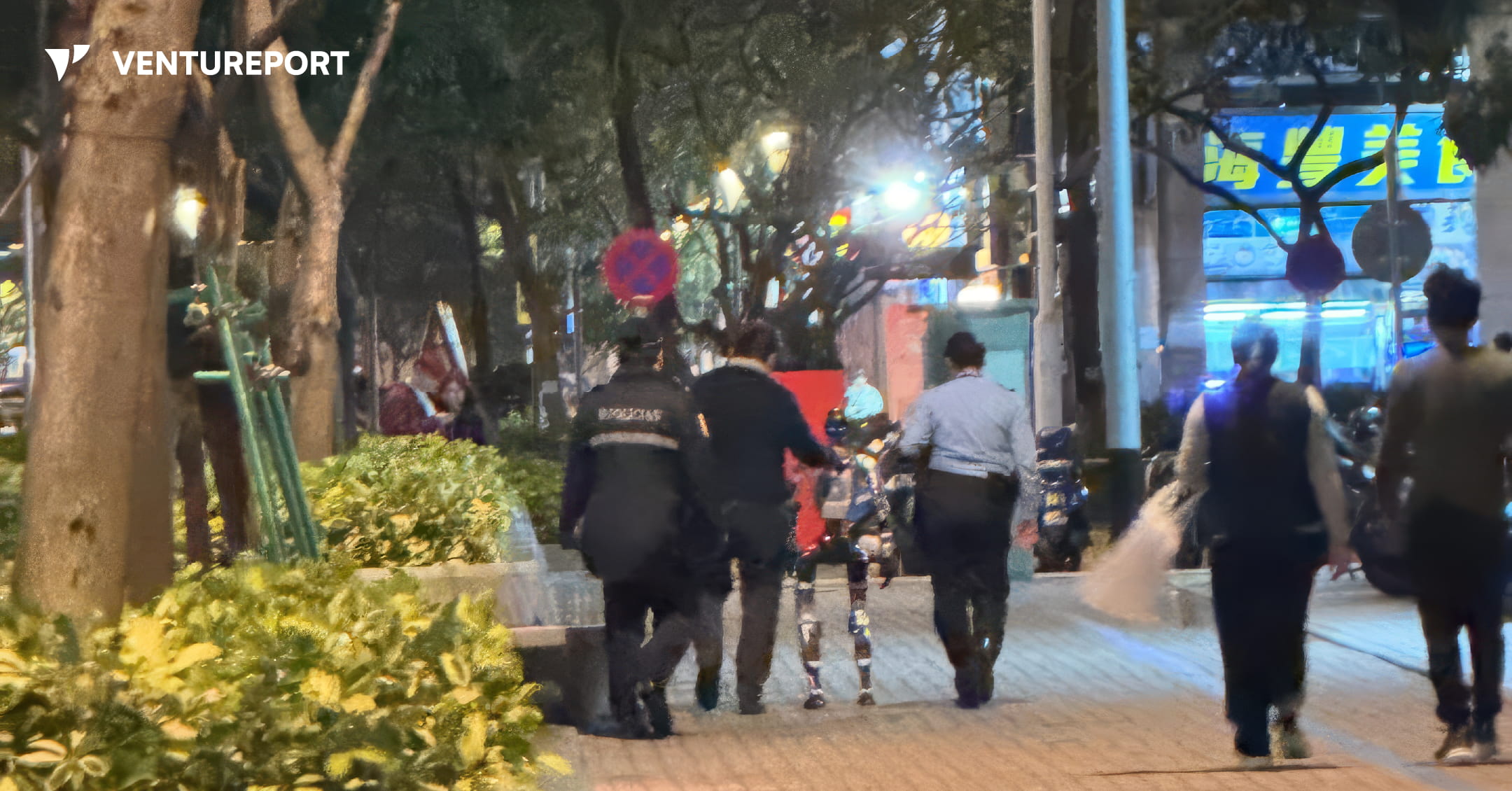
Macau police officer accompanying the humanoid robot. PHOTO: THREADS@BOXOF_CHOCOLATE
Police in Macau recently detained a humanoid robot after it frightened an elderly woman on a public street. The unusual encounter quickly spread online, prompting jokes about what some called the world’s first “robot arrest”.
On the evening of March 5, the robot was taken away by officers after the encounter triggered alarm among bystanders. Videos circulating on social media show an elderly woman confronting the robot on a sidewalk, visibly distressed and shouting that her “heart is pounding” while demanding to know why such “nonsense” was happening on the street. In the clip, the robot raises both hands toward the woman after she lashes out in fear — a gesture many viewers interpreted as a sign of apology.
Shortly afterwards, two officers from the Macau Public Security Police Force were seen escorting the robot and a man believed to be its operator away from the area. An officer is seen placing his right hand on the robot’s shoulder — the same posture police often use when presenting arrested suspects in official photographs.
That scene quickly spread online, fuelling jokes about what some called the world’s first “robot arrest”.
Photos shared online show a humanoid robot with long limbs and exposed mechanical joints, built from a black metallic frame without an outer shell. In dim lighting, several commenters said it resembled a “moving skeleton” — a striking sight for pedestrians encountering it unexpectedly on the street.
Witnesses said the woman appeared severely shaken and an ambulance was eventually called to take her to the hospital.
The incident also sparked discussion online about robots operating in public spaces. Some commenters argued that experimental technologies should be tested in controlled environments, while others said machines moving through public areas should have clearer designs or safety measures to avoid alarming pedestrians.
It remains unclear who deployed the robot or what purpose it was serving in the area at the time of the incident. Authorities have not released further details about the device or whether any action was taken following the encounter.