
Two-Day Event to be Held on 4-5 November. Bringing Together Global Investors and Entrepreneurs to Explore New Frontiers in Agentic AI, One-Person Companies (OPCs), and Hong Kong’s Role as an International Innovation, Funding, and Technology Hub
Updated
October 30, 2026 9:22 PM

Hong Kong, 26 October 2026 – As the global venture capital market evolves amid economic shifts, investment flows are increasingly concentrated, particularly in artificial intelligence (AI), which continues to drive significant momentum. The annual flagship event, Cyberport Venture & Capital Forum (CVCF), will take place on 4-5 November 2026 at Cyberport. Themed “Scaling in a Changing World: Winning the Next Competitive Cycle”, this year’s CVCF will unite influential global investors and entrepreneurs to explore key themes including Enterprise and Agentic AI, One-Person Companies (OPCs), frontier technologies, and spotlight Hong Kong's unique position as a strategic gateway connecting Chinese Mainland, ASEAN, the Middle East, global innovation and funding networks. The forum aims to empower start-ups and investors to break through financing and market expansion barriers, seizing new market opportunities.

Dr Rocky Cheng, CEO of Cyberport, said, “As global innovation and capital markets undergo accelerated reshaping, AI, data technology, and emerging industries have become crucial engines driving economic growth. CVCF is dedicated to building a bridge between innovation and capital. This year’s forum focuses on new trends such as AI, digital assets, and One-Person Companies (OPCs), exploring emerging market opportunities and global expansion strategies. It decodes how enterprises can drive scalable growth with speed and resilience in a rapidly changing market. Through our investor matching activities, we aim to facilitate the commercialisation of innovations and cross-regional collaboration. Cyberport will continue to leverage its role as Hong Kong’s digital tech flagship and AI accelerator to foster a thriving I&T ecosystem and inject new momentum into building Hong Kong as an international innovation and technology hub.”
Cyberport’s start-ups have demonstrated robust fundraising performance over the past year. With 481 companies joining the community during this period, Cyberport start-ups have raised over HK$74.5 billion in funding. During the year, 19 Cyberport companies successfully listed, alongside the addition of 2 new unicorns. Recent high-value fundraising rounds include Finloop, Qupital, Premialab, and Buy&Ship, many of which leverage AI, blockchain, and digital assets - reflecting sustained market confidence in these emerging technologies and underscoring Cyberport's success in fostering their development.

Hendrick Sin, Chairman of Cyberport Investors Network (CIN) Steering Group; Co-Founder of CMGE Technology Group Limited; Chairman of China Prosperity Capital, said, “Cyberport Investors Network (CIN) has come to its 9th anniversary this year, and our network of over 240 global investors has successfully facilitated more than HK$6 billion across over 133 project matchings, representing an increase of over 19 projects compared to last year. Simultaneously, the Cyberport Macro Fund (CMF), alongside co-investments, has directed HK$2.7 billion into high-potential ventures, with a co-investment ratio of 1:9:3., reflecting strong investor confidence in Cyberport companies. Through dedicated initiatives and our targeted investor matching sessions, CVCF continues to bridge high-growth ventures with institutional co-investment partners, public-private funds and foster collaboration across government, industry, academia, research, investment, and users, propelling enterprise scale across regional corridors.”
As Hong Kong’s digital tech hub, AI accelerator and key incubator, Cyberport leverages the Cyberport Investors Network (CIN) to attract influential investment units from around the world to connect with high-potential Cyberport enterprises to accelerate their development. Since its inception in 2017, the total investments facilitated by CIN have reached over HK$6 billion across a cumulative total of 133 project matchings. CIN’s investment units have surpassed 240, with 15% from the Greater Bay Area and 14% from the Asia-Pacific region, alongside continuous expansion into the Middle East and ASEAN, successfully aggregating global venture capital.
Another key financing channel, Cyberport Macro Fund (CMF), continues to invest in high-potential start-ups while enhancing their fundraising capabilities. As of September 2026, CMF has invested in 30 start-up projects, with the total investment, including co-investments, exceeding HK$2.7 billion, with a co-investment ratio of 1:9.3 — meaning every HK$1 invested by Cyberport attracts an additional HK$9.3 in co-investment. Further augmenting ecosystem liquidity, Cyberport, BOCHK Asset Management, and BOC Group Investment have formed a strategic partnership in May 2026 around a completed venture capital fund to back promising Hong Kong I&T start-ups. This demonstrates Cyberport’s sustained ability to attract and secure capital in a challenging environment.
Cyberport companies have recently achieved remarkable success across venture capital fundraising, advanced technology commercialisation, and international market expansion. Among them, leading Cyberport community members, including global Web5 wealth technology platform Finloop, independent fintech and data analytics platform Premialab, and cross-border fintech platform Qupital, shared their insights on navigating capital cycles, deploying next-generation financial architectures, and scaling from Hong Kong into regional and global markets.
Zhao Yang, Deputy CEO of Finloop, said, “While originating from an established corporate background, we strategically chose Cyberport as the ideal launchpad to spin off our project and scale our vision. Cyberport has been an indispensable catalyst for Finloop’s growth as we develop our AI-driven, one-stop Web5 wealth technology and RWA issuance platform, delivering AI-native liquidity solutions to institutions and SMEs. Beyond providing a vibrant community of innovators, Cyberport’s dynamic ecosystem provides an invaluable springboard for us with leading commercial banks, brokerages, and External Asset Managers (EAMs) across Hong Kong and Singapore, accelerating our mission to build compliant and institutional-grade infrastructure that unlocks new liquidity and value flows across the region.”
Pierre Trecourt, Co-Founder and Chief Operating Officer of Premialab, emphasized the growing importance of advanced data analytics in multi-asset investing, “In an increasingly complex and volatile market environment, institutional investors need greater transparency and sophisticated analytics to construct resilient portfolios, benchmark systematic investment strategies, and manage risk. Hong Kong’s unique position as a global financial hub, combined with its exceptional talent pool and Cyberport’s extensive ecosystem, provides an ideal environment for fintech companies to innovate, expand internationally, and scale their businesses.”
Winston Wong, Co-Founder and CEO of Qupital, discussed their milestone achievements in digital economy lending and underscored Cyberport’s long-standing backing throughout their journey, “Cyberport has played an integral role throughout Qupital’s journey from a homegrown startup to a profitable Series C fintech company. Under the support of Cyberport’s investor networks and platforms, we are proud to have become the first platform in Asia to securitise e-commerce merchant loans while sustaining industry-leading credit performance and profitability. Our journey truly reflects how Cyberport empowers homegrown fintech pioneers to scale sustainable cross-border supply chain financing across the Greater Bay Area and global markets.”
Cyberport Venture & Capital Forum 2026 will feature opening remarks by Lillian Cheong, Acting Secretary for Innovation, Technology and Industry, and bring together venture capital leaders, including representatives from Taara, Gobi Partners, Alumni Ventures, Rasmal Ventures, Primavera Capital, Draper Dragon, Pegasus Tech Ventures, Plug & Play and more to discuss the latest technology and market focus:
CVCF 2026 will continue to feature the popular “Investor Matching” session, offering face-to-face and online interactions to pair investors with start-ups based on their technological focus and investment preferences, enhancing collaboration efficiency. Additional highlights include over 80 physical showcase booths, funder power pitches, start-up clinic & workshop, providing attendees with practical insights and strategic advice. Memorandum of Understanding (MoU) signing ceremonies between Cyberport and international partners including Gobi Partners and Thailand’s National Innovation Agency (NIA) will also be held on the day.
The Agentic Economy Summit, a key highlight of the forum, will feature a keynote speech from Mr Joseph CHAN, JP, Under Secretary for Financial Services and the Treasury, bringing together AI pioneers, regulators, and financial giants to examine how digital identity, institutional tokenisation, HKD stablecoin issuance, programmable payments and machine-to-machine commerce are building the financial rails of the future. Featured speakers will also include representatives from HashKey, Cobo, Unlimit, Anchorpoint, UBS, Monk’s Hill Ventures, and more. The summit will also be exploring the emerging phenomenon of One-Person Companies (OPCs), highlighting how AI agents enable lean entrepreneurial ventures to achieve unprecedented operational scale.
As Cyberport’s flagship venture capital event, CVCF connects investors and entrepreneurs in the global digital technology. In 2025, the hybrid event attracted over 2,700 participants, achieved more than 180,000 views and facilitated more than 500 deal flows, fostering partnerships and investment opportunities. For more details, please visit the website: http://cvcf.cyberport.hk/.
The annual flagship event, Cyberport Venture Capital Forum (CVCF) 2026, will take place on 4-5 November 2026 at Cyberport. Themed “Scaling in a Changing World: Winning the Next Competitive Cycle”, this year’s CVCF will unite influential global investors and entrepreneurs to explore key themes include Enterprise AI, One-Person Companies (OPCs), frontier technologies, and spotlight Hong Kong's unique position as a strategic gateway connecting Chinese Mainland, ASEAN, the Middle East, global innovation and funding networks. The forum aims to empower start-ups and investors to break through financing and market expansion barriers, seizing new market opportunities. Dr Rocky Cheng, CEO of Cyberport (third right), Hendrick Sin, Chairman of Cyberport Investors Network (CIN) Steering Group (third left); Ir Eric Chan, Chief Public Mission Officer of Cyberport (second right), and Cyberport community members, Zhao Yang, Deputy CEO of Finloop (second left), Pierre Trecourt, Co-Founder and Chief Operating Officer of Premialab (first right), and Winston Wong, Co-Founder and CEO of Qupital (first left), attended the media briefing.

Ir Eric Chan, Chief Public Mission Officer of Cyberport introduced the speakers and highlights of the two-day Cyberport Venture Capital Forum 2025, as well as the Web3.0 Innovation Expo.

Ir Eric Chan, Chief Public Mission Officer of Cyberport (first left) and Cyberport community members, Zhao Yang, Deputy CEO of Finloop (second left), Pierre Trecourt, Co-Founder and Chief Operating Officer of Premialab (second right), and Winston Wong, Co-Founder and CEO of Qupital (first right), shared investment insights and experiences in facilitating fundraising during the discussion session.
Keep Reading
The Hong Kong startup combines 3D-printed reef tiles, biodiversity monitoring and long-term data to help companies manage their impact on marine ecosystems.
Updated
August 18, 2026 11:32 PM

Young corals growing on Archireef's 3D-printed terracotta reef tiles beneath the sea. IMAGE: ARCHIREFF
Anyone who has snorkeled over a coral reef has probably admired its vibrant colours and the marine life swimming between its branches. What is less visible is how easily these ecosystems can be damaged. Rising ocean temperatures and pollution continue to put reefs under pressure, while coastal development creates another threat. Construction can stir up sediment that settles on corals, blocking the sunlight they need and making it harder for damaged reefs to recover.
Protecting marine ecosystems is becoming a shared responsibility. Alongside scientists, governments and conservation groups, businesses whose operations affect the ocean are increasingly expected to understand, manage and reduce their environmental impact. They must also show regulators, banks and investors that they are meeting their environmental commitments.
Archireef helps businesses meet those demands. Founded by Vriko Yu, the Hong Kong-rooted B2B startup specializes in marine ecosystem restoration and ocean nature risk management. Drawing on years of research at the University of Hong Kong, Yu built the company to help organisations understand, measure and reduce their impact on marine ecosystems.
Yu describes Archireef as an “end-to-end ocean nature risk management company”.
“What we offer them is a credible way to meet those obligations and stand behind the results,” she says.
One of the company’s main tools for restoring damaged marine ecosystems is its flagship 3D-printed terracotta reef tile. The tiles provide a stable foundation where young corals can attach, grow and survive over time.
Archireef chose terracotta instead of concrete and other conventional materials because it is pH-neutral and does not release harmful chemicals into the water. Its surface also gives corals a suitable place to attach naturally.
Before placing a single tile in the ocean, the team studies the proposed restoration site to determine whether recovery is possible. It assesses the water quality, biodiversity and general health of the ecosystem. As Yu explains, restoration should begin only where nature has a realistic chance to recover.
“Restoration isn’t about replacing nature or engineering a reef into existence. It is about removing the barriers and giving a degraded system the conditions it needs to begin recovering on its own”, she says.
Once the team selects a site, divers carefully place the tiles on the seabed. Their curves, ridges and crevices imitate the structure of a natural coral reef, creating sheltered spaces for marine species. The design also helps limit sediment build-up, which can block sunlight and smother young corals.
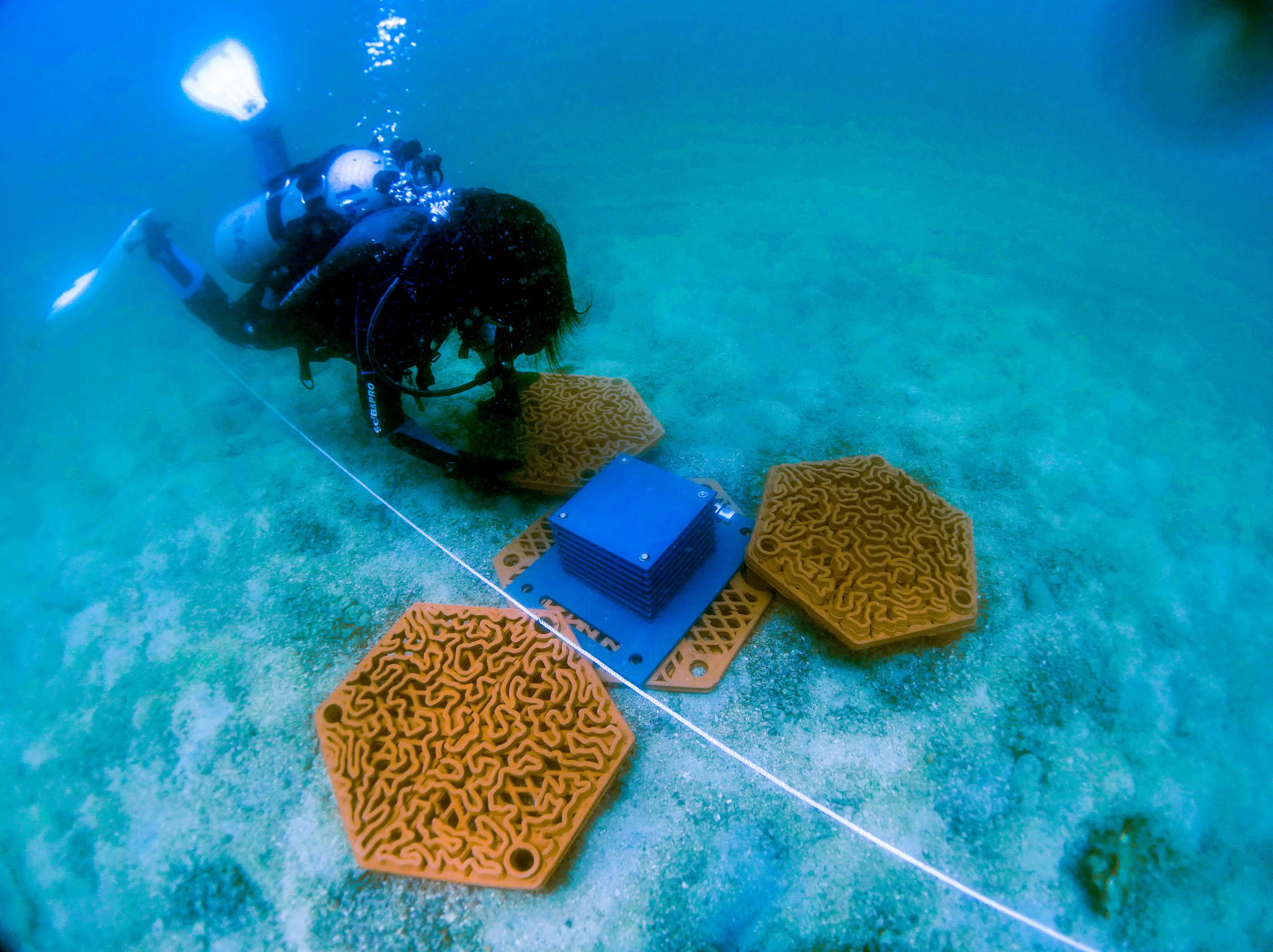
Archireef adjusts the shape of its reef tiles for each project.
“There’s no universal reef, so there’s no universal tile”, Yu says.
Instead of producing one standard model, the company adapts each design to the coral species, water conditions and surrounding marine environment. A coral restoration project in Hong Kong may therefore require a different tile from one in Saudi Arabia, even when the same manufacturing process is used.
“The biggest adaptation from site to site is usually the match between design, species and environment, not the manufacturing itself ”, Yu explains.

Although the reef tile is Archireef’s most recognizable innovation, Yu sees it as one part of a much broader service.
“The reef tile gets the attention because it’s tangible,” she says. “But the real product is the proof — defensible, audit-ready evidence of nature recovery that an organization can put in a disclosure and stand behind under scrutiny”.
Producing that evidence requires years of biodiversity monitoring. Long after the reef tiles have been installed, Archireef continues to track coral survival and the health of the surrounding marine ecosystem. Its monitoring methods include ecological surveys, AI-assisted species recognition, photogrammetry and environmental DNA testing.
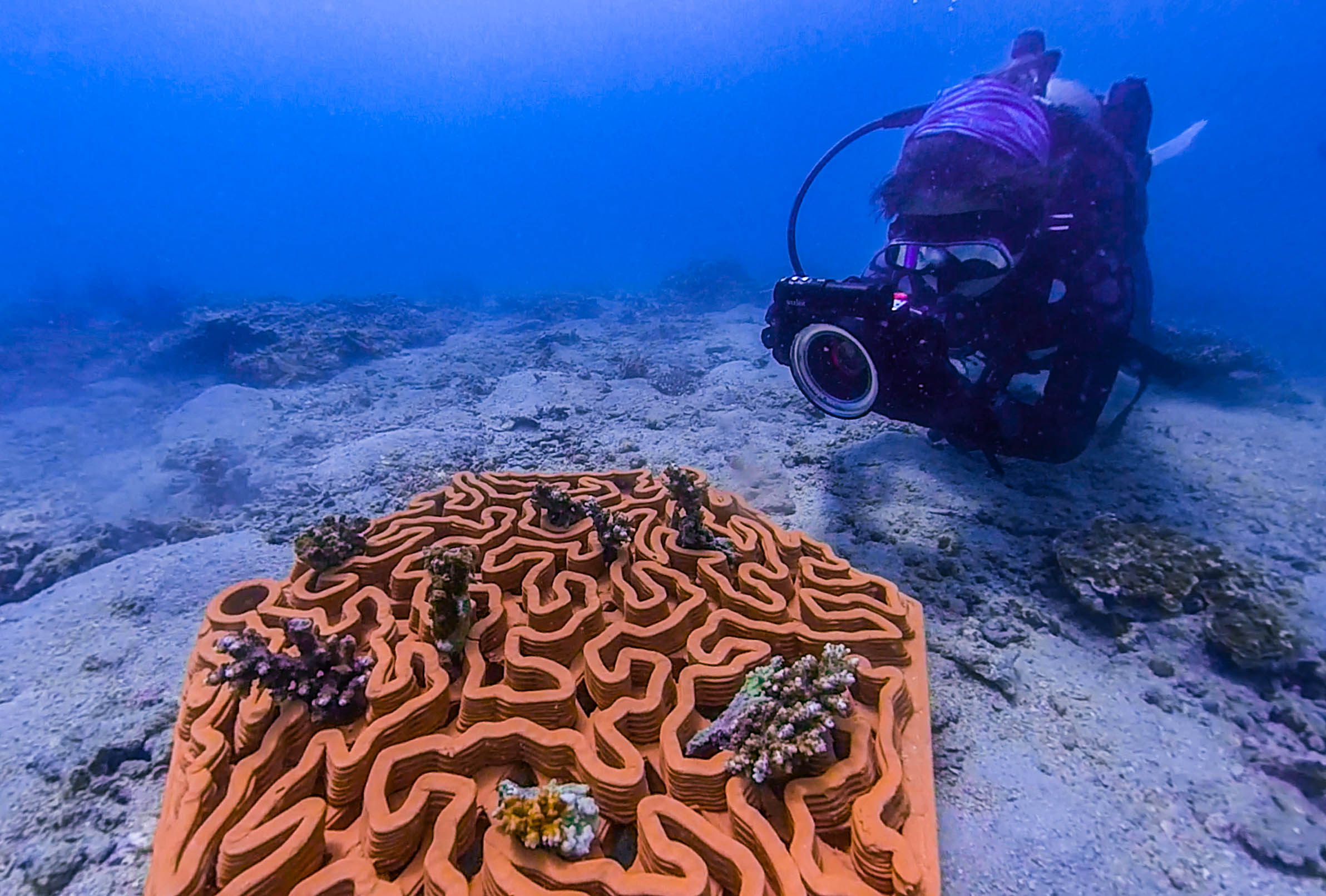
Photogrammetry uses photographs to produce detailed 3D models of the reef. These models allow the team to measure changes in coral growth and reef structure over time.
Environmental DNA, commonly known as eDNA, offers another way to monitor marine biodiversity. Traditional ecological surveys often depend on divers recording the species they can see. eDNA testing instead examines traces of genetic material left in the water by marine organisms, including skin cells, mucus and waste.
By analyzing these traces, Archireef can detect species that may be hidden, difficult to identify or absent during a dive. This gives the company a more complete picture of the ecosystem and how it is changing.
For Archireef, the success of a coral reef restoration project is determined by what happens several years after installation.
“The indicators that matter aren’t the ones that look good on deployment day”, Yu says. “They’re the ones that show, two, three and five years on, whether a genuine ecosystem is establishing and sustaining itself”.
At the company’s first restoration site in Hoi Ha Wan, Hong Kong, around 90% of the transplanted corals remained alive four years after deployment. The long-term survival rate suggests that the ecosystem is recovering rather than simply appearing healthy during the early stages of the project.
Results like these have helped Archireef move beyond academic research and secure collaborations across the public and private sectors. In Hong Kong, the company has worked with government departments and public organisations responsible for coastal infrastructure and marine conservation.