
With operations across 50 countries, MagicLab is pairing new robot systems with a platform strategy aimed at wider commercial adoption
Updated
August 10, 2026 5:56 PM
.jpg)
A standing yellow robotic arm. PHOTO: UNSPLASH
MagicLab Robotics is a Chinese startup that describes itself as an embodied AI company. At an event in Silicon Valley this week, it outlined its global ambitions and introduced new products designed for real-world use. The company said its international business now spans more than 50 countries and regions, with overseas markets accounting for 60% of total sales in 2025. That gives some indication of how quickly Chinese robotics firms are expanding beyond their home market.
At the centre of the announcement was MagicLab’s latest product line-up. It included Magic-Mix, described as a foundational world model for robots, the H01 dexterous robotic hand and its humanoid robot, MagicBot X1. In practical terms, the company is trying to build robots that can better understand their surroundings and perform physical tasks with greater precision. That is the core idea behind embodied AI, where intelligence is combined with movement and interaction in the real world rather than limited to software alone.
MagicLab says it develops both hardware and software internally. Its product range includes humanoid robots and four-legged machines, with systems designed for factories, commercial services and home use. The company also outlined where it sees demand emerging. It listed sectors such as healthcare, manufacturing, logistics, security, public safety, education and household assistance.
That wide spread of target markets reflects a broader challenge in robotics. Building capable machines is only one part of the equation. The harder task is finding enough practical uses where customers are willing to pay for them.
MagicLab also used the summit to set out a long-term commercial goal. It projected a path toward US$14 billion in annual revenue by 2036 through wider adoption of embodied AI systems. It also announced what it calls the “Co-Create 1000 Initiative”, a plan to work with external developers and partner companies.
As part of that effort, the startup said it plans to invest US$1 billion over the next five years to build a developer ecosystem that would allow third parties to create new applications for its robots. The strategy mirrors what happened in smartphones and cloud software, where ecosystems often mattered as much as the original hardware. If robotics follows a similar path, companies that attract developers could gain an advantage over those selling machines alone.
For now, MagicLab’s announcement is less about immediate breakthroughs and more about positioning. The company is presenting itself not simply as a robot maker, but as a platform business seeking a role in the next phase of intelligent machines.
Keep Reading
Rethinking 3D modelling for a world that generates too much, too quickly.
Updated
January 8, 2026 6:32 PM
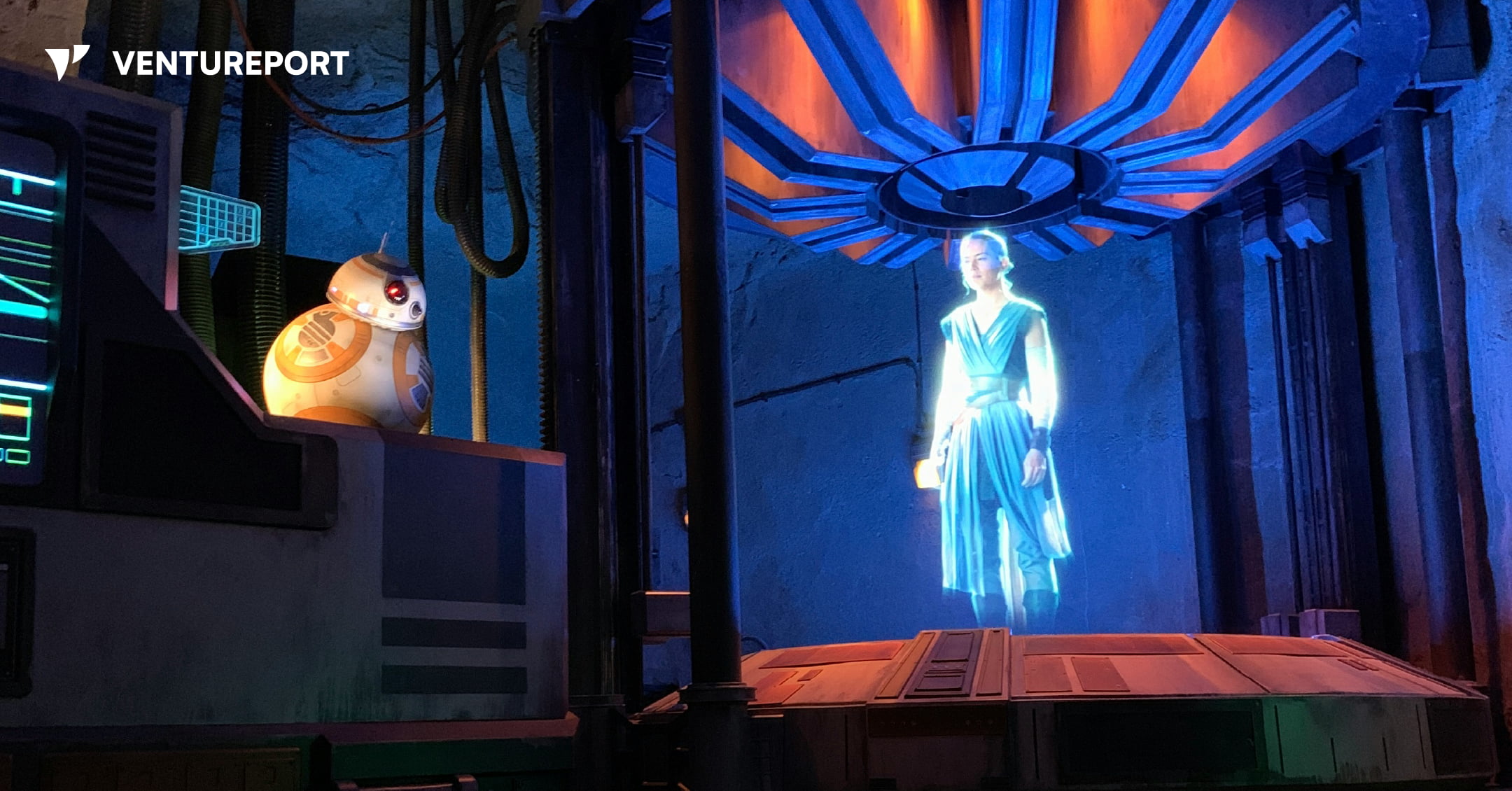
A hologram in the franchise Star Wars, in Walt Disney World Resort, Orlando. PHOTO: UNSPLASH
MicroCloud Hologram Inc. (NASDAQ: HOLO), a technology service provider recognized for its holography and imaging systems, is now expanding into a more advanced realm: a quantum-driven 3D intelligent model. The goal is to generate detailed 3D models and images with far less manual effort — a need that has only grown as industries flood the world with more visual data every year.
The concept is straightforward, even if the technology behind it isn’t. Traditional 3D modeling workflows are slow, fragmented and depend on large teams to clean datasets, train models, adjust parameters and fine-tune every output. HOLO is trying to close that gap by combining quantum computing with AI-powered 3D modeling, enabling the system to process massive datasets quickly and automatically produce high-precision 3D assets with much less human involvement.
To achieve this, the company developed a distributed architecture comprising of several specialized subsystems. One subsystem collects and cleans raw visual data from different sources. Another uses quantum deep learning to understand patterns in that data. A third converts the trained model into ready-to-use 3D assets based on user inputs. Additional modules manage visualization, secure data storage and system-wide protection — all supported by quantum-level encryption. Each subsystem runs in its own container and communicates through encrypted interfaces, allowing flexible upgrades and scaling without disrupting the entire system.
Why this matters: Industries ranging from gaming and film to manufacturing, simulation and digital twins are rapidly increasing their reliance on 3D content. The real bottleneck isn’t creativity — it’s time. Producing accurate, high-quality 3D assets still requires a huge amount of manual processing. HOLO’s approach attempts to lighten that workload by utilizing quantum tools to speed up data processing, model training, generation and scaling, while keeping user data secure.
According to the company, the system’s biggest advantages include its ability to handle massive datasets more efficiently, generate precise 3D models with fewer manual steps, and scale easily thanks to its modular, quantum-optimized design. Whether quantum computing will become a mainstream part of 3D production remains an open question. Still, the model shows how companies are beginning to rethink traditional 3D workflows as demand for high-quality digital content continues to surge.