
How ChinaMarket uses digital tools to make cross-border sourcing faster and more accessible for smaller businesses

A rack of colourful scarves. PHOTO: UNSPLASH
The 5th RCEP (Shandong) Import Commodities Expo opened this week at the Linyi International Expo Center, bringing together more than 5,300 buyers and over 400 exhibitors from 48 countries. Alongside the scale of the event, a quieter shift was visible in how trade itself is being organised.
ChinaMarket, the official platform of Linyi Mall, used the expo to show how sourcing is moving from manual coordination to software-led systems. On the first day, it hosted procurement matchmaking sessions and signed agreements with buyer groups from Argentina, South Korea and Ghana. But the focus was less on the deals themselves and more on the mechanism behind them.
The platform operates as a structured network of verified manufacturers, grouped by industrial clusters. Instead of buyers searching supplier by supplier, the system uses data and AI tools to match demand with production capacity. At the expo, this process was made visible through real-time data screens and guided sourcing sessions, where procurement teams connected directly with factories across categories such as building materials, textiles and electronics.
"Sourcing suppliers separately was time-consuming and inefficient. ChinaMarket accurately matches our needs and recommends reliable factories, saving us considerable effort," commented an Argentine buyer.
The underlying problem being addressed is not new. Cross-border sourcing is often slow, fragmented and dependent on intermediaries. What is changing is how that process is being compressed. By combining supplier verification, demand matching and communication into a single system, platforms like ChinaMarket aim to shorten sourcing cycles. They also reduce uncertainty in procurement decisions.
Financing is another layer where the model is evolving. Even when suppliers and buyers are matched efficiently, access to capital can still slow transactions down. Small and medium-sized firms often face constraints around payment terms and access to credit in international trade.
ChinaMarket’s “data + order financing” model links transaction data with financial services, allowing funding decisions to be tied more directly to verified orders rather than external collateral. In practice, this shifts part of the risk assessment from institutions to platform-level data.
The company is also extending this structure into agricultural supply chains. At the expo, it signed an agreement with a local government in Yinan County to build a digitally managed agricultural belt. The model combines sourcing at origin with platform distribution, with an emphasis on traceability for buyers across RCEP markets. This reflects a broader attempt to standardise supply visibility in sectors that are typically less digitised.
Geographically, the platform has been expanding into Southeast Asia. It has launched a digital marketplace in Malaysia and established operations in Indonesia, including support for government-linked procurement projects. These moves suggest a focus on embedding the platform within regional trade flows rather than operating as a standalone marketplace.
"We aim to be a 'super connector' between Chinese industrial belts and global markets", said Quan Chuanxiao, Chairman of Depth Digital Technology Group and ChinaMarket. "By digitizing the cross-border trade process, we solve trust and efficiency issues, making it simpler, faster, and more reliable for overseas buyers to source from China".
What emerges from the expo is less about a single platform and more about a shift in infrastructure. Trade is gradually moving toward systems where discovery, verification, negotiation and financing are handled within integrated digital layers. The question is not whether sourcing can be digitised, but how reliably these systems can scale across industries where trust and execution still depend on physical outcomes.
Keep Reading
When farm challenges grow, smart tools need to grow with them.
Updated
January 8, 2026 6:32 PM
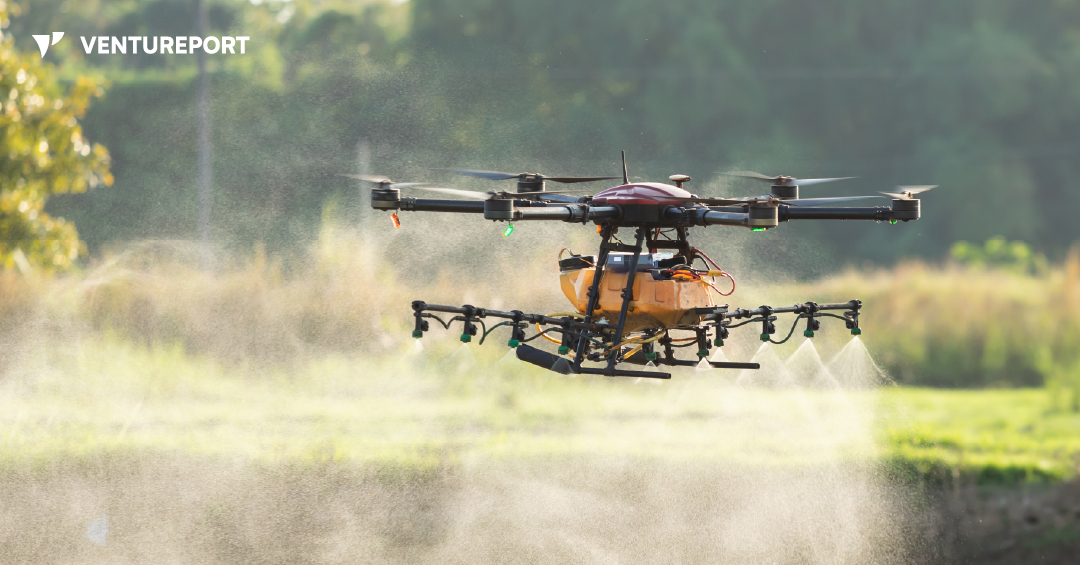
A drone spraying water over an agricultural field. PHOTO: FREEPIK
Farms today are under pressure. Fields are getting bigger, workers are harder to find and many jobs still rely on long hours of manual labor. XAG’s new P150 Max agricultural drone is designed for exactly this reality. Instead of replacing farmers, it takes over the heavy, repetitive fieldwork that slows them down, making farm operations more efficient and more precise.
The P150 Max is built around one simple idea: a single machine that can handle multiple farming tasks. Most farm drones focus only on spraying or mapping, but this one is fully modular. With a quick switch of attachments, it can spray crops, spread seeds or fertilizer, map fields or transport supplies. This flexibility helps farmers keep up with changing tasks throughout the day without needing different machines, improving both productivity and cost-efficiency.
A key challenge in agriculture is that fields are rarely smooth or predictable. Tractors can get stuck, smaller drones can’t carry much and some areas—like orchards or hilly plots—are simply hard to reach. The P150 Max fills that gap with an 80-kilogram payload and fast flight speed, letting it cover more ground per trip. Fewer takeoffs mean less downtime and more work completed before weather or daylight cuts operations short.
When it’s time to spray, the drone uses a smart spraying system that allows farmers to adjust droplet size based on the crop’s needs. This matters because precise spraying reduces waste and improves targeting. With an output of up to 46 liters per minute, the drone can serve both large open fields and dense orchards where consistent coverage is traditionally difficult.
The spreading system applies the same logic. Instead of dropping seeds or fertilizer unevenly, the vertical mechanism spreads material smoothly and resists wind drift. This ensures uniform application across irregular or hard-to-reach land—an ongoing challenge for modern farms aiming for higher yield and better resource use.
Another everyday issue for farmers is understanding and surveying the land before working on it. The P150 Max helps here with a built-in mapping tool that covers up to 20 hectares per flight and instantly converts the images into detailed maps. With AI detecting obstacles like trees or irrigation lines, the drone can plan safe and efficient autonomous routes, reducing manual planning time.
Beyond spraying and spreading, the drone can transport tools, produce and farm supplies using a sling attachment. This is particularly helpful after heavy rain, when vehicles cannot easily move across muddy or flooded fields.
Under all these functions is XAG’s upgraded flight control system, which provides centimeter-level accuracy even when network signals are weak. Integrated sensors—including 4D radar and a wide-angle camera—help the drone recognize hazards such as poles and wires. Farmers can manage all operations through the XAG One app or a handheld controller, both of which automatically generate the best route based on field shape and terrain.
Since long field days require long operating hours, the fast-charging battery system can recharge in about seven minutes using a dedicated kit. This supports continuous drone use throughout the day with minimal interruptions.
After years of testing, the XAG P150 Max is essentially an effort to make practical, scalable farm automation more accessible. By combining spraying, spreading, mapping and transport into one heavy-duty platform, it offers a way to ease labor shortages while keeping operations efficient and sustainable. Instead of focusing on one task, the drone aims to take over the time-consuming physical work so farmers can focus on decisions, planning and crop management.